
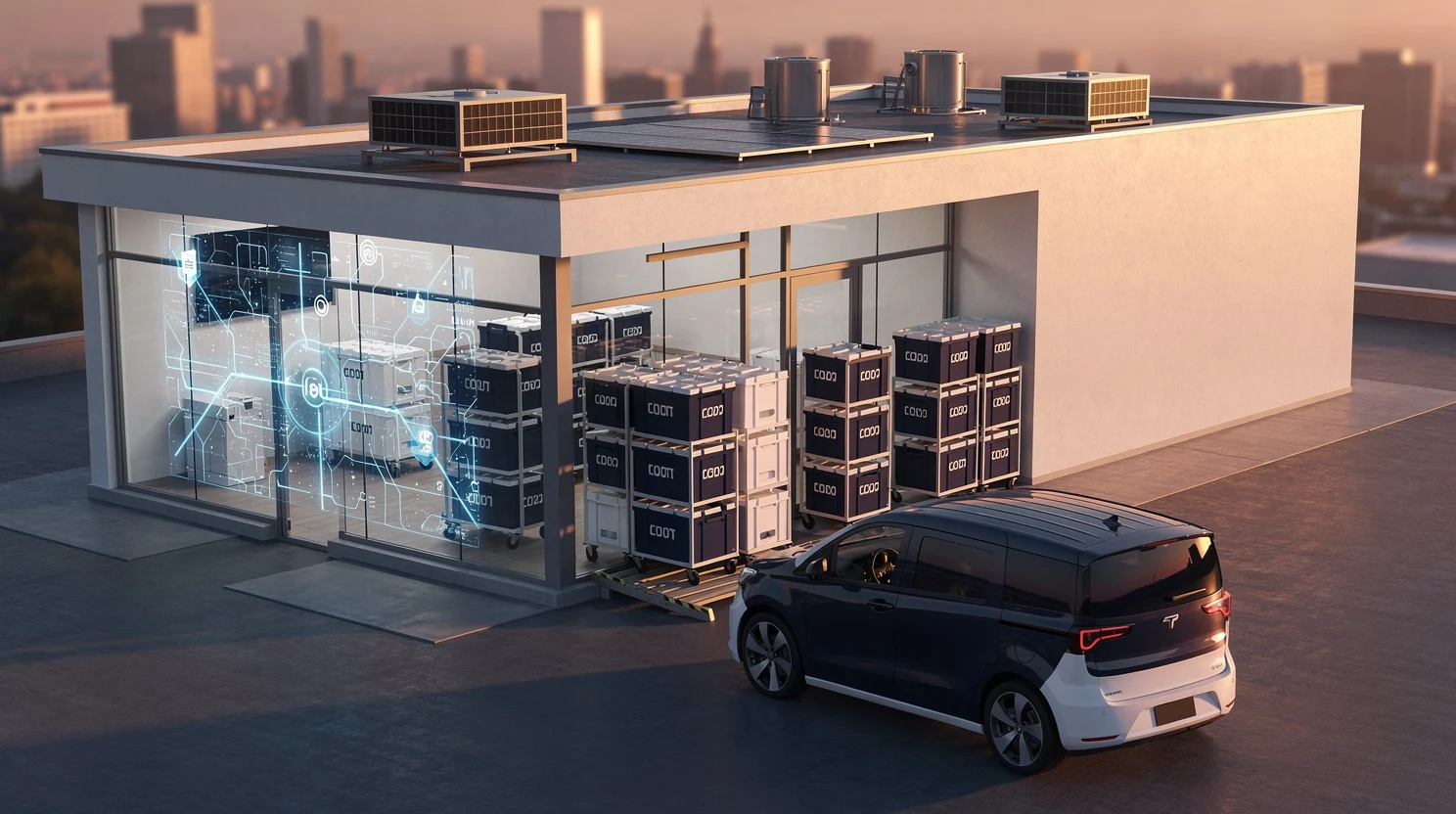
Same day delivery economics sounds simple in a pitch deck: get the order to the customer within hours, win the basket, charge a premium. The reality on a P&L is messier. For most US retailers, same-day works on a narrow band of orders, in a narrow set of zip codes, with a delivery partner that does not eat the margin alive.
In short: what every retail operator needs to know
- Same-day is a node problem, not a fleet problem. The math only works when an order can be fulfilled from a store, dark store, or micro-fulfillment center sitting within roughly 10 miles of the customer.
- The break-even basket sits between $45 and $75 for most categories once you load real delivery cost, returns, and incremental labor.
- Margin is made on density, not speed. Two same-day stops per route hour beats one stop per hour by a wide margin, and route density is what the customer never sees.
- Subsidy is fine, indefinite subsidy is not. Free same-day on a $30 basket is a customer acquisition cost, and it needs to be accounted for as one.
- Returns destroy the model faster than fuel does. A 20% return rate on same-day apparel can wipe out two months of contribution margin.
Why same-day economics matter in 2026
The pressure on US retailers to offer same-day delivery did not let up in 2026. Amazon expanded same-day to more than 90 metro areas, Walmart pushed GoLocal as a third-party fulfillment offer, and Target shifted more of its in-house Shipt volume to its own stores as fulfillment nodes. Smaller retailers are now expected to match a delivery promise that was niche just five years ago.
That expectation is not free. According to the US Census Bureau, e-commerce hit roughly 16% of total US retail sales in late 2025, and the share of those orders moving through expedited delivery options keeps rising. The carriers and gig platforms underneath that demand are not subsidizing themselves either, which means the unit economics of same day delivery economics sit much closer to the surface than they used to.
For an operator, the question is no longer “should we offer same-day.” It is “where, for which orders, at what threshold, with which partner, and at what point does it stop bleeding cash.”
This article is part of our modern retail logistics guide, which covers the full chain from warehouse design to the front door. If you are new to the topic, that pillar is the right place to anchor your reading before diving into the specific cost models below.
Key terms and definitions you actually need
Same-day delivery has more jargon than it deserves. The five terms below are the ones you need to read any vendor pitch without nodding along to nonsense.
- Cost to serve (CTS): the fully loaded cost of getting one order from inventory to a customer, including pick, pack, line haul, last-mile, returns, and a share of fixed overhead.
- Stem mileage: the distance from the depot or store to the start of the delivery route. Long stems destroy same-day margin.
- Stops per route hour (SPRH): the productivity metric that decides whether your routes earn money. Below roughly 2.5 SPRH, most urban same-day routes lose money.
- Dark store: a retail-format space converted to pure online fulfillment, sized for speed of pick rather than browsing.
- Click-to-door: the elapsed time from order placed to delivery completed. Same-day promises usually mean under 4 hours in marketing copy, and under 6 hours in operations reality.
How same-day delivery economics actually work
The cost model is not exotic. It is the sum of pick labor, pack materials, last-mile drop, payment processing, returns reserve, and an allocation of the fulfillment node. The number that determines whether the model survives contact with reality is the last-mile cost per order, which scales inversely with route density.
A useful way to think about it: a courier who completes 3 deliveries per hour at $24 per hour fully loaded costs you about $8 per drop. The same courier completing 1.5 deliveries per hour costs $16 per drop. That single variable, density, swings the per-order cost more than fuel, vehicle type, or even labor rate.
A working same-day P&L for a $75 basket
| Line item | Value | Notes |
|---|---|---|
| Order value | $75.00 | Customer pays |
| Delivery fee paid by customer | $6.99 | Typical urban same-day |
| Cost of goods (60% of order) | $45.00 | 40% gross margin assumed |
| Pick and pack labor | $3.20 | ~7 minutes at $27/hr loaded |
| Pack materials | $0.75 | Bag, tissue, label |
| Last-mile drop (3 SPRH route) | $8.00 | Dense urban, mature ops |
| Last-mile drop (1.5 SPRH route) | $16.00 | Suburban, immature ops |
| Payment processing | $2.40 | ~2.9% + $0.30 |
| Returns reserve (12% rate, $7 avg) | $0.84 | Apparel-style return assumption |
| Contribution at 3 SPRH | $21.80 | Works |
| Contribution at 1.5 SPRH | $13.80 | Marginal, sensitive to returns |
The same model with a $35 basket, the same delivery fee, and the same 40% gross margin collapses to a $1 to $2 contribution at 1.5 SPRH, which is the route density most retailers actually achieve in their first year of same-day. That gap is why most early same-day programs lose money quietly for six to eight quarters before someone notices.
The hidden costs most decks leave out
The line items that vendors leave off their sample P&Ls are usually the ones that decide whether your program is real. Five of them recur on every same-day program post-mortem.
- Order management software fees. A dedicated OMS that can split orders across nodes, route to the closest, and hand off to a courier costs between $0.10 and $0.40 per order in license fees at scale, and a lot more during ramp.
- Insurance and bonding. Couriers in California, New York, Illinois, and Washington require coverage that often gets baked into the per-drop rate, but in-house programs have to source and price it themselves.
- Customer service contacts. Same-day generates roughly 1.5x the customer service contact rate of standard shipping, because “where is my order” expectations are tighter. That is an extra $0.20 to $0.60 per order on most contact center models.
- Tip subsidies. If you do not surface a tip option, customers do not tip, and drivers churn. If you surface a tip option, your effective delivery fee perception rises, which can drop conversion. Both choices cost money.
- Failed delivery attempts. Roughly 3% to 7% of same-day deliveries fail on the first attempt in dense urban areas. Each redelivery costs roughly the same as a fresh drop.
Load those into the model and the contribution at 1.5 SPRH usually swings from $13.80 to under $10. That is the threshold where small mistakes start to matter.
How seasonality and weather change the model
Most same-day cost models are built on a steady-state assumption that does not survive November. Holiday peak compresses route density up (good for cost per drop) but raises labor cost faster (bad for everything else) because gig couriers go to the highest-paying platform first. Snow, heavy rain, and heat above 95F all reduce SPRH by 15% to 25% in field studies, which is enough to flip a marginal route from profitable to unprofitable for the day. The retailers that handle this well plan the cost model on a “moderate weather, mid-week” baseline and treat peak weeks as a separate financial event with its own budget envelope.
Common mistakes that quietly kill the program
Same-day rollouts rarely fail because of one big decision. They fail because of five small ones, repeated everywhere.
- Treating every store as a fulfillment node. Stores in low-density suburbs do not generate the SPRH needed to clear the breakeven. Use them for buy online pick up in store (BOPIS), not same-day delivery.
- Setting the free-delivery threshold by feel. Free same-day at $35 is a marketing decision. At a $35 basket the contribution margin in most categories cannot absorb a real last-mile drop cost, so the threshold has to be set against the cost model, not the competitor.
- Pricing the courier per drop in year one and never renegotiating. Most courier contracts have a density clause buried in the terms. Once you cross 3 SPRH consistently, you have leverage to move to a per-route or per-hour rate that captures the productivity gain.
- Ignoring returns until they ship. If the same-day program targets apparel, beauty, or shoes, returns will arrive within 14 days. They have to be priced into the model on day one, not bolted on in quarter three.
- Confusing speed with experience. Customers do not value 2-hour delivery over 4-hour delivery as much as the slide deck suggests. They value reliable windows and accurate ETAs, which are cheaper to deliver than raw speed.
If you want a deeper view of the operational layer behind these mistakes, our explainer on last-mile delivery for retailers who never thought about it covers the basics of route design, driver pools, and parcel handoff in plain language.
Examples from US retail and e-commerce
Three categories of operators are getting same-day right in the US market, and they are doing it for very different reasons.
Grocery: Kroger and Albertsons. Grocery is the rare category where same-day economics work at a $50 basket, because order frequency is high, the customer accepts a $9.95 delivery fee, and the basket has heavy items that justify the courier trip. Both chains use a hybrid of in-store pick and dedicated micro-fulfillment for high-velocity SKUs.
Specialty: Sephora and Best Buy. Specialty retailers run same-day on a curated subset of stores in dense metros, with average baskets above $90 and conversion rates that justify the delivery subsidy as a customer acquisition cost. Best Buy in particular built its same-day program around the moment-of-need purchase: a phone charger, a console controller, a missing HDMI cable. The unit economics on those urgent baskets are forgiving because customers will pay $10 to avoid a 30-minute drive.
Marketplace: Amazon, Walmart, and emerging cross-border players. The marketplaces solve the density problem with sheer volume. They also push the cost down by bundling same-day routes with two-day and locker-based deliveries on the same vehicle. Smaller players do not have that volume, which is why marketplace partnership is often the right answer for a retailer doing less than 500 same-day orders per day in a metro.
The cross-border angle matters here too. Players like Temu have changed the US delivery cost baseline by setting a customer expectation of free or near-free shipping, even when the physical delivery is slow. That pressure squeezes domestic retailers from below. Our note on what changed in temu for retail teams in 2026 covers how that price floor reshapes promotion design.
A short case study: how a regional apparel chain made same-day work
A regional apparel chain with 28 stores across the Mid-Atlantic launched same-day in early 2025. They started in three metros (Philadelphia, Baltimore, and DC), each with at least three stores inside the metro core. The pilot ran 90 days with a $7.99 delivery fee, free above $85, on a curated assortment of about 1,200 SKUs that represented 60% of in-store revenue but only 22% of total SKU count.
The honest result: contribution was negative in month one (route density at 1.1 SPRH), positive in month two (1.9 SPRH after demand learned the offer), and clearly positive in month three (2.7 SPRH after the team consolidated late-day routes). Return rate ran at 18%, slightly below the 22% in-store baseline because customers tried clothes on at home and decided quickly. The team ran the full pilot on Uber Direct, then renegotiated to a per-route rate in month four once density gave them leverage.
The takeaway is not that everyone should do exactly that. It is that the pilot was deliberate: curated assortment, real cost model, three metros with comparable demographics, a courier with API-driven dispatch, and a 90-day clock. Most failed same-day launches break at least three of those rules at once.
Tools, partners, and vendors worth knowing
The vendor landscape for US same-day shifted in 2024 and 2025 as venture funding pulled back and the gig labor regulations in California, New York, and Washington tightened. The current shortlist for a retailer entering same-day looks roughly like the table below.
| Partner type | Examples | Strength | Watch out for |
|---|---|---|---|
| Marketplace fulfillment | Walmart GoLocal, Amazon Multi-Channel Fulfillment | Existing density, predictable cost | Brand visibility to your customer |
| Gig courier networks | DoorDash Drive, Uber Direct, Roadie | Coverage, fast setup, API-driven | Per-drop pricing without density clause |
| Dedicated last-mile carriers | OnTrac, LaserShip (LSO), Veho | Fixed routes, better SLA | Minimum volume commitments |
| In-house fleet | Built around stores or dark stores | Full control, brand experience | Capex, labor management, insurance |
| Micro-fulfillment vendors | AutoStore, Attabotics, Fabric | Pick speed for high-velocity SKUs | Long ROI window, integration cost |
For a retailer at sub-1,000 same-day orders per day, gig courier networks plus a curated set of store nodes will almost always beat building an in-house fleet on day one. The crossover happens somewhere between 1,500 and 3,000 daily same-day orders in a metro, where in-house starts to win on cost per drop and reliability. A practical view of which vendor fits which scale is covered in our piece on tools and vendors for last-mile delivery in 2026.
One nuance worth flagging: the gig courier networks compete on coverage and convenience, not always on price. DoorDash Drive and Uber Direct will both quote per-drop pricing that looks attractive in a sandbox, but the all-in cost after surge, batching failure, and customer service spillover often lands 15% to 25% above the headline. Roadie is cheaper per drop on average but has thinner coverage in mid-sized markets. The right move for most retailers in 2026 is to integrate two of the three and route to the cheaper option in real time, which an OMS or a thin middleware layer can do for under $0.05 per order.
What “good” looks like at the metric level
| Metric | Year 1 target | Year 2 target | Why it matters |
|---|---|---|---|
| Stops per route hour | 2.0+ | 3.0+ | Single biggest driver of cost per drop |
| On-time delivery rate | 92% | 96% | Drives repeat purchase and CS contacts |
| Average basket on same-day | $55 | $65 | Needs to clear the contribution floor |
| Customer service contact rate | <6% | <4% | Each contact erodes contribution |
| Return rate vs. category baseline | ≤ baseline | ≤ baseline | Same-day should not inflate returns |
| Repeat same-day order rate (90d) | 30% | 45% | Validates customer value, not just novelty |
How to decide whether to launch same-day
The simplest test is a four-question screen, in order. If you answer no to any of them, you are not ready, and pushing through anyway is how programs lose money.
- Do you have at least one fulfillment node (store, dark store, or DC) within 10 miles of the metro center?
- Is your average basket in that metro at or above $50, or can a delivery fee structure get the effective basket there?
- Can you commit to a 90-day pilot with a real cost model, a courier partner, and a returns reserve, rather than a marketing soft launch?
- Do you have the analytics to measure SPRH, stem mileage, and contribution per order within a week of going live?
If those four answers are yes, the program is worth piloting. If you are missing one, fix that first. The most common gap is the fourth one: retailers launch same-day without the data plumbing to know whether each route is profitable, then discover six months later that the program lost $400,000.
How to staff the program internally
Same-day is not a side project. The retailers that succeed treat it as a small operating unit inside the broader e-commerce team, with at least three roles dedicated to it during the first year: a product manager who owns the customer experience and the threshold logic, an operations lead who owns SPRH and the carrier relationship, and a financial analyst who owns the contribution model and reports it weekly to leadership. Below 500 daily orders, those three roles can be 0.5 FTE each. Above 1,500 daily orders, each role is full-time and the operations lead often needs a deputy.
The retailers that fail tend to make same-day a shared responsibility across e-commerce, store operations, and fulfillment, with no single owner. When the program loses money, nobody owns it. When it does well, everyone takes credit and nobody fixes the next problem.
What changes when you cross 5,000 same-day orders per day
The model breaks differently above 5,000 orders per day in a single metro. At that scale, gig courier networks struggle to absorb the volume during the 4pm to 8pm window, in-house fleet starts to make sense, and the conversation shifts from cost per drop to capacity assurance. A few retailers in that bracket have moved to a hybrid where in-house handles the dense urban core and a gig network handles the outer ring. That hybrid is operationally heavy but tends to deliver the best cost and reliability mix once volume is reliable.
For the full operational and architectural view of how same-day fits into the rest of the logistics stack, return to our retail logistics guide, which covers the warehouse-to-doorstep journey end to end.
Frequently asked questions
What is the minimum basket size where same-day delivery economics work?
For most general retail categories in the US, the working floor sits between $45 and $75, depending on gross margin, route density, and delivery fee. Grocery and specialty can work lower because of frequency or urgency. Apparel rarely works below $60 once returns are loaded.
How important is route density compared to courier cost?
More important. A courier rate of $24 per hour at 3 stops per route hour beats $20 per hour at 1.5 stops per route hour by roughly 33% on cost per drop. Density swings the model harder than wage rate or fuel.
Should we charge for same-day or offer it free above a threshold?
Most US retailers should charge a real fee in year one, ideally between $5.99 and $9.99, and offer free same-day only above a threshold that the cost model can support. Free same-day at $35 is a customer acquisition cost, not an operating decision, and should be funded from marketing.
Is in-house fleet ever the right answer?
Yes, but rarely before you hit 1,500 to 3,000 same-day orders per day in a single metro. Below that scale, gig couriers and dedicated last-mile carriers will almost always beat in-house on cost per drop, even after losing some brand control.
How do returns affect same-day delivery economics?
Returns are the second-largest single line item after last-mile drop in most same-day P&Ls, especially in apparel and beauty. A 20% return rate at $7 per return adds $1.40 of unavoidable cost to every original order, before any goodwill markdowns on the returned item. They have to be in the model from day one.
Do customers really value 2-hour over 4-hour delivery?
Survey data and conversion data in the US point the same way: customers value a reliable window and an accurate ETA more than raw speed. A 4-hour same-day delivery with a 30-minute promised window outperforms a 2-hour delivery with a vague “by 8pm” promise on repeat purchase rate.
How long should a same-day pilot run before deciding?
Plan for 90 days minimum. Same-day economics swing with seasonality, route maturation, and customer learning. Anything shorter measures the launch, not the steady state.