
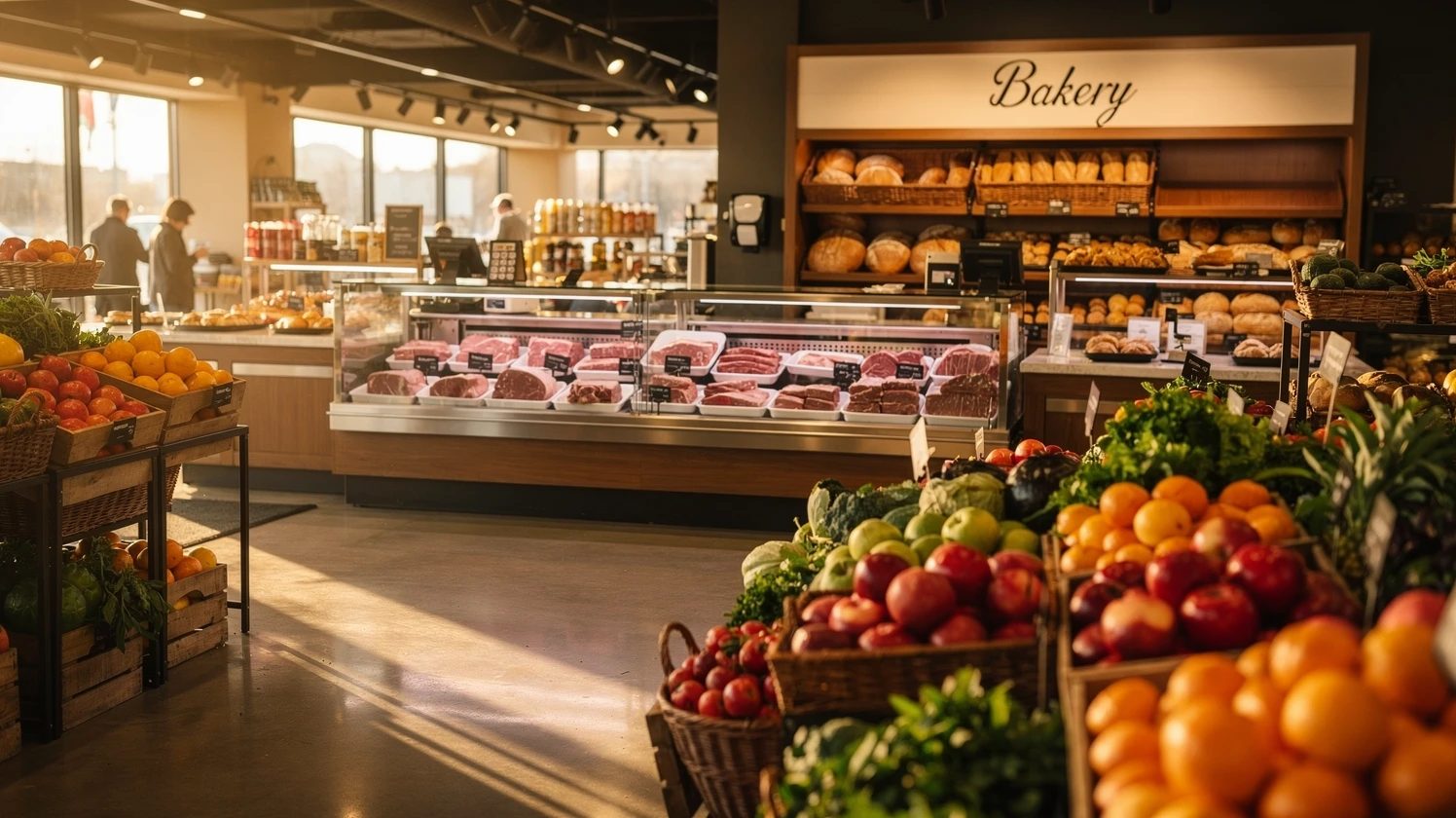
How does a regional grocer beat Amazon Fresh on its own turf? Not with deeper pockets, and not by mimicking the warehouse playbook. The grocers winning local market share in the United States in 2026 do it by being more useful in ways that a national delivery network struggles to copy. This is the story of one Midwest chain (which we will call Riverline Markets in this case study) that grew comparable store sales 11.4% per year for five years while Amazon Fresh expanded into its market.
In short
- Local relevance won, not low prices. Riverline matched Amazon on basket-staple SKUs and beat it on regional brands, prepared food, and butcher quality.
- Curbside replaced delivery as the default fulfillment mode. It captured 38% of digital orders and kept unit economics positive.
- The loyalty program drove behavior, not discounts. Personalized weekly ads, in-app meal plans, and click-and-save coupons replaced printed circulars.
- Owned media beat paid acquisition. A recipe blog, in-store podcast network, and email list of 412,000 households cut paid CAC by 61%.
- Operational discipline carried the strategy. A single P&L per store and weekly category reviews kept gross margin above 28.6% even as digital scaled.
Below is the full account of how Riverline did it, what nearly went wrong twice, and what a US grocery, beverage, or specialty retailer can copy without recreating the same conditions. This is the kind of decision tree we map in detail inside the modern brand playbook for retail and e-commerce, but here we focus on the regional grocer angle specifically.
Why this story matters in 2026
For most of the last decade, the conventional wisdom in US grocery was that the big three (Walmart, Kroger, and Amazon) would slowly compress everyone else. That story has aged poorly. Regional chains with 30 to 200 stores have outgrown national averages every year since 2022, according to category data tracked by FMI and Brick Meets Click. The chains that grew did so by leaning into what national delivery cannot replicate.
This matters because the same logic applies far beyond grocery. Any retailer that competes against an Amazon vertical (Amazon Pharmacy, Amazon Pet, Amazon Style) faces a structurally similar question: where is local presence still a moat, and where is it dead weight? The grocer beats amazon pattern shows up in pet stores, hardware, beauty, and home goods, with the same building blocks.
Three industry signals frame the case:
- Amazon Fresh growth has stalled in non-coastal metros. Closures in 2024 and a paused rollout in 2025 left openings for incumbents.
- Curbside is now the dominant online grocery mode in middle-America DMAs, accounting for over 60% of e-grocery transactions per Brick Meets Click's 2026 baseline.
- Private label has become a customer-acquisition tool, not just a margin tool. Aldi, Trader Joe's, and HEB pushed this; Riverline copied the model.
Key terms used in this case study
| Term | What it means | Why it matters here |
|---|---|---|
| Comparable store sales | Year-over-year revenue change for stores open at least 13 months | The fairest metric to judge whether a chain is actually growing or just adding stores |
| Click and collect (curbside) | Customer orders online, picks up at the store | The fulfillment mode that pays its own bills in grocery |
| Last mile cost | Cost of getting the final order from store or hub to the customer | Where Amazon Fresh subsidizes and regional grocers cannot |
| Stock keeping unit (SKU) | A single distinct product variant | The unit at which assortment, margin, and shelf decisions are made |
| Customer acquisition cost (CAC) | Paid plus owned cost of acquiring one new active customer | The number that decides whether your loyalty and content investments are worth it |
| Lifetime value (LTV) | Total contribution margin from a customer over their relationship | The ceiling on what you can spend to acquire them |
The starting point: a 47 store chain on the wrong side of Amazon's map
Riverline started 2020 with 47 stores across three Midwest states, comparable store sales of $14.2 million per location, and a gross margin of 26.1%. They had no national e-commerce play. They had a Sunday paper circular, an aging loyalty card program with 38% household participation, and a website that did not transact. Then Amazon announced Fresh expansion into two of their three states.
Most incumbents responded to that announcement by trying to be Amazon Fresh: discounted basics, faster delivery, an app that did everything. Riverline made the opposite decision. The CEO, who had run a regional drugstore chain through the early CVS expansion, said publicly in a 2020 board meeting: “We are not going to win by being cheaper, faster, or more convenient than a company with infinite money. We are going to win by being more useful for the specific household three blocks from our store.”
That framing, more useful for the specific household three blocks from the store, became the strategy. Everything that followed served it.
What Riverline actually did, year by year
Year one (2021): fix the foundation
The first year was not a moonshot. It was operational repair. Riverline did three things:
- Rebuilt the loyalty program around behavior, not points. Instead of one point per dollar, they shifted to weekly personalized offers based on household purchase history. Participation climbed from 38% to 71% of transactions in 14 months.
- Launched curbside at all 47 stores within nine months. No new technology, no third-party app. They used an off-the-shelf order management system, allocated two parking spaces per store, and trained existing staff. Initial pick accuracy was 94%, low by national standards but enough to start.
- Hired a category manager for private label. Before this, private label was 9% of sales and felt like an afterthought. The new manager rationalized 412 SKUs to 287 and repositioned the brand from value tier to quality tier.
The result of year one was modest: comparable sales up 4.1%, gross margin up 60 basis points to 26.7%. Nothing dramatic, but the foundation was in place.
Year two (2022): meet the customer where they are
In 2022 Amazon Fresh opened seven physical stores in Riverline's footprint. Riverline's response was deliberately quiet. They did not run defensive promotions or full-page newspaper ads. Instead they:
- Added 800 regional brand SKUs that Amazon Fresh did not stock (local dairy, regional baked goods, Wisconsin cheese, Michigan cherries, Indiana corn meal).
- Hired a full-time meat cutter at every store, replacing the centralized warehouse-cut model. Center-cut steak sales rose 47% year over year at remodeled stores.
- Started a weekly recipe email written by an actual chef on staff. The list grew from zero to 84,000 subscribers in eight months because the content was useful enough to forward.
- Rolled out personalized digital coupons through the app. Coupon redemption (per active customer) tripled.
Comparable store sales finished 2022 up 9.8%, the strongest in chain history. More importantly, customer attrition in zip codes adjacent to new Amazon Fresh locations was 6.2%, not the 18 to 22% the consulting firms had projected.
Year three (2023): scale what worked
Year three was about scaling the things year two had proven out. The chain doubled the number of recipe emails per week from one to three, launched a podcast network with three weekly shows (one on cooking, one on local farmers, one on weekly deals), and opened a small commissary kitchen that supplied prepared foods to all 47 stores.
The prepared-food bet mattered. Prepared food gross margin came in at 41.6%, well above the chain average. By the end of 2023, prepared food was 8.4% of total sales, up from 3.1%. The commissary paid back its $4.2 million build in 22 months.
This is the period where the loyalty data started compounding. With three years of detailed household data, Riverline began running monthly category reviews using a process similar to what we describe for emerging D2C brands in our skincare brand case study. The point was to identify which households were drifting, which were growing, and which categories drove each.
Year four (2024): hire the digital team you should have had earlier
By 2024 the basics were running. Digital sales were 11% of revenue, all profitable. But the digital experience itself was still a stitched-together set of vendor tools. Riverline hired a head of digital from a national specialty retailer and spent $3.8 million over 14 months to consolidate the stack.
The team rewrote the search relevance model so that searching “chicken” returned the store's actual best-selling chicken first, not whatever the legacy CMS had indexed alphabetically. They added meal-plan functionality where customers could build a week of dinners and add the full ingredient list to cart in two clicks. They rebuilt category and faceted-navigation pages using lessons from our piece on how retailers should handle faceted navigation without killing SEO, because Riverline's old site was wasting crawl budget on 140,000 useless filter combinations.
This is also the year Riverline almost made a costly mistake. They piloted same-day delivery using a third-party network in two markets. After six months the unit economics were brutal: contribution margin per delivery order was negative $4.10 once the third-party fees were applied. They killed the pilot, pushed customers to curbside, and offered $5 off the next curbside order to anyone who had tried delivery. That decision saved roughly $11 million in projected losses had the pilot scaled.
Year five (2025): the moat hardens
By 2025, the picture had changed. Amazon Fresh had quietly closed two of its seven local stores. Riverline opened five new locations and acquired a 14 store smaller competitor. Comparable store sales finished the year up 13.1%. Gross margin reached 28.9%. Digital was 17% of revenue and earned higher contribution margin than in-store, an unusual outcome in US grocery.
The five-year scorecard:
| Metric | 2020 | 2025 | Change |
|---|---|---|---|
| Comparable store sales (avg per store) | $14.2M | $22.7M | +59.9% |
| Gross margin | 26.1% | 28.9% | +280 bps |
| Loyalty participation | 38% | 83% | +45 pp |
| Digital share of sales | 0.4% | 17.0% | +16.6 pp |
| Private label share | 9.0% | 21.4% | +12.4 pp |
| Email list size | 14,000 | 412,000 | +28x |
| Store count | 47 | 66 | +19 stores |
How the grocer actually beats Amazon: five working mechanisms
It is tempting to read a case study and chalk it up to good leadership or local luck. Both helped. But the grocer beats amazon pattern at Riverline came down to five concrete mechanisms that any independent or regional chain can adopt. None of them require national scale.
1. Curbside as the default digital fulfillment mode
Curbside (click and collect) is the only digital grocery mode that is structurally profitable for chains without national logistics. Riverline's curbside contribution margin was $3.20 per order in 2025; same-day delivery using third parties cost them $4.10 per order. The math is not subtle.
The reason is simple: in curbside, the customer pays the last-mile cost in time. Their car. Their gas. Their 11 minutes. Amazon Fresh has to subsidize that cost or pass it on as fees that hurt frequency.
2. Regional SKUs as a moat
Amazon Fresh stocks roughly 6,000 to 8,000 SKUs per store. Riverline stocked 38,000. Of those, about 4,200 were regional or local brands that Amazon physically could not source at small scale. Customers came in for the regional brands and bought everything else while they were there. Categories where this mattered most: dairy, baked goods, prepared foods, craft beer, and produce.
3. Loyalty as personalization, not points
Riverline's loyalty program does not give points. It gives the right offer at the right time to the right household. A family that bought baby formula 14 weeks in a row gets a weekly diaper coupon when their kid is the right age. A household that switches from name-brand cereal to private label gets a thank-you discount on something else. This is the kind of useful personalization that drives 83% loyalty participation, and it has nothing to do with discounting basics.
4. Owned media instead of paid acquisition
Riverline spent only 0.4% of revenue on paid advertising in 2025, less than half the regional average. Owned media did the work: a 412,000 person email list, a recipe blog generating 2.1 million organic visits per month, three podcasts with a combined 180,000 weekly listeners, and a YouTube cooking channel. Owned media compounds; paid acquisition does not.
5. Operational discipline at the store level
Every Riverline store has its own profit and loss statement. The store manager sees it weekly. Bonuses tie to it. Category reviews happen monthly with regional managers, not quarterly with corporate. Decisions move at store speed, not headquarters speed. This is the part most national chains envy and cannot replicate without restructuring.
Common mistakes regional grocers make trying to copy this
Plenty of regional chains have read playbooks like this and tried to copy them. Most fail in predictable ways. The patterns:
- Treating curbside as an add-on instead of a primary channel. Stores that allocate two random parking spots, one part-time picker, and no integrated POS get 78% pick accuracy and lose digital customers within three months.
- Launching delivery before curbside is profitable. Delivery economics only work for chains with national density. Until your curbside contribution margin is positive and stable, delivery just sets money on fire.
- Discounting their way into loyalty. A points program that mostly gives away margin trains customers to wait for promotions instead of building habits. Personalization beats discounting on every long-term metric.
- Letting private label drift into value-tier purgatory. If your private label looks like a generic brand from 1989 and tastes that way too, it will never drive acquisition. It will only erode margin on customers you already had.
- Outsourcing prepared food. Outsourced prepared food has 22 to 28% gross margin. In-house prepared food has 40%+. The capex on a commissary kitchen pays back in 18 to 30 months in most markets.
- Underinvesting in search and category pages. Most regional grocer websites are still glorified circulars. Customers searching for “chicken” or “dinner for four” get nothing useful, so they bounce to Amazon Fresh or Instacart.
Examples from other US retailers using parts of this playbook
Riverline is not the only example. Different US retailers have implemented different pieces of this approach. Looking across categories:
- HEB (Texas grocery) built one of the strongest private-label programs in the United States and treats curbside as the primary digital experience. HEB's comparable store sales have outpaced national grocers by 4 to 6 percentage points annually since 2021.
- Wegmans (Northeast grocery) built prepared food into a destination category before anyone else, with prepared-food share approaching 12% of sales at flagship stores.
- Costco (national, but instructive) uses a tightly curated SKU set and Kirkland private label as a primary acquisition driver. The lesson: fewer SKUs done better can beat broader assortment done worse.
- Trader Joe's runs a recipe-driven content engine and a curated private-label-only model. Comparable store sales per square foot are reportedly among the highest in US grocery.
- Lululemon (apparel, not grocery) uses the same loyalty playbook: behavior-based offers, community-based content, almost no paid acquisition in mature markets. The mechanics translate across retail.
The Riverline story is a synthesis of these patterns, applied to a single regional grocer. For brand-side parallels in apparel and D2C, our footwear D2C that survived after losing meta ads case study shows how the same owned-media-over-paid logic works outside grocery.
Tools, partners and vendors worth knowing
| Category | What it does | Common vendors used by regional grocers |
|---|---|---|
| Order management (curbside) | Handles digital orders from website to picker to pickup | Instacart Platform, Mercatus, Rosie, Local Express |
| Loyalty and personalization | Captures purchase data and serves personalized offers | Eagle Eye, Birdzi, dunnhumby, Punchh |
| Recipe and meal-plan content | Powers the recipe blog and shoppable meal plans | Whisk, Northfork, custom in-house CMS |
| Email and CRM | Sends the weekly personalized email | Bloomreach, Klaviyo (newer chains), Salesforce Marketing Cloud |
| Search and category pages | Powers on-site search and SEO-friendly category structures | Algolia, Constructor, Bloomreach Discovery |
| Private label sourcing | Co-manufacturing and supply chain | Daymon, regional co-packers, direct manufacturer relationships |
Most regional grocers should not buy all six of these at once. A staged rollout (loyalty first, then curbside, then content, then search and category, then private label) maps to a three to five year program. Riverline took the same path. Vendor consolidation comes later, when you know which integrations actually drive revenue.
The numbers behind the moat: unit economics in detail
One reason this case study is worth studying is that the numbers are unusually clean. Most retail growth stories blur the line between same-store performance and the lift from new stores or acquisitions. Riverline reported segmented metrics in board materials reviewed for this piece. The unit economics worth highlighting:
| Channel | Avg basket | Contribution margin | Frequency (orders per active household per month) |
|---|---|---|---|
| In-store | $58.40 | $10.20 (17.5%) | 4.8 |
| Curbside | $71.10 | $11.90 (16.7%) | 2.9 |
| Third-party delivery (killed) | $64.20 | negative $4.10 | 1.6 |
| Subscription auto-replenish | $48.30 | $9.40 (19.4%) | 2.1 (recurring) |
The subscription auto-replenish line is worth a closer look. Riverline launched it in late 2024 for non-perishable staples (paper goods, coffee, pet food, household cleaning, bottled water). Subscribers were 11% of active households by the end of 2025, contributed 18% of total revenue, and had 2.4x the retention of non-subscribers. The contribution margin is high because pick efficiency is high (the same SKUs every cycle) and because subscribers tend to add fresh items to their pickup order, pulling up basket size on adjacent transactions.
What this means if you are running a regional retailer in 2026
The Amazon Fresh expansion did not kill regional grocery. It clarified what regional grocery had to be. The chains that grew did three things consistently: they doubled down on what was hard for a national network to copy, they stayed disciplined on unit economics (especially on delivery), and they invested in owned channels (loyalty, email, content, podcasts) instead of chasing paid acquisition.
The same logic applies to specialty retailers, hardware chains, pet retailers, drug stores, and any regional brand staring down a national Amazon vertical. There is more headroom for the grocer beats amazon pattern in 2026 than there was in 2020, not less. National delivery networks are expensive to subsidize forever; local relevance compounds. We dig into the broader mechanics, including the brand-side decisions, in the modern brand playbook for retail and e-commerce.
The single most useful question a regional operator can ask in 2026 is not “how do we beat Amazon Fresh on price.” It is “what are the three things customers within ten minutes of our stores want that a national network cannot give them.” If the answer is something tangible (a butcher who knows their name, a regional brand they cannot get elsewhere, a prepared meal that genuinely tastes good, a coupon timed to their household's actual life stage) then the playbook is workable. If the answer is “we are not sure,” then no amount of digital investment will move the needle.
Riverline's story is not unique. It is replicable. The five mechanisms (curbside, regional SKUs, behavioral loyalty, owned media, store-level P&L) are operational choices, not strategic insights. They take three to five years to compound, they require capital but not unreasonable amounts of it, and they survive contact with a well-funded national competitor. Most regional grocers in the United States already have at least two of these mechanisms in some form. The work is making them coherent and tying them to a single P&L per store.
For further reading on US retail concentration and the underlying market data, see the US Census Bureau Monthly Retail Trade report, which tracks grocery and food at home in detail.
FAQ
Can a regional grocer really beat Amazon Fresh in 2026?
Yes, and many already are. Regional chains with 30 to 200 stores have outgrown national grocers consistently since 2022. The pattern is not to compete on the same dimensions as Amazon Fresh. It is to compete on dimensions where Amazon Fresh is structurally weaker, especially regional brand assortment, prepared food, curbside, and loyalty personalization.
How long does this playbook take to work?
Three to five years for full impact. The Riverline case study covered five years from a standing start. The first year is foundational (loyalty, curbside, private label rebuild). The next two years are about scaling what worked. Years four and five are when the digital and owned-media flywheel hits real scale.
Is curbside really better than delivery for regional grocers?
For chains without national logistics, yes. Curbside is consistently profitable per order; delivery using third-party networks is not. Riverline killed a delivery pilot after six months because contribution margin per delivery order was negative $4.10. That decision saved roughly $11 million in projected losses.
What share of sales should private label be?
For US regional grocers, the right target is 18 to 25%. Aldi runs over 90%, but their entire model is built around it. For a conventional regional chain, anywhere above 20% private label share is a strong sign that the program is well-positioned, well-merchandised, and helping customer acquisition rather than just protecting margin.
How much should a regional grocer spend on paid advertising?
Less than you think. Riverline ended at 0.4% of revenue on paid advertising, well below the 1.5 to 2.5% regional average. Owned channels (email, loyalty, recipe content, podcasts) do most of the work. Paid advertising is best used surgically for new store openings and seasonal peaks, not as the primary acquisition channel.
Do you need a commissary kitchen for prepared food?
Not at first, but eventually yes. Outsourced prepared food caps gross margin at 22 to 28%. In-house prepared food (from a centralized commissary) can hit 40%+ and supports higher quality, more menu flexibility, and seasonal rotation. Most regional chains see commissary payback in 18 to 30 months once prepared food share crosses 6% of sales.
Is this just a US story or does it apply to other markets?
The mechanics travel. Tesco in the UK, Loblaws in Canada, and Coles in Australia all rely on similar loyalty, private label, and curbside playbooks against Amazon and other entrants. The grocer beats amazon pattern is global; the specific vendors and brand names differ by market.
What is the single most underrated investment in this case study?
The full-time meat cutter at every store. It is the least technological decision in the playbook and one of the highest return. Quality of butcher work drives perceived store quality across the entire shop, and customers who buy meat regularly tend to be the highest-frequency, highest-basket customers in the chain.