
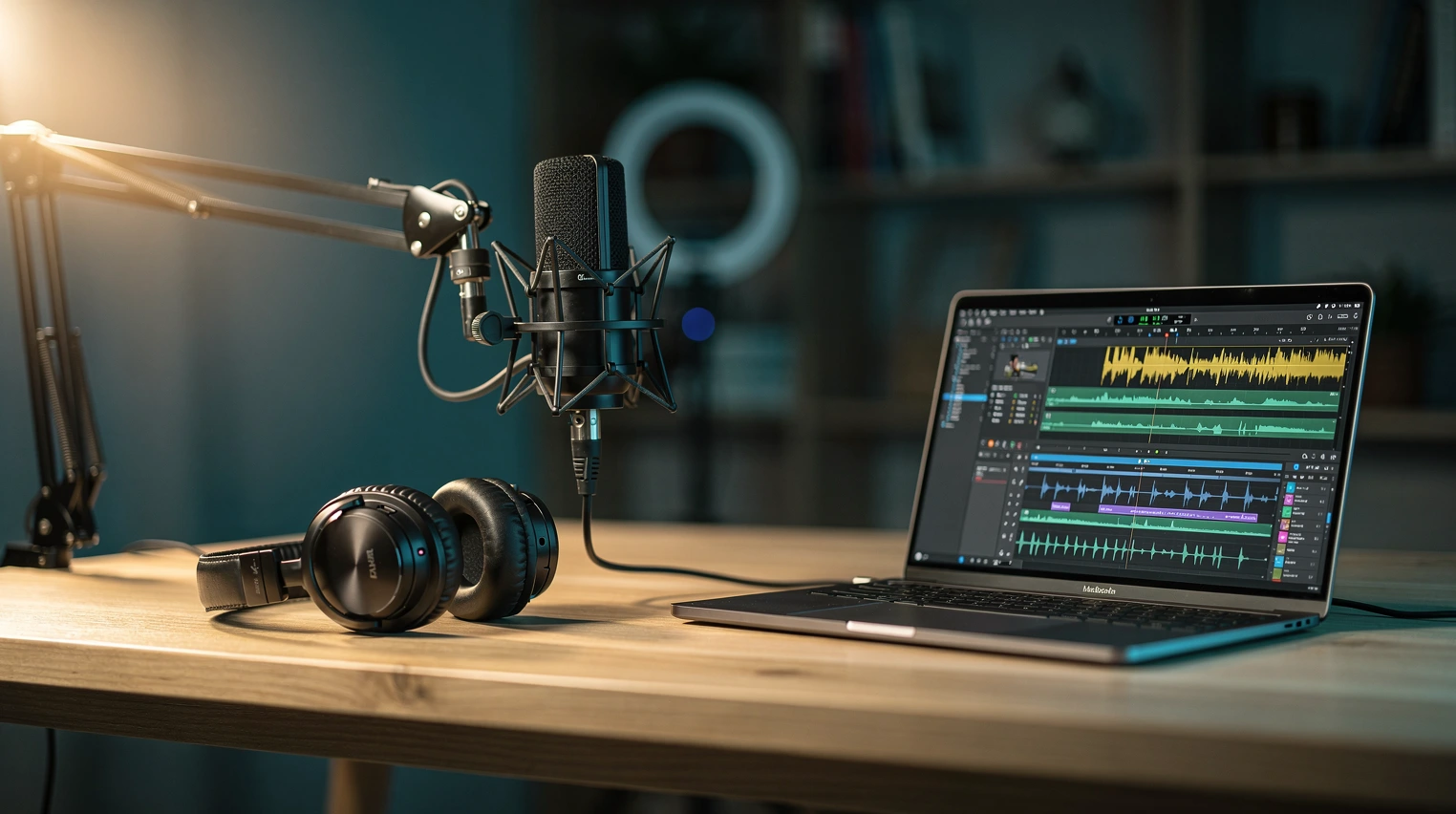
Founder stories tools 2026 are no longer optional kit for a US retail brand. Whether the goal is investor trust, recruiting senior operators, or convincing a skeptical e-commerce buyer that the company behind the SKU is worth backing, the founder narrative now lives across podcasts, short-form video, newsletters, schema-marked About pages, and AI assistants that pull from all of it. This guide breaks down the actual vendors, software, and production partners US retail and e-commerce teams use in 2026 to write, film, distribute, and measure that work.
In short
- Story capture: Riverside, Descript, and Otter remain the default trio for recording, transcribing, and producing founder interviews at studio quality.
- Distribution: Substack for owned subscribers, LinkedIn for B2B reach, Spotify for Podcasters for audio, and YouTube Shorts for discoverable founder clips.
- Production partners: Boutique studios such as Lower Street, Pacific Content, and JAR Audio now ship monthly founder series for mid-market retail brands.
- Measurement: Chartable, Podscribe, and Fathom Analytics tie listens and reads to revenue without leaking shopper data to ad networks.
- AI plumbing: Notion AI, Claude, and Perplexity are now part of the editorial chain; brand-safe prompts and a clean Article schema decide whether your founder story shows up when a buyer asks an LLM “who runs this company?”
Why founder stories tools matter in 2026
Three forces have made the founder narrative a measurable channel rather than a vanity project. First, AI assistants now answer roughly a third of all branded retail queries before a shopper ever reaches a search results page, according to public statements from major search platforms and independent panel data. Second, US retail customers, especially in beauty, food, and apparel, have moved from “good product, good price” toward founder-led trust, with private-label entries from Amazon and Walmart squeezing brands that lack a story. Third, the cost of telling that story has collapsed: a clean, evergreen founder interview can be produced for under two thousand dollars and distributed across six platforms with one editorial team.
This is where tooling matters. The brands winning founder-led commerce in 2026 are not the ones with the loudest CEOs. They are the ones whose teams picked the right stack early, kept the workflow simple enough to ship monthly, and tied every published asset back to a measurable business outcome.
If you are reading this as a marketing lead inside a retail brand, treat the rest of the guide as a buying playbook. If you sit on the founder side, read it as a quick literacy check so you can hold your team accountable for the spend.
The broader strategic backdrop, including how funding rounds, exits, and operator hiring all feed into the story, sits inside our retail business landscape pillar, which we will reference throughout.
Key terms and definitions
Most procurement decisions go sideways because the buyer and the agency use the same words to mean different things. The glossary below is the working vocabulary we use at ShopAppy when reviewing founder-content vendors.
- Founder story: A long-form narrative asset (written profile, audio interview, or video documentary) whose protagonist is a named founder and whose subject is the origin, decisions, or values of the business. Not the same as a brand video.
- Founder-led content: Recurring short-form content (LinkedIn posts, Reels, X threads) published in the founder’s voice, often ghost-supported by an in-house writer.
- Editorial stack: The tooling chain from research through publishing, typically Notion or Airtable for planning, Riverside or Descript for capture, and Substack, Spotify, and YouTube for distribution.
- Authority graph: The set of structured signals (Article schema, Person schema, Wikipedia, Crunchbase, Google Knowledge Panel) that tell search engines and LLMs who a founder is and what the company does.
- Attribution window: The lookback period used to credit a founder asset with downstream revenue. Most retail teams now use a thirty to ninety day window, with podcasts typically on the longer end.
How a founder-story workflow actually runs in 2026
A working monthly cadence looks like this. The cadence is more important than any individual tool, but the tools listed below are the ones most US retail teams default to.
Step 1: Plan and research
The editorial calendar lives in Notion (or Airtable for teams that want database views). Each entry has a topic, target audience, intended platform, founder availability date, and an “evidence” column with links to the data, customer quotes, or operational context the piece will reference. Perplexity Pro and Claude are both used at this stage to pull background, surface counter-arguments, and pressure-test the angle before a single recording slot is booked.
Step 2: Capture
Riverside.fm is the de facto remote recording platform for founder interviews, with separately recorded local tracks at up to 4K video and 48 kHz audio. Squadcast (owned by Descript since 2023) is the main alternative. For in-person shoots, a single shooter with a Sony FX3 or FX6, two Sennheiser MKE 600 shotguns, and a Zoom F6 recorder remains the standard kit, usually rented through KitSplit or local production houses such as ProductionHUB partners.
Step 3: Transcribe and edit
Descript dominates founder-story post-production because edits to the transcript flow back to the video and audio timeline. Otter.ai is still the cheapest transcription option for written profiles, especially when the writer is not editing audio. For more polished short clips, Opus Clip and Submagic auto-cut vertical highlights with captions in under ten minutes per episode.
Step 4: Publish
Owned distribution is non-negotiable. Substack and Beehiiv are the two dominant newsletter platforms in 2026; Beehiiv tends to win for retail brands that want native ad slots and referral programs, while Substack wins on subscriber portability and writer-first culture. Audio goes to Spotify for Podcasters and Apple Podcasts Connect; video lives on YouTube (long-form) and YouTube Shorts, Instagram Reels, TikTok, and LinkedIn (short).
Step 5: Measure
Chartable and Podscribe handle podcast attribution. Fathom Analytics and Plausible are the GDPR-safe web analytics defaults for founder-content sites that do not want to leak shopper data into Google Ads remarketing. For revenue attribution, most teams pipe events into Northbeam, Triple Whale, or Rockerbox alongside their main e-commerce stack.
Step 6: Repurpose and syndicate
One recorded founder interview should fan out into at least six discrete assets: a podcast episode, a YouTube long form, three to five vertical shorts, a 1,200 word written profile for the newsletter, a LinkedIn carousel, and an internal sales enablement deck. Tools like Repurpose.io, Castmagic, and Hypefury automate most of the cross-posting, and the same source recording typically delivers a six week distribution rotation across owned and rented surfaces.
Step 7: Archive and atomize for AI
Every founder interview should land in a permanent, searchable archive. Most US retail teams now publish full episode transcripts with proper headings, speaker labels, and Article schema, so that LLMs can ingest the content cleanly. Notion or Coda serve as the working archive; a static page on the brand site with full transcript and Person schema serves as the canonical, citable version. This is the step most teams skip in 2024 and 2025; in 2026 it is what separates founders who get quoted by AI assistants from those who do not.
The full 2026 tooling matrix
The table below is the working short list we share with retail clients. Pricing is indicative starting tier in US dollars, accurate as of Q1 2026, and assumes a team of three to five people.
| Stage | Tool | Best for | Starting price (USD/mo) |
|---|---|---|---|
| Planning | Notion | Small editorial teams, AI-assisted briefs | $10/user |
| Planning | Airtable | Larger teams, database-style calendars | $24/user |
| Research | Perplexity Pro | Fast, cited research with web grounding | $20 |
| Research | Claude (Anthropic) | Long-form drafting, nuanced reasoning | $20 |
| Recording | Riverside.fm | Remote interviews, separate track recording | $24 |
| Recording | Squadcast (Descript) | Built-in to Descript workflows | $15 |
| Editing | Descript | Transcript-based video and audio editing | $24/user |
| Editing | Otter.ai | Cheap transcription for writers | $17/user |
| Short clips | Opus Clip | AI-cut vertical highlights from long video | $29 |
| Short clips | Submagic | Animated captions, B-roll suggestions | $20 |
| Newsletter | Substack | Writer-first, subscriber portability | 10% revenue share |
| Newsletter | Beehiiv | Native ads, referral, retail-friendly | $49 |
| Podcast host | Transistor.fm | Indie podcast hosting with analytics | $19 |
| Podcast host | Buzzsprout | Easiest onboarding, episode dashboards | $12 |
| Attribution | Chartable | Podcast lift studies, prefix tracking | $50 |
| Attribution | Podscribe | Pixel-based podcast attribution | Custom |
| Web analytics | Fathom Analytics | Privacy-safe, lightweight | $15 |
| Revenue attribution | Triple Whale | Shopify-native MMM and dashboards | $129 |
The total monthly cost of a credible founder-story stack in 2026, including paid AI tools, sits between $400 and $1,200, depending on how much production is in-house versus outsourced.
Common mistakes when buying founder-story tools
Most of the failures we see at ShopAppy are not tool selection failures. They are workflow failures dressed up as procurement decisions.
- Buying for the launch episode, not the twelfth. Teams pick a tool that produces a beautiful first episode and discover by episode four that the workflow does not scale. Always pilot on a three-episode plan, not a one-off.
- Ignoring the authority graph. A founder profile that ranks on Google or surfaces in ChatGPT in 2026 requires clean Person schema, a Wikipedia-grade About page, and consistent NAP (name, address, position) data across the founder’s LinkedIn, the company site, and Crunchbase. Skip this and even the best episode disappears.
- Letting the agency own the master files. Always require deliverables include the raw recordings, edited master, captions file, and full transcript, in an asset bucket the brand controls. Vendor lock-in on creative assets has bitten too many DTC brands during agency changes.
- Confusing reach with retention. A LinkedIn post with 200,000 impressions and a 0.3% click-through is worth less than a 4,000-listen episode that drives 80 newsletter signups. Pick tools that measure retention and conversion, not just reach.
- Skipping the legal review. Founder interviews routinely mention competitors, suppliers, and former employees. Have counsel review the standard release form once, then template it. The team behind our founder burnout and second acts coverage flagged three real incidents in 2025 where loose release language created post-publication takedowns.
- Forgetting the chargeback risk on creator partnerships. If a founder podcast cross-promotes a checkout-driven discount, dispute exposure rises. Our explainer on how card networks handle chargebacks is the baseline brief we share with finance teams before any creator campaign goes live.
Examples from US retail and e-commerce
Real-world adoption matters more than feature comparisons. The brands below are public examples (drawn from their own published case studies, investor materials, or trade press) of founder-content stacks in production.
Beauty and personal care
Mid-market beauty brands such as Glossier, Tower 28, and Youthforia have all leaned on founder-led short-form video. The common stack is Riverside or in-house studio capture, Descript for editing, Submagic or Opus Clip for shorts, and a Beehiiv or Klaviyo newsletter for owned distribution. Founder cameos on the Lipstick podcast and Glossy network remain the most efficient paid placement for this category.
Food, beverage, and CPG
Chobani, OLIPOP, and Magic Spoon have each invested in founder-narrative documentary work in the last 24 months. The pattern: one anchor long-form documentary (typically agency-produced through Lower Street or Pacific Content), then a monthly podcast or YouTube series produced in-house. CPG founders use How I Built This appearances as a credibility on-ramp, then push owned content for ongoing reach.
DTC apparel and lifestyle
Brands such as True Classic, Vuori, and Allbirds have shifted toward LinkedIn-first founder content in 2026. The tooling here is leaner: Notion for planning, ChatGPT or Claude for draft assistance, a paid LinkedIn scheduler (Taplio or AuthoredUp), and a quarterly Substack drop summarizing the founder’s view on the business.
Marketplaces and retail-tech
Faire, Whatnot, and Recharge each run sustained founder podcasts aimed at their seller or merchant audience. The combination of a B2B audience and a long sales cycle justifies more expensive production (typically $4,000 to $8,000 per episode all-in) and rigorous attribution through Chartable. This same playbook is increasingly cited by retail co-founder pairs profiled in our piece on retail co-founders and who you bring in.
What the tooling stacks have in common
Across all four sub-categories, four patterns repeat. The brand owns the master files and the email list. The cadence is monthly or better, never quarterly. The founder spends three to five hours per cycle, not twenty. And the underlying CMS is a controlled environment (WordPress, Webflow, or a custom Next.js stack) where the team can ship Article schema, Person schema, and a clean canonical URL for every published asset. Brands that fail to meet those four conditions tend to plateau within twelve months regardless of how strong their initial episodes are.
It is also worth noting that the spend per episode is rarely the decisive variable. A $1,200 in-house episode shipped twelve times in a year typically outperforms a $20,000 documentary released once. Cadence, archive depth, and schema discipline are the variables that drive long-term founder visibility, both for human readers and for AI assistants reading on their behalf.
Tools, partners, and vendors worth knowing
If you only remember twelve names from this guide, make it these. The grouping reflects how the work actually splits across capture, edit, distribute, and measure.
Production agencies
- Lower Street. Brand podcast agency with a heavy retail and SaaS portfolio. Strongest on documentary-style founder series.
- Pacific Content. Founder-narrative pioneer, owned by Rogers Sports and Media. Higher minimums, premium output.
- JAR Audio. Toronto-based but US-active. Mid-market budgets, strong sound design.
- Magnificent Noise. Brooklyn studio with deep editorial chops, good for founder interview formats.
Editorial and ghostwriting partners
- Type/Code, Ghost Influence, Marketing Examined. Founder LinkedIn ghostwriting services with retainer models from $3,000 to $15,000 per month.
- Workweek and Morning Brew Studios. Newsletter-led brand partnerships with founder-driven editorial formats.
Distribution-side platforms
- Substack, Beehiiv, ConvertKit (Kit). The three newsletter platforms worth shortlisting in 2026.
- YouTube, Spotify for Podcasters, Apple Podcasts Connect. Required minimum distribution surfaces.
- LinkedIn. The single highest-ROI surface for founder-led B2B retail content as of early 2026, per published creator benchmarks.
AI-side platforms
- Claude (Anthropic), ChatGPT (OpenAI), Perplexity, Notion AI, Gemini. Each plays a slightly different role in the editorial chain. Most teams pay for two of the five, not all of them.
Measurement and attribution
- Chartable, Podscribe, Magellan AI. Podcast attribution and brand-lift.
- Fathom Analytics, Plausible. Privacy-safe web analytics for content sites.
- Triple Whale, Northbeam, Rockerbox. Revenue attribution for Shopify-led brands.
How to choose your stack in 90 minutes
A short, opinionated process beats endless evaluation. Run this once with your editorial lead, finance partner, and the founder in the room.
- Pick one anchor format (15 minutes). Podcast, video documentary, or written profile. Do not start with all three.
- Pick one owned surface (10 minutes). Newsletter or YouTube channel. Both is too expensive in year one.
- Pick one capture tool, one editing tool, one publishing tool (20 minutes). Default: Riverside, Descript, Substack or YouTube.
- Pick one measurement layer (15 minutes). Default: Fathom for the site, Chartable for the podcast feed if applicable.
- Decide the publishing cadence (15 minutes). Monthly is the floor; weekly is hard without a dedicated producer.
- Lock the next twelve topics in a single working document (15 minutes). Most stacks fail because the calendar empties, not because the tooling broke.
Then ship the first three episodes before reconsidering any of those decisions. If you want the strategic framing for why founder content sits inside the broader funding and operator picture, the retail business landscape pillar is the parent reference.
Budget benchmarks by stage
For teams that want a quick sanity check on what a credible founder-content program costs in 2026, the following benchmarks have held up across roughly thirty retail brand engagements we have reviewed in the past twelve months.
- Pilot (months 1 to 3): $4,500 to $9,000 total. Covers three episodes, basic editing, one anchor distribution surface, and minimal paid promotion. Goal is proof of cadence and audience signal, not scale.
- Growth (months 4 to 9): $3,000 to $7,000 per month. Full editorial calendar, two distribution surfaces, paid LinkedIn or podcast promotion, and a fractional editor on retainer.
- Scale (months 10 plus): $8,000 to $20,000 per month for brands aiming to compete with category leaders. Includes dedicated producer, in-house video capability, paid attribution tooling, and quarterly documentary releases.
Most retail brands plateau in the growth bucket and never need scale spend. The brands that benefit most from scale spend are those with a long sales cycle, a high average order value, or a regulated category where founder credibility materially shortens the buying conversation.
FAQ
What is the minimum budget to launch a founder podcast in 2026?
Realistic floor in the US market is about $1,500 per month all-in: roughly $400 in software (Riverside, Descript, Buzzsprout, an AI assistant), and $1,100 covering a fractional editor and a junior producer. Brands paying agencies typically spend $4,000 to $8,000 per episode for documentary-style production.
Do I need a dedicated podcast or can I publish founder interviews inside an existing show?
For most retail brands, a quarterly founder series inside an existing brand podcast or industry show drives more reach than a new feed. New podcast launches in 2026 fight for discovery against more than five million existing shows. Use guest appearances and owned newsletter syndication first, dedicated feed second.
How important is video versus audio for founder stories?
YouTube is now the single largest podcast platform in the US, per published Spotify and YouTube data. Recording video and publishing both audio and video is the default in 2026, even if the video output is just a static frame or simple two-camera setup.
Which AI tool is best for ghostwriting a founder LinkedIn post?
Most US retail teams have settled on either Claude or ChatGPT for first drafts, then a human editor for voice. Claude tends to handle longer, more nuanced briefs well; ChatGPT is faster for short hooks and headline variants. Notion AI works well when the post lives inside an existing editorial calendar.
How do I measure ROI on a founder podcast that does not have a direct call to action?
Use a 30 to 90 day attribution window, tag every founder asset with a unique UTM or vanity URL, and treat newsletter signups as the lead measure with revenue as the lag measure. Triple Whale or Northbeam can model the lift for Shopify brands; B2B retail tooling brands typically use HubSpot deal-stage analysis.
Should the founder write their own LinkedIn posts?
The voice should be theirs; the keystrokes do not have to be. Most retail founders publishing multiple LinkedIn posts per week in 2026 work with a ghostwriter or producer who interviews them weekly, drafts on Claude or ChatGPT, and ships with founder approval. The line to avoid crossing is fabricating opinions or quotes the founder never expressed.
How does Article and Person schema affect founder-content visibility?
Both LLMs and Google now lean on structured data to confirm authorship. A profile page with Person schema (including sameAs links to LinkedIn, Crunchbase, and the company About page) and an Article schema with a clearly marked author increases the probability that the founder is cited when a user asks an AI assistant about the company.
What is the single most common mistake retail teams make with founder content?
Publishing once, going quiet for six weeks, then trying to relaunch. Cadence is the multiplier. Three episodes shipped on a fixed monthly schedule beats one polished episode that never gets a sequel. Pick the stack that lets you ship monthly without the founder spending more than four hours per cycle.