
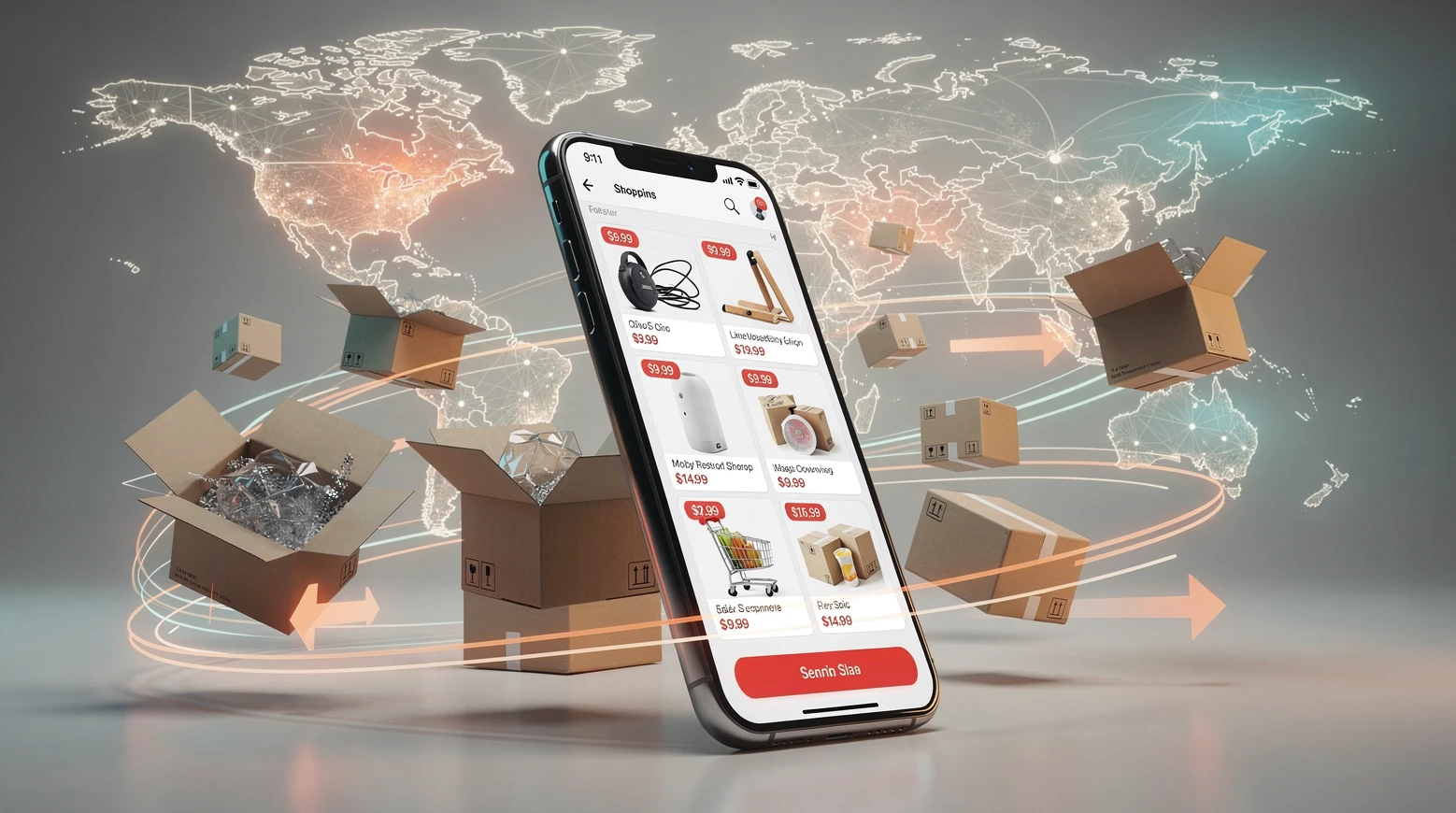
Temu low price ecommerce is no longer a curiosity for US retail teams. It is the daily reason a category manager opens a competitive dashboard, the explanation a CFO wants when basket sizes drop, and the case study a brand manager is asked to summarize before the next quarterly review. In four years the platform has gone from a US launch in September 2022 to a household name that ships hundreds of millions of orders a year, often at unit prices that look closer to industrial wholesale than retail.
This article is a working playbook on what Temu actually does, why its pricing math holds together, where competitors are losing share, and how retail and e-commerce teams in the United States can respond without copying the model wholesale. It is part of the complete guide to selling on global e-commerce marketplaces, which sits at the center of our coverage of platform economics, marketplace strategy, and cross-border retail.
In short: what to know about Temu in 2026
- Direct-from-factory model. Temu connects US shoppers to Chinese manufacturers with very few intermediate layers, compressing the markup that a traditional retailer charges between cost and shelf price.
- Operating system, not just an app. The platform combines gamified discovery, aggressive promotional pricing, and a fully managed logistics layer so vendors only ship to a Chinese warehouse, not to the end customer.
- Regulatory pressure rising. US Customs and Border Protection ended the long-standing $800 de minimis exemption for Chinese-origin shipments in 2025, and Temu has been moving more inventory to US warehouses to defend its delivery times.
- The customer is not only price-driven. Repeat orders are tied to novelty, browsing time, and the lottery feel of the storefront, not just to absolute price.
- Most competitors cannot match the price; they can match the experience. Retailers that win in 2026 are the ones that adapt merchandising, content, and category mix, not the ones that try to undercut a vertically integrated marketplace.
Why Temu changed the math of low-price retail
For most of the last two decades, the formula for low-price retail was clear. A retailer would source from overseas in container loads, hold the inventory in domestic distribution centers, mark it up to cover labor and overhead, and sell through stores or its own e-commerce site. Discount chains, off-price retailers, and online dollar stores all worked inside that formula. Temu broke it by removing the middle steps for a large slice of categories, especially apparel, accessories, home goods, and consumer electronics.
What sits behind the headline prices is a single architectural choice. Temu does not buy inventory the way a US retailer does. It runs a fully managed model, sometimes called the M2C or manufacturer-to-consumer model, where Chinese factories list products on the platform, ship in bulk to a consolidation hub, and let Temu handle pricing, logistics, customer service, returns, and marketing in the destination market. The factory keeps the cost-of-goods discipline; Temu keeps the customer relationship. That structure is what we describe in detail in the complete guide to selling on global e-commerce marketplaces, where M2C sits alongside the older marketplace and 3P models that incumbents like Amazon and Walmart rely on.
The visible result is unit prices that often look impossible. A women’s blouse for $4.97, kitchen organizers under $3, wireless earbuds under $10. The less visible result is a unit economics structure where Temu can afford to spend heavily on customer acquisition because gross margin per order is not the only number that matters. Frequency, basket size, and lifetime value carry the equation.
Key terms and definitions for retail teams
Before the rest of the article, a short glossary so the language stays precise.
- M2C (manufacturer-to-consumer): A model where the factory is the seller of record on the platform and the platform owns the customer journey end to end.
- Semi-managed model: A variant Temu rolled out in 2024 where sellers handle their own US fulfillment but keep Temu’s pricing and merchandising. Used for bulky items and fast-moving goods.
- De minimis: A US Customs threshold (historically $800) below which shipments could enter the country duty-free and with simplified paperwork. The Chinese-origin carve-out ended in May 2025.
- Section 321: The provision of the Tariff Act that codifies de minimis treatment. Still in force, but with the Chinese exclusion noted above.
- Gamified commerce: Discovery patterns that borrow from mobile gaming, including spin-the-wheel discounts, daily check-ins, and timed group deals. Designed to keep session length high.
- Sticky discount: A markdown that is presented to the shopper as conditional (limited time, limited stock) but is essentially the default price. Used heavily to anchor a higher reference price.
How Temu actually works in practice
For a US shopper, the surface experience is simple. Open the app, scroll, tap, buy, wait roughly five to twelve days, receive a package. For a retail team trying to compete, the system underneath that surface is what matters.
The supply side: factories without storefronts
Most sellers on Temu are small or mid-sized Chinese manufacturers that historically sold to wholesalers, trading companies, or US importers. On Temu they submit product specs, photos, and cost prices through the seller portal. Temu’s category buyers review the cost, set a retail price, and decide whether to onboard the SKU. The seller does not set the final price; the platform does. This is one of the sharpest differences from Amazon or Walmart Marketplace, where the seller controls pricing within a buy-box game.
The logistics layer: consolidation, not direct ship
Under the original fully managed model, factories shipped to a domestic warehouse in Guangzhou or Yiwu. Temu then consolidated parcels for international air freight to the United States, with last-mile delivery handled by USPS, UPS Mail Innovations, or regional carriers. Since 2024 Temu has expanded its US warehouse footprint so a growing share of orders ship from Indianapolis, Los Angeles, or New Jersey, which compresses delivery to two or three days for top SKUs. That shift is one of the topics we follow in our deep dive on what changed in temu for retail teams in 2026.
The customer side: discovery as entertainment
Temu invests in two things that traditional retailers tend to under-invest in: session length and surprise. The home feed is engineered to look like a slot machine rather than a catalog. Spin-the-wheel coupons, countdown timers, and “lightning deals” all push the shopper to keep tapping. Repeat orders are driven less by need and more by mood. That is uncomfortable for a category buyer who is used to thinking about demand planning in terms of stable replenishment.
The result is a session profile that looks more like TikTok than like Amazon. Average time in the Temu app for US users in 2025 reached roughly 18 to 22 minutes per day according to third-party panel data, ahead of every other shopping app in the country. That figure matters because it directly funds the platform’s cost of doing business. Long sessions create more impression inventory for sponsored placements, more cross-sell moments, and more chances for the shopper to add a low-cost item that they were not specifically looking for.
The price math, step by step
The most common question from retail teams is the simplest one: how can the prices be that low? The honest answer is that they are the product of four overlapping compressions, not one secret.
- Factory direct. Removing the importer, the wholesaler, and often the brand strips out three layers of markup. For a generic apparel item, that alone can cut retail by 40 to 60 percent.
- Tax and tariff structure. Before 2025, individual parcels under $800 entered the United States duty-free. Many low-priced Temu orders rode on that exemption. Since the de minimis change, the platform has shifted strategy, but the lower-cost shipping lanes still exist for non-Chinese-origin parcels.
- Marketing offset. Temu absorbs a meaningful share of the unit margin into customer acquisition cost. Public estimates from 2024 reporting put US ad spend in the billions per year. That money is not lost; it is reclassified from margin into growth.
- Volume and SKU rotation. Even at very low margins, the platform makes money on velocity and on the long tail of impulse buys around the initial item.
For a US retail team, the practical takeaway is that the price gap is structural, not tactical. It cannot be closed by squeezing a domestic supplier or by trimming an in-store margin. Trying to match Temu price by price is a path to negative gross margin.
A useful mental model is to split a Temu listing into four cost stacks: factory cost, international freight and customs, platform overhead, and customer acquisition. In a traditional US retail P&L, the customer acquisition line is typically 5 to 15 percent of revenue for a healthy e-commerce business. On Temu it can be larger than gross margin in the early years of a market launch, because the platform is buying long-term share, not next-quarter profit. That is a choice a publicly listed US retailer is structurally unable to make.
Common mistakes US retailers make when responding
Most defensive moves we see in the market in 2026 fall into one of five recurring traps.
- Trying to match Temu’s price on commodity SKUs. A US retailer with domestic logistics, payroll, and lease costs cannot win this fight. The right move is to exit the categories where price is the only signal.
- Copying the gamification surface without copying the supply. Adding spin-to-win popups to a Shopify store does not change the underlying basket math. The shopper notices the borrowed mechanic and discounts the brand.
- Pulling brand budget into pure performance marketing. A retailer that abandons brand investment to chase Google Shopping clicks will fight Temu on its strongest field, paid acquisition, and lose. The structurally better defensive play is more brand, not less.
- Ignoring returns economics. Temu’s return rate on apparel is, by most public estimates, materially lower than the US e-commerce average. Part of the reason is that shoppers do not bother returning a $5 item. A US competitor that does not adjust its returns policy to category cannot replicate that economics.
- Underestimating compliance risk. Replicating Temu’s import structure without its scale and legal team is dangerous. The de minimis change, plus state-level consumer protection enforcement, plus product safety regulators have all moved in the last 18 months. Small importers are exposed.
How Temu compares to the other low-price players
It is tempting to lump Temu in with every cheap online store. The mechanics are different enough that a side-by-side helps.
| Dimension | Temu | Shein | Amazon Haul | Five Below online |
|---|---|---|---|---|
| Primary model | M2C, fully managed | M2C plus owned brands | Third-party low-price storefront inside Amazon | Domestic retail with online complement |
| Average order value | $25 to $35 | $50 to $80 | $15 to $25 | $20 to $30 |
| Delivery promise (US) | 5 to 12 days, faster from US warehouses | 7 to 14 days | 1 to 5 days | 2 to 5 days |
| Category focus | Home, apparel, accessories, gadgets | Fast fashion, accessories | Sub $20 long tail | Toys, snacks, novelty |
| Returns policy | Free within 90 days, first return free | Free within 35 days, fees on subsequent | Amazon standard with restrictions | Standard US retail |
| US warehouse footprint | Growing rapidly since 2024 | Limited, mostly drop-ship | Amazon FBA network | Fully US-based |
We compare the two Chinese platforms head to head in Temu versus Shein for shoppers and for competing retailers, which goes deeper into the supply chain differences and the brand positioning of each.
Examples from US retail and e-commerce
The Temu effect shows up in different ways depending on the category. A few examples from public filings, trade press, and conversations with US merchants in 2025 and 2026 illustrate the spread.
Dollar stores and value retailers
Dollar Tree and Dollar General both flagged “online value competition” in their 2025 earnings calls, with Dollar General citing pressure in seasonal and home categories. Dollar Tree’s response, the Multi-Price Plus rollout that pushed selected SKUs to $3 and $5, can be read as a structural answer to a market where the $1 to $10 band is no longer theirs to own.
Mid-market specialty retailers
Specialty home and gift chains have seen the sharpest pinch. Buyers report that customers walk into a US store, photograph a candleholder or a desk organizer, and search for it on Temu before deciding. The defensive moves that work are exclusivity (private label, designer collaborations), service (in-store consultation, installation), and curation (smaller assortments with clear point of view).
Independent US sellers on Shopify, Wix, and Squarespace
The category most exposed is the independent merchant selling generic dropshipped goods through a Shopify store. Many of these stores source from the same Chinese factories that now sell directly on Temu, often at a third of the price. Owners that survive are pivoting to either niche communities (where brand and identity carry weight) or to physical goods that cannot be replicated cheaply. For platform-level strategy on this segment, our overview of tools and vendors for wix and squarespace in 2026 covers the apps and integrations that help small US merchants defend margin without rebuilding their stack.
Marketplaces feeling the pressure
Even the large incumbents have moved. Amazon launched Haul in late 2024 as a direct response, with a sub $20 storefront focused on apparel and home, fulfilled from Chinese consolidation centers. Walmart accelerated its W Bay program for cross-border Chinese sellers. eBay added value-tier filters that surface low-cost sellers ahead of branded merchants. Each of these moves is a quiet acknowledgment that the price floor has shifted, and that defending share in the low-priced tail of the catalog requires structural change, not just a marketing campaign.
Tools, partners and vendors worth knowing in 2026
The vendor ecosystem around the Temu effect has matured fast. Five categories of partner matter more than they did in 2024.
- Competitive price intelligence tools. Vendors such as Profitero, DataWeave, and Particl now offer Temu-specific monitoring with daily refreshes and SKU-level matching. Useful for buyers who need to know when a comparable item has dropped on the platform.
- Customs and compliance specialists. The end of the Chinese-origin de minimis exemption changed the cost-to-serve for many cross-border merchants. Brokers like Flexport, Easyship, and ePost Global publish updated rate cards that account for the new entry types.
- Sourcing alternatives. US importers who used to rely on a single Chinese supply base are diversifying to Vietnam, Mexico, and India. Platforms like Alibaba’s RTS lanes, Faire for domestic wholesale, and Tundra for North American manufacturers have all grown.
- Returns and reverse logistics. Vendors like Loop, Happy Returns, and ReverseLogix help domestic merchants tune category-specific return policies, which is a key lever once Temu raises shopper expectations.
- Brand and content tooling. Because the defensive play often runs through stronger brand, content platforms (Klaviyo for owned audiences, Attentive for SMS, TikTok Shop for discovery) are part of the response set.
None of these tools, by themselves, solves the Temu problem. They give US teams the visibility and the operational flexibility to choose where to play.
Regulatory and trust pressure on Temu in 2026
The story is not all in Temu’s favor. The platform faces a stack of regulatory and trust pressures that any retail team tracking it should keep in view.
- De minimis reform. The May 2025 executive action ending duty-free treatment for Chinese-origin shipments under $800 raised landed cost. Temu absorbed part of the cost and passed part to shoppers via creeping average order values.
- Product safety scrutiny. The Consumer Product Safety Commission and state attorneys general have pursued cases on counterfeit goods, lead in children’s jewelry, and unsafe electronics. Each case raises the cost of operating in the United States.
- Data protection and access concerns. Both federal and state policymakers have asked questions about app permissions and data flows. The platform has responded with policy updates and a US-based data hosting effort, but the trust narrative remains contested.
- Marketplace liability. Several pending court cases are testing whether a platform like Temu can be treated as the seller of record for product liability purposes, the way Amazon has been in some state courts.
For more on the operating changes the platform itself has rolled out in response, see our coverage of what changed in temu for retail teams in 2026.
What a US retail team should actually do in 2026
Stepping back from the analysis, a practical short list for category managers and e-commerce leads.
- Map your SKU portfolio against Temu match risk. Score every SKU on the share of comparable items already listed on Temu at lower than 60 percent of your retail. Exit or de-emphasize anything where the share is high and brand value is low.
- Invest where Temu structurally cannot compete. Same-day delivery, in-person fitting, expert advice, complex installation, regulated categories (alcohol, prescription, age-restricted electronics), and large freight.
- Rebuild private label as a strategic asset. A unique product that does not exist as a generic on a Chinese factory line cannot be matched on price by Temu by definition. Private label assortments are the cleanest moat.
- Tune the loyalty program to frequency. Match the Temu reward loop with something tangible (free shipping thresholds, surprise gifts, early access) so the shopper has a behavioral reason to come back to your storefront.
- Watch the regulatory news. The cost structure that makes Temu prices possible is partly a regulatory artifact. Each change in customs treatment, product safety enforcement, or platform liability narrows the gap.
The platform is not going away. It is also not invulnerable. Retailers that win in 2026 treat Temu as a structural fact, build around it, and refuse to play on its strongest field.
The two most useful diagnostic questions a US retail team can ask itself this year are these. First, what share of revenue in 2025 came from SKUs with a Temu equivalent under $10? That number is the size of the at-risk portfolio. Second, what share of our marketing budget defends those SKUs versus building brand around the categories where we genuinely lead? That ratio tells you whether your spend is on offense or on defense. The pillar piece, the complete guide to selling on global e-commerce marketplaces, walks through the same questions in the broader context of all major platforms, not only Temu.
FAQ
Is Temu cheaper than Amazon for the same product?
For comparable generic items, yes, by a wide margin, often 40 to 70 percent. For branded products, name-brand electronics, and large appliances, Amazon usually wins on price and on delivery speed.
Are Temu products safe and legal to buy in the United States?
Most are, but enforcement is uneven. Stick to non-regulated categories (home goods, accessories, basic apparel) and avoid children’s jewelry, cosmetics applied to skin, and battery-powered devices without recognized certification marks. The Consumer Product Safety Commission has flagged specific categories in 2024 and 2025.
How long does shipping really take?
Eight to twelve days for goods shipped from China, two to five days for items now stocked in US warehouses. The platform shows the estimate at checkout. Top-selling SKUs are increasingly US-stocked, which is part of the strategy shift since 2024.
Does Temu pay US sales tax?
Yes. Temu collects sales tax in every state that requires marketplace facilitators to collect it, which now covers all 45 states with a sales tax. The line item appears at checkout.
Can a small US retailer realistically compete with Temu?
Not on price for commodity items. Yes on identity, service, niche assortment, and proximity. Small retailers that try to match the platform on price tend to fail. Those that build a distinct point of view and use Temu as a foil tend to keep customers.
Will the de minimis change destroy Temu’s business model?
It will not destroy it, but it does compress the margin Temu had been working with. The platform has responded with US warehouses, modest price increases, and a push to semi-managed sellers. Expect more changes as customs rules continue to evolve.
Is Temu a marketplace or a retailer?
Legally it operates as a marketplace, with Chinese factories as sellers of record. Operationally it behaves like a retailer because it sets prices, controls merchandising, and owns the customer relationship end to end. Some pending litigation may push the platform closer to retailer treatment for product liability.
For the wider context on how marketplaces like Temu fit into the global e-commerce landscape, including Amazon, eBay, AliExpress, MercadoLibre, and the regional players, our complete guide to selling on global e-commerce marketplaces is the pillar piece that links the whole cluster together. For background on the platform’s history and corporate structure, the Wikipedia entry on Temu is a useful neutral starting point.