
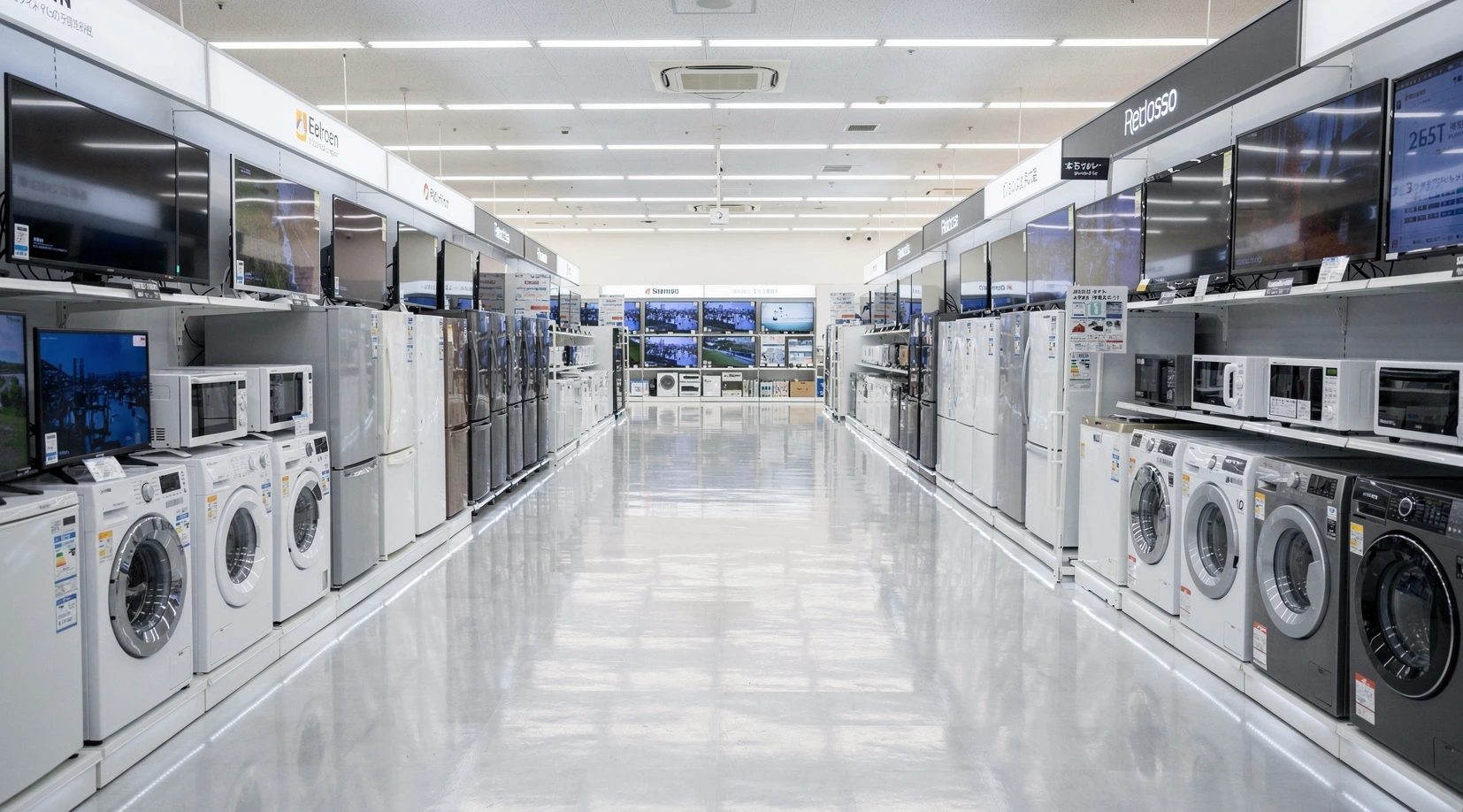
Two of Japan’s biggest sellers of televisions, refrigerators and laptops are preparing to become one. Yamada Holdings, the country’s largest consumer electronics retailer, and Edion, a regional powerhouse with deep roots in western Japan, are planning a merger that would create a chain with combined annual sales of roughly 2.5 trillion yen (about $15.6 billion at the early-June rate of close to 160 yen per dollar), according to a report from Nikkei Asia that was picked up by Reuters and the regional trade press.
The companies are expected to reach a basic agreement as early as this week, according to the reporting, with the tie-up structured through a jointly owned holding company so that both store brands can keep operating under their own names. Investors moved quickly: Edion shares jumped about 11 percent and Yamada rose roughly 3.5 percent in Tokyo trading after the news circulated, per Finimize and market data.
If completed, the deal would reshape the league table of Japanese electronics retail and hand the combined group purchasing power well beyond that of its nearest specialist rival. It would also stand as one of the most consequential pieces of domestic retail consolidation in a market squeezed by online price competition and a shrinking, ageing population.
In short
- The deal: Yamada Holdings and Edion plan to merge under a new holding company, keeping both brands, with a basic agreement expected as early as this week, according to Nikkei Asia.
- The scale: Combined sales of about 2.5 trillion yen (around $15.6 billion) would create Japan’s largest electronics retail group, with more than double the revenue of specialist rival Bic Camera.
- The why: Both chains face online price competition and a falling population, and are betting that scale will improve procurement terms and accelerate private-label products that carry higher margins.
- The risk: Antitrust review is the main hurdle, especially in western Japan, where the two networks overlap most heavily.
- The signal: The move fits a broader global pattern of legacy retailers consolidating to defend margins against marketplaces and quick commerce rather than chasing growth alone.
What did Yamada and Edion actually announce?
The core of the news is straightforward. Yamada Holdings, listed in Tokyo and the clear market leader in Japanese consumer electronics retail, and Edion, the sector’s fifth-ranked player, intend to combine their businesses, according to Nikkei Asia. Reuters carried the report under the framing that the two retailers “plan merger to create sector giant,” and the regional outlet Inside Retail Asia published its own account on the morning of June 4.
The transaction would be organized through a holding company rather than an outright absorption of one chain by the other. That structure lets both retailers retain their existing brand identities and run day-to-day operations separately, at least initially, while pooling functions such as procurement and product development behind the scenes.
According to the reporting, the stated goal is to “bolster product development and procurement in an increasingly competitive market.” In plain terms, the companies want the buying leverage and development budget of a single large group while avoiding the disruption of forcing hundreds of stores under one banner overnight.
Neither company has, at the time of writing, confirmed final deal terms publicly, and figures cited here trace to the Nikkei report and its pickups rather than to a definitive joint statement. The phrase “as early as this week” signals that a basic agreement, not a completed merger, is the immediate milestone.
Who are the two companies?
Yamada Holdings, the operator behind the Yamada Denki store network, is Japan’s largest consumer electronics retailer by sales. The group reported revenue of about 1.69 trillion yen (roughly $10.6 billion) in its most recent fiscal year ended in March, and it has expanded over the years through acquisitions, including its 2012 purchase of Best Denki.
Edion, based in western Japan, is the fifth-ranked chain in the sector and reported revenue of about 793.7 billion yen (around $5.0 billion). Its strength is regional density rather than nationwide reach, which is precisely why the combination is additive rather than purely overlapping.
How fresh is this story?
The original scoop carried a Nikkei timestamp in the early hours of June 4 Japan time, and English-language coverage from Reuters and Inside Retail Asia followed within hours. As with most deals reported ahead of a formal announcement, expect the companies to either confirm or decline to comment, and for additional terms to surface once a basic agreement is signed.
How big would the combined company be?
Scale is the headline. At roughly 2.5 trillion yen in combined sales, the merged group would be more than twice the size of Bic Camera, the next-largest listed specialist, according to the reporting. That gulf matters in a business where margins are thin and supplier negotiations turn on volume.
Within the wider Japanese retail universe, the combined entity would rank among the country’s largest retail groups, sitting behind diversified giants such as Aeon, Seven and i Holdings and Fast Retailing, the owner of Uniqlo. Those peers are not direct electronics competitors, but they illustrate the tier the new group would join by revenue.
The strategic logic mirrors what other large-format retailers have learned the hard way: a category specialist that competes mainly on the price of the same branded televisions and appliances as everyone else has little pricing power. That is the same pressure pushing established electronics sellers worldwide to add higher-margin revenue streams, a shift visible in how Best Buy has pivoted its margin story toward marketplace commissions and retail-media advertising rather than relying on hardware sales alone.
| Group | Approx. annual sales (yen) | Approx. USD (at ~160/$) | Position |
|---|---|---|---|
| Yamada + Edion (combined) | ~2.5 trillion | ~$15.6 billion | Proposed sector leader |
| Yamada Holdings (standalone) | ~1.69 trillion | ~$10.6 billion | Current No. 1 |
| Edion (standalone) | ~793.7 billion | ~$5.0 billion | Current No. 5 |
| Bic Camera | Less than half the combined total | Roughly $7 billion range | Nearest listed specialist |
Why are two electronics chains merging now?
The timing reflects structural pressure rather than a single trigger. Japanese electronics retailers are caught between online sellers that compete relentlessly on price and a domestic customer base that is no longer growing. Consolidation is one of the few levers left to defend profitability.
Online price competition
Physical electronics chains have spent more than a decade fighting the “showrooming” problem, where shoppers inspect a product in store and then buy it cheaper online. Marketplaces and direct sellers strip pricing power from anyone reselling identical branded goods, which is why speed, service and convenience have become competitive battlegrounds. The same dynamic is reshaping retail globally, from electronics to groceries, as platforms compress the gap between browsing and delivery, a trend on full display in the way the US sub-30-minute delivery race keeps intensifying and forcing incumbents to invest in convenience.
A shrinking, ageing population
Japan’s demographics cap long-term demand for big-ticket household goods. A market with fewer new households and an older median age sells fewer first refrigerators, first televisions and first washing machines each year. When the overall pie stops growing, taking cost out and gaining share become the primary routes to higher profit.
The squeeze on profit
The financial backdrop underscores the urgency. Yamada’s net profit fell about 45 percent to roughly 14.8 billion yen (around $93 million) on 1.7 trillion yen of sales in its last fiscal year, according to figures cited in the coverage. A leader posting a sharp profit decline despite holding the top sales position is a strong motivation to change the cost structure rather than wait for demand to recover.
The private-label bet
Both companies are emphasizing exclusive merchandise and private-label products. Own-brand goods typically carry higher margins than reselling the same branded electronics available everywhere, and they are far easier to fund and develop with the scale of a 2.5 trillion yen buyer. The investor case, as framed by market commentary, rests heavily on whether the group can actually shift its mix toward these higher-margin products rather than simply stacking store networks on top of each other.
A sector primed for consolidation
This combination would not appear in a vacuum. Japanese electronics retail has consolidated in waves for more than a decade, as larger chains absorbed regional players to chase the buying scale that thin-margin appliance retail demands. Yamada itself grew partly through acquisitions, including its 2012 purchase of Best Denki, while Edion’s own footprint was assembled from earlier regional combinations.
That history matters because it sets expectations. A market that has already rewarded scale through prior deals is more likely to view a number one and number five tie-up as a logical next step rather than a defensive scramble. It also means suppliers, regulators and rivals have a template for how such integrations tend to unfold.
The pattern is not unique to electronics. Across Japanese retail, slow domestic demand has repeatedly pushed operators toward mergers, alliances and holding-company structures that preserve brands while pooling cost. The Yamada and Edion plan reads as the latest expression of that long-running dynamic.
How would the holding-company structure work?
The proposed framework is a holding company that owns both retailers, with the Yamada and Edion banners preserved. That is a deliberate, lower-friction approach to integration, and it is common in Japanese corporate combinations where brand loyalty and regional identity carry real commercial weight.
Under such a structure, the two chains can keep their store formats, loyalty programs and local relationships while the parent centralizes the functions where scale pays off. Procurement, private-label development, logistics and shared services are the obvious candidates for consolidation, since those are where a larger buyer extracts better terms.
The trade-off is that a holding-company model can defer the harder synergies. Overlapping stores, duplicated back-office systems and competing supplier contracts do not resolve themselves simply because a new parent exists on paper. Investors will watch whether management sets concrete targets for cost savings and private-label penetration, or whether the brands continue to operate largely as before.
Why keep both brands?
Retaining both names protects customer relationships and avoids the churn that often follows a rebrand. Edion’s western-Japan loyalty and Yamada’s national presence are assets that a single forced banner could erode. Keeping them separate at the storefront, while merging the engine room, is a hedge that aims to capture buying power without spooking shoppers.
Where could the deal face antitrust resistance?
The clearest obstacle is competition review. Japan’s Fair Trade Commission scrutinizes combinations that could reduce competition in specific local markets, and a merger of the number one and number five national players invites exactly that examination.
The sensitivity is concentrated in western Japan, where the two networks overlap most, according to the reporting. National market share figures can look manageable while individual prefectures or cities tip toward concentration once two large chains combine. Regulators tend to focus on those local overlaps rather than the headline national number.
Remedies in such cases often involve commitments on pricing behavior, store divestitures in the most concentrated areas, or undertakings to preserve supplier access. None of that is confirmed here, and the parties have only reached the stage of a prospective basic agreement, but antitrust clearance is the variable most likely to shape the final structure and timeline.
How does Japan’s electronics retail sector stack up?
Japan’s consumer electronics retail market is unusually crowded with large, recognizable specialists, which is part of why consolidation pressure has built for years. The big-box and city-center “camera” chains compete alongside suburban superstores and a growing online channel led by Amazon Japan and Rakuten.
The combination would not eliminate that competition, but it would create a clear scale leader and could prompt rivals to reassess their own positioning. Just as legacy multi-brand retailers elsewhere have leaned on portfolio strength to navigate a tough cycle, illustrated by the way Macy’s leaned on Bloomingdale’s to lift its outlook, a larger Japanese electronics group could use combined buying power and a broadened assortment to defend its lead.
| Player | Profile | Notable trait |
|---|---|---|
| Yamada Holdings | National No. 1 electronics chain | Built scale via acquisitions, including Best Denki (2012) |
| Edion | No. 5 chain, western-Japan strength | Regional density complements a national partner |
| Bic Camera | City-center specialist | Nearest listed rival by size to the proposed group |
| Yodobashi Camera | Premium urban electronics retailer | Known for flagship stores and strong online operations |
| Online channel | Amazon Japan, Rakuten and others | The persistent source of price pressure on physical stores |
What about the online challengers?
Online platforms remain the structural threat that no amount of consolidation removes. A larger physical chain can negotiate harder and fund more own-brand goods, but it still competes with marketplaces on transparency and convenience. The merger is best read as a way to strengthen the physical model, not to escape the online one.
What does the deal mean for suppliers and private label?
For suppliers, a combined Yamada and Edion would be a counterparty that is harder to push back against. A single buyer representing roughly 2.5 trillion yen of sales can press for better wholesale pricing, promotional support and exclusive product runs. That shift in leverage is one of the clearest near-term consequences of the deal.
The flip side is the private-label push. Higher own-brand penetration means the group competes with some of its own suppliers, sourcing comparable goods under its own labels at better margins. Retailers across categories have used private label as a margin and loyalty tool, much as discounters have leaned on own brands and value positioning during a strained consumer cycle, a pattern visible in how off-price retailers managed Q1 amid pressure on the value shopper.
Will shoppers see lower prices?
Not necessarily, and not automatically. Scale can fund sharper promotions and exclusive products, but a more concentrated market can also soften the pricing rivalry that benefits consumers. This is exactly the tension competition regulators weigh, and it is why the antitrust review matters beyond the boardroom.
What changes for store staff and formats?
In the near term, the holding-company structure suggests limited visible change, since both banners continue. Over time, the pressure to realize synergies tends to surface in overlapping locations, shared logistics and back-office consolidation. The pace of any such moves will signal how aggressively management intends to integrate.
How does this fit the global retail consolidation wave?
The Yamada and Edion plan is a local story with a global echo. Across mature markets, legacy retailers are combining or restructuring to defend margins against marketplaces, discounters and quick commerce, rather than betting on organic growth that demographics and competition no longer reliably provide.
That theme runs well beyond electronics and beyond retail’s storefront. In payments and commerce infrastructure, scale-driven dealmaking has accelerated for the same defensive reasons, a dynamic explored in our look at how European payments consolidation is intensifying as sub-scale players seek shelter in larger groups. The common thread is consolidation as a margin strategy in slow-growth, high-competition markets.
What makes Japan distinctive?
Japan adds two intensifiers: an unusually fragmented field of large electronics specialists and demographics that cap demand more firmly than in growing markets. Those conditions make the case for combining stronger than a simple cyclical downturn would, and they suggest this may not be the last tie-up the sector sees.
Margins over growth
The deeper shift on display is a change in what large retailers optimize for. In an earlier era, electronics chains competed on store openings and assortment breadth, racing to capture a growing population’s first purchases. That growth playbook no longer fits a market where households are not multiplying and online sellers undercut shelf prices.
The new emphasis is on the quality of earnings rather than the quantity of revenue. Procurement leverage, own-brand penetration and operating efficiency are the metrics that determine whether a bigger chain is also a more profitable one. A merger that simply adds sales without improving those measures would disappoint the very investors who bid the shares higher.
What does the merger mean for the wider economy and consumers?
Beyond the boardroom, a tie-up of this size touches suppliers, workers, landlords and shoppers across Japan. Electronics retail is a visible part of the consumer landscape, and a single dominant specialist would influence how appliances and devices are priced, stocked and serviced nationwide.
Impact on the supply chain
Manufacturers that sell through both chains would negotiate with one larger counterparty rather than two competing buyers. That concentration can lower the prices retailers pay, but it can also squeeze smaller suppliers and accelerate the shift toward own-brand goods that displace some branded lines. The net effect on the supply chain depends on how aggressively the combined group pursues private label.
Impact on regions and jobs
Because Edion is strongest in western Japan and Yamada operates nationally, the overlap is uneven. Regions where both run dense store networks are the most likely to see eventual rationalization if the group consolidates locations, while areas served mainly by one banner may change little. Any restructuring would unfold over years rather than at signing, given the holding-company structure.
Impact on shoppers
For consumers, the promise is a stronger one-stop electronics retailer with deeper exclusive ranges and more resilient service. The risk is reduced price competition in a market that already leans on a handful of large players. Which outcome dominates will hinge on the conditions regulators attach and on how the combined group chooses to compete with online sellers.
What should investors and the industry watch next?
The immediate milestone is whether the two companies sign the basic agreement reported to be imminent, and what terms accompany it. After that, attention shifts to the share-exchange ratio or holding-company mechanics, governance, and any stated synergy or margin targets.
The longer arc is execution. The investor optimism reflected in the share moves rests on the private-label and procurement thesis, not merely on a bigger store count. The decisive question is whether the group can lift its mix toward higher-margin own-brand goods while clearing antitrust review without crippling concessions.
Watch three markers in particular: the timing and conditions of competition clearance, the first concrete cost-savings and private-label targets management commits to, and whether rivals such as Bic Camera or Yodobashi respond with their own strategic moves. Each will say more about the deal’s real impact than the headline sales figure alone.
For now, the takeaway is that Japan’s electronics retail leader is choosing scale and margin discipline over the fading growth model of the past. If the reported basic agreement is signed and survives regulatory review, the sector will have a single dominant specialist for the first time at this magnitude, and the rest of the field will have to decide whether to follow with deals of their own or carve out defensible niches. Either way, the announcement marks a clear inflection point for how electronics are bought and sold across the country.
Frequently asked questions
What exactly did Yamada and Edion announce?
According to Nikkei Asia, the two Japanese electronics retailers plan to merge through a jointly owned holding company, keeping both store brands, with a basic agreement expected as early as this week. Final terms had not been formally confirmed by the companies at the time of writing.
How big would the combined company be?
The merged group would have combined annual sales of roughly 2.5 trillion yen (about $15.6 billion at a rate near 160 yen per dollar), making it Japan’s largest electronics retail group and more than double the size of listed rival Bic Camera, per the reporting.
Why are the two chains merging?
They face online price competition and a shrinking, ageing population that limits demand. Combining is intended to improve procurement terms and accelerate higher-margin private-label products, with Yamada’s profit having fallen sharply in its latest fiscal year according to cited figures.
Will Yamada and Edion stores keep their names?
Yes, based on the reported structure. A holding company would own both retailers while each brand keeps its own stores and day-to-day operations, with scale benefits captured in shared functions such as buying and private-label development.
What is the main risk to the deal?
Antitrust review is the principal hurdle, particularly in western Japan where the two networks overlap most heavily. Regulators may focus on local market concentration even if the national share looks manageable.
How did the stock market react?
Edion shares rose about 11 percent and Yamada gained roughly 3.5 percent in Tokyo trading after the report circulated, according to Finimize and market data, reflecting investor optimism about scale and margin potential.
Will the merger lower prices for shoppers?
Not necessarily. Greater scale can fund sharper promotions and exclusive products, but a more concentrated market can also reduce pricing rivalry. That balance is central to the competition review.
How does this compare to deals elsewhere?
It fits a global pattern of legacy retailers and commerce firms consolidating to defend margins against marketplaces and quick commerce. Similar scale-driven dealmaking has been visible in sectors from department stores to payments infrastructure.
When will the merger be completed?
No completion date has been confirmed. The near-term step is a basic agreement reported to be imminent; full completion would depend on definitive terms and antitrust clearance, which can take many months.