
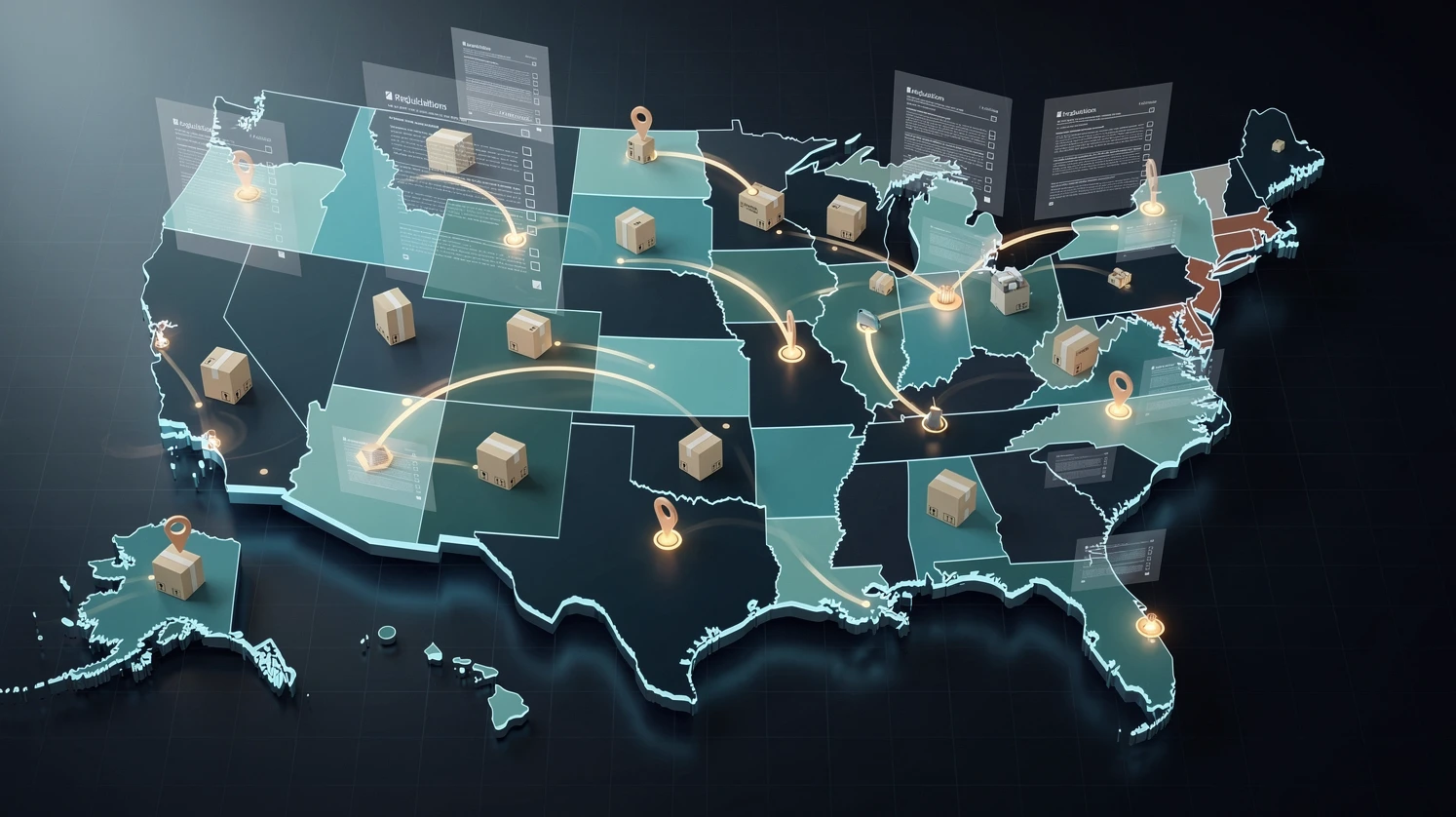
Every operator who ships across the United States is running a 50-jurisdiction compliance program whether they know it or not. Federal rules set the floor, but the rules that actually determine whether a shipment is legal, taxable, or returnable are written in Sacramento, Albany, Austin, and Tallahassee. Ignore them and the penalties do not arrive as a warning letter, they arrive as back taxes, class-action exposure, and blocked deliveries.
This guide breaks down the state-level retail laws that catch ship operators off guard, why they matter more in 2026 than they did five years ago, and how to build a practical program that keeps you out of trouble. It is written for e-commerce founders, operations leads, and finance teams who need to move product, not lawyers who bill by the clause.
In short
- Sales tax nexus is now economic, not physical. After the 2018 Wayfair decision, most states tax you once you cross a revenue or transaction threshold, even with zero warehouses or staff in the state.
- Marketplace facilitator laws shifted collection duty to platforms like Amazon and eBay, but direct sellers on their own storefronts still carry the full burden themselves.
- Packaging, plastic, and extended producer responsibility (EPR) laws in California, Colorado, Oregon, Maine, and Minnesota now bill brands for the waste their shipments create.
- Consumer protection rules diverge sharply by state, covering auto-renewal cancellation, gift card breakage, return-policy disclosure, and price gouging during emergencies.
- The cost of ignoring these laws is asymmetric. A missed registration can compound into years of uncollected tax plus penalties, and a single non-compliant subscription flow can trigger a statewide class action.
Why do state retail laws matter more in 2026?
Ten years ago a small brand could ship nationwide and reasonably ignore the patchwork. Volumes were low, enforcement was thin, and the constitutional rule required physical presence before a state could tax you. That world is gone.
The 2018 Supreme Court decision in South Dakota v. Wayfair replaced physical presence with economic nexus, and within three years nearly every state with a sales tax adopted a threshold. The result is that a Shopify store run from a garage in Denver can owe collection duties in 30 states before it hires a second employee. State legislatures noticed the revenue and kept building.
At the same time, states have become the primary venue for consumer and environmental policy. When federal action stalls, California, New York, and a cluster of others fill the vacuum with their own rules on packaging, privacy, and subscription billing. For a national shipper, the binding constraint is almost always the strictest state, not the average one. Understanding how that dynamic plays out is the same skill covered in our pillar on how retail news shapes the global e-commerce industry today.
The 2026 wrinkle is enforcement automation. State revenue departments now cross-reference marketplace 1099-K data, freight records, and payment-processor reports, which means the gap between shipping into a state and being noticed has collapsed from years to months.
The scale of the shift also explains the attention. E-commerce has grown from a rounding error to a double-digit share of total US retail, and states can see that revenue moving across their borders in the aggregate data published by the US Census Bureau. When online sales become a meaningful slice of a state’s economy, taxing and regulating those sales moves from optional to inevitable. That is why the pace of new retail legislation has accelerated rather than leveled off.
What are the key terms every ship operator should know?
The vocabulary is where most teams get lost, because the same word means different things in different states. Getting the definitions straight is the cheapest compliance investment you can make.
Nexus and economic thresholds
Nexus is the legal connection that lets a state require you to collect its sales tax. Physical nexus comes from inventory, staff, offices, or even a single trade-show booth. Economic nexus comes from crossing a sales threshold, commonly $100,000 in annual revenue or 200 separate transactions, though several states have dropped the transaction count entirely.
Marketplace facilitator
A marketplace facilitator is a platform that lists third-party sellers and processes their payments, such as Amazon, Walmart Marketplace, or Etsy. State laws make the facilitator responsible for collecting and remitting tax on those sales, which relieves the individual seller for marketplace channels but not for their own direct-to-consumer site.
Extended producer responsibility
EPR shifts the cost of end-of-life packaging and product waste from municipalities back to the companies that put the material on the market. In practice you register with a producer responsibility organization, report the weight and type of packaging you ship into the state, and pay a fee that scales with recyclability.
Breakage, auto-renewal, and cooling-off
Breakage refers to unredeemed gift-card balances, which many states require you to report and sometimes hand over as unclaimed property. Auto-renewal laws govern how subscriptions can be sold and cancelled. Cooling-off rules give buyers a window to unwind certain sales, especially door-to-door and some high-value purchases.
How do state retail laws work in practice?
Compliance is less about reading statutes and more about building a repeatable operating rhythm. The teams that stay clean treat it as a data problem: track where you ship, how much, and what you ship, then map that to obligations.
The starting point is a nexus study. You pull 12 months of sales and shipments by state, compare each against that state’s economic and physical thresholds, and flag where you have crossed the line. This is exactly the kind of jurisdiction-by-jurisdiction analysis we walk through in the guide to how retail policy in the United States is set and challenged.
Once you know where you have nexus, you register for a sales-tax permit in each state, configure your cart to collect the right rate down to the local level, and set a filing calendar. Rates are not uniform inside a state either, because counties, cities, and special districts stack their own percentages on top.
For packaging and EPR, the workflow is parallel but separate. You report material weights to a producer responsibility organization, not the tax authority, and the fee lands on a different schedule. The mistake is assuming one registration covers both, when in reality tax, EPR, and consumer-protection duties each run on their own track.
The connective tissue across all of these tracks is your shipping data. If you can answer where every order went, what it weighed, what it contained, and how it was billed, you can derive nearly every obligation from that single source. Teams that keep this data fragmented across a cart, a 3PL portal, and a spreadsheet end up rediscovering their exposure one audit at a time. Consolidating it early is the highest-leverage move a small operator can make.
The four buckets of state obligation
It helps to sort every rule into one of four buckets so nothing falls through the cracks. Each bucket has its own regulator, its own filing cadence, and its own penalty structure.
| Bucket | Typical regulator | Trigger | Main penalty risk |
|---|---|---|---|
| Sales and use tax | State department of revenue | Economic or physical nexus | Back tax plus interest and penalties |
| Packaging and EPR | Environmental agency or PRO | Selling packaged goods into the state | Fines and shipment restrictions |
| Consumer protection | State attorney general | Selling to residents on any terms | Class actions and civil penalties |
| Unclaimed property | State treasurer or controller | Unredeemed balances and credits | Audit assessments and interest |
Which state laws catch ship operators most often?
Some rules trip up newcomers again and again because they contradict intuition or hide inside otherwise routine operations. These are the ones worth flagging for every operations review.
Economic nexus with no physical footprint
The single most common surprise is owing tax in a state where you have never set foot. Founders assume that no warehouse means no obligation, then discover a five-figure liability after crossing a revenue threshold two years earlier. Interest and penalties accrue from the date you should have registered, not the date you were caught.
Marketplace and direct-sale mismatch
Sellers who move product on both Amazon and their own site often assume the marketplace covers everything. In reality the facilitator handles only its own channel, so your Shopify or WooCommerce sales still need independent registration and collection wherever you have nexus.
Packaging EPR fees that arrive with no warning
California, Oregon, Colorado, Maine, and Minnesota have live or phasing-in EPR programs, and the reporting obligations reach any brand that ships packaged goods to residents. Many operators only learn about the fee when a producer responsibility organization sends a registration demand. The same cross-border compliance pressure is playing out abroad, as we cover in the analysis of how the EU’s China-marketplace compliance regime is likely to harden by year-end.
Auto-renewal cancellation flows
California, New York, and a growing list of states require clear disclosure, affirmative consent, and an easy online cancellation path for subscriptions. A checkout that makes signing up one click but cancelling a phone call is now a documented class-action magnet.
What does a compliant program actually look like?
A workable program does not need a large legal team, it needs discipline and the right tooling. The goal is to make compliance a byproduct of normal operations rather than a fire drill.
Start with visibility. You cannot comply with rules you cannot see, so the first build is a live dashboard of sales and shipment volume by state, refreshed monthly, with threshold alerts. When you approach 80 percent of a state’s nexus threshold, that state moves onto a watch list and you prepare to register before you cross.
Next, centralize your tax calculation in software rather than hardcoded rates, because local rates change constantly and a stale table quietly undercollects. Layer in a filing calendar with owners and due dates, since most penalties come from late or missed returns, not from the underlying tax itself.
Finally, run an annual review of the non-tax buckets: EPR registrations, gift-card and unclaimed-property reporting, subscription-cancellation flows, and return-policy disclosures. These rarely change month to month, but when they do change they tend to carry the largest headline penalties, a pattern we track in coverage of marketplace enforcement and how regulators are escalating.
A simple maturity ladder
Most teams progress through predictable stages. Knowing where you sit tells you what to fix next.
| Stage | What it looks like | Biggest exposure | Next move |
|---|---|---|---|
| Reactive | Register only after a notice arrives | Compounding back tax | Run a nexus study now |
| Registered | Permits in high-volume states | Local rate errors, EPR blind spot | Automate rate calculation |
| Automated | Software collects and files tax | Consumer-protection flows | Audit subscriptions and returns |
| Managed | All four buckets on a calendar | New-state law changes | Quarterly legislative scan |
What are real examples from US retail and e-commerce?
The abstractions land harder with concrete scenarios drawn from how these laws actually bite. Names are generalized, but the patterns are common across the industry.
Consider a mid-size apparel brand selling only on its own site. It crosses $100,000 in California and Texas in the same year, ignores registration because it has no offices there, and gets a nexus questionnaire 26 months later. The assessment covers two years of uncollected tax the brand never charged customers, so it pays out of margin, and the penalty roughly doubles the bill.
Or take a subscription coffee company with a slick signup and a cancellation process that routes to email support. A California resident files a complaint, the attorney general’s office opens an inquiry under the auto-renewal statute, and the company settles by refunding a class and rebuilding its cancel flow. The engineering fix would have cost a fraction of the settlement.
A third case: a home-goods seller shipping bulky packaging into Oregon and Colorado misses the EPR registration window. The producer responsibility organization back-bills the fees for the periods already shipped, and the brand also faces the reputational hit of being listed publicly as non-compliant. The lesson repeats across every bucket, that the cost of catching up always exceeds the cost of getting ahead, because you pay the arrears and the penalty at once.
Why the penalties are asymmetric
The structural reason these mistakes hurt is timing. Tax and EPR obligations begin on the date you cross a threshold, but you usually discover them much later, so the liability compounds silently in the background. By the time a notice arrives, you owe the principal, the interest, and the penalties for every period in between.
Which tools, partners, and vendors are worth knowing?
You do not have to solve this manually, and trying to will not scale past a few states. The market has matured into a stack of specialists for each bucket.
For sales tax, automated calculation and filing platforms plug into most carts and handle rate lookups, registration, and returns. The main categories worth evaluating are tax-engine providers that live inside checkout and full-service filers that also submit your returns. Pick based on how many states you file in and whether you have finance staff to manage the calendar.
For EPR and packaging, the producer responsibility organizations themselves are the primary counterparties, and a handful of consultancies specialize in material reporting. For consumer-protection flows, the fix is usually product and legal review rather than a vendor, because the risk lives in your checkout and cancellation UX.
| Need | Type of partner | What to check first |
|---|---|---|
| Sales tax calculation | Tax engine in checkout | Local rate accuracy and cart integration |
| Return and registration | Full-service tax filer | State coverage and filing SLAs |
| Packaging EPR | Producer responsibility organization | Which states you actually ship into |
| Subscription compliance | Legal plus product review | Cancel flow parity with signup |
| Unclaimed property | Specialist accounting firm | Gift-card and store-credit reporting |
The rule of thumb: buy software for the high-frequency, rules-heavy buckets like sales tax, and buy expertise for the low-frequency, high-stakes buckets like EPR and consumer protection. Whatever you choose, keep the state-by-state data in one place so every vendor works from the same map.
How do the biggest states differ from each other?
Because you have to comply with the strictest state you ship into, it pays to know the handful that set the pace. A rule that starts in California this year tends to spread to New York, Colorado, and Washington within a couple of legislative sessions.
California as the ceiling
California is the effective national standard for most operators, because complying there usually satisfies everyone else. It runs an aggressive economic-nexus regime, one of the earliest packaging EPR laws, a strict auto-renewal statute, and the broadest consumer-privacy rules in the country. If you build your program to California’s bar, the rest of the country is largely downhill.
New York and the northeast cluster
New York pairs a low practical nexus threshold with active attorney-general enforcement on deceptive pricing and subscription terms. The northeast in general, including Maine and Connecticut, has led on packaging and right-to-repair rules, so a brand shipping into the region should watch environmental and product-serviceability laws closely.
Texas, Florida, and the high-volume south
Texas and Florida have no state income tax, which makes sales-tax enforcement a larger share of revenue and therefore a priority. Both run economic nexus with local rate stacking that can catch operators who collect a flat statewide rate. Neither has California’s environmental reach yet, but both are volume-heavy destinations where small rate errors multiply fast.
| State | Sales tax posture | Packaging or EPR | Consumer protection focus |
|---|---|---|---|
| California | Aggressive economic nexus | Early, broad EPR | Auto-renewal and privacy |
| New York | Low practical threshold | Emerging packaging rules | Deceptive pricing enforcement |
| Texas | Local rate stacking | Limited so far | Standard disclosure rules |
| Colorado | Home-rule local complexity | Active EPR program | Data privacy statute |
The practical takeaway is to build to the ceiling and monitor the fast followers. Colorado deserves special mention because its home-rule cities can levy and administer their own sales taxes, which turns one state into dozens of local filing points and surprises operators who treat it as a single jurisdiction.
What about privacy, returns, and price gouging?
Sales tax and packaging get the headlines, but three quieter categories catch shippers who assume they are only a tax problem. Each lives outside the revenue department and answers to a different regulator.
Consumer data and privacy
More than a dozen states now have comprehensive privacy laws that govern how you collect, sell, and share customer data. If you run email marketing, retargeting pixels, or any data-sharing arrangement, you likely owe residents disclosure and opt-out rights. The obligation attaches to where the customer lives, not where your servers sit, so national shipping means national privacy exposure.
Return-policy disclosure
Several states, including New York and Florida, require you to post your return policy conspicuously, and if you fail to, they impose a default policy that is usually more generous than your own. A buried or missing policy can force you to accept returns you never intended to allow. This is a cheap fix that operators routinely overlook until a dispute forces the issue.
Price gouging during emergencies
When a state declares an emergency, price-gouging statutes cap how much you can raise prices on essential goods, sometimes at 10 percent above the pre-emergency level. Dynamic-pricing algorithms are the usual culprit, because they can push a price past the cap automatically without anyone intending to. Operators using automated repricing should build emergency-state guardrails before they need them.
How should a team prioritize what to fix first?
Not every gap deserves the same urgency, and treating them equally wastes scarce time. Sort by two factors: how fast the liability compounds and how large a single incident can be.
Sales tax and EPR compound quietly over time, so they reward early action even if no incident has occurred. Consumer-protection rules are more binary, where nothing happens until one complaint turns into a class action, but that single event can dwarf a year of tax exposure. The pragmatic order is to close compounding gaps first, then harden the high-severity flows.
For most shippers the sequence looks like this: run a nexus study, register where you already owe, automate collection, then audit subscription and return flows, and finally layer in EPR and unclaimed-property reporting. Revisit the whole map at least quarterly, because state legislatures move fast and a new law can reset your priorities overnight. Staying current with policy shifts is exactly why we maintain the pillar on how retail news shapes the global e-commerce industry today.
Frequently asked questions
Do I owe sales tax in a state where I have no office or warehouse?
Often yes. Since the 2018 Wayfair decision, most states use economic nexus, which is triggered by crossing a revenue or transaction threshold rather than by any physical presence. If you ship enough product into a state, you can owe collection duties there with zero physical footprint.
If I sell on Amazon, do I still need to worry about sales tax?
For your Amazon sales, the marketplace facilitator laws make Amazon responsible for collecting and remitting. But those laws only cover the marketplace channel, so sales through your own website still require you to register and collect wherever you have nexus.
What is the common economic nexus threshold?
The most widespread threshold is $100,000 in annual sales or 200 separate transactions, though states set their own numbers and several have removed the transaction count. Always check the specific state, because the details vary and change over time.
What is extended producer responsibility and does it apply to me?
EPR makes brands pay for the end-of-life cost of the packaging they ship. If you send packaged goods to residents of states like California, Oregon, Colorado, Maine, or Minnesota, you likely need to register with a producer responsibility organization and report your packaging weights.
Why are auto-renewal laws such a big risk?
Several states require clear disclosure, affirmative consent at signup, and an easy online way to cancel. A checkout that makes subscribing frictionless but cancelling difficult violates these rules and has become a frequent trigger for class-action lawsuits.
How far back can a state assess uncollected tax?
Liability generally starts on the date you first crossed the nexus threshold, not the date the state contacts you. That means assessments can reach back several years, and interest and penalties accrue for the entire period you were unregistered.
Do I need to report unredeemed gift-card balances?
In many states, yes. Unredeemed balances, known as breakage, can fall under unclaimed-property law, which may require you to report and remit them to the state treasurer after a dormancy period. The rules vary widely by state.
Should I use software or hire an advisor?
Use both, matched to the bucket. Software is the right tool for high-frequency, rules-heavy sales tax, while specialist advisors make sense for lower-frequency but high-stakes areas like EPR, consumer protection, and unclaimed property.
How often should I review my compliance program?
At least quarterly. State legislatures pass new retail and packaging laws frequently, thresholds shift, and your own shipping footprint changes, so a stale review can leave you exposed to obligations that appeared only months earlier.