
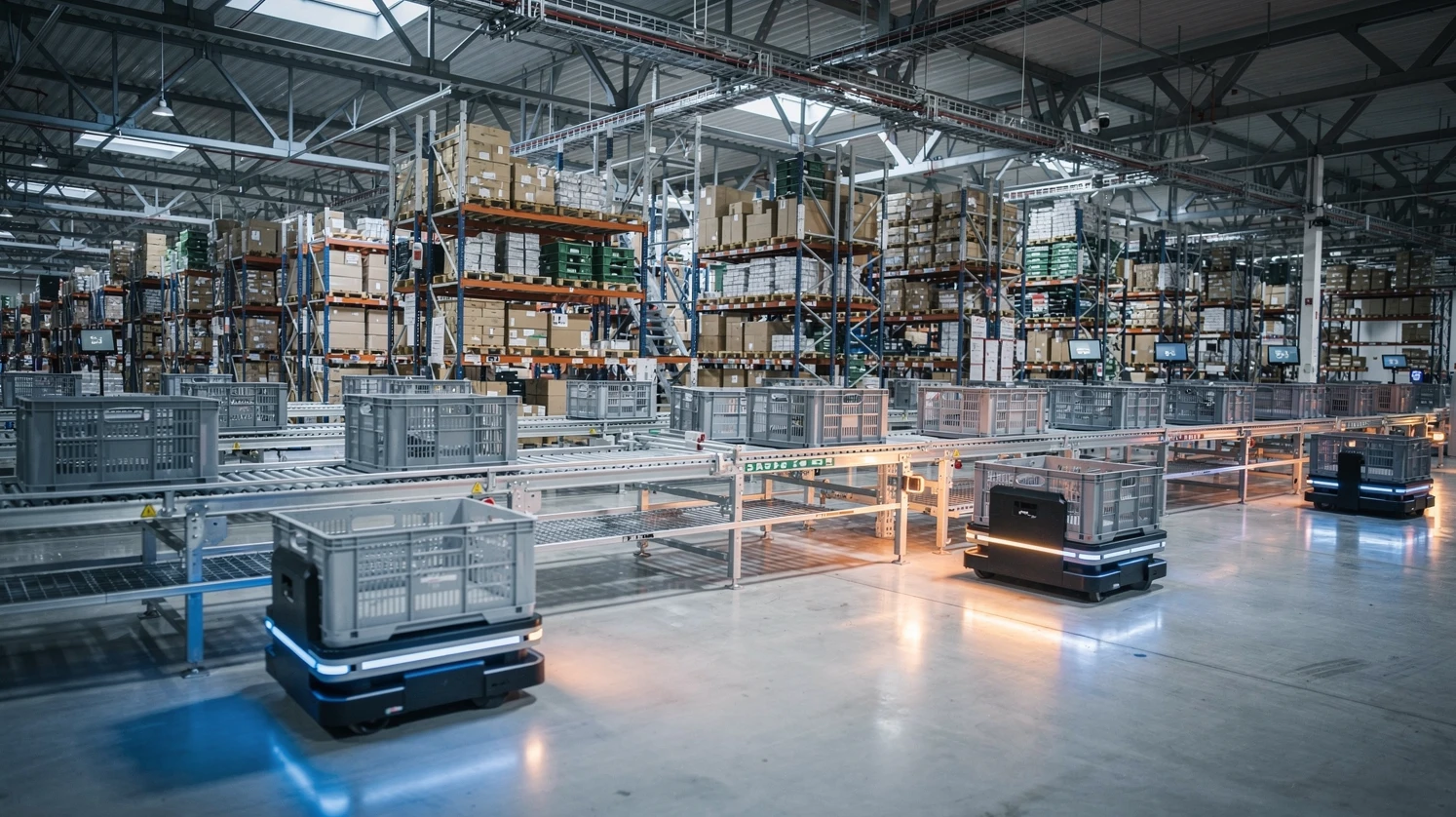
Amazon used its annual Delivering the Future event in London on 4 June 2026 to set out one of its largest single commitments to Europe in years: more than 10 billion euros (about USD 10.9 billion at exchange rates near 1.09 dollars to the euro) to expand and modernise its European fulfilment network. The package pairs heavy spending on warehouse robotics with a pledge of 25,000 additional jobs across the region and a wider rollout of ultra-fast delivery.
By the early hours of 5 June, the announcement had spilled into a series of national stories, from a new robotics-heavy distribution centre in Peterborough to the extension of Amazon’s 30-minute Amazon Now service into more British cities, including Manchester and Birmingham. Taken together, the moves sketch out how the company intends to defend its lead in European e-commerce: automate the warehouse, shorten the delivery window, and frame the whole exercise as a jobs story rather than a job-cuts one.
In short
- 10 billion euros for Europe. Amazon will spend more than 10 billion euros to modernise and grow its European fulfilment and logistics network, on top of the roughly 60 billion euros it says it invested across the continent in 2025.
- 25,000 new jobs. The company expects to add 25,000 permanent roles across European operations in the coming years, alongside a new generation of warehouse robots.
- A talking robot. A redesigned version of the Proteus autonomous robot now works across whole sites and takes plain-language instructions, while a tote-handling system called Stark rolls out to 15 European sites by 2027.
- Faster delivery. Amazon is widening its ultra-fast Amazon Now proposition to more cities, with Manchester and Birmingham named as the next UK markets for sub-30-minute delivery.
- Skills cash. A 1 billion US dollar commitment to the Career Choice upskilling programme by 2030 is meant to answer the obvious question that automation raises about the future of warehouse work.
What Amazon announced at Delivering the Future
Delivering the Future is Amazon’s set-piece logistics showcase, the venue where it typically unveils robotics, drones and delivery technology. This year’s London edition leaned almost entirely into the warehouse. The centrepiece was a more than 10 billion euro pledge to upgrade fulfilment centres across Amazon’s European footprint, which spans the UK, Germany, France, Italy, Spain, Poland, the Czech Republic and Slovakia.
The company framed the spending as a continuation rather than a reversal. Amazon says it invested around 60 billion euros (about USD 65 billion) across Europe in 2025, its largest annual continental outlay to date, so the fresh 10 billion euros is best read as the next tranche of a multi-year program. According to the company’s own figures, its European operations now support more than 1.5 million jobs once contractors and marketplace sellers are counted.
Timing matters as much as scale. Amazon is making this commitment at a moment when European growth in online retail has cooled from its pandemic surge, margins are under pressure, and regulators are watching large platforms more closely than ever. Pouring money into automation now is a bet that efficiency, not just expansion, will decide who wins the next phase of e-commerce. It also lets Amazon present itself as a long-term industrial investor in Europe at a politically useful moment.
The headline numbers
Three figures anchor the announcement. The first is the headline investment of more than 10 billion euros, directed at fulfilment-centre modernisation and new robotics. The second is the promise of 25,000 additional permanent jobs across Europe, a number Amazon repeated across its national press materials. The third is a 1 billion US dollar pledge to worker training through 2030, which the company positions as part of a broader 2.5 billion US dollar global skills push.
Amazon’s stated European headcount gives those numbers context. The company reports roughly 230,000 direct employees in Europe, more than 400,000 people in its wider extended workforce of contractors and seasonal staff, and a further 600,000 or so jobs linked to the roughly 200,000 small European businesses that sell through its marketplace. Against that base, 25,000 new roles is meaningful but incremental, a point critics were quick to make.
Where the money goes
The bulk of the 10 billion euros is earmarked for physical infrastructure: new buildings, retrofits of existing sites, and the robotics and software that run inside them. Amazon also tied national investments to the headline figure, most visibly in Britain, where the European package sits within a previously announced plan to invest around 40 billion pounds (about USD 54 billion at roughly 1.35 dollars to the pound) in the UK between 2025 and 2027.
The table below summarises the main components of the announcement as the company presented them.
| Component | Figure | Detail |
|---|---|---|
| European fulfilment investment | More than 10 billion euros | Modernisation and expansion of fulfilment centres across eight countries |
| New European jobs | 25,000 | Permanent roles added across operations in coming years |
| Upskilling commitment | 1 billion US dollars by 2030 | Career Choice programme, part of a 2.5 billion US dollar global skills push |
| 2025 European investment | About 60 billion euros | Amazon’s largest single-year continental investment to date |
| UK investment plan | About 40 billion pounds (2025 to 2027) | National plan that houses the European package in Britain |
The robots: Proteus, Vulcan and Stark
The technology underneath the spending is where Amazon wanted attention, and it named three systems. Each tackles a different physical bottleneck inside a fulfilment centre: moving inventory across the floor, picking individual items, and shifting heavy totes between conveyors and carts.
That the showcase centred on the warehouse rather than on drones or delivery vans is itself a signal. For several years Amazon’s futuristic announcements leaned heavily on aerial delivery, which has proved slow to scale against regulatory and practical limits. Shifting the spotlight to inside-the-building robotics reflects where the achievable productivity gains actually sit, and where rivals are least able to match Amazon’s scale of deployment.
A talking warehouse robot
The headline machine is a redesigned Proteus, Amazon’s autonomous mobile robot. The original version, first shown in 2022, was confined to loading docks and moved wheeled carts along fixed routes. The new Proteus is built to operate across an entire site and, in the company’s framing, to understand instructions given in everyday human language rather than code.
Amazon described the interaction in simple terms: an employee tells the robot what needs to be done, and the robot works out how to execute it. That conversational layer is the genuinely new element. It moves Proteus from a fixed-path mover toward a more general-purpose floor robot that staff can redirect on the fly, which is the direction most warehouse-automation vendors have been pushing toward.
The shift mirrors a wider trend in industrial robotics, where large language models are being grafted onto physical machines so that non-specialist staff can operate them without programming. If it works reliably at Amazon’s scale, the practical payoff is flexibility: a single robot type that can be reassigned across tasks as demand shifts during a peak day. The open question, as with any natural-language system, is how it handles ambiguity and error in a fast-moving warehouse where mistakes have physical consequences.
Stark and tactile picking
The second system, Stark, is a collaborative robot that lifts full totes off conveyors and places them onto carts, one of the more repetitive and physically taxing tasks in a fulfilment centre. Amazon said Stark will roll out across 15 European sites by 2027, giving the announcement a concrete deployment timeline rather than a vague ambition.
The third, Vulcan, is a tactile-sensing robot designed to pick and handle individual items, the long-standing hard problem in warehouse robotics because soft, oddly shaped goods resist standard grippers. Amazon said it is expanding Vulcan’s use, though it was lighter on numbers here. Read together, the three systems cover transport, heavy lifting and fine manipulation, the trio of tasks that have kept warehouses labour-intensive.
| System | Job it does | Status |
|---|---|---|
| Proteus (new generation) | Autonomous floor transport, now site-wide and voice-instructable | Redesigned version unveiled at the event |
| Stark | Lifts full totes from conveyors onto carts | Rolling out to 15 European sites by 2027 |
| Vulcan | Tactile-sensing item picking and handling | Use being expanded, fewer figures given |
Automation at this scale is no longer unique to Amazon. Grocers and pure-play retailers have spent years building dark stores and micro-fulfilment sites stacked with robotics to compress the time between order and dispatch, and Amazon’s announcement signals that the bar for fulfilment automation in Europe is rising again.
Faster delivery: Amazon Now reaches more cities
The warehouse upgrades are only half the pitch. The other half is speed at the doorstep, delivered through Amazon Now, the company’s ultra-fast service promising delivery in around 30 minutes for a curated range of everyday items. On 5 June, reports confirmed that Amazon is extending Amazon Now to additional UK cities, with Manchester and Birmingham named as the next markets after earlier London availability.
The model is deliberately narrow. Rather than offering Amazon’s full catalogue, Amazon Now leans on a smaller selection of high-demand essentials held close to customers, the same logic that powers rapid-grocery operators. That keeps the promise of sub-30-minute delivery credible without requiring a full warehouse on every block.
Speed has become the central battleground of retail logistics, and not only for Amazon. The same competitive pressure is visible in the US 30-minute delivery race, where grocers and big-box chains are racing to collapse delivery windows ahead of the holiday peak. Amazon’s European move imports that contest into more UK cities and raises the stakes for domestic rivals.
Why the 30-minute window matters
For Amazon, ultra-fast delivery is partly defensive. Quick-commerce apps and supermarket rapid services have trained shoppers to expect a small basket of essentials within the hour, eroding one of Amazon’s historic advantages. Matching that window in more cities protects the convenience habit that keeps Prime members loyal.
It is also a data and density play. Every Amazon Now order generates demand signals about what people want immediately and where, information that helps Amazon decide which items to stock in its closest, most expensive real estate. The economics only work where order density is high, which is why the rollout targets large metropolitan areas first.
Extending the service to Manchester and Birmingham, two of the UK’s largest urban markets after London, follows that density logic precisely. Both cities offer the population concentration and order frequency that ultra-fast delivery needs to cover the cost of holding inventory nearby. Success there would give Amazon a template for further UK and European cities, while failure would expose how thin the margins on 30-minute delivery really are.
Peterborough and the UK build-out
Nowhere was the announcement more tangible than in Peterborough, where Amazon confirmed a new distribution centre. The company put the investment in the site at around 107 million pounds (about USD 145 million) and said it would create 1,400 jobs once operational, with the facility expected to launch in late September 2026.
The new building expands a presence Amazon has held in the city since 2010, where an existing site already employs more than 1,000 people. Local officials welcomed the commitment, with the Peterborough site leadership and the city council’s growth portfolio holder both framing it as a boost for the local economy. The company set out the wider plan in its official UK statement.
Peterborough is a useful illustration of how the European headline translates locally. The 10 billion euro figure is abstract; a 1,400-job warehouse with a September opening date is not. Expect Amazon to keep localising the announcement market by market through the summer, attaching national job numbers and ribbon-cutting dates to the continental total.
The UK angle carries political weight too. Britain has courted large technology and logistics investment as a signal of post-Brexit competitiveness, and a multi-billion-pound commitment with concrete job numbers is the kind of headline governments welcome. For Amazon, the goodwill is reciprocal: visible local investment helps soften the criticism it regularly faces over tax, working conditions and its effect on high-street retailers.
Jobs, automation and the workforce question
The uncomfortable subtext of any robotics announcement is what it means for human workers. Amazon has tried to get ahead of that question by bundling the 25,000 new jobs and the 1 billion US dollar training pledge into the same story as the robots. The argument is that automation reshapes roles rather than erasing them, and that retrained staff move into higher-skilled, better-paid work.
25,000 new roles, and the asterisk
The 25,000 figure is real but needs framing. It is spread across eight countries and several years, and it sits against a European base that already exceeds 230,000 direct employees. Labour groups have long argued that headline hiring numbers can mask changes in the mix and intensity of warehouse work, and the robotics push will sharpen that debate.
There is also a productivity logic that cuts the other way. If robots like Stark and the new Proteus lift output per worker, Amazon can grow shipment volumes faster than headcount, which is precisely the efficiency story investors want. Reconciling that with a public jobs pledge is the communications tightrope the company is walking.
The 1 billion dollar upskilling pledge
The training commitment runs through Career Choice, Amazon’s long-running programme that funds courses for hourly staff. The 1 billion US dollar pledge through 2030 targets areas such as cybersecurity, software development, logistics, renewable energy and mechatronics, fields chosen to point workers toward the technical roles that automated sites still require.
Whether the money changes the trajectory of individual careers is harder to verify from a press release, and independent assessment will take time. What is clear is that Amazon now treats upskilling as a core part of the political licence to automate, not an afterthought. For a company under regular scrutiny over working conditions, that positioning is deliberate.
How Amazon’s European push compares
Amazon is not automating in a vacuum. Across Europe and beyond, rivals are pouring money into fulfilment and last-mile speed, each with a different emphasis. The contrast is sharpest with Walmart, Amazon’s nearest global peer, which has leaned less on warehouse robotics theatrics and more on monetising its platform.
Walmart’s strategy has tilted toward higher-margin revenue streams, a shift captured in Walmart’s profit pivot toward advertising and membership rather than store-level margins. Amazon, by contrast, is doubling down on the cost and speed of physical fulfilment as its moat. Both bets aim at the same prize, durable e-commerce profitability, by different routes.
The cross-border discount platforms are a third model again. Chinese-founded marketplaces have been forced to move inventory closer to European shoppers to survive new duty rules, a trend examined in how Temu and Shein are localising EU fulfilment. Where those players are building European logistics to escape tariffs, Amazon already has the network and is now automating it.
| Player | Primary logistics emphasis | Where the advantage sits |
|---|---|---|
| Amazon | Owned fulfilment plus warehouse robotics and ultra-fast delivery | Scale, density and automation of an existing network |
| Walmart | Store-as-warehouse plus platform monetisation | Physical store footprint and advertising or membership income |
| Temu and Shein | Localising EU inventory to cut duty and delivery times | Low prices and rapidly built cross-border logistics |
Amazon’s reach is not limited to mature markets, either. The company continues to spend on faster-growing regions, including its long contest with Flipkart in Amazon’s push into markets like India, where the same playbook of fulfilment investment and selection breadth applies under very different rules.
What it means for sellers, rivals and shoppers
For third-party sellers, faster and more automated fulfilment is a double-edged proposition. Quicker dispatch and tighter inventory handling can lift conversion and reduce lost sales, but deeper automation also strengthens Amazon’s control over the logistics layer that many merchants depend on. The more efficient the network, the harder it is for sellers to justify leaving it.
For rival retailers, the announcement raises the cost of competing on speed. Matching sub-30-minute delivery in major cities requires either dense micro-fulfilment or partnerships with rapid-delivery specialists, and Amazon’s scale lets it spread those fixed costs across enormous volume. Smaller chains will feel the pressure most acutely heading into the holiday season.
For shoppers, the near-term effect is more cities with faster delivery and, in theory, more reliable availability as robots smooth inventory handling. The longer-term questions about market power and working conditions are real but slower to surface. In the immediate window, the consumer experience improves.
There is a competitive ripple for grocers and quick-commerce apps specifically. Amazon Now overlaps directly with the rapid-delivery niche that supermarkets and standalone apps have spent heavily to own, and a deeper-pocketed entrant in more cities compresses their pricing power. Some may respond by leaning on loyalty and fresh-food ranges that Amazon’s curated essentials list does not cover, areas where local operators still hold an edge.
Brands that sell across multiple channels face a subtler calculation. Faster Amazon fulfilment can pull more of their volume onto the platform, which improves short-term sales but deepens dependence on a single distributor. The strategic response many are weighing is to keep a direct-to-consumer presence alongside Amazon, preserving the customer relationship and data even as they benefit from the speed Amazon offers.
Risks, regulation and what to watch next
The biggest risk to the narrative is execution. Robotics rollouts slip, and a target of 15 Stark-equipped sites by 2027 leaves room for delay. Investors will judge Amazon less on the size of the pledge than on whether cost per shipment actually falls as the technology lands.
Regulation is the second variable. Amazon’s expanding logistics dominance in Europe sits within a tightening framework of competition and digital-market rules, and a 10 billion euro deepening of its network may attract as much scrutiny as applause from policymakers. Labour regulation and union activity across Germany, France and the UK could also shape how smoothly the automation proceeds.
The European Union’s digital-market rulebook already constrains how the largest platforms can favour their own services, and a more powerful, more automated Amazon logistics arm will keep that question live. Antitrust authorities have repeatedly probed how Amazon balances its dual role as both marketplace operator and seller, and a faster, cheaper fulfilment network only sharpens the structural advantage at the centre of those cases. None of that blocks the investment, but it raises the odds that regulators attach conditions over time.
Worker representation is the quieter risk. Amazon has faced organised labour action at sites across Germany and elsewhere in Europe, and the framing of automation as a jobs creator will be tested by how the company manages staff whose tasks the robots absorb. How transparently it handles redeployment and retraining will determine whether the upskilling pledge reads as substance or as public relations.
The third thing to watch is the read-across to peers. Amazon setting a new European automation benchmark pressures every other operator to respond, which tends to pull forward industry-wide capital spending on robotics and last-mile speed. If that happens, the 4 June announcement will be remembered less as a one-off and more as the moment the European fulfilment arms race entered a new phase.
Frequently asked questions
How much is Amazon investing in Europe?
Amazon pledged more than 10 billion euros (about USD 10.9 billion) to expand and modernise its European fulfilment network, announced at its Delivering the Future event in London on 4 June 2026. That sits on top of roughly 60 billion euros the company says it invested across Europe in 2025.
How many jobs will the investment create?
Amazon said it expects to add 25,000 permanent jobs across its European operations in the coming years. The figure spans eight countries and several years, against an existing European base of more than 230,000 direct employees.
What is the new Proteus robot?
Proteus is Amazon’s autonomous mobile robot. The redesigned version unveiled at the event works across whole fulfilment sites rather than only loading docks, and the company says it can take instructions in plain human language rather than requiring code.
What are Stark and Vulcan?
Stark is a collaborative robot that lifts full totes from conveyors onto carts and is set to roll out to 15 European sites by 2027. Vulcan is a tactile-sensing robot for picking and handling individual items, a long-standing challenge in warehouse automation, and Amazon says it is expanding its use.
Which cities are getting faster Amazon delivery?
Amazon is widening its ultra-fast Amazon Now service, which targets delivery in around 30 minutes for a curated range of essentials. Reports on 5 June named Manchester and Birmingham as the next UK cities to gain the service after earlier London availability.
What is happening in Peterborough?
Amazon confirmed a new distribution centre in Peterborough worth around 107 million pounds (about USD 145 million), expected to create 1,400 jobs and to open in late September 2026. It expands a presence the company has held in the city since 2010.
Does automation mean fewer warehouse jobs?
Amazon argues that automation reshapes roles rather than removing them, and it paired the robotics news with a 1 billion US dollar upskilling pledge through 2030. Labour groups counter that headline hiring numbers can mask changes in the nature and intensity of warehouse work, a debate the robotics push will intensify.
How does this compare with Walmart and other rivals?
Amazon is leaning on owned fulfilment, warehouse robotics and ultra-fast delivery, while Walmart has emphasised store-based fulfilment and platform income from advertising and membership. Cross-border players such as Temu and Shein are separately building European logistics to cut duty costs and delivery times.
When was the announcement made?
The core announcement came at Amazon’s Delivering the Future event in London on 4 June 2026, with national details, including the Peterborough centre and the UK delivery expansion, reported through the early hours of 5 June 2026.