
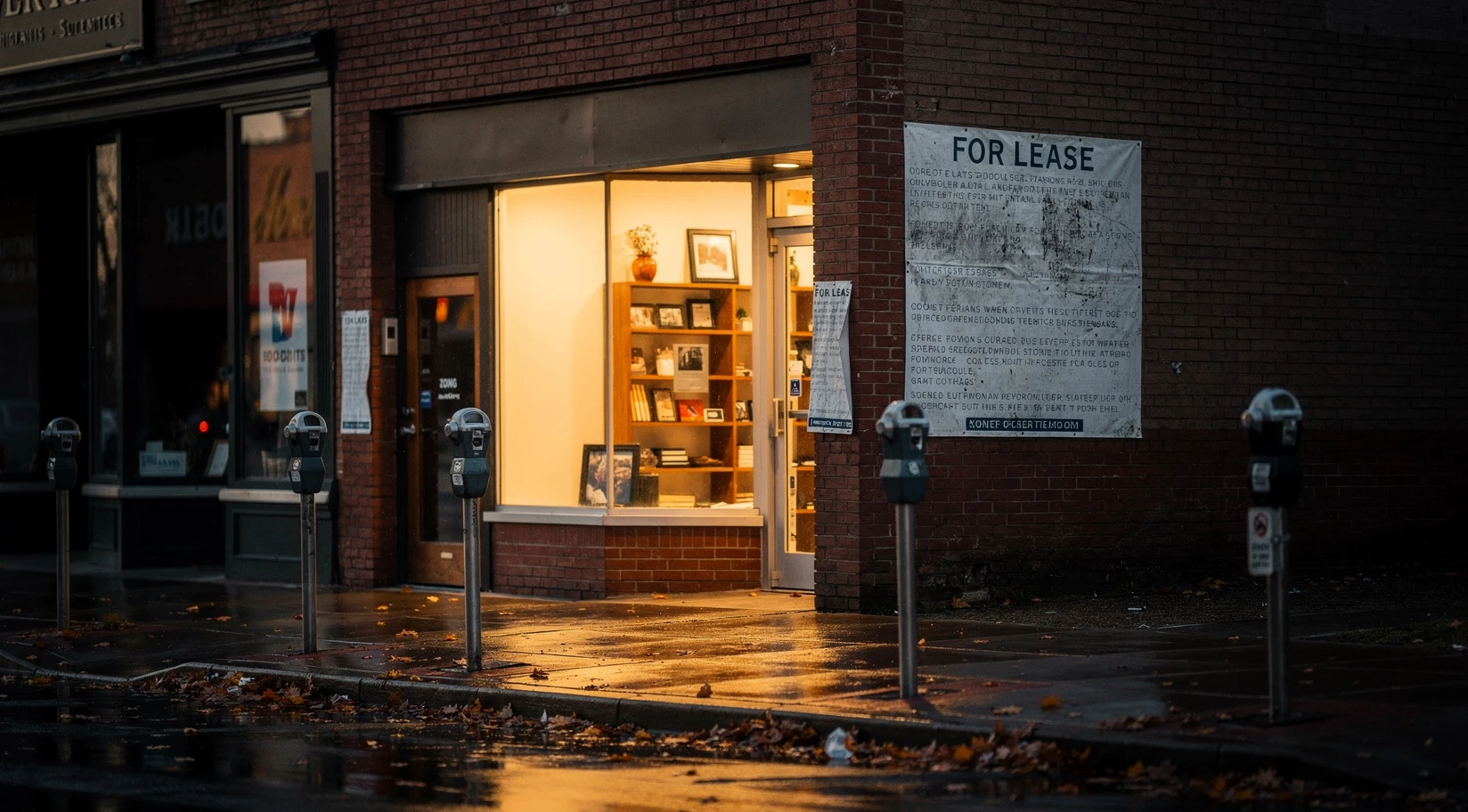
Ask a retailer what keeps them up at night and you will hear about TikTok, Amazon, or the next big shift in payments. Ask the same retailer what actually closed their last store and the answer is usually duller: a 38% rent bump at renewal, a parking variance that never came through, or a zoning code that quietly banned drive-through pickup on the only block worth leasing.
Main street retail in the United States runs on three boring inputs that almost no one talks about in keynotes: rent, parking, and zoning. They decide which storefronts open, which ones stay open, and which categories of merchant can even exist in a given downtown. For e-commerce teams looking at omnichannel expansion, ignoring these inputs is the fastest way to burn a launch budget.
In short
- Rent on US main streets has decoupled from foot traffic in many markets, with NNN structures and percentage rent clauses doing most of the damage to retailer margins.
- Parking minimums set by municipal code can add $15,000 to $40,000 per required stall in build cost, and they often kill small-footprint concepts before the lease is signed.
- Zoning overlays, not zoning maps, are where the real restrictions live; a property zoned “commercial” can still ban your specific use through a historic district or downtown design overlay.
- Pre-lease due diligence on these three items costs under $5,000 and prevents the most common reasons new main street stores fail in year one.
- The retailers winning on main street in 2026 negotiate zoning amendments, not just lease terms; they treat city planning departments as a counterparty, not a hurdle.
If you run a small chain, a single boutique, or a digitally native brand opening its first physical store, understanding the future of local retail and main street commerce starts with these three variables. They look unglamorous on a deal memo. They show up later as the entire reason a location either prints money or bleeds.
Why rent, parking and zoning still decide who survives on main street
Every other retail factor is downstream of these three. You can have the best assortment, the strongest brand, and a loyal customer base, but if your rent is $85 per square foot on a NNN lease in a city where comparable foot traffic supports $42, you will lose money every month you stay open. The boring fundamentals are not just risk factors. They are the operating envelope inside which all the interesting work happens.
The post-pandemic main street is not the same as the 2018 main street. Vacancy rates in secondary downtowns rose, then partially recovered, but landlords largely refused to reprice. Many held empty storefronts for two or three years rather than sign at lower marks, because a lower comp would impair their building valuation. The result in 2026 is a strange equilibrium: high asking rents, persistent vacancy, and a small number of tenants who negotiated unusually favorable terms during the soft window of 2021 through 2023.
Parking, the second pillar, was once treated as infrastructure the city provided. That assumption broke. Cities including Buffalo, Hartford, San Francisco, and Minneapolis have abolished or sharply cut parking minimums, but most US municipalities still require them, and the requirement bites hardest on small main street parcels where there is no room to put the stalls.
Zoning, the third pillar, has moved from a slow background variable to an active battleground. Form-based codes, downtown overlays, historic preservation districts, and use-specific bans on items like vape, cannabis, drive-through, and even certain food categories have proliferated. The zoning code printed on the city website is almost never the full picture. Overlay maps, design review boards, and special use permits stack on top.
Key terms and definitions you will see on every main street deal
Before any negotiation, get the vocabulary right. The same word means different things in different cities, and a misread term inside a letter of intent can cost six figures over a lease term.
Rent terms that matter
- NNN (triple net) lease: tenant pays base rent plus property taxes, building insurance, and common area maintenance. The headline rent is misleading; full occupancy cost is usually 20% to 40% higher than the base.
- Gross lease: landlord covers the operating expenses inside the rent. Rarer on main street; more common in older buildings with single landlords.
- Percentage rent: tenant pays base rent plus a percentage of sales above a stated breakpoint. Standard for mall tenants, increasingly pushed onto main street tenants by REIT landlords.
- CAM (common area maintenance): charges for shared spaces, often inflated and rarely audited by tenants. CAM caps and audit rights are negotiable.
- Tenant improvement allowance (TIA): dollar amount the landlord contributes to build-out, usually quoted in dollars per square foot. On second-generation main street space, $20 to $60 per square foot is common; on raw space, $80 to $150 per square foot may be required.
Parking terms that matter
- Parking minimum: the number of stalls a use is required to provide by municipal code, usually expressed per 1,000 square feet of retail space.
- Variance: case-by-case waiver of a code requirement, granted by a zoning board after a hearing.
- Fee-in-lieu: cash payment to the city that substitutes for providing required stalls. Common in dense downtowns; rates run from $2,000 to $25,000 per stall.
- Shared parking agreement: legal arrangement letting two uses with different peak hours count the same stalls toward their respective requirements. Underused on main street.
Zoning terms that matter
- Use group: classification of what can happen in a building (retail, restaurant, office, residential). Subcategories matter; “retail” may exclude pawn, cannabis, or auto parts.
- Overlay district: extra layer of rules on top of the base zoning, often for historic, downtown, or transit-oriented districts.
- Form-based code: regulates building form (height, setback, frontage) rather than use. Increasingly common in downtown revitalization plans.
- Special use permit (SUP): discretionary approval for a use that is allowed in the zone only with specific conditions. Often required for drive-through, late-night hours, or alcohol.
- Nonconforming use: legal use established before the current code, allowed to continue but often not allowed to expand or rebuild after damage.
Memorize this vocabulary before any site tour. Brokers and city planners will use these terms casually, and clarity at the LOI stage prevents most expensive surprises later.
How rent, parking and zoning work in practice on a real main street deal
The cleanest way to see how the three variables interact is to walk through a typical deal cycle. Take a small specialty retailer expanding from one location to a second, eyeing a 2,400 square foot storefront on a secondary main street in a US city of 180,000 people.
The asking rent is $32 per square foot NNN. The broker says comparable deals close at $28. The space is in a historic district, on a block with metered street parking and a city-owned lot half a block away. The zoning is C-2 (general commercial), and the seller mentions a downtown overlay.
Here is the order of operations a disciplined operator runs before signing anything.
- Pull the actual rent comps. Not asking rents; closed deals. CoStar, Reonomy, or a tenant-side broker can produce a list of executed leases for similar space within a 12-month window. The number that matters is base rent plus full pass-throughs, divided by occupied square footage.
- Estimate full occupancy cost. Base rent ($32) plus estimated NNN load ($9 to $11) gives $41 to $43 per square foot. For a 2,400 square foot store, that is $98,400 to $103,200 per year in occupancy, before utilities or labor. If projected revenue is $720,000, occupancy is 14%, which is high but workable for specialty retail. Above 18%, the location does not pencil.
- Check parking math against use. Specialty retail at 1 stall per 250 square feet requires 10 stalls. The lot half a block away counts only if there is a written shared parking or lease agreement. Metered street parking usually does not count toward code requirements. If the landlord is providing 4 stalls and code requires 10, the deal needs a variance, a fee-in-lieu, or a shared parking agreement.
- Pull the actual zoning, not the listing description. Visit the city planning office or its GIS portal. Confirm the base zone (C-2), then check every overlay that touches the parcel. The downtown overlay typically restricts hours, signage, and storefront alterations; the historic overlay may require design review for any exterior change.
- Identify discretionary approvals required. If the use is allowed by right, you can proceed. If the use requires a special use permit, design review, or a variance, build 8 to 14 weeks of approval time into the schedule and budget $5,000 to $30,000 in legal and consultant fees.
- Negotiate the LOI with these facts on the table. The broker will start at $32 NNN, 10-year term, 3% annual escalators, with the tenant taking the space “as is” except for $20 per square foot of TIA. With real comps and parking concerns documented, a realistic counter is $26 NNN, 7-year term with two 3-year options, 2.5% escalators after year three, and $45 per square foot of TIA.
Notice that the rent number is not negotiated in isolation. It is bracketed by the parking risk (which may require fee-in-lieu of $30,000 to $80,000), the zoning risk (which may require a $15,000 special use permit application and three months of delay), and the build-out risk (which depends on what condition the space is in).
Common mistakes operators make and how to avoid them
The same handful of mistakes show up in post-mortems on failed main street stores. None of them are sophisticated; all of them are preventable with a checklist and 40 hours of diligence.
Mistake 1: Trusting the listing on zoning and parking
Broker listings reliably understate restrictions. “Retail, restaurant, or office use” in a flyer can mean retail by right, restaurant by special use permit only, and office subject to ground-floor activation rules under an overlay. Always pull the zoning yourself from the city portal and read the overlay text.
Mistake 2: Underestimating NNN charges
NNN load on older main street buildings can run 25% to 50% of base rent. On newer mixed-use buildings with structured parking and elevators, it can hit 60%. Ask for two years of actual reconciled CAM, tax, and insurance statements before signing. If the landlord refuses, that is itself the answer.
Mistake 3: Signing a 10-year term to get a higher TIA
Landlords offer rich tenant improvement allowances in exchange for long lease terms because they amortize TIA over the full term. On main street, retail formats change faster than 10-year leases, and personal guarantees on long terms have ended more independent operators than any other single document. A 5-year term with options is usually safer than a 10-year fixed term, even at lower TIA.
Mistake 4: Assuming a variance will get approved
Variances are discretionary. Zoning boards are political. A variance that “always gets approved” in one neighborhood may face organized opposition in another, especially if the use involves alcohol, late hours, drive-through, or any controversial category. Build approval risk into the deal, including a contingency clause that lets you exit the lease if discretionary approvals are denied within a stated window.
Mistake 5: Ignoring ADA compliance triggers
Most existing main street buildings predate the Americans with Disabilities Act and are grandfathered. Once you do a meaningful renovation, accessibility upgrades may be triggered, sometimes for the full building. An ADA compliance review by an architect or specialist consultant costs $1,500 to $4,000 and avoids surprise costs that can run into six figures.
Mistake 6: Forgetting that operating cost is more than rent
Property tax pass-throughs, garbage and recycling fees, sprinkler and fire suppression inspections, sidewalk snow removal, BID assessments, and storefront window cleaning all add real money. A useful exercise: build a full 24-month operating budget before signing, including line items for all of these. If the number surprises you, you priced the deal wrong.
Mistake 7: Treating the planning department as an obstacle
The retailers who thrive on main street treat city planning departments as relationships, not transactions. A pre-application meeting before you sign the lease, free in most cities, surfaces every overlay, every required approval, and every quiet opposition group. This is the single highest-ROI use of a few hours of an operator’s time.
Examples from US retail and e-commerce that prove the point
Three short cases, drawn from publicly reported and observable patterns rather than confidential deal data, show how rent, parking, and zoning play out in 2026.
Case 1: A digitally native brand opens its first physical store
A direct-to-consumer apparel brand, post-Series B, decides to open in a popular shopping district in the Northeast. The marketing team picks the block based on Instagram visibility. The real estate team signs a 7-year NNN lease at $110 per square foot for 1,800 square feet, with no TIA and a strong personal guarantee, because the landlord knows DTC brands are price-insensitive.
Year-one occupancy cost lands at $230,000. Revenue lands at $920,000. Occupancy ratio is 25%, almost double the workable threshold for apparel. The store closes in month 26 and the brand writes off $480,000 in tenant improvements. The lesson is not that the store should not have opened; it is that the rent should have been negotiated against a realistic revenue model, not against the brand’s marketing budget.
Case 2: A regional grocer expands to a downtown core
A regional grocery chain identifies a downtown opportunity in a Midwestern city of 240,000. The base zoning allows grocery, but the downtown overlay requires “active ground-floor uses” and limits curb cuts. The grocer needs a loading dock and dedicated customer parking.
Rather than fight the overlay, the grocer works with the city for nine months on an amendment that allows ground-floor loading behind a screened facade, with shared parking in a city-owned garage two blocks away. The store opens, performs above plan, and becomes a model for other downtown grocery deals in the region. Total cost of the zoning work: about $180,000 in legal, design, and consultant fees. Total value created: a viable downtown store generating $14 million annually.
Case 3: A small chain misreads parking math
A coffee and bakery chain expanding from two to five locations targets a former dry cleaner on a busy main street. The space is 1,400 square feet. Parking code requires 1 stall per 200 square feet of restaurant use, totaling 7 stalls. The site has 2 stalls.
The operator assumes a variance is automatic because the use is “less intensive” than a sit-down restaurant. The zoning board disagrees, citing neighbor complaints about existing parking spillover. The variance is denied. The operator has already spent $40,000 on architectural drawings and now needs to either lease additional parking from a nearby private lot, pay $90,000 in fee-in-lieu, or walk away. The deal collapses.
Tools, partners and vendors worth knowing in 2026
Diligence on rent, parking, and zoning used to require expensive specialists. In 2026, a competent operator can do 80% of the work with the right tools and bring in specialists only for the last 20%.
| Need | Tool or partner type | Typical cost | When to use |
|---|---|---|---|
| Closed rent comps | CoStar, Reonomy, Crexi Pro | $300 to $1,500 per month | Before any LOI negotiation |
| Zoning lookup | City GIS portal, Zoneomics, UrbanFootprint | Free to $200 per parcel | Before site visit |
| Pre-application meeting | City planning department | Free, 60 to 90 minutes | Before signing LOI |
| Parking analysis | Civil engineer or traffic consultant | $2,500 to $8,000 | When code requires variance |
| Lease review | Real estate attorney with local experience | $3,500 to $10,000 per lease | On every lease over $250,000 total value |
| Tenant rep brokerage | Tenant-side broker (no dual agency) | Paid by landlord, no out-of-pocket | On every deal; never use the listing broker |
| Construction cost estimate | Owner’s representative or GC pre-bid | $2,500 to $6,000 | Before LOI is finalized |
| Demographics and traffic | US Census Bureau, Placer.ai, SafeGraph | Free to $1,500 per report | Before market entry decision |
The single most important partner is the tenant-side broker. Listing brokers represent the landlord and are paid by the landlord. A tenant rep is paid the same commission out of the same pool but works against the listing broker on price, terms, and timing. There is no reason for a retailer to negotiate without one on the first few deals.
For brands building omnichannel strategies that connect physical and digital footprints, the alignment between local store catchment areas and online demand data is becoming central. Operators are using anonymized mobile location data to validate trade areas before signing leases, then feeding store-level performance back into how main street retailers should think about online presence and inventory allocation.
How this connects to the broader main street picture in 2026
Rent, parking, and zoning are not isolated technical issues. They are the structural inputs that determine which retail formats can survive on US main streets in the next decade. A few patterns are clear in 2026.
First, parking minimums are slowly losing political support. Roughly 40 US cities have eliminated minimums citywide, and many more have done so for downtown districts. This is good news for small-footprint operators but creates short-term distortions in markets transitioning from car-dominant to mixed-mode access.
Second, downtown overlays are becoming more common, more specific, and more activist. The era of “any retail use is fine” is over in most desirable main streets. Operators should expect to negotiate around hours, signage, materials, and use restrictions that did not exist in earlier leases.
Third, REIT and institutional ownership of main street buildings is growing. This professionalizes the landlord side but also pushes lease terms toward mall-style templates with percentage rent, aggressive CAM, and lower TIA flexibility. The independent landlord on main street is becoming rarer, especially in cities with strong real estate markets.
Operators evaluating expansion plans should read the main street retail outlook for 2026 in mid-size US cities alongside this guide; the rent, parking, and zoning dynamics described here are sensitive to local market conditions in ways the national-level analysis covers in detail.
For brands thinking about how main street relates to department store and big-box strategy, the contrast in cost structures is instructive. The detailed comparison in Macy and Nordstrom strategy compared for the next decade shows how anchor-tenant economics differ from main street economics, and why the same brand often cannot make both formats work.
The overarching point: small operators who understand rent, parking, and zoning have a structural advantage over larger operators who delegate these to junior staff or rely on landlord representations. The diligence is unglamorous and the work is boring. The payoff is that you do not close stores in year two because of a variance you assumed would clear, and you do not bleed cash for a decade because you signed at $85 per square foot when the market would have supported $58. Read the broader context in the future of local retail and main street commerce for how these fundamentals fit the wider direction of US retail.
A practical checklist before any main street lease in 2026
Print this and stick it on a wall. Every successful main street operator runs a version of it.
- Pull closed lease comps from a paid data source, not asking rents from a flyer.
- Request two years of reconciled CAM, tax, and insurance pass-throughs from the landlord.
- Confirm base zoning and every overlay touching the parcel from the city GIS portal.
- Read the actual overlay text, not the summary.
- Take a pre-application meeting with the city planning department.
- Calculate parking required by code and compare to parking available on site.
- Identify any discretionary approvals required and estimate timeline and cost.
- Order an ADA compliance review if any renovation is planned.
- Build a 24-month full operating budget including all pass-throughs and assessments.
- Engage a tenant-side broker, not the listing broker.
- Engage a local real estate attorney for lease review.
- Include a contingency clause for failed discretionary approvals.
- Cap CAM at a stated dollar amount or annual escalator.
- Negotiate audit rights on operating expenses.
- Sign for the shortest term that justifies your TIA recovery; use options for upside.
FAQ
What is a reasonable occupancy cost ratio for main street retail in 2026?
For specialty retail, occupancy (rent plus pass-throughs as a percentage of sales) should target 8% to 12% and tolerate up to 15%. Above 18%, the location rarely pencils long term. Food and beverage formats can sometimes carry 10% to 14%; luxury brands accept higher ratios to fund visibility. Run the math on year-two and year-three sales projections, not just opening month.
Can I count street parking toward parking minimums?
Usually no, unless the city has a specific policy allowing it for downtown districts. Most parking minimums require off-street stalls dedicated to the use. If you need street parking to count, get the city policy in writing and confirm it covers your specific parcel and use group.
How long does a special use permit take in a typical US city?
From application to approval, 8 to 16 weeks is typical for non-controversial uses. Add 4 to 8 weeks for controversial uses (alcohol, late hours, drive-through) that draw public hearings. Add another 4 to 12 weeks if appealed. Plan for at least 90 days minimum and build a contingency for delay.
Is a fee-in-lieu cheaper than building required parking?
Usually yes, often by a wide margin. Building a single structured stall costs $25,000 to $60,000; a surface stall on existing land costs $3,000 to $8,000 plus the land. Fee-in-lieu rates run $2,000 to $25,000 per stall depending on the city. The catch: fee-in-lieu is a sunk cost that does not create an asset for the property, so it does not help on resale or refinancing.
What is the most overlooked clause in a main street NNN lease?
The CAM cap and audit rights. Tenants rarely negotiate these, and landlords reliably push CAM upward over time. A cap (for example, no more than 5% increase year over year on controllable CAM) and a written audit right are inexpensive to negotiate and save real money over a 7- to 10-year term.
Should I sign a personal guarantee on a main street lease?
If avoidable, no. If unavoidable, negotiate a “burn-down” personal guarantee that reduces to zero after 24 to 36 months of on-time payment, or a “Good Guy guarantee” that limits liability to the period you actually occupy the space if you vacate and surrender properly. Avoid full-term personal guarantees on first-store deals.
How do I find out about overlay districts I do not know exist?
Take the free pre-application meeting at the city planning department. Bring the address and your intended use. Planners will walk you through every base zone, overlay, and discretionary approval that applies. This step alone surfaces 90% of zoning surprises.
How does main street rent compare to mall and lifestyle center rent in 2026?
Main street base rents are typically 30% to 60% lower than comparable mall in-line space, but NNN and percentage rent terms close part of the gap. The bigger difference is in landlord control: malls dictate operating hours, marketing contributions, and co-tenancy; main street landlords usually do not. For brands valuing operational freedom, main street is usually the better structural fit even at higher full occupancy cost in some markets.