
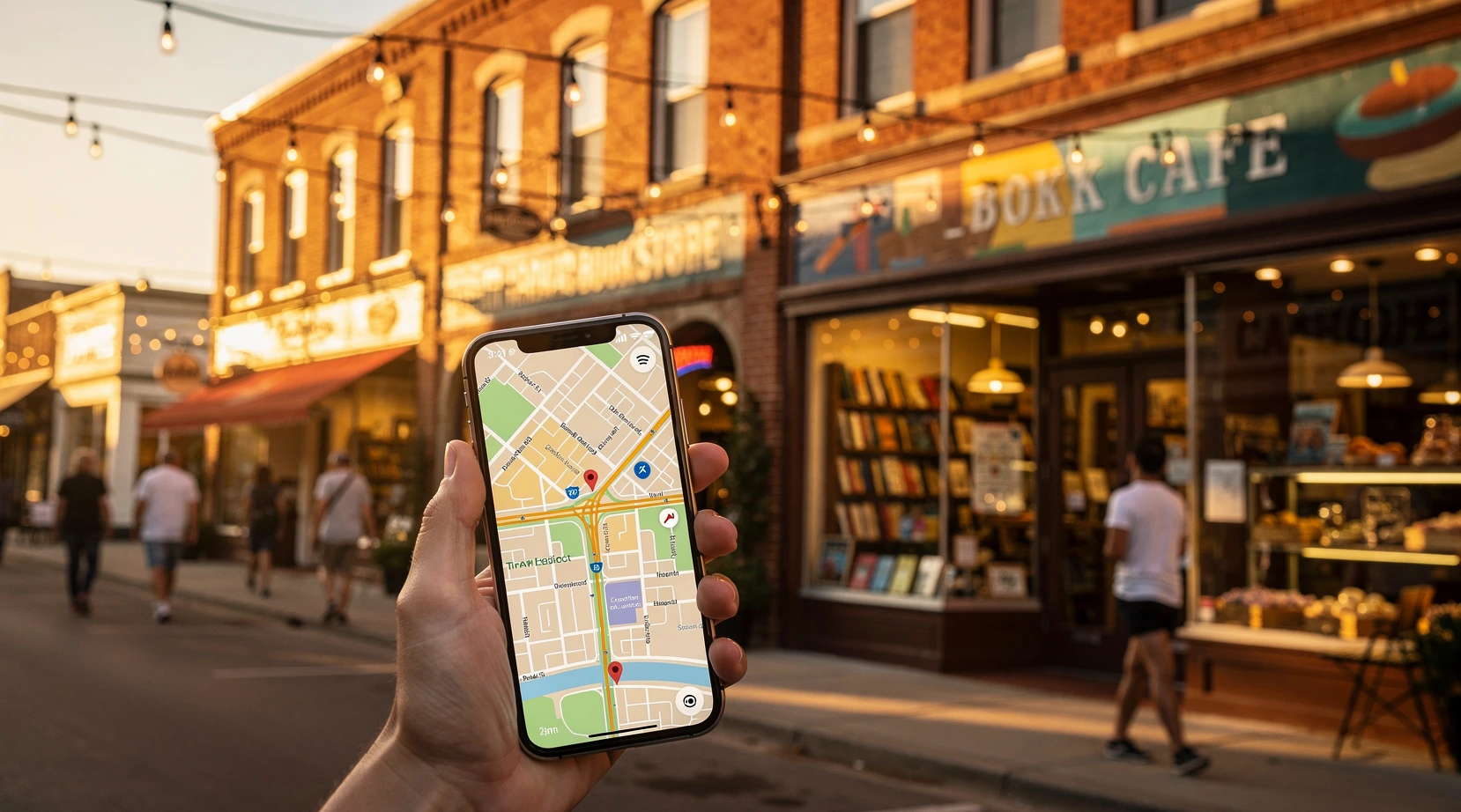
Main street online presence is no longer a side project for independent retailers in the United States. In 2026, a storefront on a town’s main street and a digital footprint that the same town can actually find online operate as one combined channel. Customers research before they walk in. They check hours, photos, reviews, and inventory on a phone while they decide whether to drive across town or open a delivery app instead.
This guide is written for owners and operators of brick and mortar shops on traditional main streets in the US, from a boutique in a Vermont village to a hardware store in a Texas county seat. It explains what main street online presence actually means in 2026, how the practice works week to week, and where small retailers waste money. It links into the wider future of local retail and main street commerce coverage on ShopAppy and into deeper pieces on outlook and tooling.
In short
- Main street online presence is one system, not several channels. Google Business Profile, the store website, and a small set of social accounts feed each other.
- Findability beats follower counts. Showing up in local search for “near me” queries is worth more than viral content for most main street stores.
- Inventory and hours have to be truthful in real time. A wrong closing time or a sold-out item shown as available is the fastest way to lose a customer for good.
- Reviews are the new word of mouth. A steady stream of recent reviews, with replies from the owner, signals that the shop is alive and attentive.
- Cheap, consistent beats expensive, sporadic. A simple weekly rhythm of updates is more effective than a once a year website rebuild.
Why this topic matters in 2026
Three trends collided in the last two years and changed how main street shoppers behave. AI assistants now answer many “where can I get X today” questions directly, pulling structured data from Google Business Profile, Apple Business Connect, and a handful of vertical directories. Same day delivery from large marketplaces is available in most metropolitan areas, which means a customer’s default is no longer to walk to main street, it is to type the product name into a phone. And the cost of a poor digital impression has risen, because a stale photo or a wrong phone number now shows up across dozens of surfaces at once.
The store on the corner that ignored digital from 2018 to 2022 could often recover with a quick cleanup. In 2026 that catch up is harder. AI-generated summaries describe a business based on the data they find, so a store with thin information gets thin descriptions, and a store described thinly is rarely the one a tourist chooses for lunch. The future of local retail and main street commerce hub on ShopAppy goes deeper into these structural shifts, including how Gen Z treats the storefront as the third stop after Instagram and the maps app.
The good news for owners reading this: the bar to look credible online is not high. It is steady and specific, not flashy. Most main street competitors are still treating digital as an annual chore.
What “main street online presence” actually means
The phrase covers four practical assets that have to exist and stay current. Each one is cheap on its own. The leverage comes from keeping them in sync.
- A claimed and complete Google Business Profile, including categories, attributes, photos, hours, and a Q&A section that is moderated by the owner.
- A simple website at the store’s own domain, with the same hours, address, and phone number that Google shows, plus a product or service page that an AI can read.
- One or two social accounts that match the audience, used as a feed of fresh photos and short notes, not as a marketing megaphone.
- Local citations on the few directories that still matter, including Apple Business Connect, Yelp, Bing Places, and the relevant vertical site for the trade (Houzz for home, Vrbo for lodging-adjacent shops, OpenTable or Resy for food adjacent retail).
Owners often ask whether they need a TikTok account or a Reels strategy. The honest answer for most main street shops is no, not first. The four assets above produce more revenue per hour spent than a viral video, because they catch customers who are already looking. For more on the local search side specifically, see our piece on the main street retail outlook for 2026 in mid-size US cities.
How the system works in practice
Think of the four assets as a small machine with feedback loops. Google Business Profile is the front door for search and maps. The website is the source of record for everything customers should be able to verify. Social accounts are the proof that the shop is open, staffed, and stocked this week. Directories repeat the same facts in places where customers and AI assistants double check.
A typical weekly rhythm for a two-person main street store looks like this. On Monday, the owner walks through the store with a phone and takes three or four photos of new arrivals, a window display, or a staff member at work. The photos go up on Google Business Profile and one social account. On Wednesday, the owner answers any new Google reviews from the last week, including the positive ones. On Friday afternoon, the owner updates the website’s “this week” section, even if the only change is one sentence.
That rhythm takes under ninety minutes a week. It produces a fresh stream of signals that AI assistants, search engines, and human shoppers all read. It also surfaces problems early, like a wrong phone number, before they cost a sale.
The four-asset checklist
| Asset | What good looks like in 2026 | Typical time per week | Cost |
|---|---|---|---|
| Google Business Profile | Owner verified, 25+ photos under 12 months old, hours correct including holidays, recent posts, Q&A monitored | 30 minutes | Free |
| Store website | Mobile first, address and hours visible on every page, schema markup for LocalBusiness, two or three product or service pages with real text | 20 minutes | $10 to $30 per month hosted |
| Social account (Instagram or Facebook, sometimes both) | Profile complete, link to website, posts at least weekly, replies to DMs within a day | 30 minutes | Free |
| Citations (Apple, Bing, Yelp, vertical sites) | Identical name, address, phone number, owner claimed | 5 minutes | Free |
Common mistakes and how to avoid them
Most main street owners are not lazy or unwilling. They are stretched. The most common mistakes are not strategic blunders, they are small habits that erode trust online over time.
- Hours that disagree across surfaces. Google says open until 7, the website says 6, the front door sign says 6:30. AI assistants pick whichever they read first. Fix by writing hours in one place and copying everywhere on the same morning.
- Stock photos instead of store photos. A customer can spot a stock image in under a second. Replace every stock photo with a real photo of the store, the staff, or the inventory, even if the photo is slightly amateur.
- No phone number on the homepage. Customers in their fifties and older still call before they drive. A click to call button on mobile is not optional in 2026.
- Reviews answered only when they are angry. Owners often reply only to one-star reviews. Reply to the four and five-star ones too, briefly. That signals to other customers and to algorithms that the owner reads everything.
- Trying to do everything at once. A common pattern is a January push, three weeks of content, then silence until November. AI assistants and search engines weigh recency. A small, steady rhythm beats a sprint.
- Ignoring spam Q&A on Google. Anyone can post a question on a Google Business Profile. Owners should answer the real ones and report the obvious spam.
- Treating the website as a brochure. Customers want hours, address, photos, and an idea of what’s in stock. They do not need a flash intro or a multi-page “about” essay.
Examples from US main streets
A few patterns from real categories give a sense of what works. None of these examples require a marketing budget. They require attention.
Independent bookstores
Bookstores like Parnassus in Nashville and Politics & Prose in Washington DC built their online presence around a recurring rhythm of staff picks. Every week, a few employees post short reviews of three or four titles, with a photo of the book on a shelf or in a hand. Those posts feed Google Business Profile, the social account, and the website’s “new this week” page at the same time. The store gains a reputation as curated and human, which is exactly what an Amazon search cannot offer.
Hardware and home goods
A True Value or Ace hardware store in a small town wins online when it answers two questions on its website: “do you carry X” and “is X in stock today”. The most effective independent hardware stores keep a public spreadsheet or an embedded inventory feed that updates daily. They also keep a Q&A on Google answering classic questions like “do you sharpen knives” or “do you cut keys for cars made after 2020”.
Apparel boutiques
Boutiques in mid-size cities have shifted their Instagram from polished editorial shoots to short videos of new arrivals on a hanger and on a person. The shift moved follower counts down and walk-in conversions up, because the videos answer the only question that matters: does this top look the way I would wear it. Owners often link the Instagram bio to a website page that lists the brands carried, so AI assistants can answer “where can I buy Faherty in Asheville”.
Cafes and small grocers
Food adjacent retail benefits the most from Google posts. A daily post showing today’s pastries or this week’s farm delivery costs five minutes and generates measurable foot traffic. Cafes that post once a day on Google Business Profile see substantially more weekday lunch traffic than those that post once a month, according to multiple operator surveys.
Department store anchors and chains
Even traditional chains have learned that the per-location presence matters more than the national page. Stores anchored in malls or in former mall sites now run hyperlocal pages with photos that show the actual building, not a stock exterior. Our companion piece on mall anchor tenants in the post-mall era covers how chains adapted to the same shift.
Tools, partners and vendors worth knowing
Owners often ask which software they need. For a single-location main street store, the honest answer is very little. A few categories matter, and within each there are one or two reasonable choices. The full landscape, with detailed comparisons, is covered in our tools and vendors for main street in 2026 piece. The summary below is enough to start.
| Category | Why it matters | Reasonable options in 2026 |
|---|---|---|
| Website builder | Mobile speed, schema markup, easy hours updates | Squarespace, WordPress with a small theme, Shopify if there is any online ordering |
| Point of sale (POS) with online sync | Inventory shown online matches what’s behind the counter | Square, Shopify POS, Clover |
| Review and reputation | Reply to reviews on Google, Yelp, Facebook from one inbox | Birdeye, Podium, or the free tools in Google Business Profile |
| Local listings sync | Update name, address, phone in one place | Yext, Moz Local, or manual updates if there are fewer than five locations |
| Email and SMS | Re-engage past customers around events and seasons | Klaviyo for ambitious shops, Mailchimp for simpler needs |
Not every store needs every category. A single-location boutique can run for years with a website, a POS, and the free Google tools. A multi-location chain on multiple main streets benefits more from listings sync software, because the cost of getting the address wrong scales with the number of stores.
Measuring whether it is working
The risk of a digital program is that effort gets measured by activity rather than outcome. The metrics that matter for main street are narrower than they look. Google Business Profile reports views, searches, calls, direction requests, and website clicks. Direction requests and calls are the closest proxies for foot traffic. Website clicks are useful only if the website is the place customers verify hours and inventory.
Owners should also track three offline questions. How many new customers say they found us online. How many returning customers found a specific product online before walking in. How many calls came from a Google search versus a saved contact. None of these requires software, just a clipboard at the counter for two weeks every quarter.
Where to spend the next ten hours
If an owner has ten hours to invest in the next month, the order matters. The right sequence is to fix the basics before adding anything new. The list below is opinionated on purpose. Skipping ahead is the most common reason main street stores spend money without seeing results.
- Hour 1 to 2: claim and complete Google Business Profile, including 10 fresh photos and accurate hours.
- Hour 3 to 4: audit the website for hours, phone, address, and schema markup. Fix the homepage first, then the contact page.
- Hour 5: claim Apple Business Connect and Bing Places, copy the exact same data from Google.
- Hour 6 to 7: reply to every Google review from the last 12 months, even briefly.
- Hour 8: write a short FAQ page on the website with the five questions customers ask in the store.
- Hour 9: schedule the weekly rhythm into the calendar, with reminders on Monday, Wednesday, and Friday.
- Hour 10: ask three regular customers for an honest review online, in person.
The ten-hour plan is intentionally boring. It produces a much steadier presence than a one-time agency engagement, and it gives the owner a feel for the system that no outsourced service can replicate. For a long form view of where main street is heading from here, see the parent guide on the future of local retail and main street commerce.
Budgeting time and money realistically
The biggest pushback main street owners give to a digital plan is not skepticism, it is fatigue. The owner already runs payroll, manages inventory, opens and closes the store, and may live in the apartment above the shop. Adding “digital marketing” to that load sounds impossible. The way out is to treat the work as part of the operating routine, not as a separate marketing job.
A useful framing is the 90-minute weekly block. Pick the same day and the same hour, ideally a slow time when the store is open but quiet. Do the Google update, the photos, and the review replies in that block. If the block gets skipped, do it the next slow hour. Owners who block the time consistently report that after six weeks the work feels like restocking shelves, not like a project.
On budget, the realistic minimum for a single-location store in 2026 is around $30 per month for website hosting and domain, plus the cost of the POS the store already uses. Everything else, including Google Business Profile and Apple Business Connect, is free. The first paid add-on worth considering is review and listings software, in the $50 to $150 per month range, but only after the basics are stable for at least 90 days. For broader spending benchmarks, our companion piece on tools and vendors for main street in 2026 compares actual subscription costs across categories.
Working with neighbors and the local district
Main street is a network, not a collection of independent stores. A customer who comes downtown for one shop often visits two or three before going home. The digital corollary is that stores benefit from cross-linking and cross-promotion within their district, especially when those links are real and editorial rather than transactional.
A few practical patterns work in most districts. The local business association can host a single page listing every member with consistent name, address, and phone data. Each store links to the association from its own website, and the association links back. When a store hosts an event or a local maker night, every store involved posts about it on the same day. None of this requires money, only coordination. Owners who participate in three or four such moments per year tend to see compounding gains, because AI assistants and search engines pick up on the clustering of local activity.
Storefront window decals that point to social or to a website work, but only when the handle is short and the QR code is large enough to scan from the sidewalk. Decals printed in 2018 with vanity URLs nobody can read are net negative. If the decal is faded or the URL no longer resolves, take it down. Old digital signals in physical form quietly undercut trust.
What changes when AI assistants become the search box
Through 2025, most “near me” questions still went through a traditional search results page. Through 2026, an increasing share are answered by ChatGPT, Gemini, Perplexity, and the built-in assistants on iOS and Android. The assistants read the same Google Business Profile and the same website schema, but they summarize differently. A bookstore described as “independent, with a strong children’s section and a regular author events series” will be recommended more often than one described as “books and gifts”.
Owners can influence those summaries directly. Write the website’s homepage in plain, specific sentences that describe what the store actually is. Add categories and attributes generously on Google Business Profile. Keep the photos current. Avoid marketing language that AI assistants are trained to discount, like “best” or “premier”. For a more general framing of how AI changes local retail traffic, see the US Census Bureau retail data and the broader analysis on our main street retail outlook for 2026 in mid-size US cities.
Frequently asked questions
Do I need a website if I have a strong Google Business Profile?
Yes, even a simple one. Google Business Profile alone is enough to be found, but customers and AI assistants both verify against a second source. A one-page website with hours, address, photos, and a short description is enough.
Which social platform should a main street store choose?
For most stores, the answer is one of Instagram or Facebook, not both. Instagram suits visual categories (apparel, food, decor) and reaches a younger audience. Facebook still suits community-focused stores in smaller towns where the local groups remain active.
How often should I post on Google Business Profile?
Once a week is enough for most categories. Cafes and food adjacent retail benefit from posting daily, because the menu and the photos change constantly. A post can be one sentence with a photo. It does not need to be a campaign.
Are paid local ads worth it?
For a single-location main street store, paid ads are usually the last step, not the first. Spend the first $500 on photography and on updating the website. Spend the next $500 on a small Google Ads test only after the organic presence is solid.
How do I handle negative reviews?
Reply within a day, briefly, in a tone that a future customer would respect. Acknowledge the experience, state what you did or will do, and stop. Avoid arguing, even when the review is unfair. Most customers reading reviews look at the owner’s reply more than the original complaint.
Should I list my inventory online?
If your POS supports it and the inventory does not change every hour, yes. Even a partial list of the brands or categories you carry helps AI assistants and search engines answer “does this store have X”. For volatile inventory like fresh produce, list categories rather than items.
What about voice search and AI assistants in cars?
Voice queries are a growing share of “near me” traffic, especially for food, fuel, and pharmacies. The same fundamentals apply: accurate Google Business Profile, descriptive categories, and a website with schema markup. Avoid clever taglines in your business name field, since voice assistants read them verbatim.
How long until I see results?
Most owners see measurable changes in direction requests and calls within 60 to 90 days of fixing the basics. New customers walking in and citing online research show up sooner, within four to six weeks. Reputation effects (steady review flow, AI summaries getting better) take longer, often six months.