
In short
- Main street retail still beats e-commerce on three durable advantages: trust built face to face, immediate product access, and community standing that money cannot buy quickly.
- The main street vs ecommerce debate is no longer about which channel wins, but about which advantages each channel can actually defend over a five year horizon.
- Independent storefronts capture sensory shopping, social rituals, and same-minute fulfillment that online stores can only approximate with logistics spend that often exceeds the order value.
- The strongest local operators in 2026 act like media companies with a physical anchor, using their floor space as a stage rather than a warehouse.
- For brands, the practical question is no longer “online or offline” but “what does my main street footprint do that my website cannot, and am I paying for both jobs.”
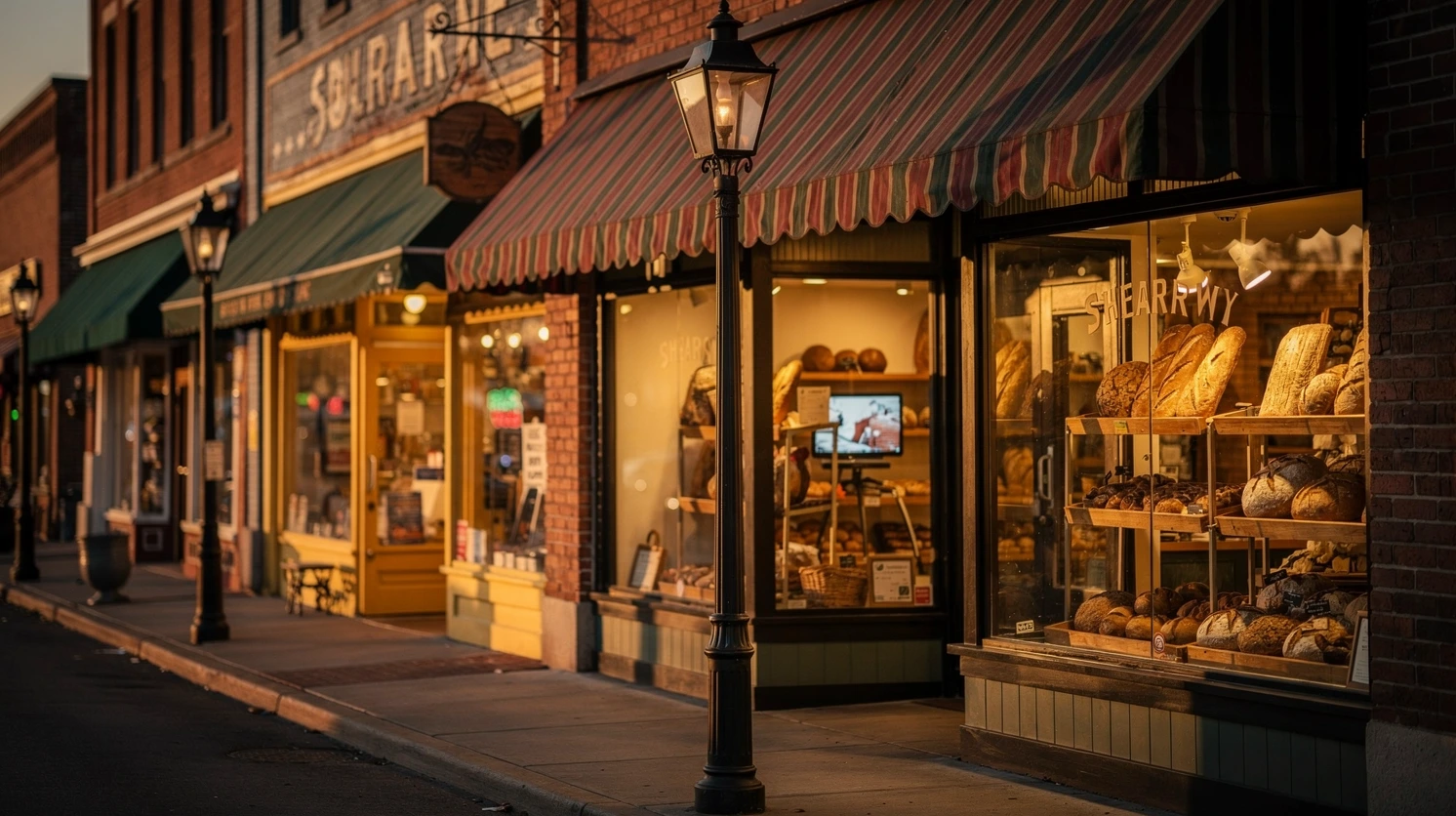
Walk down any healthy commercial corridor in the United States in 2026 and you can read the local economy in the windows. The hardware store that knows your boiler model, the bookshop that hosts a Tuesday reading group, the bakery that opens at 5:30 a.m. for the construction crews. These businesses do not look like the future of retail in a McKinsey deck, yet they keep posting numbers that the analytics dashboards of national chains struggle to match on a comparable basis. That gap, the one between what spreadsheets predict and what main streets actually deliver, is the subject of this guide.
This article sits inside the future of local retail and main street commerce pillar on ShopAppy. It is written for independent retailers, brand managers thinking about wholesale partnerships, and city planners trying to figure out which storefronts to subsidize. We will look at what main street still does better than online, where the gap is genuinely closing, and where the conventional wisdom about e-commerce is simply wrong.
Why main street vs ecommerce is the wrong question in 2026
For two decades, retail trade press framed the choice as a zero sum contest. Either e-commerce would eat main street, or main street would prove resilient enough to push back. The framing was useful for headlines and consultants, less useful for operators.
What actually happened is more interesting. E-commerce ate the predictable, replenishment-heavy categories first, the ones where the product is identical regardless of where it ships from: printer ink, batteries, generic vitamins, paperback novels. It made far slower progress in categories where the product is variable, the moment of purchase matters, or the customer needs to assess a physical object before committing. Wine, cheese, furniture, prescription eyeglasses, hardware, fresh flowers, prepared food, and almost everything sold at a counter where someone explains the difference between two similar items.
The US Census Bureau has tracked this divergence quarterly since 2000. Its Quarterly E-Commerce Report shows e-commerce settling at roughly 16 percent of total retail in early 2026, a share that has crept up slowly but never collapsed traditional retail outright. The remaining 84 percent is the territory where main street operates, and inside that territory the question is not whether to fight online stores but how to build a business that does what they cannot.
The categories where e-commerce has clearly won
Be honest about the categories where the contest is over. Generic consumer electronics, mass-market apparel basics, household consumables, and most office supplies have moved decisively online. A main street shop selling printer paper as its core business in 2026 is operating on borrowed time, and no amount of community goodwill changes the math.
The categories where main street still leads
The reverse is also true. Specialty grocery, prepared food, services with a physical component, furniture above the entry price tier, professional tools, and gift purchases for occasions all show higher conversion and margin in physical stores. The reason is rarely sentimental. It is that the buyer needs to make a judgment call that text and photos cannot fully support.
The trust advantage main street has not lost
Trust in retail is measured in fine grained moments. The way a salesperson handles a complaint about a defective product, whether returns are accepted graciously or grudgingly, how the store treats a customer who is clearly browsing without buying that day. Online merchants invest heavily in trust signals, from review systems to free returns to fast-loading product pages, but they are working uphill against a channel that lacks faces, voices, and accountability beyond a chat queue.
The 2025 Edelman Trust Barometer found that small local businesses retained the highest trust rating of any institutional category in the United States, ahead of nonprofits, large corporations, and government at every level. That ranking has been stable for more than a decade. When a customer hands a credit card to someone they have seen at the same counter for five years, the transaction carries a different psychological weight than a click on a payment button.
What this means for operators
The practical lesson is that main street operators should stop trying to compete with the price transparency and selection breadth of online stores. Those are losing fights. They should compete instead on the experience of being known, the consistency of staff, and the small daily acts of service that compound into a relationship. The main street reinvention story of the past five years is largely a story of operators rediscovering this insight after a decade of trying to copy e-commerce tactics that did not suit them.
Brands working with independent retailers can apply the same principle. A wholesale partner that treats its main street accounts as showrooms first and revenue sources second tends to build durable distribution. One that treats them as marginal volume on a quarterly target sheet tends to lose them to competitors who understand the channel better.
The sensory and same-minute advantages online cannot replicate
There are two physical advantages of main street that no logistics breakthrough will close. The first is sensory. The second is temporal.
Sensory advantage means the customer can touch, smell, taste, lift, smell again, hold next to their face, and compare two items in the same hand. Categories where this matters include fresh and prepared food, fragrances, premium textiles, plants, hardware where weight and finish signal quality, and most pet supplies. Online retailers have spent enormous sums trying to reduce this gap with video, augmented reality, and free returns. They have narrowed it. They have not closed it.
Temporal advantage means the customer can walk in, pay, and leave with the item in the next five minutes. Same day delivery has compressed the gap from days to hours in major metros, but it has not reached zero, and it has not reached most of the country. For a parent who realizes at 6:45 p.m. that their child needs a poster board for a school project due tomorrow, the nearest open store still wins every time.
Comparison: where main street and ecommerce each win
| Buying scenario | Winner in 2026 | Why |
|---|---|---|
| Replenishment of identical product | E-commerce | Convenience and subscription pricing |
| Urgent purchase under 1 hour | Main street | Same-minute fulfillment |
| Fresh food and prepared meals | Main street | Sensory inspection and freshness window |
| Bulk basics with no quality variance | E-commerce | Price and delivery efficiency |
| Gifts requiring presentation | Main street | Wrapping, advice, last-minute timing |
| Specialty hardware and tools | Main street | Staff expertise and physical inspection |
| Commodity electronics | E-commerce | Price transparency and review depth |
| Custom or measured items | Main street | Fitting, sizing, returns friction |
| Subscription consumables | E-commerce | Recurring billing efficiency |
| Furniture above $1,000 | Main street | Inspection of finish and structure |
Community standing as a defensible moat
The category that surprises operators who came from corporate retail is community standing. It is not a marketing channel, it is an asset class. A shop that has been at the same address for fifteen years, sponsored the local high school baseball team, and contributed to every neighborhood fundraiser has built a moat that no e-commerce player can dig through with paid acquisition.
This is the part of main street economics that quantitative analysts struggle to model. The lifetime value of a customer who feels civic loyalty to a store is not just higher revenue per visit. It includes referrals to friends, social media defense when a competitor opens nearby, tolerance for occasional stockouts or off days, and willingness to pay a slight price premium without resentment. These behaviors do not show up in a checkout funnel, which is why they tend to be undervalued in strategy decks.
How operators build community standing without faking it
Community standing is earned by years of small, consistent gestures, not by a sponsorship plaque on the wall. Operators who succeed at this share a few habits. They show up to school board meetings even when there is nothing on the agenda relevant to their business. They sponsor things that have nothing to do with their target customer profile. They hire from the neighborhood. They give the kid behind the counter authority to make small judgment calls. They remember names.
None of these are scalable in the way an online ad budget is scalable, which is exactly why they remain defensible. The same factor that makes them hard to execute centrally is what makes them hard for competitors to copy.
The hidden cost structure of e-commerce that nobody publishes
One reason main street keeps surviving is that e-commerce unit economics are worse than public discussion suggests. The list prices visible to consumers do not reflect the fully loaded cost of customer acquisition, returns processing, fraud chargebacks, and last-mile delivery in low density areas.
Returns alone are a structural drag on online retail. The National Retail Federation 2024 returns study put total returns at roughly $890 billion in the US, with online return rates running two to three times higher than in-store rates depending on category. Apparel is the worst offender, with some pure play online apparel brands quietly reporting return rates above 40 percent. Each return triggers reverse logistics, inspection, repackaging, and often a partial markdown on resale. The cost rarely appears as a line item in the customer view of the price.
What this looks like in numbers
- An online apparel order of $100 with a 40 percent return rate generates an expected reverse logistics cost of $12 to $18 before any other variable expenses.
- Customer acquisition cost for a mid-tier direct-to-consumer brand sits between $35 and $90 per first order in 2026, depending on category and platform mix.
- Last-mile delivery to a rural ZIP code costs the carrier two to four times the equivalent urban delivery, a cost increasingly passed back to the merchant.
- Payment processing on card-not-present transactions is roughly 30 to 50 basis points higher than card-present transactions because of fraud exposure.
- Customer service for online orders runs at higher cost per ticket because the resolution often involves a refund or replacement, not a same-store fix.
Stacked together, these costs explain why even very large online retailers struggle to match the operating margins of well-run main street businesses in similar categories. The conventional wisdom that e-commerce is structurally cheaper to operate than physical retail does not survive contact with a full cost accounting.
Where main street is losing and what to do about it
None of the advantages above mean main street is invincible. The categories where it is losing ground are real and worth naming clearly. Generic consumer goods, basic electronics, books outside specialty stores, and most non-perishable groceries have shifted online to a degree that will not reverse. Local operators who anchor their business model in those categories without a defensible specialty layer are in trouble.
The fix is not to fight harder on price or selection. The fix is to lean further into what cannot be replicated. That means narrower assortments curated by someone the customer trusts, more events that turn the store into a destination, and tighter integration with community institutions. Foot traffic patterns matter here, and operators should be looking at what foot traffic data actually tells main street retailers rather than guessing about who walks past their windows.
Practical playbook for independents
If you operate a main street business and you are wondering where to focus, three priorities tend to deliver outsized returns in 2026.
- Narrow your assortment until you can explain every item on the shelf. If a staff member cannot tell a story about a product, it should not be there.
- Treat the storefront as a stage, not a stockroom. The cost of holding back-room inventory eats margin that could fund better merchandising up front.
- Invest in two or three signature experiences per year that draw people in for reasons other than buying. A wine tasting, an author visit, a repair clinic. These create the community standing that defends the business in slower months.
Examples from US retail in 2026
The clearest evidence that main street still has structural advantages is in the operators who are growing through it. A handful of patterns recur.
Specialty grocery has been a quiet success story. Stores that combine prepared foods, a tight produce program, and a beer or wine license routinely outperform big box rivals on revenue per square foot. Ace Hardware cooperative members have continued to add stores in markets that big box analysts had written off as too small, often by leaning on the same staff expertise advantage their parents leveraged thirty years ago. Independent bookstores, frequently reported as dying through the 2010s, recorded net positive store openings every year from 2020 onward according to American Booksellers Association data.
The pattern is not that these operators ignore digital tools. Most of them use point-of-sale systems that did not exist a decade ago, email marketing platforms, social media, and ship-from-store fulfillment for the small share of orders that originate online. The pattern is that they treat digital as plumbing for a physical-first business, not as the business itself.
The experiential layer borrowed from pop-up retail
One trend worth watching is the merging of permanent main street stores with the playbook from pop-up and experiential retail. Permanent storefronts increasingly host residencies, demonstration events, and temporary brand activations that change the look of the floor every few weeks. This is where the 2026 experiential retail trends intersect directly with the main street story, and operators who can adapt parts of that playbook tend to outperform peers who keep the floor static.
Tools, partners and vendors worth knowing
The vendor ecosystem around main street has matured considerably. There are now serious options for point-of-sale, loyalty, scheduling, and lightweight e-commerce that integrate with the physical floor without forcing operators to choose between channels.
| Tool category | What to look for | Common pitfalls |
|---|---|---|
| Point-of-sale | Inventory sync with online store, hardware reliability, offline mode | Lock-in to payment processor that raises rates after year one |
| Loyalty | SMS or email rather than app-based, recognizes regulars by face or phone | Programs that require an app download burn the relationship the program is meant to build |
| Lightweight e-commerce | Ship-from-store, local pickup, inventory feed from POS | Marketplace listings that conflict with in-store margins |
| Marketing automation | Segmentation by purchase recency, simple flows | Over-segmentation that hides the customer behind a model |
| Workforce scheduling | Mobile-first, handles tip pooling and shift swaps | Tools designed for chains that ignore independent constraints |
The common failure mode is buying enterprise-grade tooling that solves problems an independent does not have, then paying for it monthly while the actual day-to-day work stays manual. Less is usually more. The future of local retail belongs to operators who pick three or four tools that they actually use, not those who buy ten and use parts of each.
FAQ
Is main street really beating e-commerce in 2026?
Not across the board, but in many categories yes. E-commerce has captured roughly 16 percent of US retail and has largely stopped growing share rapidly. The remaining 84 percent is dominated by physical retail, and within that the strongest performers on operating margin tend to be specialty independents and well-run mid-size chains rather than national big box stores.
What categories should main street operators avoid as their core business?
Generic consumer electronics, mass apparel basics, replenishment household goods, office supplies, and most non-perishable groceries below the specialty tier. These are categories where online price transparency and selection breadth create a structural disadvantage that is very hard to overcome at the unit economics level.
Can a main street store compete with Amazon on price?
Almost never on identical SKUs. The competitive ground is not price parity on a commodity item, it is offering products and services that are not on Amazon at all, or selling identical items with a service layer that justifies a different price. Trying to match Amazon on price for the same item is a losing strategy and usually ends with margin compression and no winning move.
How important is having an online store for a main street business?
Useful but rarely critical. For most independents the online channel works best as a digital storefront for local customers checking inventory before walking in, plus a small ship-from-store revenue line. Treating the website as a primary revenue channel usually means competing against operators with far better logistics infrastructure, which is a losing setup.
What is the single biggest mistake main street operators make in 2026?
Spreading their assortment too thin in an attempt to be a one-stop shop. The strongest independent stores in 2026 have narrower selections than they had ten years ago, not wider, and use the freed-up floor and capital to invest in service depth and curation. Trying to carry everything pushes them toward the territory where e-commerce wins.
How long does it take to build real community standing?
Three to five years of consistent presence is roughly the threshold at which a store starts to be referred to by name in local conversations, sponsorship invitations become unsolicited, and longer-tenured staff become locally recognized. Standing built faster than that tends to be marketing veneer rather than the durable asset that defends the business through tougher cycles.
Are returns really that big a problem for online retail?
Yes, and the issue has grown rather than shrunk as free return policies became standard. Apparel return rates above 30 percent are normal, and the reverse logistics cost is a meaningful drag on operating margin for pure play online sellers. Many DTC brands now charge for returns to bring the math back into balance, which weakens one of e-commerce’s historic advantages over physical stores.
Bringing it together
The honest answer to the main street vs ecommerce question in 2026 is that neither channel is going away, and the operators who win in either channel are the ones who understand what their format does that the other cannot. For main street that means leaning into trust, sensory experience, same-minute fulfillment, and community standing rather than trying to imitate online price competition. For e-commerce it means consolidating the categories where logistics and selection genuinely win rather than chasing every retail dollar.
The future of US retail looks less like a winner-takes-all transition and more like a stable equilibrium where each channel does what it is built for. For independent operators, the strategic question is no longer survival but specialization. Pick the advantages that are real, defend them with discipline, and stop trying to fight battles on terrain that does not suit you.