
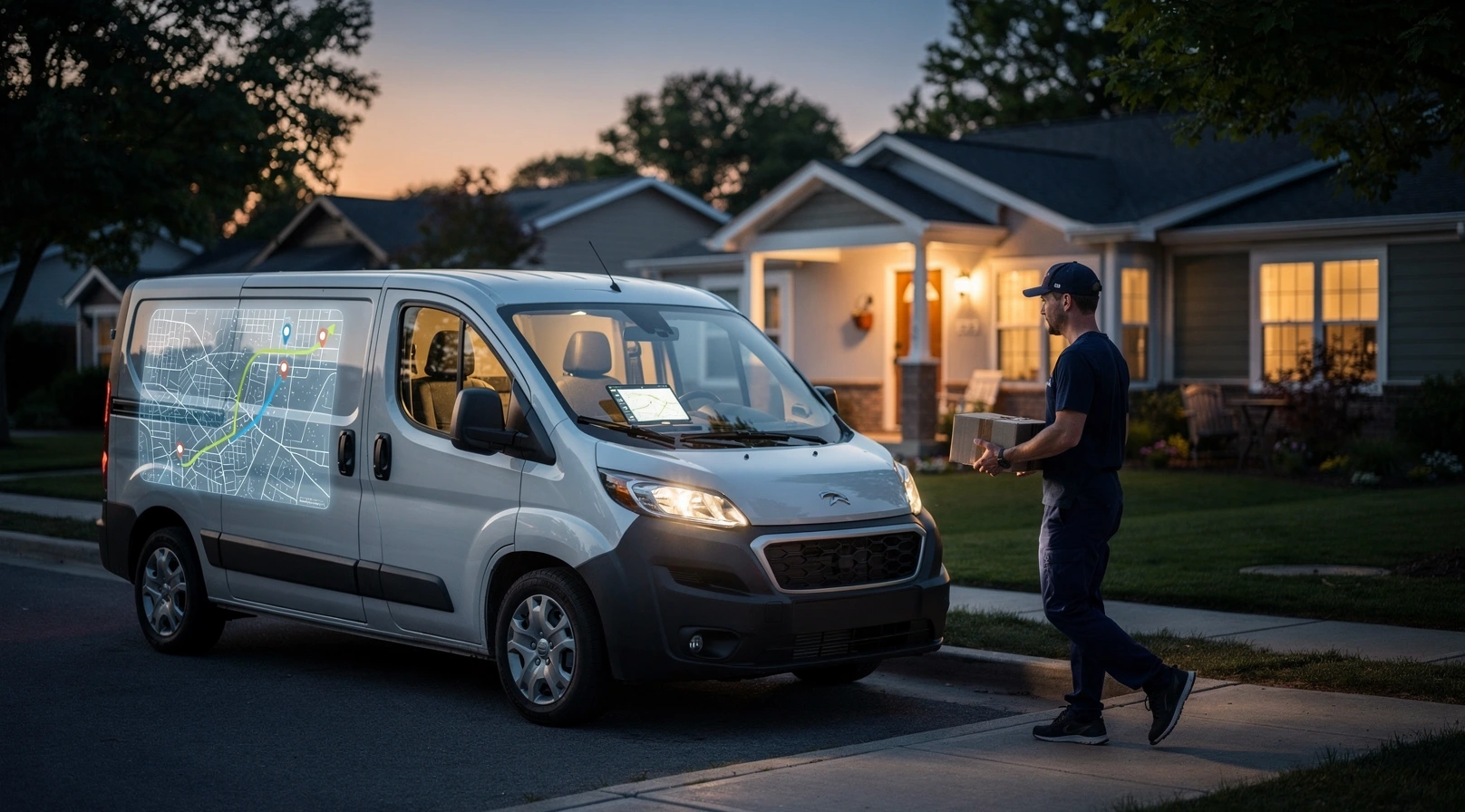
Last-mile delivery is the part of the supply chain shoppers actually feel. By 2026, US retailers and e-commerce brands have moved past the question of whether to invest in last-mile technology and are now picking between dozens of overlapping platforms, apps, and gig networks. This guide walks through the last-mile delivery tools 2026 that matter, how they fit together, and which vendors brands are quietly standardizing on.
In short
- Five tool categories dominate the stack: route optimization, driver apps, customer tracking, returns, and crowdsourced fleets.
- Onfleet, Bringg, and Locus remain the most common dispatch and orchestration platforms among mid-sized US retailers.
- Uber Direct, DoorDash Drive, and Roadie now act as the default “instant delivery” rails for non-Amazon merchants.
- Delivery promise accuracy, not raw speed, is the metric that separates strong vendors from weak ones in 2026.
- The right stack is rarely one tool. Most US brands run an orchestration layer on top of two or three carriers and one crowdsourced network.
If you want a wider lens before diving in, the broader picture sits in our pillar on modern retail logistics from warehouse to doorstep. This article is the commercial deep dive into the actual software and networks you will end up evaluating.
Why last-mile delivery tools matter in 2026
The cost of the final leg has not stopped climbing. According to repeated industry surveys, last-mile delivery now represents between 41 and 53 percent of total parcel logistics spend for US e-commerce, depending on category. Apparel and beauty sit at the lower end, grocery and bulky goods at the higher end. Tools exist for one reason: to bend that curve without breaking customer experience.
Three forces are pushing investment in 2026. First, consumer expectations set during the 2020 to 2024 boom have not relaxed. Same-day and next-day windows are still treated as table stakes in major metros. Second, carrier capacity remains uneven. UPS, FedEx, and USPS have all adjusted dimensional pricing, and merchants now actively diversify away from any single carrier. Third, the rise of zero-click and AI-driven product discovery means shoppers compare delivery promises across multiple retailers in seconds, often via an assistant rather than a browser.
Reliability beats raw speed in this environment. A two-day promise that lands on time outperforms a same-day promise that misses 15 percent of the time, both in conversion and in repeat purchase. We covered the underlying behavioral data in delivery promise reliability and how it shapes repeat purchase, and the lesson holds: every tool in this guide should ultimately be judged on how it improves the gap between promised and actual delivery time.
Key terms and definitions
The vendor space is full of overlapping vocabulary. A short glossary keeps the rest of this guide readable.
- Orchestration platform. Software that sits between your order management system and multiple carriers or delivery networks. Picks which carrier ships which order based on rules, cost, and SLA.
- Dispatch and routing engine. The component that builds the actual driver routes, often a sub-feature of orchestration platforms.
- Driver app. The mobile app a driver runs in the vehicle. Handles route, proof of delivery, photos, and exceptions.
- Crowdsourced network. A pool of independent drivers, usually gig workers, accessed via an API. Uber Direct, DoorDash Drive, Roadie, GoShare.
- Final-yard. Everything from curb to door: locker, smart access, attended delivery, age verification.
- Delivery promise. The cutoff time and date range shown on the product detail page or at checkout. Often dynamic in 2026.
Most retailers conflate “carrier” with “tool”. They are not the same. FedEx is a carrier. Bringg is a tool. The carrier moves the box; the tool decides which carrier gets it and tells the customer what to expect.
The five categories of last-mile tools
Almost every vendor pitch in 2026 fits into one of five buckets. Knowing which bucket a tool occupies prevents the most common procurement mistake: paying twice for overlapping capability.
| Category | What it does | Representative vendors | Typical buyer |
|---|---|---|---|
| Orchestration | Multi-carrier rating, allocation, and tracking | Bringg, Shipium, Cario, project44 | Mid to large retailers |
| Dispatch and routing | Route optimization for owned or contracted fleets | Onfleet, Locus, Routific, Wise Systems | Brands with in-house drivers |
| Crowdsourced fleets | On-demand independent driver pools | Uber Direct, DoorDash Drive, Roadie, GoShare | Almost everyone, for overflow |
| Customer experience | Tracking pages, branded notifications, SMS | Sonar, Narvar, AfterShip, Route | DTC brands |
| Returns and reverse | Drop-off, pickup, refurb routing | Happy Returns, Loop, ReverseLogix | Apparel, electronics, beauty |
A working 2026 stack typically includes one tool from rows one or two, one or two networks from row three, one from row four, and, if returns volume justifies it, one from row five. That is rarely fewer than three contracts.
Route optimization platforms worth knowing
If you run any vehicles yourself, even a fleet of three vans for a Sunday grocery service, route optimization is the first piece of software to buy. The math is straightforward: even modest optimization reduces total drive time by 8 to 18 percent on dense urban routes, according to studies referenced by the vehicle routing problem literature.
Onfleet
Onfleet is the default mid-market choice in the US. Strong driver app, clean dispatcher console, and an API that most order management systems can plug into within a few days. Pricing scales by tasks per month, which works well for brands with predictable volume and less well for spiky promotional weeks. Onfleet’s proof-of-delivery flow is one of the cleanest on the market, which matters for grocery and pharmacy.
Locus
Locus took longer to land in the US but has gained share in 2025 and 2026, especially among brands that already shipped internationally or that needed multi-stop optimization across regional hubs. Stronger than Onfleet on heuristics for very large route counts, weaker on small fleet ergonomics. Often the right answer for retailers running more than 50 vehicles per metro.
Wise Systems
Wise focuses on continuous, machine-learning-based route refinement rather than static daily plans. The vendor is small but punches above its weight in industries with tight time windows, such as foodservice distribution and pharmacy. Buyers report a longer ramp than with Onfleet but better steady-state performance once routes settle.
Routific
Routific is the lightweight option for small fleets, often 3 to 25 vehicles. Self-serve, transparent pricing, and a setup process that does not require a sales call. Good fit for local florists, boutique grocers, and DTC brands experimenting with owned delivery in one or two cities.
Driver and dispatch apps
Most route optimization platforms ship their own driver app. The exceptions are large retailers that built proprietary apps for compliance reasons (think alcohol delivery, age-verified pharmaceuticals, or high-value electronics) and crowdsourced networks that come with their own driver experience baked in.
When evaluating a driver app, four features separate strong from weak vendors in 2026:
- Offline mode. Drivers lose signal in basements, garages, and rural pockets. Apps that queue updates without crashing keep operations sane.
- Photo and signature capture. Required for chargeback defense and for most insurance policies on goods over $250.
- Exception handling. What happens when no one is home, when the package will not fit in the locker, when the address is wrong. Strong apps surface a short list of dispositions and route the exception back to dispatch in real time.
- Native mileage and time tracking. Drivers in the US increasingly use these logs for 1099 tax reporting under updated IRS self-employed guidance. Apps that produce clean reports reduce driver churn.
Customer notification and tracking
The tracking layer is where customers actually meet your last-mile tools. A delivery happens once; the notification flow happens five to seven times per order, between purchase confirmation and delivery confirmation. Get this layer wrong and the rest of the stack does not matter.
| Vendor | Strength | Weakness | Best for |
|---|---|---|---|
| AfterShip | Broadest carrier coverage globally | Generic branded tracking pages | Multi-region merchants |
| Narvar | Best-in-class branded experience | Higher cost, enterprise sales motion | Apparel and beauty DTC |
| Route | Insurance + tracking bundle | Skews toward smaller merchants | Shopify Plus brands |
| Sonar | Predictive delay alerts | Newer, smaller install base | Brands sensitive to late arrivals |
One pattern worth noting: brands that import heavily from marketplace suppliers (covered in our piece on AliExpress shipping options and what they really mean) often need a tracking layer that can ingest cryptic Chinese postal scans and translate them into something a US shopper understands. AfterShip and 17track lead in that niche.
Crowdsourced and gig delivery networks
This is the category that grew the most between 2023 and 2026. Five years ago, crowdsourced delivery meant Postmates for restaurants. Today, every major US retailer outside of Amazon uses at least one gig network as an overflow rail for same-day and next-day orders.
Uber Direct
Uber’s white-label delivery API. Strong urban density in roughly 70 US metros, predictable pricing, and a developer experience that has improved sharply over the past two years. Best fit for restaurants, pharmacies, and any merchant whose average order ships in a single bag or box.
DoorDash Drive
DoorDash’s equivalent. Edges out Uber Direct in suburban density and in the South. Slightly weaker API documentation, slightly better support for bulky items. Many retailers run both and let an orchestration layer pick whichever quotes cheaper at order time.
Roadie (a UPS company)
Roadie targets larger items: furniture, appliances, oversized retail. Strong nationwide footprint thanks to UPS, and the only major US gig network that handles routes longer than 50 miles reliably. Common at Home Depot, Tractor Supply, and Bed Bath types.
GoShare
The niche option for big and bulky. Drivers bring trucks and vans rather than sedans. Strong in California, Texas, and Florida. Worth a look if your average parcel weighs more than 70 pounds.
Veho
Veho is the closest current alternative to a full carrier, running its own routes with crowdsourced drivers and reaching roughly 50 US metros in 2026. Stronger SLA than DoorDash Drive or Uber Direct for next-day, weaker for same-day. Often used as a UPS or FedEx replacement on slower lanes.
One useful rule: if your order can fit in a sedan and needs to land within four hours, default to Uber Direct or DoorDash Drive. If it needs to land tomorrow but you do not want to pay full carrier rates, default to Veho. If it does not fit in a sedan, default to Roadie. That covers about 85 percent of decisions.
Returns and reverse logistics
Returns are where most last-mile stacks fall apart. Forward delivery gets engineering attention; the reverse leg often runs on spreadsheets and a single warehouse manager. In 2026 that gap is starting to close.
Three vendors stand out. Happy Returns, now owned by UPS, runs a network of physical drop-off locations across the US where shoppers can return items without packaging or printed labels. It is the closest the industry has to a default returns experience for apparel and accessories. Loop is the leading software layer on Shopify Plus, optimizing for exchanges over refunds, which protects revenue. ReverseLogix targets larger retailers with multi-warehouse refurb and resale flows, and has gained ground in consumer electronics.
If returns exceed roughly 15 percent of your order volume, a dedicated tool starts paying for itself within a year. Below that threshold, native shipping platform features (ShipStation, Shippo) usually cover the basics.
How to choose the right stack
A simple sequence prevents most procurement disasters. Run through these steps before signing anything.
- Map your current flow. List every system that touches an order from checkout to doorstep. Most retailers find duplicate tools they already pay for.
- Quantify your gap. Pull six months of promised vs. actual delivery data. If the gap exceeds 12 percent, prioritize orchestration. If under 5 percent, prioritize customer experience.
- Pick the carrier mix first, the tools second. Tools should adapt to your carriers, not the other way around. Most orchestration platforms support 30 or more carriers natively, but compatibility lists do not equal mature integrations.
- Run a 90-day pilot in one metro. Pick a single city, divert a fixed share of orders to the new stack, and measure on-time delivery, cost per order, and net promoter score against the control.
- Negotiate based on the pilot data. Vendor pricing has become more flexible in 2026 as the market has matured. Hard numbers from a pilot move discounts more than RFP boilerplate.
Brands that follow this sequence typically end up with three to five vendor contracts. Brands that skip it tend to accumulate eight or nine, with significant overlap.
Common mistakes and how to avoid them
The most expensive mistake is layering tools without retiring old ones. A retailer that adds Onfleet but keeps Excel route sheets is paying for both. A retailer that buys Narvar but keeps the default carrier tracking page splits the customer experience.
The second most expensive mistake is ignoring the data contract. Every last-mile tool needs a clean, consistent feed of orders, addresses, and statuses. Brands that try to integrate a new platform on top of dirty data spend 70 percent of the project budget cleaning records and 30 percent on the tool itself. The fix is rarely glamorous: a small data engineering project to normalize addresses, deduplicate SKUs, and enforce timezone consistency.
The third mistake is treating crowdsourced delivery as a price game. Uber Direct and DoorDash Drive are usually cheaper than carriers for short distances, but the SLA is not the same. Brands that route fragile or high-value goods through gig networks without insurance pay the difference in chargebacks. The right model is a routing rule that excludes orders above a value threshold or weight threshold from gig networks.
Examples from US retail and e-commerce
A few public patterns illustrate how the 2026 stack looks in practice.
Sephora built its same-day delivery on top of Instacart for many years, then layered DoorDash Drive in 2024 and Uber Direct in 2025. Its orchestration logic now picks whichever quotes cheaper at order time, with a fallback to the next provider if the first cannot fulfill within the promise window. The tracking experience runs on Narvar.
Best Buy uses Roadie for large items (washers, refrigerators) and its own fleet for premium installation services. The dispatcher tool is custom, built on top of Locus for the routing engine. Customer notifications run through a proprietary layer connected to the Best Buy app.
Wayfair uses a mix of carriers and Roadie for last-mile, with Bringg as the orchestration brain. Wayfair was an early adopter of dynamic delivery promise display, which it rolled out in 2023 and refined in subsequent years.
Smaller DTC brands tend to converge on a simpler stack: ShipStation or Shippo for label generation, AfterShip or Route for tracking, and one gig network (usually Uber Direct via a Shopify app) for same-day in their home metro. That setup costs roughly $1,200 to $4,000 per month at typical Shopify Plus volumes.
The pattern across all of these is the same: pick a carrier mix, add an orchestration layer, give the customer one clean tracking page, and avoid duplicating tools. None of them rely on a single vendor for everything, and none of them try to build the whole stack in-house.
Pricing models you will encounter
Vendor pricing in last-mile is rarely straightforward. The four models you will see most often in 2026 each suit different buyers, and getting this wrong can quietly inflate your cost per order by 20 percent or more over a year.
Per-task pricing charges a fixed fee for every order processed through the platform. Onfleet, Routific, and most dispatch tools use this model. It is predictable for steady volume but punishing during promotional spikes. Negotiating a soft cap or burstable allowance is normal at mid-market.
Per-shipment pricing applies mostly to crowdsourced networks. The base rate covers a short distance and a single drop, with surcharges for mileage, wait time, oversized packages, and surge windows. Brands new to Uber Direct or DoorDash Drive almost always underestimate the surcharge layer. Ask for a 90-day historical billing sample before signing.
Subscription pricing is common for tracking and customer experience tools. Narvar and AfterShip both run tiered subscriptions that scale by order volume, channels supported, and analytics depth. The cost per order looks low at large volumes but the entry tier can feel expensive for smaller brands.
Hybrid models combine a baseline platform fee with per-task or per-shipment overage. Bringg, Shipium, and most enterprise orchestration tools sit here. The fixed baseline funds the integration team, and the variable layer aligns vendor incentives with merchant growth.
One practical tip: every vendor quote should be rebuilt as cost per delivered order. That single number is the only honest comparison across pricing models. Two platforms can have wildly different list prices and end up within five cents of each other once normalized, while two that look comparable on the surface can differ by 40 cents per order.
Integration patterns that work
The technical architecture of a healthy last-mile stack tends to follow a familiar shape. The order management system, whether NetSuite, Shopify, or a custom platform, sits at the top. Below it, a thin integration layer pushes orders into the orchestration platform, which routes to one or more carriers and gig networks. The tracking layer pulls events back from carriers and pushes branded notifications to customers. Returns flow runs in parallel, often through the same orchestration layer but with separate routing rules.
Most integration failures happen at two specific points. The first is the handoff from order management to orchestration: address validation, customer phone formatting, and SKU normalization need to be solid before orders enter the orchestration layer, or routing rules misfire. The second is the carrier-to-tracking handoff: tracking events arrive in dozens of formats, and platforms that do not normalize them well surface confusing statuses to customers.
Brands that use middleware (Mulesoft, Workato, or a custom Node service) between order management and orchestration tend to have cleaner long-term setups. The middleware absorbs vendor swaps without breaking upstream contracts, and it is the natural place to enforce data quality rules. Brands that point order management straight at a vendor API typically rewrite the integration every time they change vendors, which can happen every two to three years.
Where this fits in the broader logistics picture
Last-mile tools are one slice of a much larger logistics architecture. The pillar piece on modern retail logistics from warehouse to doorstep covers the upstream layers: warehouse management, parcel and freight carriers, returns reverse flow, and inventory positioning. If you are evaluating last-mile tools without understanding how they connect to the warehouse and the order management system above them, expect surprises. For a forward-looking view on where the last-mile market itself is heading, the companion piece on the 2026 last-mile delivery outlook for US retailers walks through the trends shaping vendor strategy over the next 18 months.
FAQ
What is the single most important last-mile tool to buy first?
For most US retailers in 2026, an orchestration platform pays back fastest. It unlocks carrier comparison, dynamic delivery promises, and unified tracking with one integration. Onfleet, Bringg, and Shipium are the three most common starting points depending on volume.
How much do last-mile delivery tools cost?
Pricing varies widely. Small DTC stacks run $1,200 to $4,000 per month. Mid-sized retailers typically spend $8,000 to $25,000 monthly across orchestration, tracking, and returns. Enterprise contracts move into six figures annually. Most platforms quote per order, per task, or per shipment rather than per seat.
Are crowdsourced delivery networks reliable enough for premium brands?
For short distances and low-to-mid value goods, yes. For high-value, fragile, or age-verified items, premium brands still prefer carriers or their own fleets. The standard practice in 2026 is to set routing rules that exclude certain order types from gig networks based on value, weight, or category.
Can one tool replace UPS or FedEx?
Not yet at national scale. Veho comes closest for next-day in major metros, and Roadie covers many specialty lanes. Most retailers still keep a carrier contract as the baseline, then layer gig and regional carriers on top to optimize cost and speed.
How long does it take to implement an orchestration platform?
A clean implementation runs 8 to 16 weeks for mid-sized retailers, longer if data quality is poor. The fastest implementations happen when the merchant already has a well-structured order management system and consistent address data.
Should I buy a route optimization tool if I outsource all deliveries to carriers?
No. Route optimization tools are for fleets you control, whether owned or contracted. If every order ships via UPS, FedEx, USPS, or gig networks, your investment belongs in orchestration and tracking instead.
What metrics should the new stack improve?
Track four things: on-time delivery rate against the promised window, cost per delivered order, net promoter score on the post-delivery survey, and the gap between promised and actual delivery time. If all four improve, the stack is paying for itself.
How often should the vendor mix be reviewed?
Once a year for orchestration and tracking, every six months for crowdsourced networks. Gig network pricing and coverage shift fast enough that a quarterly check on quoted rates is worth the effort for high-volume merchants.