
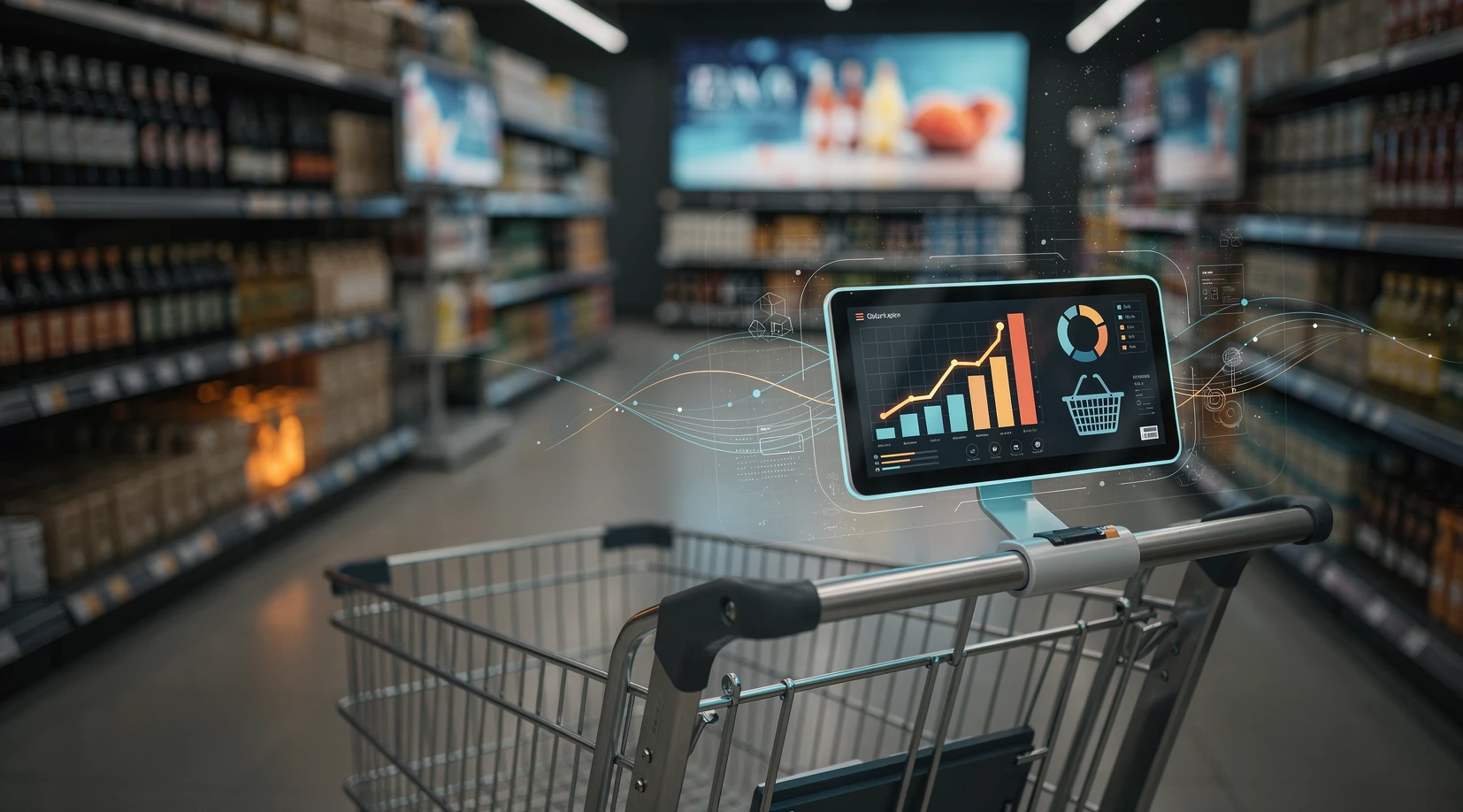
The next leg of retail media’s growth is likely to come from the store floor, not the search bar. Signals from the last month point to in-store retail media (the ads on smart-cart screens, end-cap panels and digital displays inside grocery stores) crossing from pilot to scale across US grocery during the second half of 2026, with the inflection most visible by holiday 2026 and the Q4 reporting that follows in early 2027. The pattern is not loud yet, but three concrete moves between early May and early June 2026 line up in the same direction.
The prediction here is specific and falsifiable. By the Q4 2026 results season (roughly January to February 2027), the evidence suggests we should expect connected-stores or in-store advertising to be called out as a distinct growth driver by at least one platform and one major grocer, the count of US grocery banners running on-cart or in-screen advertising to keep climbing through Q3, and in-store inventory to be positioned as standard, self-serve and measurable rather than experimental. If instead new banner go-lives dry up, platforms retreat to onsite-only messaging, or advertisers pull spend after weak measurement, the call is wrong. Both outcomes are checkable.
In short
- The prediction: in-store retail media likely crosses from pilot to scale in US grocery during H2 2026, with the clearest evidence arriving by holiday 2026 and the Q4 results that follow in early 2027.
- Signal 1: Instacart’s first-quarter 2026 results (reported May 6) show advertising and other revenue up 16% year over year to $286 million, the fastest growth since the third quarter of 2023, with Caper smart carts now live in more than 100 cities.
- Signal 2: a May 13 move opened Instacart’s Ads Manager to retailers themselves, with self-serve tools and off-platform extension, a classic sign that a channel is being industrialised rather than hand-sold.
- Signal 3: on June 4, Weis Markets went live with Caper Carts and on-cart advertising, the latest in a steady cadence of new grocery banners switching the inventory on.
- The caveat: in-store measurement is still immature and the hardware is expensive, so a softer ad market or disappointing incrementality data could stall the rollout. The piece weighs that risk explicitly.
Why this matters now
Retail media has been the advertising industry’s clearest growth story for five years, but almost all of that growth has lived on screens consumers already hold: sponsored listings on marketplace apps, search ads on retailer sites, and off-site extensions powered by first-party purchase data. That onsite pool is now large, competitive and, by several accounts, maturing toward single-digit growth at the leaders.
The store floor is the obvious next frontier because roughly 80% of US grocery spending still happens in physical aisles. That is where the impressions are, where the purchase decision is made, and where the measurement loop can close fastest. The economics only work, though, once the hardware is deployed at scale and the buying tools are self-serve. Both conditions appear to be arriving at once.
For context on how the onsite version of this channel developed, our explainer on retail media networks and whether to advertise on Amazon and beyond traces the same arc one platform earlier. The in-store chapter looks likely to rhyme with it, only compressed.
There is also a calendar logic to the timing. Holiday is the quarter when grocers and CPG brands spend most aggressively, so any new ad surface that is live and measurable by Q4 gets its first real revenue test then. A channel being deliberately scaled through spring and summer is being positioned, whether or not anyone says so, to monetise the holiday peak.
The reason to flag this in June rather than December is timing. The signals are still early and quiet, which is exactly when a forward-looking call is worth making. By the time in-store retail media is a headline at the January 2027 conferences, the prediction will already have resolved.
Signal 1: Instacart’s ad reacceleration and the connected-stores callout
Instacart reported its first-quarter 2026 results on May 6, and the numbers matter less for their size than for their shape. Total revenue topped $1 billion for the first time, but the more telling line was advertising and other revenue, up 16% year over year to $286 million, which the company’s materials frame as the fastest growth since the third quarter of 2023.
That reacceleration is notable because the prevailing narrative on onsite retail media has been deceleration. When a leader’s ad line speeds up after several softer quarters, the marginal dollar is usually coming from somewhere new. In Instacart’s case, the materials point to connected stores and Caper smart carts as part of that mix.
According to the company’s investor materials, Caper Carts are now live in more than 100 cities across more than a dozen retail banners, with recent launches at Sprouts, Wegmans and Coles in Australia, and a pilot with Morrisons in the United Kingdom described as upcoming. The release language emphasises that the carts are starting to lift basket sizes and loyalty activations for participating banners, not just collect impressions.
The ad-rate detail reinforces the read. Advertising and other revenue ran at roughly 2.8% of gross transaction value in the quarter, up from prior periods, which means the take rate on each dollar of grocery sold is rising. A rising take rate alongside a rising sales base is the financial fingerprint of a media business adding new surfaces, not merely riding existing ones harder.
One quarter is not a trend. The signal is not the 16% itself; it is the pairing of an ad reacceleration with explicit, repeated mention of an in-store format that did not feature in the growth story two years ago. That is the kind of language shift that tends to precede a reporting-segment shift.
It is also worth separating cause from correlation here. Much of the 16% almost certainly still comes from onsite sponsored listings, and the company has not broken out an in-store number. The point is narrower: the carts have moved from a curiosity mentioned in passing to a recurring item in the growth narrative, which is the rhetorical step that historically comes just before the financial one.
Signal 2: the channel is being industrialised, not hand-sold
On May 13, Instacart expanded its Ads Manager so that retailers themselves, not only consumer brands, can build and activate campaigns directly. The new suite lets retailers create basket-level offers, target high-intent segments and measure outcomes through closed-loop data, with the option to extend campaigns off-platform through partners including Meta.
This is a subtle but important tell. Channels that are still experimental get sold by humans, deal by deal. Channels that are about to scale get self-serve tooling, because the operator has decided the demand justifies productising the buy. The shift from managed service to self-serve is one of the more reliable markers that a media format is moving from pilot to platform.
It also broadens the buyer base. When a regional grocer can run its own promotions through the same pipes that national CPG brands use, the addressable demand for in-store inventory widens well beyond the few dozen launch partners that seeded the early Caper Cart ad tests. The same dynamic, opening tools to a long tail of advertisers, is what turned onsite search ads into a multi-billion-dollar pool.
For readers weighing where ad budgets still earn their keep, our guide to paid ads for retailers in 2026 covers the trade-offs that in-store inventory will now compete inside. The self-serve move makes that competition a near-term reality rather than a 2027 question.
Signal 3: a steady cadence of new banner go-lives
On June 4, Weis Markets, a Mid-Atlantic chain of roughly 197 stores, went live with Caper Carts at select Pennsylvania locations and, crucially, launched on-cart advertising alongside them. The release notes additional rollouts planned through 2026 and places Weis inside a footprint that now spans more than 100 cities across 15 states and more than a dozen banners.
Taken alone, one regional grocer adopting smart carts is a minor item. Taken as the latest entry in a list that already includes Sprouts, Wegmans, Kroger banners, Schnucks and Wakefern’s ShopRite, it reads as cadence. New banners switching the ad inventory on at a rough monthly rhythm is the supply-side equivalent of a hiring wave: it signals that the operator expects demand to absorb the new inventory.
The detail that Weis turned on advertising at launch, rather than treating it as a later phase, is the part worth underlining. Early smart-cart deployments often led with shopper features (spend tracking, coupons, loyalty) and added monetisation later. Launching the ad layer on day one suggests the playbook is now templated, with the commercial model bundled into the rollout rather than bolted on afterward.
| Signal | Date (2026) | What it shows | Why it points to scale |
|---|---|---|---|
| Instacart Q1 results: ads +16% YoY to $286m | May 6 | Demand reaccelerating; Caper in 100+ cities | New marginal ad dollars, in-store named in the growth story |
| Ads Manager opened to retailers; off-platform extension | May 13 | Self-serve tooling for a broader buyer base | Channels get productised when the operator expects volume |
| Weis Markets goes live with Caper Carts plus on-cart ads | June 4 | New banner adopting; ads on at launch | Monthly cadence of go-lives, ad model now bundled in |
What the pattern suggests
Read together, the three signals describe a supply build, a demand reacceleration and a tooling shift happening inside the same eight-week window. That combination is what a channel inflection tends to look like before the revenue line makes it obvious.
The supply side is the smart-cart and screen footprint, which keeps adding banners. The demand side is the ad reacceleration, which suggests buyers are finding the inventory worth paying for. The tooling shift is the self-serve Ads Manager, which lowers the friction for the next wave of buyers to participate. When all three move at once, the base case is that the channel compounds rather than plateaus.
The most likely near-term expression of this is mundane but checkable: more banner go-lives through Q3, more advertiser case studies citing in-store lift, and clearer in-store disclosure in Q3 and Q4 earnings commentary. The pattern suggests the holiday 2026 quarter is when in-store retail media stops being a footnote in retail media decks and becomes a named line.
The prior precedent points the same way. Onsite retail media followed a recognisable sequence: pilot inventory, a handful of anchor advertisers, self-serve tooling, then a reporting-segment carve-out once the number got large enough to brag about. In-store appears to be midway through that same sequence, roughly where onsite search ads sat a few years before they became a headline number.
| Stage of the playbook | Onsite retail media (earlier) | In-store retail media (now) |
|---|---|---|
| Pilot inventory | Sponsored listings on a few categories | Caper Cart ad tests with ~50 CPG partners |
| Anchor advertisers | Large CPG brands buy first | National CPG brands seed cart and screen ads |
| Self-serve tooling | Ads Manager opens to the long tail | Ads Manager opened to retailers (May 2026) |
| Footprint scale | Inventory across the whole site | Carts and screens across 100+ cities, more banners monthly |
| Segment carve-out | Ad revenue reported as its own line | Predicted: connected-stores callouts by Q4 2026 |
Why the store floor is structurally different
It would be easy to treat in-store as just another inventory pool, but its economics differ from onsite in ways that matter for the prediction. The store floor sits at the last moment before purchase, where intent is highest and substitution is easiest, which is exactly the point in the funnel that advertisers pay the most to influence.
That proximity changes the value proposition. Onsite ads compete with a search box and a near-infinite shelf; an on-cart screen reaches a shopper who is already holding a basket and standing in front of the category. The conversion window is measured in seconds and steps, not clicks and sessions, which is why early case studies emphasise basket lift rather than click-through.
It also offers incremental reach rather than overlapping it. The audience inside a store at 6pm on a Tuesday is not perfectly the same as the audience browsing a grocery app, so in-store impressions add reach to a campaign rather than simply duplicating onsite exposure. That incrementality is part of the pitch from networks adding the format to media plans.
The structural catch is that physical media is harder to measure and standardise than pixels. There is no cookie on a cart, no uniform creative spec across screen vendors, and no shared currency for in-store impressions. That gap is the channel’s biggest constraint, and closing it is where the next phase of competition is likely to concentrate.
Wider context: this is bigger than one platform
The Instacart trio is the cleanest evidence because it is recent and well documented, but the in-store push is broader, which is what makes the prediction about a category rather than a company. Two retailer-led efforts and a third-party network corroborate the direction.
Albertsons Media Collective has signalled plans to expand its in-store digital screen fleet to around 800 stores during 2026, a roughly tenfold step up from an 80-store pilot launched in the summer of 2025, across a base of more than 2,200 stores. Tellingly, the company has paired the expansion with an incrementality measurement approach that compares test stores against matched control stores, an attempt to prove the lift that advertisers keep asking for.
Kroger Precision Marketing’s in-store screen program, built on Barrows connected-stores technology, has moved beyond its pilot and is expected to reach a good portion of stores during 2026, with the retailer signalling that store and market counts will be announced. Separately, third-party network Grocery TV reports operating across more than 6,500 stores and 120-plus retail partners, evidence that the buildout is not confined to the largest chains.
For grocers themselves weighing the operational side of this, our roundup of tools and vendors for supermarkets and grocers in 2026 sits adjacent to the question of which media stack to adopt. The buildout is as much a procurement decision as a marketing one.
The demand backdrop is supportive too. Food-delivery advertising alone, across DoorDash, Uber and Instacart, runs at more than $4 billion annualised and has been growing at double-digit to triple-digit rates depending on the player, which shows how much appetite exists for grocery and convenience ad inventory once it is made buyable. In-store is the same advertiser base reaching into a new surface, not a cold-start market.
That matters because the hardest part of launching a new ad channel is usually demand, not supply. Here the demand already exists and is proven on adjacent surfaces; the gating factor has been deployed inventory and clean measurement. When the constraint is supply rather than demand, scaling tends to be faster and more predictable, because the operator controls the rollout pace directly.
It is worth keeping the scale honest. Even at a fast clip, in-store remains a small fraction of total retail media spend, which itself remains dwarfed by the onsite pool. The prediction is about a phase change in trajectory and disclosure, not about in-store overtaking digital. That distinction matters for how the call should be judged.
Wider context: the loyalty and data flywheel
In-store retail media does not stand alone; it plugs into the same first-party data and loyalty machinery that grocers have been building for years. The Caper Cart pitch is explicitly that on-cart screens lift baskets and drive loyalty sign-ups, not just serve ads, which is why the format is being framed as a connected-stores play rather than a pure media product.
That framing matters because it changes who inside a retailer champions the spend. When in-store media is tied to loyalty and basket growth, it gets sponsored by merchandising and membership teams, not only the media-network unit. Our piece on loyalty program design across points, tiers and paid membership covers the machinery that in-store screens increasingly feed.
The data angle also explains the off-platform extension in the May 13 tooling. Retailers want to use in-store behaviour to inform campaigns that run elsewhere, which turns the store floor into a data source as well as an ad surface. That dual role is part of why the larger players are willing to fund the hardware capex now rather than wait.
This dynamic echoes the broader shift toward platform profit pools across retail. Our analysis of why Walmart’s profit growth will lean on ads and membership rather than aisles describes the same gravitational pull at the largest scale: high-margin media and membership revenue subsidising thin retail economics. In-store media is the next surface in that same strategy.
Implications for retailers, brands and platforms
For grocers, the strategic question is shifting from whether to build in-store media to how fast and with whose stack. The signals suggest the window to be an early scaled network, with the data advantages that brings, is narrowing through 2026. Late movers risk buying inventory into a market the leaders have already shaped.
For consumer brands, the near-term implication is a new line item to test before peers crowd in. In-store inventory is likely to be relatively underpriced while supply outpaces demand in the early innings, which is the usual window for outsized returns. The self-serve tooling lowers the cost of running those tests.
For platforms and ad-tech vendors, the opportunity is the measurement and standardisation layer. The single biggest blocker to in-store budgets is proof of incrementality, which is precisely why Albertsons is leading with matched-market testing. Whoever solves clean, comparable in-store measurement is positioned to take an outsized share of the channel’s growth.
For retail-tech vendors and screen makers, the read-through is a hardware and software demand cycle that is likely to run through 2026 and beyond. Each new banner that commits to a chain-wide rollout pulls through carts, screens, shelf labels and the connected-stores software to run them, which turns the media trend into a procurement tailwind for the suppliers underneath it.
For investors, the tell to watch is disclosure. A reporting-segment carve-out or a repeated connected-stores callout in Q3 or Q4 2026 earnings would confirm the inflection. The absence of one, or hedged language about pilots, would suggest the channel is taking longer than the supply build implies.
Scenarios: how the next two quarters could play out
It helps to bound the prediction with explicit scenarios rather than a single point estimate. The base case is the most likely, but the bear case is live and worth pricing in.
| Scenario | What happens by holiday 2026 | Rough odds | Key tell |
|---|---|---|---|
| Base: steady scaling | New banners keep going live; in-store called out in earnings; ads stay self-serve | Most likely | Monthly go-lives plus a connected-stores line in Q3/Q4 commentary |
| Bull: clear inflection | A reporting-segment carve-out or a named in-store revenue figure; a major grocer hits its full-store target early | Plausible | Explicit in-store revenue disclosure |
| Bear: stall | Go-lives slow; advertisers pull back on weak measurement; messaging retreats to onsite | Live risk | Quiet quarter with no new banners and hedged language |
The scenarios are deliberately checkable. A reader returning in 90 to 180 days can count banner go-lives, scan earnings transcripts for connected-stores language, and see whether Albertsons and Kroger hit their stated 2026 footprint targets. The base case wins if the cadence holds; the bear case wins if it breaks.
Caveats: what could go wrong
The most serious counter-signal is measurement. In-store attribution is genuinely hard, and the reason Albertsons leads its expansion with incrementality testing is that buyers remain sceptical that the lift is real and not just reaching people who would have bought anyway. If the matched-market results underwhelm, budgets could freeze even as the hardware ships.
The second risk is capex and timing. Smart carts and integrated screens are expensive to deploy and maintain, and the return per cart is still being established. In a softer consumer or ad-spend environment, retailers could slow rollouts to protect margins, stretching the timeline past holiday 2026 even if the strategic direction is unchanged.
A third caution is definitional. Because in-store starts from a tiny base, fast percentage growth can look like an inflection without being one in dollar terms. There is a real chance that in-store retail media keeps growing quickly yet remains a rounding error against onsite for another year or two, in which case the trajectory call is right but the significance is overstated.
Finally, there is execution and standardisation friction. In-store identity, creative formats and cross-retailer measurement are not standardised, and the absence of common rails could keep the channel fragmented and hand-sold for longer than the self-serve tooling suggests. The prediction assumes the productisation trend holds; if it reverses, the timeline slips.
Frequently asked questions
What exactly is being predicted, and by when?
That in-store retail media likely crosses from pilot to scale in US grocery during the second half of 2026, with the clearest evidence by holiday 2026 and the Q4 results reported in early 2027. The concrete markers are continued banner go-lives through Q3, self-serve buying as the norm, and an explicit in-store or connected-stores callout from at least one platform and one grocer.
How would a reader check whether the prediction came true?
Count new grocery banners launching on-cart or in-screen advertising through Q3, scan Q3 and Q4 2026 earnings transcripts for connected-stores or in-store language, and track whether Albertsons (around 800 stores) and Kroger (Barrows screens) hit their stated 2026 footprint targets. A reporting-segment carve-out would be the strongest confirmation.
Why not just call this an Instacart story?
Because the buildout spans retailer-led efforts too. Albertsons Media Collective is scaling screens toward roughly 800 stores, Kroger Precision Marketing’s Barrows-powered screens are moving past pilot, and third-party network Grocery TV operates across 6,500-plus stores. Instacart is the cleanest recent evidence, not the whole market.
Could the prediction be wrong?
Yes. The biggest risk is weak incrementality measurement, which could freeze advertiser budgets even as hardware ships. Heavy capex in a softer ad market could also slow rollouts, and fast growth from a tiny base could look like an inflection without being meaningful in dollar terms.
Is in-store retail media about to overtake digital retail media?
No, and the prediction does not claim that. In-store remains a small fraction of total retail media spend, which itself trails onsite. The call is about a change in trajectory and disclosure during H2 2026, not about in-store surpassing digital channels.
What should brands do in the near term?
Treat in-store inventory as a test budget while it is likely underpriced in the early innings. The May 13 self-serve tooling lowers the cost of experimenting, and early case studies on basket lift will help calibrate spend before the channel gets crowded.
Why does the self-serve tooling move matter so much?
Because experimental channels are hand-sold deal by deal, while channels about to scale get productised with self-serve tools. Opening Ads Manager to retailers themselves widens the buyer base well beyond the launch partners and mirrors how onsite search ads scaled into a multi-billion-dollar pool.
Where can I read more on the underlying mechanics?
For the broader retail media context, see our explainer on retail media networks. For the platform-profit logic driving this, see our analysis of Walmart’s shift toward ads and membership. Primary numbers cited here come from Instacart’s own investor materials, available on the company’s investor relations page.