
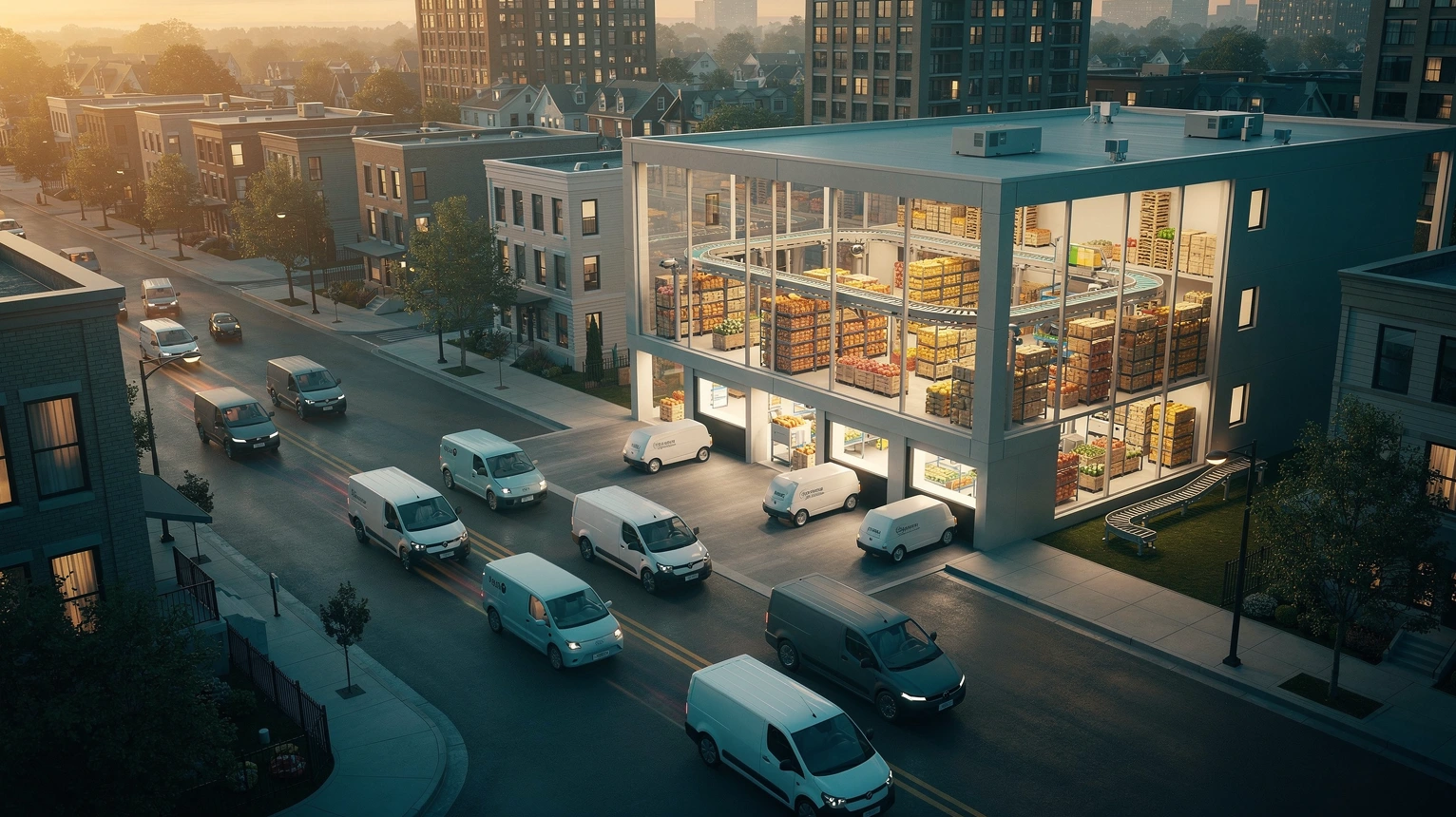
Grocery delivery looks simple from the kitchen table: tap an app, get bags on the porch. Inside the warehouse and on the road, the math is brutal. After more than a decade of subsidized growth, the question for 2026 is not whether households will order groceries online (millions already do, every week), but who in the value chain can actually run the model at a profit.
This guide breaks down grocery delivery economics for retail and e-commerce teams. We map the costs, the revenue lines, the players that print money, the ones that bleed cash, and the structural shifts that decide whether the next five years repeat the past or look very different. The pricing examples are illustrative ranges from public filings, investor calls and trade press; your unit economics will depend on basket size, region, density and labor model. For a wider view of the category, see our pillar on the state of retail, which sets the context this analysis sits inside.
In short
- Last-mile delivery is the single largest cost lever, often 40 to 60 percent of the variable cost stack on a typical US order.
- Basket size matters more than frequency. Orders under $35 rarely cover pick, pack and delivery, even with fees and tips.
- Retail media and membership fees are the two real profit engines, not delivery markups on individual baskets.
- Dark stores and micro-fulfillment only pay off where density is high enough to fill 6 to 12 orders per labor hour.
- Marketplaces (Instacart, DoorDash) take the customer relationship, while grocers get volume but thin margin. Owned channels are the long game.
Why grocery delivery is harder than any other e-commerce category
Grocery is the worst-behaved e-commerce category by almost every measure. Baskets are heavy. Items are fragile, frozen, refrigerated and ambient on the same ticket. Substitutions are constant because real-time inventory is rarely accurate to the unit. Customers care about specific brands, ripeness of produce and the exact thickness of deli meat. And the average order value is low relative to non-grocery e-commerce, with US grocery baskets typically landing in the $60 to $110 range, while general merchandise online averages well above that on a per-order basis.
On top of that, the delivery window is tight. Frozen pizzas tolerate maybe 20 minutes outside a freezer in summer before quality drops. That forces same-day or even one-hour service, which kills the route density that makes parcel delivery cheap. A UPS van might drop 120 to 200 packages per route. A grocery driver running one-hour windows often drops 2 to 4 orders per trip, sometimes just one. That ratio decides the whole P&L.
Key terms used throughout this guide
- UPT (units per transaction): average items in a basket. Grocery is typically 25 to 45.
- Drop density: deliveries per route hour. Higher is better; under 2 is usually unprofitable.
- Pick rate: items a personal shopper picks per hour in store or warehouse. Strong operators target 80 to 140.
- Take rate: commission a marketplace charges the grocer per order, often 7 to 15 percent of basket plus fees.
- Contribution margin: revenue minus all variable costs on the order itself, before fixed overhead.
The cost stack of a typical grocery delivery order
Let us walk through where the money actually goes on a single $80 grocery basket delivered to a US suburb. Numbers are illustrative midpoints based on public filings and trade reporting; real figures vary by region, density, labor model and fuel cost.
| Cost line | Typical range per order | Notes |
|---|---|---|
| Cost of goods sold | $60 to $68 | Grocery COGS runs roughly 72 to 82 percent of basket revenue. |
| Pick and pack labor | $3.50 to $6.00 | At 100 picks per hour and a $20 fully loaded wage, a 35-item basket costs about $7 to pick. Multi-order picking cuts that. |
| Last-mile delivery | $7 to $14 | Single-stop suburban routes; lower in dense urban grids, higher in rural ones. |
| Payment processing and chargebacks | $1.50 to $2.50 | Roughly 2 to 3 percent of basket on card and wallet rails. |
| Bags, ice, totes, returns | $0.50 to $1.20 | Insulated bag rotation is a real line item for chilled and frozen. |
| Customer service and refunds | $0.80 to $1.50 | Substitution complaints drive most contact volume. |
| Tech and app overhead allocated | $0.50 to $1.50 | Lower at scale. |
Add the variable lines and a typical order carries roughly $13 to $26 of non-COGS cost. Revenue beyond the basket itself usually comes from delivery fees ($3 to $10), service fees ($2 to $6), tips (driver-bound, not margin) and the retail markup baked into shelf prices online. In most published models, the contribution margin on a one-off basket sits between negative $3 and positive $4. That is why nobody got rich on individual orders.
Who actually makes money in grocery delivery
Three groups have a credible path to profit in 2026, and they make money in different ways. Understanding which lever a player pulls is the fastest way to evaluate any grocery delivery business.
1. Membership-driven grocers
Costco, Sam’s Club and Walmart+ run on annual or monthly fees that subsidize the unit economics of any single order. A $98 Walmart+ member who places 30 to 50 delivery orders a year effectively prepays the delivery cost; Walmart breaks even on the variable side and pockets the membership fee as near-pure margin. Amazon Fresh and Whole Foods on Prime work the same way. The membership is the moat.
2. Retail media and ads
The dirty secret of grocery delivery is that the most profitable line is not delivery; it is the ad slots inside the app. Instacart’s investor disclosures show ad revenue running at gross margins well north of 80 percent, while transactions run thin or negative. Kroger, Walmart Connect, Albertsons Media Collective and Sam’s Club MAP have built ad networks that monetize search results, sponsored product placements and category sponsorships funded by CPG brands. That is where the real EBITDA lives. For grocers without scale to run their own retail media, this profit pool is closed.
3. Marketplace aggregators on density
Instacart, DoorDash, Uber Eats and Gopuff make money when they can stack multiple orders per trip and charge fees on both sides. Their gross margins on the transaction itself are still single-digit at best, but their advertising and white-label fulfillment businesses (powered by the same data flywheel as the marketplace) carry the company. Where they cannot achieve drop density, they lose money and quietly exit the market.
Examples from US retail and e-commerce
The clearest way to see grocery delivery economics is to compare three real US operating models that publish enough data to analyze.
Walmart runs an integrated stack: store-pick, store-handoff and Spark Driver crowdsourced last mile, backed by Walmart+ membership and a large retail media business. Public disclosures put US e-commerce on a positive contribution margin since 2024, with ads and membership the explicit drivers. Walmart can also use stores as fulfillment nodes that are already paid for, so the marginal cost of adding a delivery order to existing store labor is far lower than a pure-play dark store operator.
Instacart is the marketplace case. It does not own inventory and pays personal shoppers as gig workers. The platform takes commissions from grocers, fees from shoppers and ad dollars from CPG brands. Its profitability inflected once ads scaled. Without ads, the transaction model alone would still be unprofitable, which is exactly what the S-1 disclosed in 2023 and subsequent filings reaffirmed.
Gopuff represents the inventory-owning quick-commerce model: small warehouses (micro-fulfillment centers, or MFCs) in urban areas, 15 to 30 minute delivery on a curated 4,000 SKU assortment. Gopuff has spent years tuning store-level economics and shutting cities where density did not get there. Public reporting suggests that mature, high-density stores generate positive contribution, but the company-wide P&L still depends on advertising and B2B fulfillment for growth. For background on how the broader category is repositioning, our note on the 2026 retail industry outlook traces where investment and consolidation are heading.
How fulfillment models change the math
The fulfillment node decides almost everything about cost. There are four main models in use across the US grocery sector in 2026, and they trade off speed, range, capex and unit economics in very different ways.
| Model | Pick rate (items/hr) | Capex per node | Speed promise | Best for |
|---|---|---|---|---|
| Store-pick from existing supermarket | 60 to 110 | Low (under $250K) | 2 hours to next day | Wide assortment, low extra capex, slower picking |
| Dark store (dedicated mini-warehouse) | 100 to 160 | $1M to $3M | 30 to 120 min | Dense urban, high-frequency baskets |
| Automated MFC (Ocado, AutoStore, etc.) | 200 to 400 | $10M to $40M | Same day | High volume, regional hubs, long ROI |
| Third-party fulfillment (Instacart, etc.) | n/a (outsourced) | None | 1 to 4 hours | Smaller chains without their own logistics |
Each model implies a different P&L. Store-pick is cheap to start but ties up store associates and is hard to scale beyond roughly 10 percent of store volume before in-store shoppers get crowded out. Dark stores remove that conflict but require enough orders per square foot to amortize rent. Automated MFCs only make sense above maybe 1,500 to 3,000 orders per day per node; below that, the robotics never pay back. Third-party fulfillment is the right answer for regional chains that cannot justify their own logistics and would rather pay a commission to access volume. For a deeper look at how grocers compete on freshness inside these networks, see our explainer on fresh food supply chains.
How customer behavior shapes the P&L
Operations math is half the story. The other half is how customers actually behave, and the patterns are stronger predictors of profit than most operating teams admit. Five behavioral patterns recur in nearly every published grocery delivery cohort study.
- Frequency is sticky once it crosses a threshold. Households that order at least twice a month in their first 90 days tend to keep ordering at that cadence for years. Below that cadence, churn climbs sharply after the first six months.
- Basket size grows with trust. First baskets tend to be small and skewed toward pantry staples. By order five or six, the share of fresh, meat and produce climbs, taking the average basket from roughly $55 to closer to $95 in many published cohorts.
- Members order across more dayparts. Non-members concentrate orders on Sunday afternoons. Members spread orders across weekdays, which is exactly the demand profile fleets need to keep drop density up.
- Substitutions drive churn more than missed delivery windows. A wrong cheese is more memorable than a 20-minute late slot. Operational investment skewed toward picker training and packaging tends to outperform investment in raw speed.
- App-first customers spend more. Native app users tend to outspend mobile-web users by 15 to 25 percent on a like-for-like basket, in part because push notifications and saved lists make reorder frictionless.
The strategic implication is that customer acquisition cost is best evaluated against twelve-month basket margin, not first-order contribution. Most published cohorts only turn positive on a fully loaded basis in months 4 to 9. A grocer that walls off short-term spend on the basis of break-even-by-order-one is almost certainly underinvesting.
The last-mile equation
Last mile is where most grocery delivery businesses live or die. The classic equation runs: cost per drop = (driver wage + vehicle cost per hour) divided by drops per hour. A $25 per hour fully loaded driver who completes 3 drops per hour costs $8.33 per drop. The same driver at 2 drops per hour costs $12.50. At 1 drop per hour, $25. Density is everything.
Three levers move drop density in the right direction:
- Wider delivery windows. A 2-hour window lets the routing algorithm cluster stops. A 30-minute promise forces hub-and-spoke trips with low density.
- Order batching. Picking multiple orders on one trip down the same supermarket aisles cuts pick labor 25 to 40 percent and travel time on the last mile.
- Crowdsourced fleets with surge pricing. Spark, Roadie, DoorDash Drive and Uber Direct match driver supply to demand without paying full-time wages during low periods. Trade-offs include compliance risk and quality variance.
Quick-commerce promises (10 to 20 minute delivery) inverted these levers and lost billions of dollars between 2020 and 2024 doing it. The 2026 picture is more sober: most quick-commerce players now operate 30 to 45 minute SLAs in narrow city zones, or they exited the business. For statistical context on US e-commerce penetration that frames these economics, the US Census Bureau quarterly e-commerce report remains the cleanest public benchmark.
Tools, partners and vendors worth knowing
The grocery delivery stack is a layered ecosystem. Most US grocers in 2026 buy or rent at least four or five of the following components rather than build them all. Our companion piece on tools and vendors for supermarkets and grocers in 2026 goes deeper on selection criteria; this is the short version.
- Storefront and search: Mercatus, Rosie, Swiftly, custom builds on Shopify Plus or commercetools.
- Fulfillment software: Symphony Retail, Relex, Blue Yonder for forecasting; Take Off Technologies, Fabric, Ocado Smart Platform for automated picking.
- Last-mile orchestration: Bringg, FarEye, DispatchTrack, Onfleet for routing and dispatch.
- Crowdsourced fleets: Walmart Spark, Roadie (now part of UPS), DoorDash Drive, Uber Direct.
- Retail media: Criteo Retail Media, Citrus Ad (Epsilon), Pacvue, Skai, or in-house networks for the largest chains.
- Payments and fraud: Stripe, Adyen, Forter, Signifyd.
The right combination depends on scale and ownership of the customer relationship. Smaller regional grocers usually plug into Instacart Connected Stores and a payment processor and accept the take rate as the cost of playing. Mid-market chains (200 to 800 stores) typically own the storefront, lean on Bringg-class orchestration and use a mix of in-house and crowdsourced drivers. National players build most of the stack themselves and treat retail media as a strategic asset, not a vendor relationship. The pillar on the state of retail covers how these tiers are evolving across the broader sector.
Common mistakes and how to avoid them
The same handful of strategic and operational errors show up across grocers trying to grow a delivery business. They are well documented in trade press, investor calls and (often) in the post-mortems of failed quick-commerce startups. Most fall into five buckets.
- Subsidizing baskets that will never repeat. Free first-delivery offers attract one-time bargain hunters, not loyal members. Targeted offers tied to membership signup convert at far higher lifetime value.
- Promising speed the network cannot deliver. A 30-minute promise without dark-store density forces dedicated single-drop trips. Set delivery windows that match actual fleet capacity.
- Treating retail media as an afterthought. Ads should be designed into the storefront from day one, not bolted on later. Without media revenue, transaction margin alone will not carry the business.
- Ignoring fresh-quality complaints. Substitution and produce-quality issues drive most refunds and the bulk of churn. Investing in trained pickers and tighter freshness SLAs has a clearer ROI than most marketing spend.
- Outsourcing the customer too early. Marketplaces deliver volume, but the customer relationship and the data sit with them. Grocers that defer building owned channels often find themselves locked out of the loyalty economics that drive long-term profit.
Regulatory and labor factors that quietly reshape the model
Most grocery delivery analyses focus on operations and ignore regulation, but the cost of labor compliance is now a significant line in the variable stack. Three regulatory tracks deserve attention.
Gig worker classification. California’s Proposition 22, New York City’s minimum-pay rules for app-based delivery workers and similar measures in Seattle and Minneapolis have raised the floor cost per delivery hour by 15 to 35 percent in affected markets. Operators that designed their unit economics on the old rates have had to compress margins, raise fees or exit. Watch state-level activity, because the next two years will likely add several more cities and states to the affected list.
Food safety and cold chain rules. The US Food Safety Modernization Act sets traceability requirements that apply to many fresh and frozen categories. Compliance pushes operators toward better packaging, temperature logging and audit-ready data, all of which add small per-order cost but reduce long-tail recall and complaint exposure. For background on the broader regulatory framework, the FSMA overview on Wikipedia is a fast primer.
SNAP online acceptance. The USDA Supplemental Nutrition Assistance Program’s online pilot has matured into a national program. Grocers accepting SNAP online have access to a meaningful incremental customer base, but the operational requirements (eligible-item flagging, payment-rail integration, fraud controls) are non-trivial. National players have absorbed the cost; regional players sometimes still find the integration uneconomic and skip it, leaving demand on the table.
How to evaluate a grocery delivery business in five questions
If you are sizing up a delivery business as an investor, retailer, supplier or operator, these five questions cut through the marketing slides quickly.
- What is the contribution margin per order at the average basket size, with no membership or ad revenue included?
- What share of orders are first-party (owned site/app) vs marketplace? Owned orders are roughly 3 to 6x more profitable on a fully loaded basis.
- What is the attach rate of retail media impressions per session, and what is the average CPM the network commands?
- What is the drop density (deliveries per route hour) in mature markets, and how does it trend over the past four quarters?
- What share of households served are members? Member retention above 80 percent annually is a signal of structural moat; below 65 percent is a warning.
For a wider view of how these signals feed into the overall sector picture, the pillar on the state of retail ties grocery delivery into the rest of the e-commerce and store-based ecosystem.
FAQ
Is grocery delivery profitable for grocers in 2026?
For most national grocers, yes, but not on the basket itself. Profit comes from a combination of membership fees, retail media and incremental basket size from delivery customers. Regional chains relying purely on transaction margin still struggle.
How much of grocery delivery revenue comes from delivery fees?
For most operators, delivery and service fees cover only 50 to 80 percent of the variable cost of fulfilling the order. The rest is funded by basket margin, membership fees and ads. Few operators run delivery as a standalone profit center.
Why do delivery apps add so many fees at checkout?
Because the headline delivery fee rarely covers actual cost. Service fees, small-basket fees, fuel surcharges and busy-time premiums are how marketplaces and grocers close the gap without raising shelf prices. Membership programs increasingly bundle these fees away in exchange for an annual or monthly subscription.
What is a healthy basket size for online grocery?
In US suburban markets, baskets above $75 are generally above breakeven once you include all variable costs. Below $35, almost no model is profitable. Quick-commerce operators target higher frequency at smaller basket sizes, betting on long-term loyalty and ad revenue.
Are dark stores still a good idea?
Dark stores work where order density per square foot is high enough to amortize the rent and labor. They are mostly an urban model. In suburban and rural areas, store-pick or hybrid models almost always beat them on unit economics.
How does Instacart make money if delivery margins are thin?
Advertising, primarily. CPG brands pay for sponsored search results and category placements in the Instacart app. That ad business runs at very high gross margin and now drives the bulk of company profit. Transaction commissions and fees cover much of the variable cost but rarely produce strong margins on their own.
Will quick-commerce (15 to 30 minute delivery) survive long term?
In dense urban markets, probably yes, on narrower assortments and at sustainable SLAs around 30 to 45 minutes rather than 10 minutes. The pure 10-minute promise has mostly collapsed. Sustainable players combine convenience baskets with strong ad networks and B2B fulfillment to spread the fixed cost.
How should a regional grocer think about Instacart vs building its own delivery?
Use Instacart and similar platforms to access volume and prove demand, but invest in an owned storefront in parallel. The biggest long-term risk is letting a marketplace own the customer relationship. Membership programs, owned data and direct loyalty are what compound over time.