
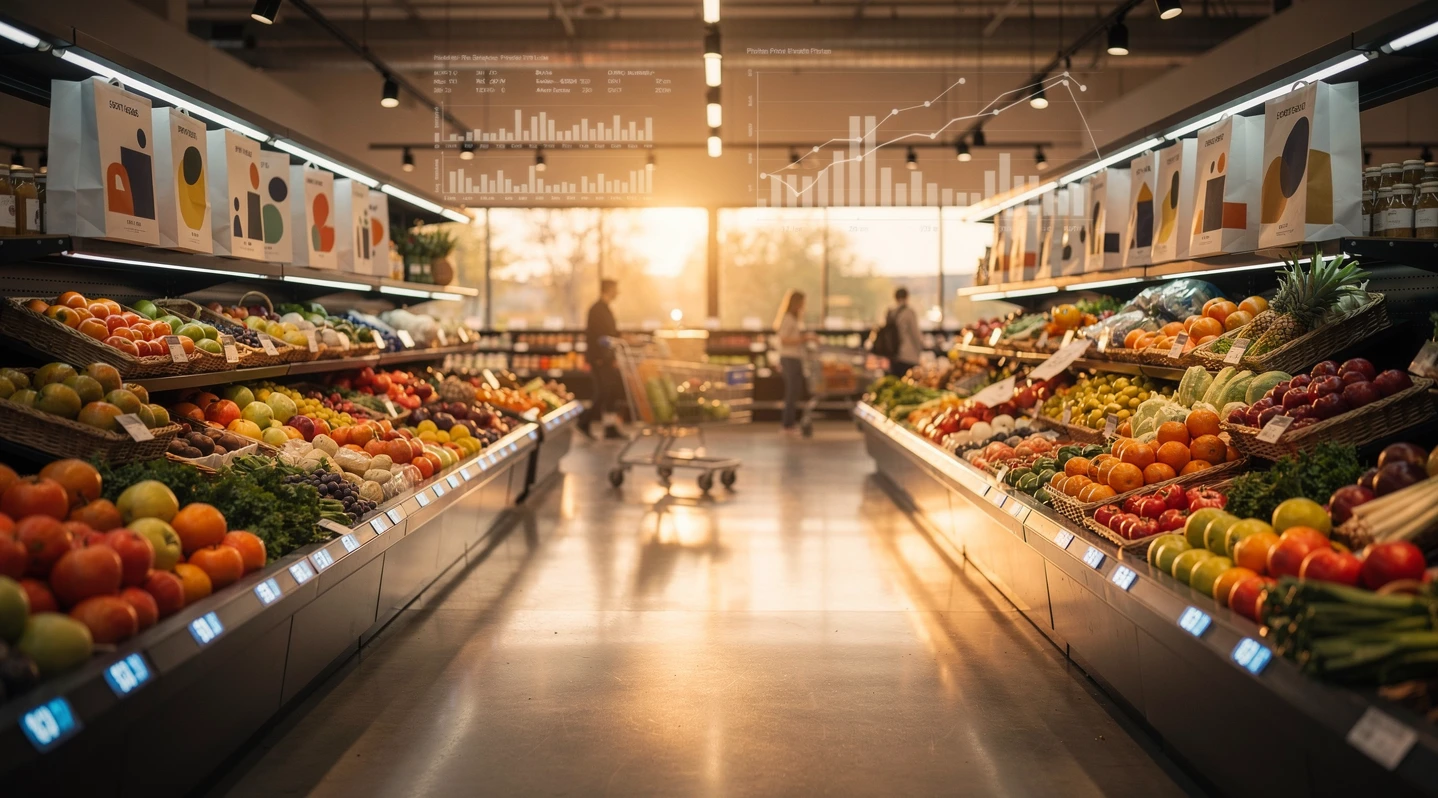
The US supermarket sector enters 2026 with thinner margins, smarter shoppers, and a digital aisle that finally rivals the physical one. The state of retail: department stores, grocers and experiences mapped the wider category. This piece zooms into the grocery floor: what a working supermarket strategy 2026 actually looks like for chains, regionals, and independents trying to keep customers and protect cash flow.
In short
- Private label is the margin engine. US grocers are pushing own-brand share above 25% to defend gross profit as national brand price gaps narrow.
- Delivery is no longer optional, but it must pay. Profitable e-commerce now means picking fees, paid membership, or third-party tie-ups, not free same-day everything.
- Retail media is the new endcap. On-site ads, app placements, and shopper data licensing are pulling 5 to 7% net margins on top of grocery’s flat 2 to 3%.
- Hard discount is the threat to plan around. Aldi and Lidl are still opening stores while legacy chains close underperforming boxes.
- Loyalty data beats loyalty discounts. The chains winning in 2026 are using first-party data for personalized offers, not flat 10% off coupons.
Why supermarket strategy matters in 2026
Grocery is a roughly $1.6 trillion category in the United States, and yet operating margins for traditional supermarkets sit between 1 and 3%. That tiny cushion is what makes supermarket strategy 2026 a real operating question, not a marketing slide. A 50 basis point shift in shrink, labor, or basket size can flip a quarter from profit to loss.
Three forces are squeezing the model at once. Hard discounters are taking share from price-sensitive shoppers, club and mass channels (Costco, Walmart, Sam’s Club) keep widening their grocery share of wallet, and digital ordering has structurally raised the cost of getting groceries to a household. Chains that ignored one of these forces in 2023 are restructuring in 2026.
The flip side is that grocery has never had more tools to fight back. First-party shopper data, retail media networks, and connected pricing software let a regional chain price like a national one. Independent grocers using cooperative buying (think Wakefern, Associated Wholesale Grocers, Unified Grocers) can match Kroger on private label cost while keeping local product mix.
For deeper context on which chains are best positioned, see our breakdown of Kroger versus Walmart for grocery in the US and the discount side in discount grocers Aldi and Lidl: the playbook explained.
Key terms and definitions
Before unpacking the playbook, a few terms that get used loosely in trade press but mean specific things to operators.
- Private label (own brand): Products sold under the retailer’s name (Kroger’s Simple Truth, Walmart’s Great Value, H-E-B’s Hill Country Fare). Margins typically run 5 to 15 points above comparable national brands.
- Retail media network (RMN): A retailer-owned advertising platform that monetizes shopper data and digital shelf placement. Kroger Precision Marketing, Walmart Connect, and Albertsons Media Collective are the largest grocery RMNs.
- Click and collect (BOPIS): Buy online, pick up in store. The cheapest fulfillment path for digital grocery because the customer does the last mile.
- Micro-fulfillment center (MFC): A small automated warehouse, often inside or attached to a store, that picks online orders faster than humans walking the aisles.
- Shrink: Inventory lost to theft, damage, and spoilage. In US supermarkets, shrink runs 2 to 3% of sales and is rising in urban formats.
- Comparable store sales (comps): Year-over-year sales growth for stores open at least 13 months. The metric Wall Street uses to grade grocery operators.
How supermarket strategy works in practice today
A modern US supermarket runs on six interlocking levers. Pull one without adjusting the others and margin disappears.
Assortment and private label. The biggest 2026 shift is depth, not breadth. Chains are cutting SKUs (Kroger trimmed roughly 7,000 SKUs in 2024 to 2025) and replacing them with private label tiers: entry value, mainstream, and premium. The premium private label tier (Simple Truth Organic, Walmart Bettergoods, Target Good & Gather Signature) is the real profit driver.
According to the private label category on Wikipedia, own-brand share in US grocery passed 20% by unit volume in 2024 and is climbing. European grocers run 35 to 45%, so US chains still have runway.
Pricing and promotions. Mass-market price-matching is dead. The 2026 model is personalized: app users see different offers than non-app users, loyalty members get sharper prices on items the data says they buy weekly. Software vendors like Eagle Eye, Dunnhumby, and 84.51° sit underneath most of this work.
Digital and delivery economics. First-party apps with paid membership (Kroger Boost, Walmart+, Sam’s Plus, Albertsons FreshPass) are the only consistently profitable digital channel. Third-party (Instacart, DoorDash, Uber Eats) drives volume but is breakeven at best for the grocer after picking labor and commission.
Store footprint and format. The 80,000 square foot suburban supercenter is no longer the default. Chains are testing 15,000 to 25,000 square foot urban formats (Whole Foods Daily Shop, Target small-format, Aldi compact), and closing underperforming legacy boxes. Kroger and Albertsons each closed dozens of locations in 2025.
Loyalty and data. A grocery loyalty program in 2026 is really a data product. The discount is the bait. The value is shopper-level purchase history that powers personalization, retail media targeting, and category planning with CPG partners.
Retail media. The endcap, the shelf wobbler, and the circular have moved into the app. CPGs now spend a meaningful slice of trade dollars buying ad placements on the retailer’s own digital surfaces. Margins on retail media run 50 to 70% gross.
Traditional versus modernizing supermarket models in 2026
The fastest way to see the strategy shift is to compare a legacy supermarket model with what 2026 leaders look like across the same levers.
| Lever | Traditional model (pre 2020) | 2026 modern model |
|---|---|---|
| Assortment | 40,000 to 50,000 SKUs, national brand heavy | 30,000 to 35,000 SKUs, 25 to 30% private label |
| Pricing | Weekly flyer, Hi-Lo promotions | Personalized digital offers, dynamic shelf pricing |
| Digital | Outsourced to Instacart | First-party app, paid membership, MFC fulfillment |
| Store format | One size suburban supercenter | Mixed: large for stock-up, small urban for fill-in |
| Loyalty | Plastic card, flat 10% off | App-based, personalized, fuels retail media |
| Revenue mix | ~98% grocery sales | 90 to 93% grocery, 5 to 8% retail media and services |
| Margin profile | 1 to 2% operating | 2 to 4% blended, lifted by media and private label |
The chains that read like the right column on this table (Kroger, Walmart, H-E-B, Wegmans, Publix in most categories) are the ones taking share. The chains stuck in the left column are the merger targets and store-closure headlines.
Common mistakes and how to avoid them
Most failing supermarket strategies in 2026 share the same handful of mistakes. They are not mysterious. They are familiar pressures that operators kept deferring until they compounded.
- Treating digital as a cost center, not a channel. Outsourcing delivery to Instacart was a survival move in 2020. Keeping it as the primary digital experience in 2026 hands the shopper relationship (and the data) to a competitor.
- Underinvesting in private label premium tiers. Value-tier private label defends the basket. Premium private label drives margin and brand affinity. Chains that only built value tiers cap their upside.
- Flat loyalty discounts. A blanket 10% off rewards your best customers for behavior they would do anyway and trains everyone to wait for the promotion. Personalized, behavior-triggered offers beat flat discounts on every measurable KPI.
- Ignoring shrink in urban formats. Urban small-format stores are running 4 to 6% shrink versus 2% in suburban. Tech (computer vision, RFID, locked cases) needs a clear ROI model before rollout, but doing nothing is not the answer.
- Sub-scale retail media. A retail media network only works above a certain shopper count (roughly 5 to 10 million identified loyalty members). Below that threshold, work with an aggregator (Criteo, Microsoft Advertising) rather than building solo.
- Holding underperforming stores too long. Real estate is sentimental but cash is not. Chains that closed slow stores in 2024 to 2025 are now reinvesting that capital in remodels, MFCs, and new private label lines.
- Skipping the basics: cleanliness, in-stocks, friendly checkout. Every executive survey ranks technology as a top priority. Every shopper survey ranks cleanliness, fresh quality, and fast checkout. Strategy that ignores the second list loses to chains that get the basics right.
Examples from US supermarkets and grocers in 2026
Real operating examples make the abstract strategy concrete. Each of these chains is doing something specific that competitors are studying.
Kroger. The clearest case study in the modern model. Private label sits above 26%, Kroger Precision Marketing is one of the largest grocery retail media networks in the US, and 84.51° supplies the data spine for personalization. Even after the failed Albertsons merger, Kroger’s strategy remained intact: deepen own-brand, expand digital margin, and close the bottom decile of stores.
H-E-B. A privately held Texas regional that consistently ranks first or second in US grocery customer satisfaction. Its strategy: deep local product mix, aggressive own-brand including Texas-specific lines, and a digital app that handles curbside, delivery, and meal planning in one experience. H-E-B proves regional scale can still win.
Publix. The Southeast incumbent’s strategy is service plus assortment, not price leadership. Publix accepts thinner price-perception scores in exchange for higher dollars per visit and the highest grocery customer loyalty scores in the country. The lesson: pick a quadrant and commit.
Wegmans. A premium experiential model: prepared foods, restaurant-grade fresh, store openings treated as community events. Wegmans demonstrates that grocery can compete with restaurants for share of stomach, not just with other grocers for share of cart.
Aldi. Roughly 2,500 US stores by 2026, mostly 12,000 to 15,000 square feet, with 90% private label assortment. The Aldi playbook (limited SKU count, deep private label, no-frills operations) is the single most disruptive force pressuring legacy supermarkets on price.
Sprouts Farmers Market. Specialty produce-led format that grew comps in the high single digits through 2024 to 2025 by targeting the health-conscious shopper segment that traditional supermarkets undermerchandise. Sprouts shows that a clear positioning can beat scale.
Trader Joe’s. A roughly 95% private label assortment in a 12,000 to 15,000 square foot footprint, with no loyalty program and no digital channel beyond a basic site. Trader Joe’s proves that an extremely tight strategy (curated SKUs, cult brand, fast checkout, no frills) still wins basket share in 2026 without any of the technology layers most operators consider mandatory.
Albertsons. After the failed Kroger merger, Albertsons pivoted to a standalone strategy emphasizing Own Brands growth (Signature Select, O Organics, Lucerne), Albertsons Media Collective scale, and FreshPass paid membership. The chain offers the cleanest live test of whether a number-two national grocer can compete with Walmart and Kroger on the modern model.
Costco. Not a supermarket strictly, but the chain every supermarket strategy needs to account for. Costco’s Kirkland Signature private label crossed $80 billion in annual sales by 2024, larger than most national CPG brands. The Costco model (paid membership, treasure-hunt assortment, $1.50 hot dog as price perception anchor) is so internally consistent that competing on the same lever rarely works. Supermarkets win against Costco on proximity, fresh, and small-basket convenience, not on price or pack size.
For shopper demographics behind these strategies, the US Census income data is the source most grocers use to map trade-area buying power before signing a lease.
Tools, partners and vendors worth knowing
A 2026 supermarket strategy depends on a stack of vendors more than ever. The build versus buy question favors buy in most categories because the technology compounds faster than internal teams can keep up. The pieces that matter:
- Data and personalization: 84.51° (Kroger), Dunnhumby (Tesco roots, now serving US clients), Eagle Eye, Aki Technologies.
- Retail media platforms: Criteo Retail Media, CitrusAd, Microsoft Advertising (PromoteIQ), Pacvue.
- E-commerce and MFC: Instacart Connected Stores, Ocado Smart Platform, Takeoff Technologies, Fabric, AutoStore.
- Pricing and category management: Symphony RetailAI, Revionics, Nielsen Connect, NielsenIQ.
- Front-end (POS and self-checkout): NCR Voyix, Toshiba Global Commerce Solutions, Diebold Nixdorf, Mashgin (computer-vision checkout).
- Loss prevention and shrink: Sensormatic (Johnson Controls), Everseen, AiFi for autonomous stores.
- Workforce and labor: Legion, WorkJam, UKG Pro, Reflexis.
- Sustainability and waste: Afresh, Shelf Engine, Flashfood, Too Good To Go.
Smaller regional chains and independent grocers typically pick two or three of these and partner with a buying cooperative (Wakefern, Associated Wholesale Grocers, Unified Grocers, KeHE Distributors) to access enterprise-grade tools. For broader vendor coverage across retail and e-commerce categories, see our running list in tools and vendors for breaking in 2026.
How US shopper behavior is changing the supermarket model
Operators can build the cleverest pricing engine in the world, but the strategy only works if it tracks how households actually shop in 2026. Three behavioral shifts are doing the most damage to outdated assumptions.
The basket has split into trips. The single weekly stock-up trip is fading. The average US grocery household now spreads spend across roughly 2.5 banners per month: one large stock-up (often club or supercenter), one or two mid-week fill-in trips (traditional supermarket or hard discount), and a growing slice of delivery for heavy and bulky items. A supermarket strategy designed around “owning the weekly basket” is fighting a battle that no longer exists.
Price perception is asymmetric. Shoppers anchor their price perception on 50 to 100 known-value items (KVIs): milk, eggs, bananas, chicken breast, store-brand pasta, a small set of cereal SKUs, and so on. Win on those and the rest of the basket can carry healthy margins. Lose on those and no amount of promotional spend on the back half of the store recovers the perception.
Health, freshness, and provenance matter at a new tier. The premium end of the shopper base is willing to pay for produce origin transparency, animal welfare standards, and organic certification. The value end has tightened on calories per dollar. The middle, which used to define the supermarket model, is shrinking. A 2026 assortment plan that ignores either end loses share on both sides.
The chains adjusting fastest are the ones treating shopper data as the planning input rather than as a marketing afterthought. That work cycles directly back to the broader state of retail discussion, where personalization is the connective tissue across every category, not only grocery.
Sustainability, ESG, and the supermarket bottom line
Grocery sustainability used to be a marketing line. In 2026 it is a cost line and a regulatory line. California’s SB 1383 organics diversion rules, growing extended producer responsibility (EPR) for packaging in states like Colorado, Oregon, and Maine, and federal disclosure pressure on Scope 3 emissions all touch the supermarket P&L.
The practical playbook for supermarket sustainability in 2026 is narrower than the glossy reports suggest. The five moves that pay back inside two years for most chains:
- Refrigeration retrofit. Replacing R-404A systems with CO2 transcritical or propane (R-290) units cuts refrigerant leak liability and energy cost. Payback ranges from 18 to 36 months depending on store size.
- Demand forecasting for fresh. Vendors like Afresh and Shelf Engine cut produce and meat shrink by 20 to 40% in pilot stores. Shrink reduction goes straight to margin.
- Flashfood or Too Good To Go partnerships. Move close-dated product through a discounted secondary channel rather than write it off.
- Private label packaging redesign. Lighter, more recyclable packaging cuts freight cost and reduces EPR fees in regulated states.
- Renewable energy PPAs. Power purchase agreements lock long-term energy cost and unlock state and federal tax credits.
Sustainability is not the headline of a 2026 supermarket strategy, but it is increasingly the floor under it. Operators who treat it as a cost-of-doing-business question rather than a CSR question protect margin and stay ahead of the regulatory curve.
Independents and regional chains: where the strategy diverges
The playbook above leans national, but most US supermarkets are not national. There are roughly 40,000 grocery stores in the US, and well over half are operated by regional chains, independents, and cooperatives. For those operators, copying Kroger’s strategy line for line is a recipe for capital destruction. The 2026 playbook for an independent or regional grocer looks different in a few specific ways.
Lean into local. A regional chain’s structural advantage is local relevance: assortment tuned to a metro area, supplier relationships a national chain cannot replicate, and community ties that loyalty data alone cannot manufacture. H-E-B in Texas, Wegmans in the Northeast, Heinen’s in Cleveland, and Stew Leonard’s in Connecticut all built durable strategies around being unmistakably of a place. National private label cannot copy that.
Buy collectively, sell uniquely. Cooperative buying groups (Wakefern under the ShopRite banner, Associated Wholesale Grocers, Unified Grocers, KeHE Distributors, Topco) let independents access pricing and private label comparable to Kroger. The independent’s job is then to differentiate at the front of the store while the buying group handles the back.
Pick two or three vendors, not twelve. A 15-store regional chain cannot run the full stack of 84.51°, Eagle Eye, Symphony, Sensormatic, Legion, and Afresh. Pick the two or three vendors aimed at the chain’s biggest leak (shrink, fresh waste, labor productivity, or pricing) and depth-deploy them. Breadth of tooling without depth of use is the most common money pit in mid-size grocery.
Loyalty for data, not discount theater. A small chain’s loyalty program should be ruthless about identified-shopper penetration even if the discount itself is modest. Knowing what 70% of your sales look like at the shopper level beats giving away 5% in margin to drive a card swipe rate that never gets used for decisions.
What a 12-month supermarket strategy roadmap looks like
For an operator building a 2026 plan from scratch, the sequencing matters as much as the choices. The proven order most successful regional chains followed since 2022:
- Quarter 1. Audit shrink, in-stocks, and labor productivity at store level. Fix the bottom 10% of stores or close them.
- Quarter 2. Launch or relaunch the loyalty app with paid membership tier. Begin collecting identified shopper data at meaningful scale.
- Quarter 3. Expand private label, especially in premium tier. Renegotiate top 20 CPG contracts using updated category data.
- Quarter 4. Stand up retail media offering (solo or via aggregator). Begin testing personalized pricing on app users.
This is not a glamorous roadmap. It is what working grocery operators actually do because each quarter funds the next. The further back to the state of retail playbook reminds us, grocery has the lowest margin of any major retail category and the strategy that wins is the one that compounds small advantages over multiple quarters, not the one that bets everything on a single transformation.
Frequently asked questions
What does a successful supermarket strategy in 2026 look like in one sentence?
A defensible private label program above 25%, a first-party digital channel with paid membership, a retail media revenue line, and a store footprint matched to format demand rather than legacy real estate.
Is the traditional supermarket dying?
No, but the average mediocre supermarket is. Chains that pick a clear position (price, service, specialty, or convenience) and invest behind it continue to grow comps. Chains stuck between positions are losing share to club, mass, and discount.
How profitable is grocery delivery in 2026?
First-party app delivery with paid membership runs roughly breakeven to slightly profitable for most chains. Third-party marketplace delivery (Instacart, DoorDash, Uber Eats) is usually breakeven to negative once picking labor and commission are included. The profitable digital channel is click and collect.
What private label share should a regional supermarket target?
15 to 20% as a baseline, 25 to 30% as a stretch goal over three years. Chains pushing 35% plus typically need both internal scale and a sourcing partnership (cooperative buying or contract manufacturing relationships) to maintain quality.
Are hard discounters (Aldi, Lidl) a real threat to legacy supermarkets?
Yes, and the threat is structural rather than cyclical. Aldi alone plans to keep opening 80 to 100 US stores per year through 2027. Every Aldi opening pulls 4 to 8% of nearby supermarket traffic permanently. Legacy chains need a clear answer (private label, format, service) on every overlapping trade area.
Do I need to build my own retail media network?
Only above roughly 5 to 10 million identified loyalty shoppers. Below that scale, partner with an aggregator like Criteo Retail Media or Microsoft Advertising. The infrastructure cost of building solo is hard to justify without that audience size.
How important is store cleanliness and friendly service versus technology investment?
More important. Every grocery shopper survey in 2024 to 2025 ranked cleanliness, fresh quality, and checkout speed above any digital feature. Technology compounds those basics. It does not replace them.
What KPIs should a supermarket CEO watch in 2026?
Identified shopper penetration (percentage of sales tied to a known shopper), private label share, retail media revenue per dollar of grocery sales, comp sales by digital and in-store, and shrink as percentage of sales. The first three are the leading indicators for the next two.