
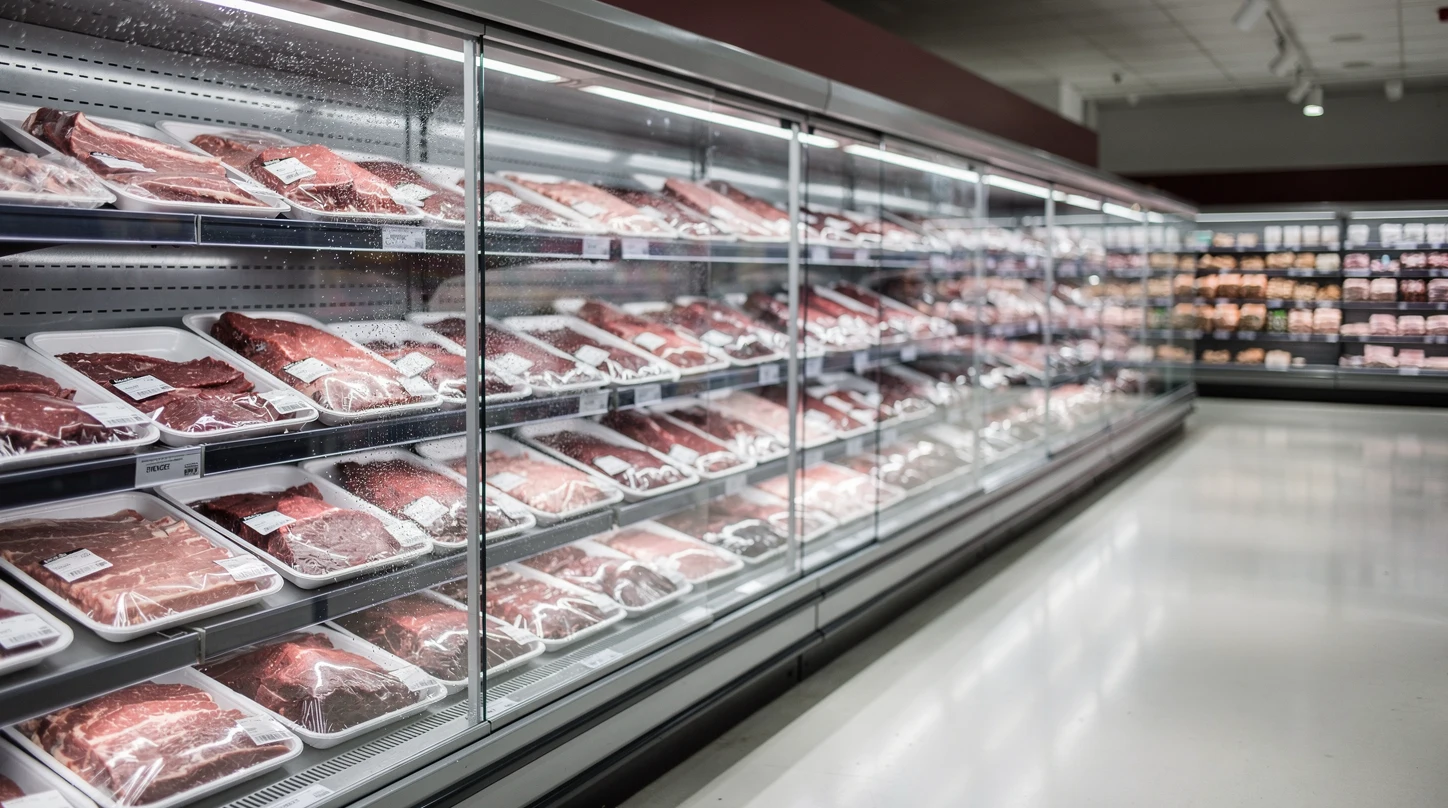
The US Justice Department has widened its beef pricing investigation from the meatpacking plants to the checkout lane. Eight of the largest grocery retailers operating in the United States have received formal information requests from the Antitrust Division seeking six years of pricing, cost and margin data on beef.
The recipients are Walmart, Costco, Amazon, Kroger, Publix, Albertsons, Aldi and Ahold Delhaize USA, according to reporting from Bloomberg, Fox Business, Forbes and Fortune. The Justice Department confirmed the expansion publicly on September 1 and the letters were reported the following day.
No retailer has been accused of wrongdoing. The Antitrust Division described the exercise as an assessment of pricing trends rather than an enforcement action, and the requests appear to be information demands rather than charges. That distinction matters, but it does not reduce the compliance burden on the eight companies now assembling the files.
What makes this expansion significant for the retail industry is the scope. The Justice Department is not asking only what shoppers paid. It is asking what the retailers paid, what they made, and how both changed between 2020 and 2026.
In short
- Eight national grocers received Justice Department letters seeking beef sales, pricing, cost, margin and purchasing data covering 2020–2026.
- The recipients are Walmart, Costco, Amazon, Kroger, Publix, Albertsons, Aldi and Ahold Delhaize USA. Only Ahold Delhaize is reported to have commented, and it declined.
- The probe began upstream in May 2026 with the “Big Four” meatpackers (JBS, Cargill, Tyson Foods and National Beef), which control more than 85% of US beef processing. Investigators have reviewed over 3 million documents.
- The supply backdrop is extreme: the US cattle herd stood at roughly 86.2 million head at the start of 2026, the lowest level since 1951, down from about 94.7 million in 2019.
- Ground beef averaged $6.89 per pound in July 2026, up about 10% year over year, and analysts do not expect meaningful supply recovery before 2028.
What did the Justice Department actually ask the eight grocers for?
The information requests are unusually broad for a retail category review. According to Fox Business, which reported the contents of the letters, the Antitrust Division asked each company for data on retail beef sales and prices, wholesale beef purchases, costs and profit margins.
The requests also cover pricing and purchasing strategies, internal analyses of wholesale and retail beef price trends, and the specific wholesale arrangements each retailer holds with meatpacking companies. The stated window is 2020 to 2026, which captures the pandemic disruption, the inflation surge and the current shortage in a single dataset.
That last element is the one retail lawyers will focus on. Asking for the terms of supply agreements with the Big Four packers moves the inquiry beyond consumer prices and into the structure of the wholesale market itself.
Why the 2020 start date matters
Choosing 2020 as the baseline is not arbitrary. It places the pandemic era plant closures, the resulting wholesale price spike and the subsequent margin behavior inside the comparison set.
Investigators can therefore test whether retail beef margins compressed when wholesale costs rose, held steady, or expanded. A margin that expanded through a cost shock is not illegal on its own, but it is the kind of pattern that invites follow-up questions.
The six-year window also lets the division compare how eight different companies responded to the same input cost curve. Divergence is normal in competitive markets. Convergence is what antitrust economists look at twice.
Information request, not a complaint
It is worth restating the legal posture. A letter seeking data is an early-stage investigative step, and most such inquiries close without any enforcement action.
The broader context of federal antitrust rules as they apply to retail is that the agencies routinely gather industry data without ever filing a case. Retailers treat these requests seriously because the documents produced can shape later theories, not because a case is imminent.
Who received the letters, and what have they said?
The eight recipients between them span every major grocery format in the United States, from supercenters and warehouse clubs to conventional supermarkets, hard discount and online delivery. That breadth suggests the division is mapping the whole retail channel rather than targeting one business model.
Public responses have been minimal. Ahold Delhaize USA declined to comment when approached by Fox Business. Fortune reported that neither the retailers nor the Justice Department responded to its requests for comment.
| Retailer | Ownership or parent | Primary grocery format | Reported response |
|---|---|---|---|
| Walmart | Walmart Inc. | Supercenter and neighborhood market | No comment reported |
| Costco | Costco Wholesale Corp. | Membership warehouse club | No comment reported |
| Amazon | Amazon.com Inc. | Online grocery and Whole Foods Market | No comment reported |
| Kroger | The Kroger Co. | Conventional supermarket | No comment reported |
| Publix | Publix Super Markets Inc. | Conventional supermarket, southeast US | No comment reported |
| Albertsons | Albertsons Companies Inc. | Conventional supermarket, multi-banner | No comment reported |
| Aldi | Aldi Süd (US operations) | Hard discount | No comment reported |
| Ahold Delhaize USA | Ahold Delhaize N.V. | Conventional supermarket, multi-banner east coast | Declined to comment |
The silence is expected. Companies under active information requests rarely characterize the scope of what they have been asked, partly because doing so can narrow their own options later.
For investors, the more useful signal will come from disclosure. If any of the listed public companies treats the request as material, it will surface in the next round of filings rather than in a press statement.
How did a meatpacker probe become a retail probe?
The investigation did not start with grocers. In May 2026 the Justice Department opened an antitrust probe into the four largest US meatpackers: JBS, Cargill, Tyson Foods and National Beef.
Those four companies control more than 85% of US beef processing capacity, a concentration ratio that has drawn political attention for years. Federal investigators have since reviewed more than 3 million documents and conducted interviews across the industry, according to reporting on the probe.
The political trigger came earlier. In November 2025 the president directed the Justice Department to investigate the meatpackers, alleging that they were driving up the price of beef through what he described as illicit collusion, price fixing and price manipulation.
Following the margin up the chain
Expanding to retail is a logical next step for an investigation that has spent months on the processing side. If wholesale costs rose and retail prices rose faster, the incremental margin sits somewhere, and the division needs both halves of the chain to locate it.
Retailers are also the party with the cleanest record of what packers charged them. Wholesale invoices held by eight independent buyers are, in evidentiary terms, a useful cross-check on what the packers themselves report.
This is why the requests ask for wholesale arrangements as well as retail prices. The grocers may be sources as much as subjects.
The midterm context
Beef prices have become a visible political metric. Fortune framed the expansion explicitly against the midterm elections, noting that grocery inflation remains a leading voter concern.
Associate Attorney General Stanley E. Woodward Jr. said that beef prices are a critical concern to Americans and a priority for the Justice Department. The Antitrust Division separately stated that it is assessing trends in beef prices as a matter of critical concern to the American public.
Retail policy teams should read that language carefully. “Assessing trends” is not the vocabulary of an imminent complaint, but it is the vocabulary of an inquiry that intends to publish something.
Why are beef prices at record levels?
The uncomfortable fact for the antitrust theory is that the supply side offers a complete and well-documented explanation on its own. The US cattle herd is the smallest it has been in three quarters of a century.
USDA data put the national inventory at approximately 86.2 million head at the start of 2026. That is the lowest count since 1951 and down from roughly 94.7 million cattle and calves in 2019, a decline of more than 8 million animals in seven years.
Drought, cost and consolidation
The causes are well established and largely physical. Successive years of drought forced ranchers to cull breeding stock, while high operating costs and debt made rebuilding uneconomic.
Consolidation in processing has been cited as a contributing pressure on producer economics, which is precisely the link the Justice Department is examining upstream. But the herd contraction itself is a response to weather and input costs more than to market structure.
Once breeding females leave the herd, they are not quickly replaced. That is the constraint that makes this shortage different from a normal cyclical tightening.
The biological lag that rules out a quick fix
Cattle production runs on a roughly three-year cycle from the decision to retain a heifer to the point where her offspring reaches market weight. Even if every rancher began rebuilding today, the additional supply would not reach processors until 2028 at the earliest.
Industry groups have cautioned that rebuilding the national herd will take years given ongoing cost pressure. Several analyses reviewed for this article put normalized ground beef pricing no earlier than 2028.
That timeline is the single most important number for grocery category planning. It means the current price level is a multi-year condition, not a spike to be waited out.
| Indicator | Earlier reading | Current reading | Direction |
|---|---|---|---|
| US cattle and calf inventory | About 94.7 million head (2019) | About 86.2 million head (start of 2026) | Down more than 8 million head |
| Ground beef, average retail price | July 2025 base | $6.89 per pound (July 2026) | Up about 10% year over year |
| Big Four share of US beef processing | Long-standing concentration | More than 85% | Stable and highly concentrated |
| Expected supply recovery | Not applicable | 2028 at the earliest | Multi-year constraint |
| Documents reviewed in packer probe | Probe opened May 2026 | More than 3 million | Active and advanced |
Does the retail margin story support the antitrust theory?
This is the question the letters are designed to answer, and the honest position today is that the public record does not settle it. Retail grocery is a low-margin business in aggregate, but category-level margins vary enormously and are not routinely disclosed.
Fresh meat is one of the most operationally difficult categories in the store. It carries high shrink, short shelf life and heavy labor content, which is why reported category margins rarely resemble headline gross margin.
Why category margin is not company margin
A grocer reporting a mid-twenties gross margin at company level may run fresh meat well below that, and may deliberately run parts of it near cost. Beef in particular has historically functioned as a traffic driver, especially around holiday weekends.
Any analysis that compares consumer beef prices against a retailer’s total gross margin will produce a misleading answer. The Justice Department appears to understand this, which is why it asked for category-level cost and margin data rather than financial statements.
The operational economics matter here too. Waste and markdown in the meat case are a real cost of goods, and work on shrink in fresh departments shows how much of the theoretical margin never reaches the register.
What a pricing pattern would need to show
For an antitrust theory to develop, investigators would need more than high prices. They would need evidence that prices moved in ways competition cannot explain.
Typical markers include margin expansion during a cost shock, price moves that track competitors more closely than costs, or pricing decisions that appear to reference rivals rather than inputs. None of these have been alleged against any of the eight retailers.
The alternative finding is equally plausible and arguably more likely on the current evidence: that retail beef prices rose because wholesale beef prices rose, because there are eight million fewer cattle.
What legal theory could the Antitrust Division be testing?
Because no complaint exists, any discussion of theory is inference from the data requested. But the shape of the request narrows the field considerably.
Information exchange and algorithmic pricing
The request for pricing strategies and internal analyses of competitor and market price trends fits the pattern of an information-exchange inquiry. Antitrust enforcers have grown increasingly interested in whether rivals coordinate indirectly through shared data or common pricing tools.
This is the same conceptual territory as the enforcement wave around personalized and algorithmic pricing. The regulatory posture on that front has been hardening, as the recent move to bring state-level surveillance pricing bans into force illustrates.
Nothing in the reported letters mentions algorithms specifically. The request for pricing strategy documents would nonetheless capture them if they exist.
Monopsony and the buyer side
A second possibility runs in the opposite direction. Large grocers are powerful buyers, and the terms they extract from packers shape what packers in turn pay ranchers.
The political framing of the probe has consistently emphasized squeezed cattle producers alongside squeezed consumers. A buyer-power theory would explain why the division wants the wholesale arrangements rather than only the shelf prices.
Or simply a market study
The most probable outcome, based on how such inquiries usually resolve, is a market assessment rather than litigation. The division said it is assessing trends, and a published analysis of beef price formation would satisfy the political demand for action without requiring a case it might lose.
What does this mean for grocery buyers and category managers right now?
The immediate consequence is documentary. Eight companies now need to reconstruct six years of category pricing decisions, and the quality of that reconstruction depends on records that were never written for a regulator.
Category teams should expect legal review of pricing communications, competitive benchmarking files and vendor negotiation notes. Internal documents that casually reference competitor pricing are routine in retail and are also the documents that generate the most follow-up questions.
The second consequence is planning. If supply does not recover before 2028, beef will remain an inflation headline through at least two more holiday seasons.
Practical steps worth taking
- Reconstruct the cost-to-shelf bridge for beef by year from 2020, with wholesale invoices attached.
- Separate category margin from company gross margin in any internal or external explanation of pricing.
- Document the operational cost of the fresh meat case, including shrink, markdown and labor, so margin is not read as profit.
- Review how competitive price checks are collected and recorded, and confirm they use lawful public sources.
- Prepare a consistent public line, because political attention on grocery prices is unlikely to fade before November.
None of this assumes wrongdoing. It assumes that a six-year data request will be followed by questions about the data.
There is also a communications dimension that sits outside the legal file. Grocery chains are already the most visible price signal in the economy, and a Justice Department letter attaches an enforcement narrative to a category most shoppers buy weekly.
Retailers that can explain beef pricing in cost terms, with the wholesale curve alongside the shelf curve, will handle that conversation better than those that decline to engage. The data being assembled for the division is the same data that answers the public question.
Where do cattle ranchers sit in this investigation?
The political case for the probe rests on a two-sided squeeze. Consumers pay record prices at the meat case while cow-calf producers, the ranchers who breed and raise the animals, are described as capturing too little of that price.
Both halves of that claim can be true at once without collusion, and both can also be true because of it. Distinguishing between those explanations is the analytical core of what the Antitrust Division has taken on.
The rebuilding economics that keep supply tight
Retaining a heifer for breeding means giving up the immediate revenue from selling her. When cattle prices are at record highs, that opportunity cost is at its most painful, which is why record prices can slow herd rebuilding rather than accelerate it.
Add carried debt from eight years of drought and the arithmetic gets harder still. Producer groups have warned that rebuilding the national herd will take years given ongoing cost pressure, and that warning is about cash flow as much as about pasture.
This dynamic matters to the investigation because it produces high prices and constrained supply simultaneously, which is exactly the pattern a collusion theory would also predict. The two hypotheses generate similar surface data.
Why the wholesale contracts are the pivot
What separates the hypotheses is the contract layer between packers, retailers and producers. Formula and forward contracts determine how much of a retail price change reaches the ranch, and how quickly.
If retail beef prices rose sharply while producer receipts lagged, the gap sits with packers, retailers or both, and the wholesale arrangements show where. That is the most likely reason the Justice Department asked eight retailers for their supply agreements rather than only their shelf prices.
Retailers should expect that framing to persist regardless of the outcome. In a politically charged inflation debate, the distribution of the beef dollar is the number everyone will quote.
How does this fit the wider retail enforcement picture in 2026?
The beef probe is not an isolated event. Federal and state enforcers have been unusually active across retail and e-commerce this year, and the common thread is consumer price formation.
On the federal side, the Federal Trade Commission has pursued marketplace conduct aggressively, including the case in which the FTC sued Amazon over undisclosed advertising surcharges. Grocery-specific policy has moved too, with federal nutrition programs reshaping category demand across participating states and state legislatures writing their own pricing rules.
Taken together, the pattern is a regulatory environment that treats retail pricing mechanics as a public policy question rather than a commercial one. Beef is simply the most politically legible example.
The earnings channel
Grocery earnings season will now carry an extra line of questioning. Analysts have a specific and quantifiable topic to raise, and management teams will need answers that separate cost pass-through from margin capture.
Kroger is the most exposed of the listed companies to that dynamic in the near term, with its quarter due imminently. The Kroger second-quarter report arrives with the probe unresolved and fresh categories under scrutiny.
Expect careful language. Retailers have strong commercial reasons to emphasize that they absorbed cost increases rather than amplified them.
What happens next, and what should retailers watch?
There is no published deadline for the eight retailers to respond, and voluntary information requests typically involve negotiated timelines rather than fixed statutory ones. The practical sequence is production, review, then either follow-up demands or closure.
Three signals will indicate which way the inquiry is heading. Each is observable from outside the process.
| Signal to watch | What it would indicate | Likely visibility |
|---|---|---|
| Escalation from letters to civil investigative demands | The division has a specific theory and wants compelled testimony | Public company disclosures |
| A published market study or report on beef price formation | Outcome is analytical, not litigation | Justice Department announcement |
| Action against the Big Four packers before any retail step | Retail data was corroborative, and grocers were sources not targets | Court filings |
| Additional retailers or regional chains receiving letters | Scope is widening toward a full channel review | Trade and local press |
| Quiet closure with no announcement | Supply-side explanation prevailed | Absence of further news |
The base case remains that the fundamental driver of beef prices is a herd that has lost more than 8 million animals. That does not make the investigation pointless, because concentration in processing is a legitimate subject regardless of the current price level.
It does mean retailers should resist framing the inquiry as an accusation. The Justice Department has asked eight companies for their data, and on the public record that is all it has done.
Frequently asked questions
Which retailers received Justice Department letters over beef prices?
Walmart, Costco, Amazon, Kroger, Publix, Albertsons, Aldi and Ahold Delhaize USA. The expansion was confirmed publicly on September 1, 2026, with the letters reported the following day by Bloomberg, Fox Business and others.
Have any of the grocers been accused of price fixing?
No. The letters are information requests, and the Antitrust Division described its work as assessing trends in beef prices. No complaint has been filed against any of the eight retailers and no wrongdoing has been alleged.
What data did the Justice Department request?
Retail beef sales and prices, wholesale beef purchases, costs and profit margins, pricing and purchasing strategies, internal analyses of price trends, and wholesale arrangements with meatpackers. The period covered is 2020 to 2026.
How does this relate to the meatpacker investigation?
The Justice Department opened an antitrust probe into JBS, Cargill, Tyson Foods and National Beef in May 2026. Those four companies control more than 85% of US beef processing. The retail letters extend that existing inquiry down the supply chain.
Why are beef prices so high in 2026?
The US cattle herd fell to roughly 86.2 million head at the start of 2026, the lowest since 1951, down from about 94.7 million in 2019. Drought, high operating costs and debt drove ranchers to reduce breeding stock, and the resulting shortage lifted wholesale and retail prices.
How much does ground beef cost now?
Ground beef averaged $6.89 per pound in July 2026, an increase of about 10% compared with July 2025. That is a record level in nominal terms.
When will beef prices come back down?
Not quickly. Cattle production carries a roughly three-year lag from the decision to retain a heifer to market-ready offspring, so meaningful additional supply is not expected before 2028 even if herd rebuilding started immediately.
Could the investigation lead to fines or a lawsuit?
It could, but nothing on the public record suggests that outcome is near. Most information requests of this kind close without enforcement, and a published market analysis is at least as likely as litigation.
What should grocery retailers do in response?
Preserve and organize beef pricing, cost and margin records from 2020 onward, review how competitive price benchmarking is documented, and be able to distinguish category margin from company gross margin. Legal counsel should lead any production of documents.