
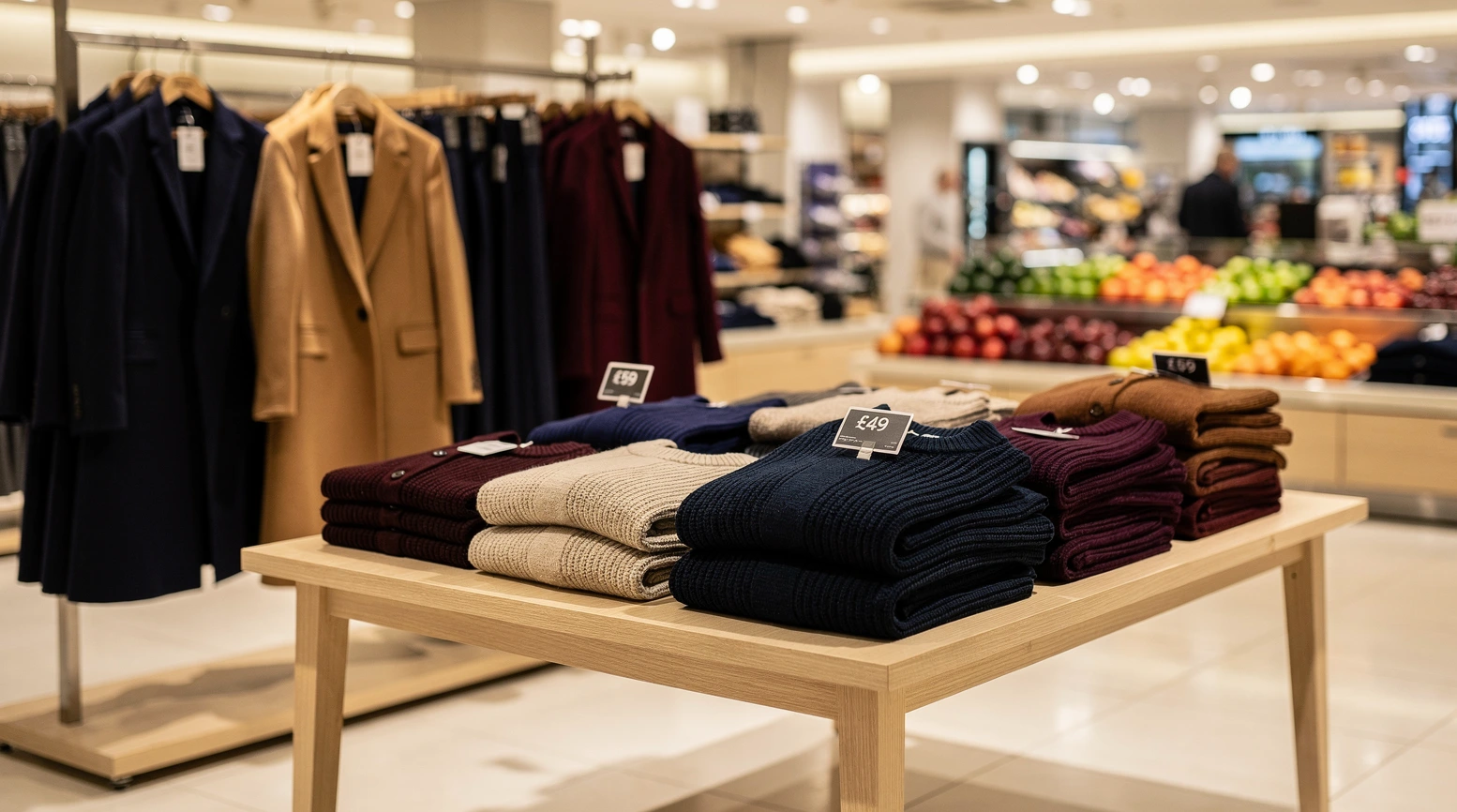
Marks & Spencer reports its half-year results on Wednesday 4 November 2026, and it is the first set of interim figures that can be compared with a normal year rather than with a business that had switched off its own website. Profit is expected to have more than doubled to around £390 million, according to a PA Media preview. That would still leave it below the £413.1 million M&S made two years ago, before the cyber attack of spring 2025.
For shoppers, sellers and anyone who follows the high street, the headline profit is only part of the story. The numbers will show whether the clothing and home business has really recovered its online customers, whether the food business can keep growing at double-digit rates, and how much of the rising cost of running shops M&S is passing through to the till. This preview sets out what is already known, what the City expects and what to look for when the statement lands at 7am.
In short
- Results date: M&S publishes its 2026/27 half-year results on Wednesday 4 November 2026, followed by a Capital Markets Day on 10 November and a Christmas trading statement on 8 January 2027.
- Profit expectation: PA reports first-half profit is expected to more than double to around £390 million, up from £184.1 million a year ago but short of the £413.1 million made before the cyber attack.
- Food is the engine: Shore Capital’s Clive Black has forecast Food sales growth of about 11% for the half and wrote that “Food is flying”.
- Fashion is the question: clothing and home online sales fell 42.9% in the first half of last year; the key test is how much of that has come back.
- Cost pressure: the Budget’s £13.20 National Living Wage from April 2027, packaging levy charges and higher freight costs make any outlook comment on prices and margins worth reading closely.
When does M&S report and what period do the results cover?
M&S’s own financial calendar lists 4 November 2026 as the date for its 2026/27 half-year results. The figures cover the first 26 weeks of the financial year, running from the start of April to late September 2026. Like most FTSE 100 companies, M&S issues its statement through the London Stock Exchange’s regulatory news service at 7am, with an analyst presentation later in the morning.
The results are the first of three scheduled updates before the spring. The calendar shows a Capital Markets Day on 10 November 2026, a Christmas trading statement on 8 January 2027 and full-year results on 26 May 2027. That full year will be a 53-week year, which flatters sales comparisons slightly and is worth remembering when headlines appear next summer.
The timing matters because M&S lands in a crowded week for British retail news. Primark’s owner, Associated British Foods, Next and ASOS all report within days of each other, which means investors and shoppers will get an unusually clear picture of how clothing demand held up through a warm September and a cold October. We have set out what to expect from the Primark full-year results and its home delivery plans separately.
A Capital Markets Day is where a company sets out medium-term targets in more detail than a results statement allows. Holding one six days after the interims suggests M&S wants the half-year numbers to be read as a clean base, with the strategic story kept for a separate stage. It also means management may be reluctant to say much new about long-term ambitions on 4 November itself.
Shoppers should not expect a dramatic announcement on prices or store numbers on results day. The bigger strategic signals, on online targets, store openings and the technology programme, are more likely to arrive on 10 November.
What are analysts expecting from the half-year numbers?
The clearest public forecasts come from a PA Media preview published on 30 October and a Shore Capital note reported in September. PA reported that M&S’s profit is expected to more than double to around £390 million for the half-year to September. It added that this would still be below the £413.1 million achieved two years ago, before the cyber attack.
Shore Capital’s food and retail analyst Clive Black forecast first-half pre-tax profit of £389 million, according to a report by AskTraders. His note compared that with £409 million two years earlier; the gap with the £413.1 million figure most likely reflects a different profit measure. Black kept his full-year adjusted pre-tax profit forecast at £925 million.
Not every broker is as confident about the shape of the year. Fidelity International’s November preview quoted Peel Hunt as saying profits could be weighted towards the second half, that “question marks persist in fashion” and that food is “doing a lot of the heavy lifting”. Morningstar was more upbeat, telling Fidelity: “We expect both revenue growth and profitability expansion.”
| Measure | H1 2024/25 (before attack) | H1 2025/26 (attack year) | H1 2026/27 (forecast) |
|---|---|---|---|
| Adjusted profit before tax | £413.1m | £184.1m | About £390m (PA); £389m (Shore Capital) |
| Statutory profit before tax | £391.9m | £3.4m | Not forecast publicly |
| Food sales growth | Not compared here | +7.8% | About +11% (Shore Capital) |
| Fashion, Home & Beauty sales | Pre-attack base | -16.4% | Strong rebound expected (PA) |
| Fashion online sales | Pre-attack base | -42.9% | Key test of recovery |
| Interim dividend | 1.0p | 1.2p | Policy: one third of prior-year total |
Figures for H1 2024/25 and H1 2025/26 are from M&S’s half-year statement of 5 November 2025. Forecasts are from PA Media and Shore Capital as reported, and are estimates rather than company guidance.
M&S has said its interim dividend is set at one third of the previous year’s total. The full-year dividend for 2025/26 was 4.2p, so that policy points to an interim payment of around 1.4p, up from 1.2p. That is arithmetic based on the company’s stated policy rather than a forecast, and the board can choose to depart from it.
How badly did the cyber attack hit M&S a year ago?
To read this week’s figures properly, it helps to remember how deep the hole was. M&S paused online orders in late April 2025 after a cyber incident, resumed home delivery in June and restarted click and collect only in early August. In the 26 weeks to 27 September 2025, adjusted profit before tax fell 55.4% to £184.1 million and statutory profit before tax fell 99.1% to just £3.4 million.
The damage was concentrated in clothing and home. Fashion, Home & Beauty sales fell 16.4%, with store sales down 3.4% and online sales down 42.9%. The division’s operating margin collapsed from 12.0% to 2.7%. Food held up better on sales, rising 7.8%, but its margin fell from 5.1% to 2.0% as markdowns and waste rose while systems were rebuilt.
The company booked £101.6 million of incident-related costs as adjusting items in that half and recorded £100 million of insurance proceeds. Over the full 2025/26 year, costs directly related to the incident reached £131.3 million, according to the annual results statement published in May 2026.
What chief executive Stuart Machin said at the time
Machin described the first half of last year as “an extraordinary moment in time for M&S”. He told investors that the business was “now getting back on track” and that “it’s all to play for”. The company also said it was “confident we will be recovered and back on track by the financial year-end”.
The interim statement added that “with warehouse systems now restored, both our website and stores are improving availability, and trading is recovering”. Wednesday’s numbers are the first full half-year in which that recovery can be measured from start to finish.
Why the comparison flatters this year’s profit
Profit doubling sounds dramatic, but most of the increase reflects how weak last year was rather than a sudden leap in performance. The more useful comparison is with the first half of 2024/25, the last normal period before the attack. On PA’s figure, M&S would still be roughly £23 million short of that level; on Shore Capital’s measure, about £20 million short.
That gap matters because costs have moved a long way in two years. Employer National Insurance rose in April 2025, the packaging levy began charging retailers for the packaging they put on the market, and the National Living Wage has risen twice. M&S itself said its half-year statement last November included “new cost increases of over £50m” from the packaging levy and National Insurance.
The headline sales figure will also look inflated for a second reason. M&S now consolidates Ocado Retail, its online grocery joint venture with Ocado Group, which lifted reported group sales by 22.1% to £7,965.2 million last year. Readers should look for the like-for-like and segment figures rather than the group total when judging how M&S’s own shops and website performed.
The full 2026/27 year runs for 53 weeks, which will add roughly a week of trading to the annual total in May 2027. That does not affect Wednesday’s half-year figures, which cover 26 weeks. It is, however, a reason to treat any full-year profit forecast above last year with care, since part of any growth will come from the extra week.
Can Food keep growing at double-digit rates?
Food is the part of M&S that has carried the business through the past two years. In the 2025/26 year, Food sales rose 7.0% to £9.7 billion, with like-for-like sales up 6.7% and UK volumes up 3.3% in what M&S called a broadly flat market. The company said it gained more than 800,000 additional shoppers during the year and lifted its grocery market share by 17 basis points to 4.1%.
Clive Black’s forecast of 11% Food sales growth for the first half would be a step up again. AskTraders reported that industry data showed about 11% sales growth for M&S in the 12 weeks to 5 September. Black described the half as “a tale of M&S being 2-1 up in sales”, with Food ahead and clothing behind.
The question is whether that growth is profitable. Black’s note flagged a trading margin of 5.6%, which he said “looks elevated and unsustainable” given investment in prices and the supply chain and the cost of the packaging levy. Food margins were 2.0% in the attack-hit first half last year and 4.6% for the full year, so a big jump would invite questions about how long it can last.
Prices at the till
M&S has been leaning on price as well as quality to win shoppers from bigger grocers. Its annual statement said Food “invested in trusted value, increased quality and made regular new product launches”. The company has also experimented with ways to reduce waste, including joining the surplus food app Too Good To Go, which we covered when M&S began selling £3.80 bakery bags in 350 stores.
Shoppers will want to see what management says about food inflation into Christmas. The British Retail Consortium’s shop price monitor showed food inflation rising to 2.9% in October, and M&S’s outlook for this year already warned of “higher fuel, freight and input costs”.
Has fashion and home won back its online customers?
This is the single most important part of Wednesday’s statement for anyone who shops M&S clothing online. The division’s quarterly figures for 2025/26 show how sharply online sales fell and how slowly they recovered. Online sales fell 58.5% in the first quarter and 29.7% in the second, then edged up 1.0% in the third quarter and 6.1% in the fourth.
| Fashion, Home & Beauty, change vs 2024/25 | Q1 | Q2 | Q3 | Q4 | Full year |
|---|---|---|---|---|---|
| Total sales | -20.8% | -12.3% | -2.6% | +4.3% | -7.7% |
| Like-for-like sales | -20.2% | -12.1% | -2.7% | +4.3% | -7.5% |
| Store sales | -3.5% | -3.2% | -4.4% | +3.3% | -2.3% |
| Online sales | -58.5% | -29.7% | +1.0% | +6.1% | -18.4% |
Source: M&S full-year results statement for the 52 weeks to 28 March 2026.
Because this half is being compared with the collapse of a year ago, online growth figures could look enormous. A rise of 40% or more would be possible simply from returning to normal, so the better question is whether online sales are now above the level of two years ago. Over the full 2025/26 year, clothing and home online sales were £1,165.7 million, down 18.4%, and the online channel ran at a negative margin of 5.2% compared with 10.0% in stores.
The wider market for clothing
The market backdrop has been mixed. The Office for National Statistics reported that retail sales volumes fell 0.4% in September as demand for autumn and winter clothing was slow, a point PA highlighted in its results preview. The BDO High Street Sales Tracker then showed a sharp rebound in October, with UK online sales up 10.1% while the high street lagged at 2.2%.
That pattern suits a retailer whose online operation is recovering. It is less helpful for the half-year itself, which closed at the end of September before the cold snap arrived. Any comment from M&S on October trading would therefore be valuable for judging how the clothing business enters Christmas.
What changes are coming to M&S delivery and Sparks?
M&S has set itself an ambition to double clothing and home online sales and lift online’s share of the division to 50%. Its annual statement said near-term online improvements were focused on “search, imagery, check-out and payments”, alongside a modernisation of its e-commerce platform. These are the parts of the website shoppers notice, so any progress update is worth looking for.
The biggest physical change is a new distribution centre in Lichfield. On 28 October, M&S began recruiting the first wave of 70 roles for the 437,000 sq ft site, which it said is expected to create 600 jobs in total and open next year. David James, its supply chain and logistics director for clothing and home, said the hub “will mean we can better serve our customers, delivering M&S fashion faster than ever before”.
The annual statement said the automated centre will start fulfilling customer orders in 2027 with a phased ramp-up, and that it will expand online capacity earlier and at lower capital cost than first planned. Additional storage at Bradford and automated sorting capacity at Castle Donington are due this year. For shoppers, the practical promise is fewer split parcels, where one order arrives in several boxes, and faster delivery of clothing orders.
M&S has also relaunched its Sparks loyalty scheme around a wallet of rewards that customers can spend across the business. The company has said this lays the groundwork for more personalised offers. Any data on Sparks sign-ups or usage on Wednesday would show whether the relaunch is drawing people back after a year in which trust was tested by the attack.
How do the other retailers reporting this week compare?
M&S is one of four major clothing names reporting within days of each other, and each is dealing with a different problem. ASOS also suffered a cyber attack this autumn and has watched its shares fall sharply, as we set out in our preview of ASOS’s results, the first since its customer data hack. Next, the sector’s benchmark for online clothing, has already trimmed its sales growth forecast.
| Retailer | Update this week | What is expected or known | Main issue for shoppers |
|---|---|---|---|
| Marks & Spencer | Half-year results, Wed 4 Nov | Profit around £390m, more than double last year (PA) | Online clothing recovery, food prices |
| Primark (ABF) | Full-year results this week | ABF indicated Primark sales dipped 2.6% over the year (PA) | Home delivery plans, price cuts |
| Next | Trading update, Thu 5 Nov | Six-month sales growth forecast cut to 2% from 2.8% (PA) | Cost of living, Christmas demand |
| ASOS | Full-year results, Thu 5 Nov | Shares down about 15% since early October after a cyber attack (PA) | Data security, returns, prices |
PA reported that Next cut its forecast because of the cost of living, mortgage costs and a cooling jobs market. Next is often treated as a bellwether, and when we previewed its half-year results in September the focus was on whether its online model could keep beating the market. If Next is cautious and M&S is upbeat, it would suggest M&S is taking share rather than riding a rising tide.
Why M&S trades at a discount
Fidelity noted that M&S shares have more than doubled over five years, yet the company still trades on a lower price-to-earnings ratio than Next, Sainsbury’s and Tesco. Shore Capital valued M&S at about 11 times forecast earnings in its September note. A clean set of results could narrow that discount, while any sign that fashion is still struggling would reinforce it.
What will the Budget and rising costs mean for M&S?
The Budget on 28 October added fresh costs for big retailers. The National Living Wage for workers aged 21 and over will rise from £12.71 to £13.20 an hour from April 2027, according to the government’s announcement. For a company with tens of thousands of store and warehouse staff, that is a significant addition to the wage bill.
M&S has said it aims to offset frontline pay inflation and “government tax levies” through a structural cost reduction programme. It is targeting £600 million of savings between 2022/23 and 2027/28. Its outlook for 2026/27 also listed “higher fuel, freight and input costs and continued government tax levies and regulatory headwinds for the sector”.
The question for shoppers is how much of this reaches prices. M&S has said it is mitigating costs “through improved buying, reinvestment in value to drive volume, and savings from the structural cost reduction programme”. Listen for any change in tone, particularly on food prices into Christmas and on whether M&S expects inflation to ease or rise in 2027.
Despite the cost pressure, M&S has increased its spending plans. It expects capital expenditure of about £650 million to £750 million this year, with roughly two-thirds aimed at the long-term growth of Food. That covers new and relocated stores, food warehouses and a £340 million food distribution centre at Daventry due to open in 2029.
What should shoppers and sellers watch for on Wednesday?
Most coverage will lead on the profit figure, but the detail is where the useful information sits. These are the lines in the statement that tell you most about how M&S will feel as a place to shop over the coming months.
- Clothing online sales against two years ago. Growth against last year will look huge; the honest test is whether online is back above the 2024/25 level.
- Food volumes and margin. Volume growth shows whether M&S is winning new shoppers, while the margin shows whether it is doing so by cutting prices or by selling more.
- Stock availability. M&S said the effect of the incident on availability was tapering in May; any comment that it is fully resolved would be good news for shoppers who found gaps on rails.
- Christmas outlook. Any reference to trading since the end of September, food orders or seasonal ranges will hint at how the January update will look.
- Returns and delivery. Updates on additional returns capacity and the Lichfield site show whether delivery and refund times are improving.
- Dividend. An interim payout in line with the one-third policy would signal that the board is comfortable with the year ahead.
For marketplace sellers and brands, there is a further thread. M&S has been building wholesale and marketplace partnerships, including expanded ranges on Zalando in Europe, and is moving European customer fulfilment to Zalando’s logistics arm Zeos. Any update on third-party brands sold through M&S’s own site would matter to suppliers looking for new routes to UK shoppers.
Readers who want to check the official dates can find them on the M&S investor financial calendar.
What would a good or bad result look like?
A good result would combine profit at or above the £390 million expected with clothing online sales back above pre-attack levels and food margins that hold up without heavy price cuts. It would also need a confident outlook for Christmas. In that case, M&S would be on course to beat the £881.1 million it made in 2024/25, which is what its outlook statement implied when it said that “profit growth is expected to resume versus 2024/25”.
A disappointing result would most likely show up in clothing. If online sales are still below two years ago, or if markdowns have been needed to clear stock, Peel Hunt’s warning that profits will be weighted towards the second half would look justified. That would put more pressure on the Christmas quarter, when M&S food has its busiest weeks of the year.
There is also the possibility of a mixed picture, which many analysts appear to expect: strong food, steady but unspectacular fashion and cautious words on costs. For shoppers, that combination usually means continued promotions on clothing, careful pricing on food and a heavy push on Sparks offers to keep loyal customers coming back.
Frequently asked questions
When are the M&S half-year results published?
M&S publishes its 2026/27 half-year results on Wednesday 4 November 2026. Like most listed companies, it releases the statement through the stock exchange news service at 7am, followed by a presentation for analysts.
How much profit is M&S expected to make?
A PA Media preview said profit is expected to more than double to around £390 million for the half-year to September. Shore Capital forecast £389 million. Both are estimates, not company guidance.
Why is profit expected to double?
Mainly because last year’s first half was hit hard by the cyber attack. Adjusted profit fell 55.4% to £184.1 million in that period as M&S paused online orders and cleared disrupted stock, so the comparison is unusually easy.
Is M&S back to where it was before the cyber attack?
Not quite on profit. The expected figure of around £390 million is still below the £413.1 million M&S made in the same half two years ago, according to PA. Online clothing sales had only returned to modest growth by the end of the last financial year.
Can I still use M&S click and collect and home delivery?
Yes. M&S resumed home delivery in June 2025 and click and collect in early August 2025. It has since said it is investing in search, imagery, checkout and payments on its website and in a new Lichfield distribution centre due to start fulfilling orders in 2027.
What is happening at the M&S Lichfield site?
M&S has started recruiting the first 70 roles for a 437,000 sq ft clothing distribution centre in Lichfield. It expects the site to create 600 jobs once fully operational and to speed up delivery of clothing orders.
What else is M&S announcing this month?
M&S holds a Capital Markets Day on 10 November 2026, where it is likely to set out medium-term plans in more detail. Its Christmas trading statement is scheduled for 8 January 2027.
Will M&S food prices go up?
M&S has warned of higher fuel, freight and input costs and new government levies, but says it is offsetting them through better buying and cost savings. Any comment on food inflation in Wednesday’s outlook will give the clearest signal of where prices are heading.