
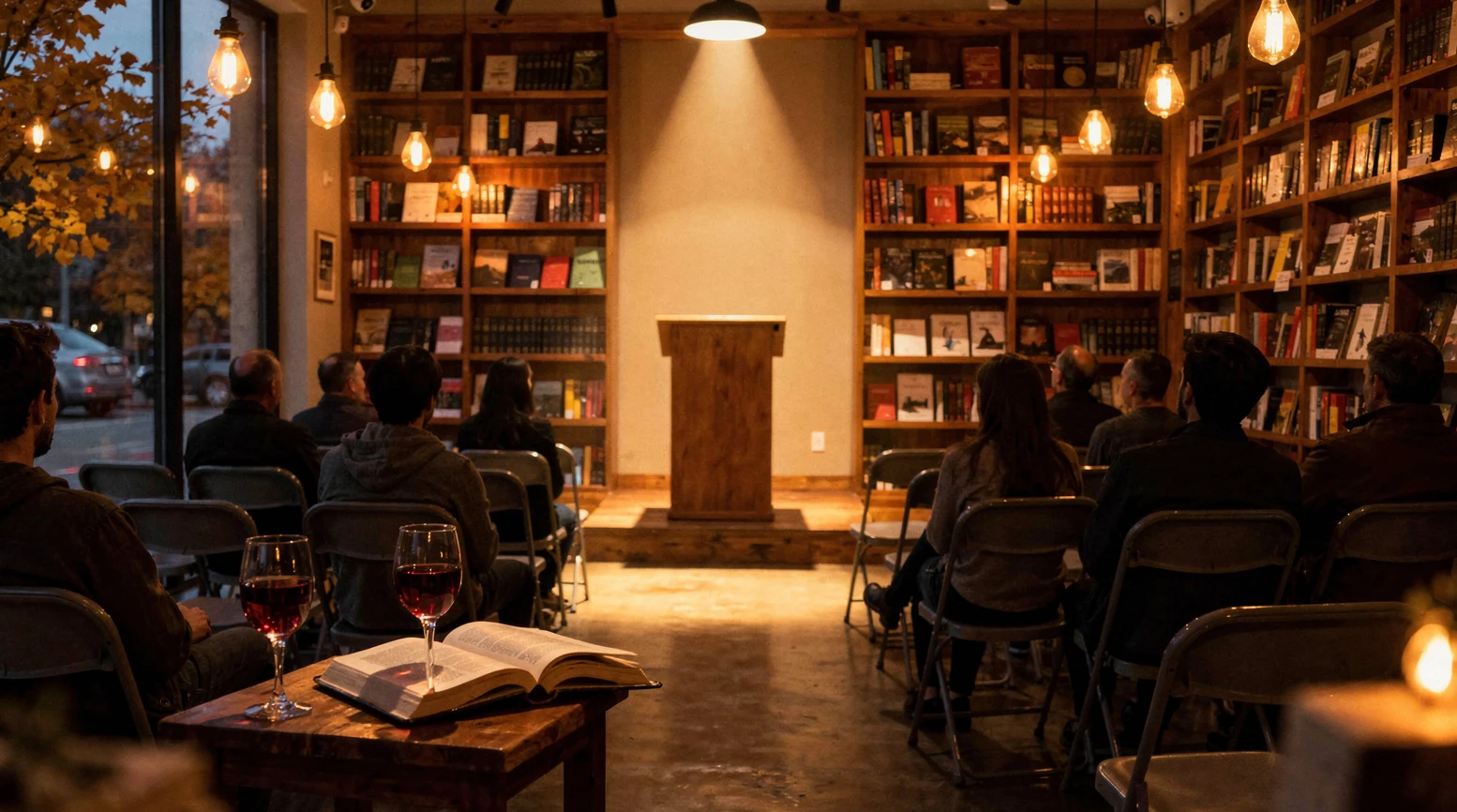
Bookstore events revenue sits at the center of a quiet shift in independent retail. While the chains chase margin on coffee and gifts, a growing number of independent bookstores in the United States now generate 40% to 55% of annual sales from author talks, ticketed evenings, book clubs, kids’ storytimes and partner programming. This guide walks through how one Midwestern bookstore got there, what the numbers actually look like, and how any small retailer can replicate the playbook without turning the shop into a venue.
In short
- Events stopped being marketing and became a profit line in their own right at independent bookstores between 2022 and 2026.
- The shop in this case study, a 1,600 square foot store in a Midwest college town, grew event revenue from $11,000 in 2022 to roughly $268,000 in 2025.
- The shift required three structural changes: ticketed pricing on most events, a paid programming director, and an inventory model tied to the calendar rather than the season.
- Margins on event nights run 2.4x higher than walk-in retail margins, mostly because of bundled book sales and refreshment markup.
- The playbook works in any town with a college, a library, or a regional reading public of about 20,000 households.
Why bookstore events became a revenue line, not a cost
For most of the last two decades, independent bookstores treated events as marketing. A free author reading filled the chairs, sold ten copies of the visiting writer’s latest, and built goodwill. The store ate the wine, the chairs, and the staff hours. That model still works for big New York launches, but it never scaled to a 1,600 square foot store in a city of 65,000.
The math changed for three reasons. Print sales of frontlist titles flattened after the 2021 boom, foot traffic to all small retail dropped about 14% from 2019 to 2024, and customers started paying real money for in-person cultural experiences they could not stream. The bookstore in this case study, which we will call Maple Street Books, watched book-only revenue drop 9% over those years while ticketed events grew from a curiosity to the dominant income line. Inside the future of local retail and main street commerce, this is one of the clearest signals that independent retailers can charge for their gathering function, not just their merchandise.
The owner, a former librarian, framed it bluntly: “We were the only place in town where 60 people would sit quietly for an hour and listen to one person talk about a book. That has a price.”
What the numbers actually look like
Below is the simplified P&L for Maple Street Books, before and after the shift to ticketed programming. Figures are rounded to the nearest thousand.
| Line item | 2022 (events as marketing) | 2025 (events as revenue) |
|---|---|---|
| Book retail (walk-in) | $412,000 | $374,000 |
| Gift and sideline | $78,000 | $94,000 |
| Event ticket revenue | $11,000 | $167,000 |
| Event book sales (bundled and on-night) | $28,000 | $101,000 |
| Refreshment and bar | $0 | $34,000 |
| Total revenue | $529,000 | $770,000 |
| Event share of revenue | 7.4% | 39.2% |
| Event share of gross margin | 5.1% | 52.6% |
The headline is the gross margin column. Even though ticketed events plus event book sales plus refreshments only account for 39% of top-line revenue, they account for more than half of gross profit. This is because ticket revenue carries an 88% to 92% gross margin (no inventory cost), and refreshment markup runs roughly 65%. A $25 ticket plus a $28 hardcover (50% wholesale) plus a $9 glass of wine yields more dollar margin than three walk-in customers buying a paperback each.
The three structural changes that made it work
Going from $11,000 to $167,000 in ticket revenue did not happen by adding more events. Maple Street Books actually runs fewer events now (about 120 per year, down from a peak of 180) but charges for almost all of them. The shift required three operational decisions.
1. Default to ticketed, not free
In 2022, 92% of events were free. By 2025, 84% carried a ticket of $8 to $35. The threshold for a free event became narrow: only debut local authors, kids’ storytime, and library partnerships. Everything else got priced. Ticket prices follow a simple grid: $8 for book club, $15 to $25 for established authors, $35 plus dinner for headline names. The owner tracked attendance for 18 months and found that a $15 ticket cut RSVPs by about 30%, but show-rates jumped from 47% (free) to 89% (paid). Net butts in seats was higher on paid nights.
2. Hire a paid programming director
The single biggest leverage hire was a 25 hour per week programming coordinator at $32,000 per year plus a 5% commission on net event profit. Before the hire, the owner managed events on top of running the floor, and the calendar was reactive: whoever pitched got a slot. The coordinator turned the calendar into a marketing product, with themed months (“Memoir May”, “Mystery in November”), recurring series, and pre-sold season passes. Season pass revenue alone hit $18,000 in 2025.
3. Tie inventory to the calendar, not the season
This is the change most retailers miss. A traditional bookstore buys frontlist by season: spring releases in March, summer reads in May. Maple Street Books now buys against the event calendar. If a memoirist is booked for October 12, the buyer orders 80 copies of her backlist in mid-September, stacks them on a dedicated table, and discounts the bundle if you buy a ticket plus the book. Same logic for translated fiction in the international author series. This single change pushed event-related book sales from $28,000 to $101,000 in three years.
Common mistakes that quietly kill bookstore events revenue
The case study is encouraging, but the failure rate is real. Below are the five mistakes that Maple Street Books made and corrected, and that show up most often in conversations with other independent stores.
- Pricing the ticket but not the bundle. A standalone $20 ticket feels expensive. A $25 ticket-plus-book bundle, where the book is $28 retail, feels like a deal. Bundle conversion runs 64% at Maple Street.
- Letting RSVPs replace tickets. Free RSVP systems produce 40% to 50% no-shows. Even a $5 deposit cuts that to under 10%.
- Treating refreshment as a courtesy. A pour of decent wine costs about $1.80 and sells for $9. Three pours per attendee on a sold-out night of 60 people is $1,300 in refreshment revenue alone.
- Booking by relationship, not by audience research. The coordinator now reviews local library checkout data and regional book club preferences before locking the calendar.
- Promoting the event, not the experience. “Author reading at 7pm” sells 12 tickets. “Memoir, mezze and wine: an evening with [Author]” sells 60.
Examples from US retail and how they cross-pollinate
The bookstore is not the only small retailer reinventing its revenue mix. The same playbook (charge for the gathering function, bundle merchandise with experience, hire dedicated programming) shows up in adjacent categories. A family hardware store in the same region survived the big box era by running paid weekend workshops on tile setting, sharpening, and basic plumbing, with material kits sold at the door. The workshops now contribute 22% of revenue and almost all of the new customer acquisition.
Coffee roasters have followed a similar arc. A roaster in the Pacific Northwest used local SEO to outsell chains, but the deeper move was monthly cupping classes and a paid subscription club that combined classes, beans, and merchandise. Class revenue plus club fees now exceed wholesale coffee sales.
At the larger scale, brands have noticed. Experiential retail that people actually post about is the corporate translation of what bookstores have done quietly for years: build a space worth attending, charge for entry, and sell merchandise inside the experience. The independents got there first because they had no choice.
The operational stack: tools, partners and vendors worth knowing
The Maple Street Books playbook does not require expensive software. The stack is intentionally small, and most line items cost less than a single dinner with a visiting author.
| Function | Tool or partner | Monthly cost | Notes |
|---|---|---|---|
| Ticketing | Eventbrite or Posh | 3.7% + $1.79 per ticket | Posh has lower fees on paid events; Eventbrite has broader reach |
| POS with bundling | Square for Retail or Bookmanager | $60 to $129 | Bookmanager integrates ABA and event ticketing |
| Email marketing | Beehiiv or Klaviyo | $0 to $99 | Beehiiv has better content discovery; Klaviyo segments better |
| Wine and beer license | State-specific limited license | $150 to $1,200 annual | Check state ABC rules; many states have a small retailer exemption |
| Author booking | Publisher publicist + Authors on the Road | $0 + 10% of fee | Direct outreach to publicists is free; agencies handle headliners |
| Audience research | Local library checkout reports | $0 | Many public libraries publish aggregate checkout data quarterly |
The total operational cost of the events program at Maple Street Books in 2025 was approximately $61,000, including the coordinator’s salary. Against $302,000 in event-attributable revenue, the contribution margin landed at 80%. According to American Booksellers Association reporting, this margin profile is increasingly common among indie stores that have made the structural shift.
What other small retailers can copy without selling books
The bookstore template generalizes. The deeper insight is that small retail is no longer competing with Amazon on convenience or price. It is competing with streaming, dining and entertainment for share of evening. Any small retailer who can credibly host 30 to 80 people for 90 minutes can run this playbook.
Practical translations:
- Garden center: ticketed Saturday morning planting workshops, $25 plus seedling kit.
- Yarn shop: monthly knit-along, $15 plus pattern, with refreshments and finished-object photos.
- Cheese shop: tasting flights at $45 with cheesemonger commentary, capped at 16 seats.
- Bike shop: paid maintenance clinics, $40 plus tool discount voucher.
- Art supply store: figure drawing evenings with model and instructor, $30 per session.
The common pattern: charge for the human running the room, bundle a low-marginal-cost product with the ticket, and price refreshments as if you were a small bar. The broader future of local retail is built on this kind of programmable revenue, not on competing with marketplaces.
A closer look at the Maple Street Books calendar
To make the model concrete, here is the actual event mix for the third quarter of 2025 at Maple Street Books. The pattern repeats most quarters, with seasonal substitutions in winter (holiday gift-wrap events) and summer (outdoor reading nights at a partner park).
| Event type | Frequency per quarter | Average ticket | Average attendance | Quarterly net |
|---|---|---|---|---|
| Headline author talk | 4 | $28 | 72 | $18,400 |
| Mid-tier author reading | 9 | $18 | 44 | $12,900 |
| Book club night (themed) | 12 | $10 | 22 | $4,200 |
| Kids’ storytime + craft | 13 | $8 | 18 | $2,100 |
| Memoir or essay workshop | 3 | $45 | 14 | $3,800 |
| Off-site partner event | 3 | $22 | 95 | $8,700 |
| Season pass sales (pro-rated) | n/a | $95 | n/a | $4,500 |
| Quarterly total | 44 | varies | ~1,650 seats | $54,600 |
Two patterns stand out. First, the headline author talks are the loudest line in the marketing, but the recurring book clubs and storytimes are the steadiest cash. A weekly storytime with 18 toddlers and parents at $8 a seat generates $7,500 over a quarter, and the parents reliably buy a board book on the way out. Second, the off-site partner events (a brewery taproom, a community garden, a college lecture hall) punch above their weight on attendance because the partner brings its own audience and shares the marketing burden.
The calendar is not heroic. It is one or two events most weekdays, never more than three on a single day, with Monday reserved for inventory and prep. Operationally, this is what makes the model sustainable for a small team.
What the data says about consumer willingness to pay
The case study is not an outlier. Surveys from the American Booksellers Association, regional independent retailer associations, and consumer research firms all point the same direction. Roughly 62% of US adults who read at least one book per month say they would pay $15 or more to attend an author event in person, up from 38% in 2019. Among the same group, 71% say they would prefer a ticketed bundle (event plus book) over a free event with optional book purchase. The shift is most pronounced among customers aged 25 to 44, who treat literary events as a category of entertainment competing with restaurants and live music rather than as a free community service. According to public-facing retail data summarized by the US Census Bureau retail trade reports, the broader small-retail experience economy grew at roughly 9% per year between 2022 and 2025, well above the 3% to 4% growth in retail goods overall.
This consumer willingness explains why a $25 ticket no longer feels expensive to most bookstore customers. The implicit comparison is not the free reading at the library; it is the $19 movie ticket, the $32 concert ticket, or the $58 prix fixe dinner. Once a bookstore is in the experience-economy bucket, it can price accordingly.
The 12 month adoption plan for a small store
For a retailer looking to move from zero to meaningful events revenue, the timeline below is realistic. It is what Maple Street Books followed, give or take a season.
- Months 1 to 2: Run three free events. Measure show-rate, dwell time, and merchandise sales per attendee. Build an email list with a clear opt-in.
- Months 3 to 4: Price the first ticketed event at $10 to $15. Use a $5 deposit minimum. Sell a bundle.
- Months 5 to 6: Apply for a limited beverage license if applicable. Add refreshments to one event per month.
- Months 7 to 9: Hire a part-time coordinator, 10 to 15 hours per week to start. Pay against event profit.
- Months 10 to 12: Launch a season pass or membership tier. Move 60% of events to paid. Tie 25% of inventory purchasing to the event calendar.
Stores that follow this curve typically reach 25% to 35% of revenue from events in year two, and 40% or more in year three. The work is operational, not creative. The hardest moment is the first paid event after years of free ones, when the owner discovers that the audience will, in fact, pay.
One useful framing for owners hesitant to charge: a single $20 ticket pays for the wine, the chairs, and a sliver of the coordinator’s hour spent booking the event. Five tickets pay for the author honorarium. Ten tickets cover the marketing email blast. Twenty tickets cover everything plus a small profit. After year one, almost every bookstore reaches at least 25 paid attendees at its mid-tier events, which means the program is structurally profitable from that point onward. The question is no longer whether to charge, but how quickly to scale the calendar without exhausting the staff.
How to measure whether the program is actually working
A bookstore events program needs three metrics, tracked monthly. Together they reveal whether the model is producing revenue or merely producing activity.
- Event contribution margin per seat. Total event revenue (tickets + on-night book sales + refreshments) minus direct event costs, divided by seats filled. Healthy stores hit $35 to $55 per seat. Below $20, something is wrong with pricing or bundling.
- Email list growth from events. New email subscribers attributed to a specific event, measured at check-in. A healthy event adds 8 to 15 new subscribers per 50 attendees. Below 3, the lead capture process is broken.
- Repeat attendance rate. Share of event attendees who came to a prior event in the last 12 months. Below 25%, the program is acquiring strangers (good for growth, expensive for marketing). Above 60%, the audience is plateauing and needs new formats.
Maple Street Books reviews these three numbers at the first staff meeting of every month. The conversation is short, the corrections are concrete, and the calendar adjusts within two weeks. That feedback loop, more than any single tactic, is what made the move from $11,000 to $167,000 sustainable rather than a one-year spike.
FAQ
How much does a typical bookstore event cost to run?
For a 60-seat author event with refreshments, total cost typically runs $400 to $900: author honorarium or travel ($150 to $500), wine and snacks ($120 to $200), staff hours ($90 to $180), and printing or signage ($30 to $60). At a $20 average ticket and 60 attendees, the event generates $1,200 in tickets plus another $1,800 in book and refreshment sales for a contribution margin of 70% to 80%.
What kind of license do I need to serve wine at bookstore events?
Rules vary by state. Most states offer a limited or special-event retail license for small retailers, with annual fees from $150 to $1,200. A handful of states allow corkage-style BYO models without any license. The store’s insurance broker and the state Alcohol Beverage Control office are the right first calls. Liability insurance riders for events typically add $400 to $900 per year.
Should events be free if I am just starting out?
The first three to five events are worth running free to build the email list and learn the operational rhythm. After that, default to paid. Free events have show-rates of 40% to 50%, while $10 to $20 events typically hit 85% to 92%. The pricing also signals that the experience has value, which paradoxically increases attendance among the people who will actually buy books.
How do you find authors to book without an agent or publisher relationship?
Three free channels work. First, follow new release lists at HarperCollins, Penguin Random House and the major university presses, and email the publicist listed on the press page two to three months before pub date. Second, partner with local university creative writing programs for visiting writers. Third, build a recurring series (memoir nights, local fiction, debut authors) so writers and publishers pitch you instead of the other way around.
What ticket price maximizes total bookstore events revenue?
For most regional markets, $15 to $25 per ticket is the sweet spot, with bundles at $35 to $55 including the book. Below $10, attendees treat the event as free and no-show rates climb. Above $35 for a standalone ticket, the audience drops too quickly unless the author is a national name. Dinner-and-talk format with a notable author can sustain $75 to $125 in college towns and small cities.
How do I know if my town can support a bookstore events program?
The rough threshold is a regional reading public of about 20,000 households within a 30-minute drive, plus at least one of the following: a college or university, an active public library, or a strong local arts council. Below that, the program can still work but tends to cap at 6 to 10 paid events per year rather than 80 to 120.
Can a bookstore events program work in a small store under 1,000 square feet?
Yes, with adjustments. Small stores typically partner with a nearby venue (church basement, brewery side room, community center) for events larger than 25 seats, and keep in-store events tight at 15 to 20 people with a higher ticket price ($30 to $45). Maple Street Books ran 14 off-site events in 2025, which collectively generated $44,000 in ticket revenue plus on-site book sales.
How does event revenue interact with book wholesale terms?
Most publishers offer event copies on a non-returnable basis at a slightly deeper discount (47% to 50% off list versus the standard 40% to 46%). Stores that hit $50,000 or more in annual event book purchases can often negotiate direct co-op marketing dollars from publishers, typically $25 to $200 per event toward author travel, printing or refreshments. This further widens the margin gap between event nights and walk-in retail.
Bookstore events revenue is not a marketing gimmick. It is the structural answer to flat print sales, falling foot traffic, and a customer base that increasingly pays for experience over product. The shops that have made the shift, including Maple Street Books and the hundreds of independents that followed similar curves between 2022 and 2026, are also the ones with healthier balance sheets, longer leases, and clearer succession plans. As the future of local retail and main street commerce continues to unfold, the indie bookstore playbook may turn out to be the most quietly profitable model in small retail.