
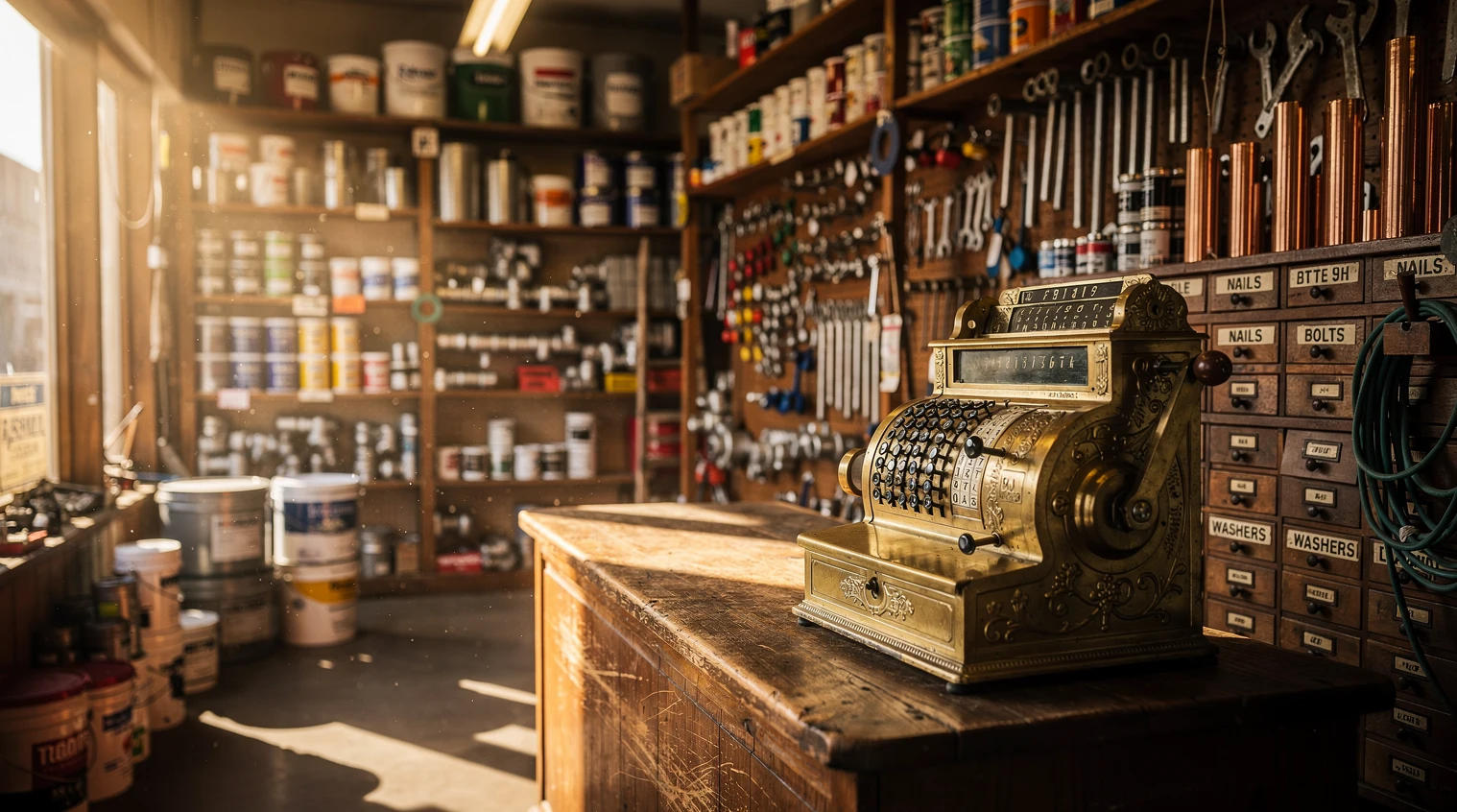
When a Lowe’s opened seven miles from Bauer Hardware in 2003, the third-generation owner gave the family business eighteen months. Twenty-three years later, Bauer is still on the same corner, the lights are still on, and the back room still smells like cut keys and 3-in-1 oil. The big box never closed Bauer. It made Bauer better.
This is the story of how a family hardware survives big box pressure when the math, on paper, says it shouldn’t. It is also a playbook drawn from dozens of independent operators across the United States who watched the same Home Depot and Lowe’s wave roll into their counties and decided to fight back with the only weapons an independent has: speed, expertise, and a refusal to be just another aisle.
In short
- Independents do not beat big boxes on price. They beat them on advice, on five-minute fixes, and on knowing which screw your 1972 furnace actually takes.
- Service density is the real moat. Repairs, rentals, propane, key cutting, screen rebuilds, and contractor accounts pull in margin a box store will not chase.
- Hyperlocal SKUs win. Stocking the obscure plumbing part for the 1940s housing stock down the street is something no national planogram can do.
- Co-ops change the math. Ace, Do it Best, and True Value give a 4,000 square foot store the buying power of a 40,000 square foot one.
- Digital is now table stakes. Curbside, BOPIS, and a clean local SEO footprint are no longer optional, even for a 90-year-old store.
Why this topic matters in 2026
The independent hardware channel is, against most forecasts, growing. The North American Retail Hardware Association reports that average independent store sales crossed $4.9 million in 2024, the highest figure on record, and same-store growth has outpaced the big box channel for three consecutive years. That is a remarkable statistic when you remember that the conventional wisdom in the late 1990s held that Home Depot and Lowe’s would close every Main Street hardware store in the country by 2010.
They didn’t. The reason matters because the lessons travel. Booksellers, grocers, toy stores, pet shops, and bakeries all face their own version of the big box question, and the hardware playbook is one of the most studied survival stories in American small business. We cover the same dynamic in the future of local retail and main street commerce, which frames why the next decade may be even kinder to well-run independents than the last one was.
2026 also brings new pressure points. Tariffs on imported tools, a generational handoff in family ownership, and the rise of AI-powered home improvement chat tools all reshape the competitive frame. The stores that adapt early are pulling further ahead. The ones that treat 2026 like 1996 are quietly closing.
Key terms and definitions
Before getting into the playbook, it helps to define the vocabulary the trade actually uses. These are not academic terms. They are the words a hardware buyer at Orgill or a regional Ace rep will use when talking shop.
| Term | What it means | Why it matters to an independent |
|---|---|---|
| Big box | A large-format home improvement retailer, typically 80,000 to 130,000 square feet (Home Depot, Lowe’s, Menards) | Sets the price floor on commodity SKUs and absorbs the DIY weekend shopper |
| Co-op (cooperative) | A member-owned wholesale buying group such as Ace Hardware, Do it Best, or True Value | Gives independents shared buying power, private label, and store-systems software |
| SKU productivity | Revenue per stock keeping unit per year | The single most useful metric for ruthless assortment editing |
| Pro account | A contractor or tradesperson on net-30 terms with a dedicated account manager | Often 30 to 60 percent of an independent’s annual revenue |
| BOPIS | Buy online, pick up in store | Lets a 4,000 sq ft store offer the same fulfillment promise as a 100,000 sq ft one |
| Hyperlocal SKU | An item carried specifically because of the surrounding housing stock, climate, or trade base | The single hardest thing for a national chain to replicate |
The interplay between these terms is the whole game. An independent that uses its co-op to subsidize commodity SKUs, then reinvests gross margin from hyperlocal SKUs and pro accounts into service density, has a structurally defensible business. One that tries to out-Home Depot Home Depot does not.
How it works in practice
Bauer Hardware sits on a 5,800 square foot footprint. Home Depot, seven miles away, runs 108,000 square feet. On any given Saturday Bauer has eight people on the floor. Home Depot has roughly twice that, but spread across an area twenty times larger. That ratio is the entire competitive insight.
When a customer walks into Bauer with a broken faucet cartridge in a paper bag, three things happen within sixty seconds: an associate identifies the brand and model, walks to the plumbing aisle, and either pulls the exact replacement or special-orders it on a same-day truck from a regional co-op warehouse. Total transaction time, including payment, is under five minutes. The customer pays a 22 percent markup over the big box price and considers it a bargain because they did not lose a Saturday morning wandering aisle 14.
That is the unit economics of survival in one paragraph. The independent does not compete on price per part. It competes on price per outcome. Outcome includes time, certainty, and the absence of a second trip.
The service stack
Most surviving independents layer revenue streams that big boxes either cannot or will not chase. A representative service stack at a strong independent looks like this:
- Key cutting and rekeying. Low capital, high foot traffic, repeat customer pattern.
- Propane tank exchange and refill. Drives weekly visits in summer, locks in grilling season.
- Small engine repair. Mowers, blowers, trimmers. Big boxes refer this out; independents capture it.
- Screen and window repair. A $40 service call that takes 20 minutes and converts the customer for life.
- Paint color matching and tinting. Sherwin-Williams or Benjamin Moore programs through co-op pricing.
- Tool sharpening, chain saw chains, mower blades. Seasonal, sticky, almost zero competition.
- Glass cutting, pipe threading, plumbing soldering kits. The handful of services the box stores quietly stopped offering after 2015.
- Rental. Carpet cleaners, tile saws, power washers, augers. Co-op rental programs make this turnkey.
Layer three or four of these on top of retail and a 5,000 square foot store will gross more per square foot than the box stores nearby. That is not a marketing claim; it is the published NRHA benchmark.
The pro account engine
Walk through any healthy independent on a Tuesday at 6:45 a.m. and the parking lot tells the real story. Contractor pickups, plumbers’ vans, electricians’ service trucks. These accounts are typically billed net-30, get a dedicated account manager, and represent recurring revenue that is largely indifferent to weekend Home Depot promotions. Building this book takes years. Stealing one from a chain takes a single phone call answered on the first ring at 6:30 a.m.
Common mistakes and how to avoid them
Not every independent that survived did so on purpose. Some got lucky. The ones that built durable businesses tended to avoid a predictable set of mistakes.
Mistake one: trying to match every big box price. A 4 inch PVC fitting at $0.42 is not where you win or lose the customer. Pricing commodity SKUs within 10 to 20 percent of the big box and pricing service and specialty items at 30 to 60 percent markup is the formula. Operators who slashed everything to match big box pricing on commodities ran out of working capital inside 24 months. The same dynamic plays out in food retail, as we cover in the story of a small bakery that beat a national chain on customer loyalty, where the operator stopped trying to compete on bread price and started competing on community.
Mistake two: keeping the assortment static. The store inherited from grandpa stocked the items grandpa’s customers wanted in 1985. The houses changed, the contractors changed, the climate priorities changed. Successful operators run a quarterly SKU productivity report, dropping the bottom 10 percent and adding twenty new SKUs against current local demand: smart locks, EV charging accessories, weatherization for the new wave of heat pumps, fire-resistant landscaping in the western states.
Mistake three: ignoring digital. A surprising number of independents in 2018 still considered a website optional. In 2026 that view is a death sentence. A clean Google Business Profile, a basic e-commerce shelf for the top 500 SKUs, BOPIS through the co-op platform, and active responses to reviews are all non-negotiable. The independents who got online before 2020 captured the COVID surge and never gave it back. The ones who waited until 2022 spent two years catching up.
Mistake four: under-investing in the store experience. Lighting, signage, clean restrooms, fresh paint, and a logical layout sound trivial. They are not. Customers translate visual order into trust, and trust into repeat visits. A $40,000 lighting upgrade typically pays for itself in 14 months through measurable basket size lift.
Mistake five: refusing to professionalize succession. The biggest reason healthy independents close is not big box competition. It is that the founder retired without a plan. Bringing in a non-family general manager, formalizing employee equity, or selling to an ESOP are all paths that keep the doors open across generations.
Examples from US retail and e-commerce
The pattern is easier to see in actual cases. Below are four stores, each illustrating one of the survival moves.
Bauer Hardware, Pennsylvania
Joined Ace in 2004 the same year Lowe’s opened nearby. Used Ace’s red vest training program and co-op pricing on commodity items to keep the price gap below 15 percent. Doubled down on small engine repair and pro accounts. By 2010 was net profitable; by 2020 had bought the building next door for inventory expansion. Annual revenue grew from $1.8 million in 2003 to $6.2 million in 2024.
Cole Hardware, San Francisco
Four locations across the city, founded 1959. Survived multiple big box openings by leaning hard into delivery (free same-day in San Francisco), a robust contractor account program, and aggressive community involvement. The store sponsors local schools, runs free repair clinics, and donates roughly 10 percent of pretax profit to neighborhood causes. Customers reward the loyalty with consistent foot traffic that no national chain replicates.
Killingsworth Environmental, Carolinas
Started as a small hardware operation and pivoted entirely into the service trades: pest control, plumbing, HVAC. Recognized in the early 2000s that the box stores had won the DIY shopper but had not touched the service economy. Today operates from a hub store with a service van fleet, doing more revenue from service calls than from retail sales.
Hammer & Stain, multi-state
A franchise of small experiential hardware-adjacent stores that combine traditional retail with DIY workshop programming. Customers come for a Saturday class on building a farmhouse table, leave with $200 of lumber, paint, and stain. The model proves that even in 2026, experiential retail beats pure transactional retail on margin per visit. The same insight, applied to brand launches rather than DIY, is explored in pop-up retail explained as a brand growth lever.
What unifies these four is not a single business model. It is a willingness to refuse the big box framing. None of them tried to be a smaller Home Depot. They each picked a different defensible niche and built around it.
Tools, partners or vendors worth knowing
An independent hardware operator in 2026 has a richer vendor ecosystem than at any point in the channel’s history. The right partners can compress what used to be a five-year transformation into eighteen months.
| Category | Notable partners | What they unlock |
|---|---|---|
| Co-op / wholesale | Ace Hardware, Do it Best, True Value, Orgill | Buying power, private label, store systems, marketing |
| POS and inventory | Epicor Eagle, RockSolid Max, Lightspeed Retail | SKU productivity reporting, BOPIS, pro account billing |
| E-commerce | Co-op-provided e-commerce (Ace.com, DoItBest.com), BigCommerce | National catalog with local fulfillment, Google Shopping feed |
| Local SEO and reviews | Birdeye, Podium, Google Business Profile | Review velocity, local pack ranking, message-to-store |
| Pro account financing | Net-30 underwritten by co-op or Wells Fargo Retail Services | Working capital protection on contractor terms |
| Training | NRHA training portal, co-op vest programs | Associate certification, OSHA compliance, paint mixing |
| Delivery and last mile | Roadie, Uber Direct, GoShare | Same-day delivery without a fleet investment |
The single highest-leverage choice for most independents remains the co-op decision. Ace, Do it Best, and True Value each have a slightly different cost structure, marketing posture, and store identity, and the right fit depends on geography, store size, and the operator’s tolerance for centralized branding. Talking to three current members of each co-op before signing is the standard advice from the North American Retail Hardware Association.
The e-commerce question
Independent operators occasionally ask whether to build a custom e-commerce site or accept the co-op platform. For 90 percent of stores, the co-op platform is the right answer. It comes with the national catalog already loaded, integrates with the POS, and routes orders to the nearest member store automatically. The exceptions are stores with a regionally distinctive assortment (marine hardware in coastal Maine, ranch hardware in west Texas) that benefit from a custom catalog and SEO strategy.
One pattern worth borrowing from outside the trade: independent bookstores have spent the past decade turning author events and book clubs into a significant revenue stream. The lesson generalizes. Workshops, repair clinics, and contractor breakfasts are the hardware equivalents, and they pull in the same loyalty dynamics described in a bookstore that turned events into half its revenue.
Putting it all together: a 12-month plan for an at-risk store
If a family hardware store is feeling the pressure today and the owner is reading this looking for a sequence rather than a theory, the following twelve months is the consensus playbook from operators who have actually walked the path.
- Months 1 to 2. Pull two years of SKU productivity data. Identify the bottom 15 percent. Mark for clearance. Identify the top 5 percent. Make sure they are never out of stock.
- Months 2 to 3. Audit the service stack. Add at least two services you do not currently offer (typical candidates: rental, screen repair, propane).
- Months 3 to 4. Choose or re-evaluate the co-op. If you are independent, get quotes from at least two. If you are already in a co-op, schedule a marketing program review.
- Months 4 to 6. Build or rebuild the digital footprint. Claim and optimize the Google Business Profile, deploy review collection, launch BOPIS, list 500 top SKUs online.
- Months 6 to 8. Launch or formalize the pro account program. Hire or designate a pro account manager. Open before 7 a.m. on weekdays.
- Months 8 to 10. Refresh the store. Lighting, signage, restrooms, layout. Aim for visible change a customer would notice on their first visit back.
- Months 10 to 12. Run two or three community events. Repair clinic, contractor breakfast, kids’ workshop. Capture emails and reviews from every attendee.
This is the same arc Bauer ran in the mid-2000s, the same one Cole has rerun every decade, and the same one a half dozen of the 2024 NRHA Beacon Award winners describe in their own case studies. None of it is secret. The reason it works is that it requires sustained operational discipline that the big boxes, with their quarterly earnings cycles, struggle to muster at the individual store level.
For operators thinking longer term about how independent retail fits into the broader main street economy, the strategic framing in the future of local retail and main street commerce is worth a careful read. It situates the hardware story inside a larger trend that is now reshaping every retail vertical.
What the next decade looks like for the independent channel
Three forces are shaping the next ten years of independent hardware. None of them favor the big boxes, and all three play to traditional small business strengths.
Force one: the rise of AI agents in home improvement search. When a homeowner asks ChatGPT or Gemini “where can I buy a Moen 1225 cartridge near 78704,” the model increasingly pulls from local sources, not just chain inventories. Independents with structured product data, accurate Google Business Profiles, and clean schema.org markup on their websites are getting cited at rates the chains, with their generic SKU pages, cannot match. This is the same dynamic that has lifted local plumbers and electricians in the past 18 months, and it is starting to apply to retail.
Force two: contractor demographics. The trades are aging. Roughly 40 percent of working US contractors are over 55. As they retire, the independent who has spent fifteen years building relationships with them is also losing accounts. The winning move is investing in the next generation today: trade school sponsorships, apprentice pricing programs, mobile-first ordering for the under-35 contractor who would never call in an order. Stores that started this in 2020 are already collecting the dividend.
Force three: the great housing handoff. The 2026 to 2036 decade will see the largest generational transfer of US housing in modern history as boomers downsize. New owners renovate. Renovation cycles drive hardware spend. Independents in markets with high boomer ownership and a healthy millennial inflow (Pittsburgh, Cincinnati, Raleigh, Boise) are positioned to benefit disproportionately if they have the assortment and the pro account base ready.
The data on US small business resilience is widely tracked by the US Census Bureau Statistics of US Businesses program, which publishes annual establishment and employment counts by industry. Reading the hardware retail subsector data year over year is one of the most sobering and encouraging exercises an operator can do, because it shows both the steady attrition at the bottom of the channel and the steady growth at the top.
FAQ
How does a family hardware store actually beat a Home Depot on customer experience?
Not on selection or price, but on speed of resolution. The independent answers the phone, knows the inventory by heart, and gets the customer in and out in under ten minutes with the right part. A Home Depot trip is rarely under thirty minutes door to door. That time premium is what the customer is paying for.
Is joining a co-op required for an independent to survive?
Practically, yes. The combination of buying power, private label products, store-systems software, marketing co-op funds, and e-commerce infrastructure is too expensive to replicate independently below about $20 million in annual revenue. The vast majority of healthy independents are members of Ace, Do it Best, or True Value.
What percentage of a hardware independent’s revenue typically comes from pro accounts?
It varies by trade area, but a healthy store usually sees 30 to 60 percent of annual revenue from contractor and tradesperson accounts. Stores that fall below 20 percent are usually consumer-only operations more vulnerable to big box pricing pressure.
How important is e-commerce for a small hardware store in 2026?
It is foundational. Even customers who intend to shop in person check the website first to confirm an item is in stock. BOPIS converts roughly a third of those checks into same-day visits. A store without a functional online presence is invisible to the customer journey that starts on a phone.
What is the most common reason a multi-generation hardware store closes?
Succession failure, not big box competition. The store usually closes because the founder retires without a plan to transfer ownership, train a non-family general manager, or sell to employees through an ESOP. Stores that handle succession well usually outlast the box stores that opened to challenge them.
How fast can a struggling independent turn around?
With committed ownership and a co-op partner, the published case studies typically show a turn to net profitability within 12 to 18 months. The first six months are usually painful as legacy inventory clears and operations shift. Months six to twelve typically show the first sustained same-store sales gains.
Do tariffs on imported tools help or hurt independents in 2026?
Mixed. On commodity items, both independents and big boxes face the same cost pressure, so price gaps narrow. On specialty and US-made products, independents tend to benefit because their assortment is already weighted toward American-made tool brands. Net, most analysts see tariffs as roughly neutral to mildly positive for the independent channel.
Where can an owner find peer-reviewed benchmarks for store performance?
The North American Retail Hardware Association publishes the Cost of Doing Business Study annually, which remains the most cited benchmark in the trade. Co-ops also publish member-only benchmark data. Comparing a single store to the relevant size and region cohort is the most useful first step in any turnaround.