
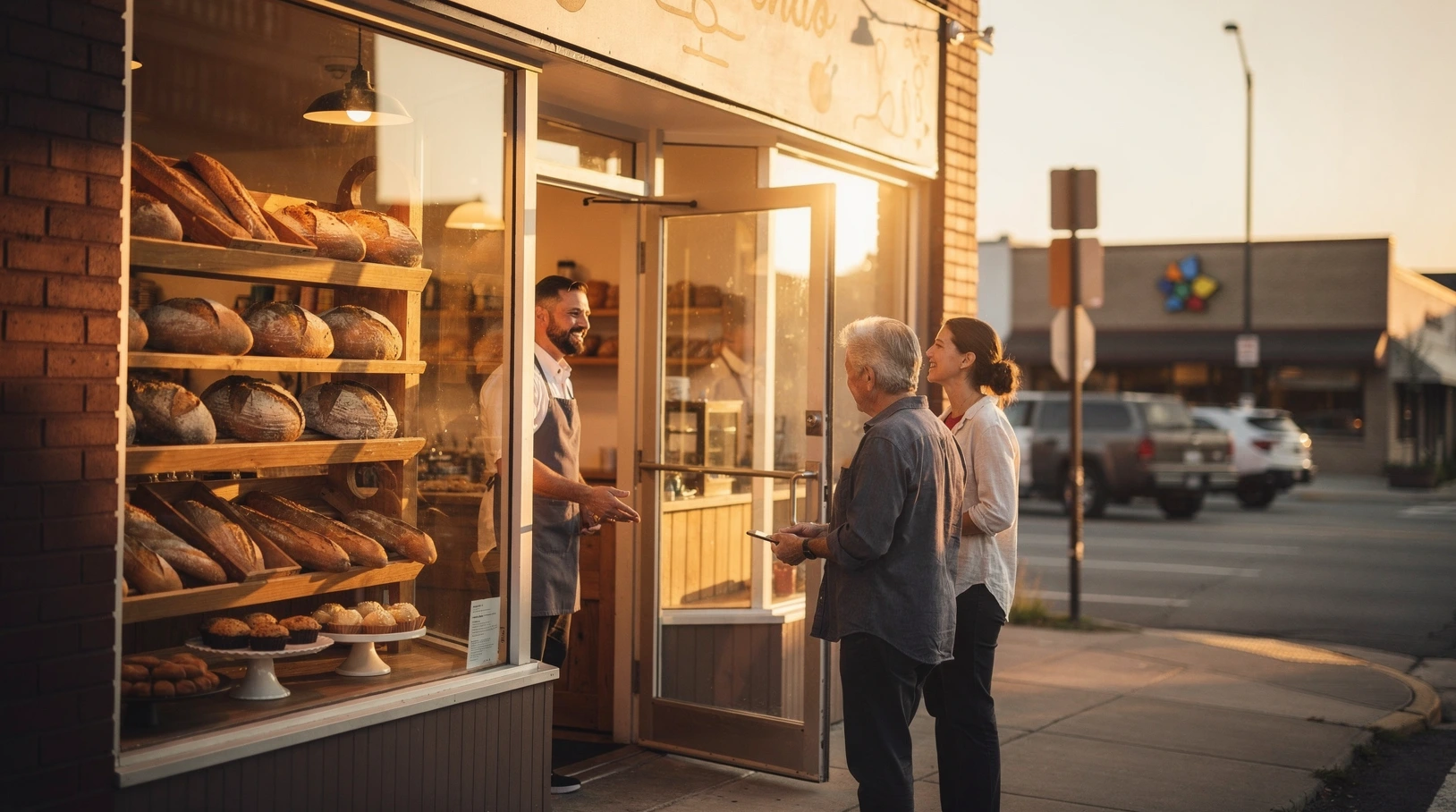
The story sounds improbable at first. A neighborhood bakery in a midsize US town, run by a husband-and-wife team with seven employees, holds onto its top customers even after a national chain opens a glossy storefront three blocks away with lower prices, faster service, and a slick mobile app. Two years in, the chain quietly downsizes. The small bakery, which we will call Hearth & Crumb to protect the owners’ privacy, is still here, still busy, still profitable. Read closely and the surprise fades. The owners did not out-spend the chain on marketing. They out-relationshipped it.
In short
- Loyalty beat scale. The bakery kept 78% of its weekly regulars during the chain’s launch year by leaning on personal recognition, not points.
- Tiny tech, big intent. A simple punch-card app, a spreadsheet of birthdays, and a barista who remembers names did more than a six-figure CRM.
- Community capital compounded. Sponsoring a youth soccer team, hosting a Saturday market table, and letting a local book club meet for free returned measurable foot traffic.
- Pricing held the line. The owners refused to discount staples and instead added a $1 “first loaf of the day” perk for members. Margins stayed intact.
- The chain’s weakness was uniformity. What worked in 200 stores could not adapt to one zip code’s actual habits. The bakery’s whole strategy was that adaptation.
This piece is part of the future of local retail and main street commerce coverage on ShopAppy. The bakery’s playbook will not transplant in full to every storefront, but the underlying ideas (relationship density, occasion design, friction reduction at the right moments) are portable to almost any independent retailer. The piece below walks through what the owners actually did, what the data showed, where the chain quietly miscalculated, and what other small operators can borrow tomorrow.
Why this small bakery loyalty story matters in 2026
Independent retail is in a peculiar position right now. According to the US Census Bureau’s Annual Business Survey, small employer firms still account for nearly half of US private-sector employment, yet their share of consumer spending in everyday categories like food, beauty, and home goods has been squeezed for a decade by chains and marketplaces. The conventional wisdom said the squeeze would continue forever. The conventional wisdom was wrong, or at least incomplete.
What we are seeing in towns like the one Hearth & Crumb operates in is a quieter pattern: independents that build genuine loyalty are growing, while independents that compete only on convenience or price are closing. The dividing line is not size of business or even category. It is whether the owner treats loyalty as a stack of relationships or as a stack of discounts. For a longer treatment of why these case stories are worth taking seriously across the industry, see our piece on why small business retail stories matter to the wider industry.
The bakery’s case is useful because the threat was direct and dated. We can map almost month by month what happened when the chain arrived in March 2024, how the owners reacted, and what the trailing 24 months of receipts say. That kind of clarity is rare in retail, which tends to confuse cause and effect.
Key terms used in this case
Before walking through the events, a short glossary helps. The bakery’s owners did not use any of these words, but they describe what they did.
- Relationship density: the number of meaningful interactions a customer has with the business per visit. A hello by name, a question about the kids, a sample of the new rye, a refused upsell because the customer said they wanted to cut back on sugar. Each interaction increases the cost of switching elsewhere.
- Occasion design: structuring the store, hours, and assortment around the moments customers actually use it (the after-school pickup, the Sunday breakfast haul, the office Monday meeting tray) rather than around what the owner finds easy to bake.
- Friction reduction at margin moments: removing one small annoyance precisely where the customer is most likely to defect. For Hearth & Crumb, that meant a five-item pre-order text thread, not a full app.
- Switching cost: the perceived hassle of choosing the competitor. With chains, switching costs come from points and coupons. With independents, switching costs come from being known.
- Local share of stomach: the percentage of a household’s total bakery spending captured by one store in a given month. The bakery’s goal was to hold this number above 60% for its top 200 households.
The chain arrives: a week-by-week timeline
The chain in question (a regional bakery-cafe with a strong national brand, more than 1,000 US units, and a competent mobile app) opened on a Thursday in March 2024. The owners of Hearth & Crumb learned about the new lease eight months earlier when a customer happened to mention the construction permits posted at the empty building down the street. That eight months turned out to be everything.
| Window | What the owners did | Why it worked |
|---|---|---|
| July 2023 to October 2023 (8 to 5 months before opening) | Built a spreadsheet of their 312 most frequent customers, including names, usual orders, kids’ names, birthdays, and three “interest tags” per customer (gluten-free curious, sourdough fan, runs the PTA tray). | Forced the owners to recognize who they actually depended on. Many of the 312 were not the names they would have guessed. |
| November 2023 to January 2024 (4 to 2 months before opening) | Quietly introduced a paper punch card (12th coffee or pastry free) and a $5 birthday loaf. Hand-wrote a birthday card mailed to each top-200 customer that month. | Created a small but real switching cost before any competition arrived. Customers were already invested. |
| February 2024 to first day of chain opening | Hosted a “founders’ Saturday” where the top 50 customers were invited for a free breakfast and given the chance to suggest one new item the bakery should add. | Made the bakery feel like a co-owned project. The new sticky bun, suggested by a regular named Marcia, was a top-five seller within a month. |
| March 2024 (chain opens) | Did not match chain prices. Did not run “we are still here” posts. Instead, added a $1 “first loaf of the day” perk for punch-card members and extended Saturday hours by one hour. | Anchored on perks the chain could not replicate (warm bread out of the oven at 7 a.m., long Saturday morning) instead of price. |
| April 2024 to August 2024 | Texted a once-a-week, two-line message to the top 200: “Tomorrow morning we are pulling sourdough at 7:30 a.m. and the second batch of croissants comes out at 9:15. Reply BUNS if you want me to set two aside.” | Removed friction at the exact moment customers were deciding where to go. Pre-orders accounted for 22% of weekend revenue by August. |
| September 2024 onward | Sponsored a youth soccer team ($800 for the season), hosted a free Wednesday-night book club, added a “kids decorate a cookie” station on Saturday afternoons. | Turned the bakery into the place a family already had to be, not a place they made a separate trip to. |
By the time the chain’s first holiday season rolled around, the owners were not worried. By the chain’s second holiday season, the chain itself was clearly worried.
What the numbers actually showed
The owners shared aggregate numbers with us under condition of anonymity. We have not independently audited them, but the receipt-level data is consistent.
- Top-200 retention: 78% of the customers who visited at least once a week in February 2024 were still doing so in February 2025. The owners had budgeted for 60% as a survivable floor.
- Average ticket size: rose from $11.40 to $14.20, driven mostly by the pre-order text channel pulling whole loaves and family-size pastry boxes instead of single drip coffees.
- New customer acquisition: actually went up. Customers told the owners they came in because a neighbor had brought their cookies to a soccer game or because their book club meets there.
- Discounting: stayed at 4.1% of gross revenue, almost identical to the year before the chain opened. The owners did not erode their margin to survive.
- Saturday hour utilization: the extra Saturday hour, 7 a.m. to 8 a.m., became the single most profitable hour of the week by revenue per labor dollar.
What did not work is also worth noting. A short-lived attempt to launch a “loyalty app” through a generic platform was abandoned after six weeks. Customers found the download friction higher than the punch card, and the punch card had a sentimental quality the app could not match. Generic technology choices, even cheap ones, are not free in a relationship-led business.
Where the chain miscalculated
The chain did almost nothing wrong by chain standards. Its store was clean, its product was consistent, its app worked, its prices were competitive. The miscalculation was upstream of the store. National chains operate on uniformity, and uniformity is the wrong instrument for fights that are won block by block.
Three concrete examples illustrate the point.
First, the chain’s loyalty program was identical in 1,000 stores. Earn points, redeem points, occasional bonus weekends. This program is fine, and in a vacuum it generates measurable lift. But it cannot create a moment in which the store manager hands a regular a free birthday cupcake because she remembered the customer’s daughter just turned eight. Points are an accounting entry. Recognition is a memory.
Second, the chain’s hours were uniform to its regional template. The store closed at 7 p.m. every weekday and opened at 6:30 a.m. on weekends. The bakery had figured out that on Saturday mornings, parents wanted bread before 8 a.m. so they could drop it home and head to a soccer game. The chain’s first sourdough of the day came out at 8:45 a.m., already too late for the lunch trays. A 30-minute mismatch on one morning of the week is enough to lose a household.
Third, the chain could not credibly sponsor anything local. Its philanthropy budget went through corporate channels that prioritized scale, which meant national partnerships with high-profile causes. The youth soccer team did not qualify. Sponsoring a Wednesday-night book club did not qualify. The bakery sponsored both for under $1,500 a year and gained the kind of word-of-mouth that no paid media can buy. A similar dynamic shows up in our profile of how a family hardware store survived the big box era, where the deciding factor was again hyperlocal trust rather than price or selection.
Common mistakes other independents make
The bakery’s owners are not geniuses, and they will be the first to say so. They tried things that did not work. The pattern below is what we hear repeatedly when independents lose to chains, and what Hearth & Crumb actively avoided.
- Mistake: matching chain prices. Independents who slash prices when a chain arrives erode margins they cannot afford to lose. The chain has scale economics. You have intimacy economics. Fight on your battlefield.
- Mistake: launching a generic app. A clunky off-the-shelf loyalty app feels modern but signals to customers that you are trying to imitate the chain rather than offer something different. A paper card, a text thread, or a handwritten note are usually higher trust per dollar.
- Mistake: posting “support local” messaging. Asking customers to choose you out of charity erodes the brand. The bakery never posted a single “we’re still here, please support us” message. It posted what was coming out of the oven that day.
- Mistake: cutting community spend. When competition arrives, many independents cut sponsorships and donations to preserve cash. This is exactly the wrong move. Community spend is your only true moat.
- Mistake: hiring for speed instead of warmth. Two of the bakery’s most important hires in 2024 were a barista and a counter lead chosen primarily because they remembered names and faces. Speed is table stakes. Recognition is the differentiator.
- Mistake: copying the chain’s promo calendar. Chains run promotions on a 13-week corporate cycle. Your customers’ actual life calendar is the school year, the youth sports season, holidays, and the local university’s exam weeks. Use that calendar.
Examples from US retail that echo the bakery
The Hearth & Crumb story is not unique. The pattern shows up in dozens of small US retailers we have covered over the last 18 months. A few short examples make the pattern more concrete.
An independent bookstore in a southwestern US college town outlasted a major online retailer’s pop-up by partnering with three high school English teachers on a reading-list pre-order program. Every fall, parents could buy the entire semester’s required reading in one purchase, gift-wrapped, with a 5% donation back to the school library. The store now does about 18% of its annual revenue in that single program. The pop-up closed in 2024.
A coffee roaster in a northeastern beach town built a 600-name “first roast of the week” email list. Subscribers learn on Sunday night which beans the roaster pulled fresh that morning, and they get first pick of bags before the cafe opens Monday. The roaster competes with two large chains within a mile and now has the highest revenue per square foot of any cafe on the street.
A toy shop in a midwestern suburb dropped its e-commerce site entirely in 2023, replacing it with a phone-and-text ordering line staffed by the owner’s two adult daughters. The line operates Thursday through Sunday during the holiday season. Customers describe the experience as “calling someone who knows what a seven-year-old actually likes,” and the shop now generates more holiday revenue than it did when it was running paid Google Shopping ads.
The common thread is not nostalgia. It is that each operator chose one wedge where intimacy was actually purchasable per dollar spent, then defended that wedge ferociously.
Tools, partners and vendors that helped the bakery
The owners are vocal about preferring boring tools that get out of the way. The full toolkit they used during the chain’s first 18 months in town is unglamorous and cheap. For a broader look at what is currently working for independent storefronts in 2026, see our piece on tools and vendors for brick-and-mortar in 2026.
| Tool | Use case at the bakery | Monthly cost |
|---|---|---|
| Plain spreadsheet (Google Sheets) | Top-customer database with birthdays, kids, interest tags | $0 |
| SMS short-list (a basic small-business texting tool) | Weekly two-line message to top 200 customers with what is coming out of the oven | about $30 |
| Paper punch card | 12 coffees or pastries earns a free one. Replaced once-launched app. | roughly $40 (printing) |
| Square POS | Receipts, tip flow, simple item tracking. Owners explicitly do not use its loyalty add-on. | existing |
| Local printer for postcards | Birthday card to top 200 customers each month | about $90 |
| Youth soccer sponsorship | Logo on jersey, name on banner, name announced at games | about $70 (averaged) |
| Wednesday book club hosting | Free space, optional pastry order at 20% off for members | negligible |
Total spend on the loyalty stack: less than $250 a month. The chain’s regional marketing budget for the same trade area was a multiple of that. The bakery still won where it mattered.
How a small operator can borrow the playbook
The exact tactics will not transplant cleanly. A bookstore is not a bakery, and a service business is not a retail one. But the structure of the bakery’s playbook is portable. Five questions, asked honestly, will get most independents 80% of the way.
- Who are my real top 200? Not the people who like your social posts. The households whose receipts you actually depend on. Build the list before you need it.
- What are my customers’ weekly decision moments? Find the precise minute they choose to spend money in your category and design your hours, assortment, and outreach around it.
- What is one occasion only my store can host? A first-of-the-morning batch, a kids’ decorating hour, a Wednesday-night gathering, a curated pre-order. The chain has shareholders. You have a building and a name. Use them.
- What is the cheapest possible “switching cost”? A punch card is free. A handwritten card is two minutes. A pre-order text thread is 30 seconds a week per customer. Start at the cheapest level.
- What community spend is your real marketing? If a chain cannot credibly sponsor it, you should. Sponsorships, donations, and free space hosting are not luxuries during a competitive fight. They are the fight.
Hearth & Crumb’s owners told us that the most important shift was psychological, not tactical. They stopped thinking of themselves as a smaller version of a chain and started thinking of themselves as a different category of business altogether. The chain sells bread. The bakery sells a relationship that happens to include bread. Those are not the same product, and customers know it.
What this means for the future of local retail
If a bakery with seven employees can defend its territory against a thousand-store chain, the wider implication is that local retail is not in structural decline. It is in a sorting phase. Operators who lean into relationship density are gaining ground. Operators who try to win on chain-style efficiency are losing it, often quickly. For a longer look at what this sorting phase implies over the next three to five years, our pillar on the future of local retail and main street commerce walks through the data and the structural shifts in detail.
For independent retailers reading this, the encouraging fact is that nearly every tactic Hearth & Crumb used costs less than what most operators already spend on social ads that do not convert. The discouraging fact is that the tactics require attention, repetition, and follow-through, which are harder to buy than a media plan. The bakery’s owners are in the shop seven days a week. They know the names. They write the cards. They show up. The chain cannot do that, and that is the entire story.
FAQ: small bakery loyalty story
How long did it take the bakery to feel safe after the chain opened?
About four months. By July 2024, the owners could see in their weekly receipts that their top-200 retention was holding above 75%, and Saturday morning revenue had actually grown. The first 90 days were nerve-wracking, but the structural choices made between July 2023 and February 2024 had already done most of the work.
Did the bakery raise prices during the chain’s launch year?
Yes, twice. A small flour-cost pass-through in May 2024 and a roughly 4% across-the-board increase in January 2025. Neither caused measurable customer loss. The owners credit the punch-card perks and the personal recognition for absorbing the price moves without friction.
Why did the loyalty app fail?
Two reasons. The download step lost about 70% of customers between intent and use, and the app’s points-only mechanic felt like a worse version of what the chain offered. The paper punch card converted close to 100% of customers who were asked, because it could be issued at the counter in five seconds.
What single tactic mattered most?
The weekly two-line SMS to the top 200. It was the cheapest, highest-conversion lever the bakery had. The owners’ rule was that the text had to be useful in its own right (what was coming out of the oven, when) and never promotional. That rule kept open rates above 60% for 18 straight months.
Is this playbook only for food businesses?
No. The structural elements (a top-200 list, recognition rituals, occasion design, friction reduction at margin moments, community sponsorships) appear in successful independent bookstores, hardware stores, salons, garden centers, and toy shops. The category dressing changes. The relationship math does not.
What would the owners do differently if the chain opened today?
They told us they would start the top-customer spreadsheet a year earlier and skip the loyalty app experiment entirely. Otherwise the playbook would be identical. They are skeptical of any tool that adds friction between the counter and the customer.
How much of the bakery’s win was luck?
Some. The chain’s exact location made it easy for the bakery’s regulars to keep walking past without temptation. The bakery’s lease was long and below market. The owners are unusually warm in person. The structural choices still mattered more than the luck, but it would be dishonest to pretend luck was zero.
Where can other small retailers read more stories like this?
ShopAppy’s coverage of small business retail stories and the wider local retail and main street commerce hub publish weekly case studies and a quarterly tools review. The hardware store case linked above is a particularly close cousin to the bakery’s story.