
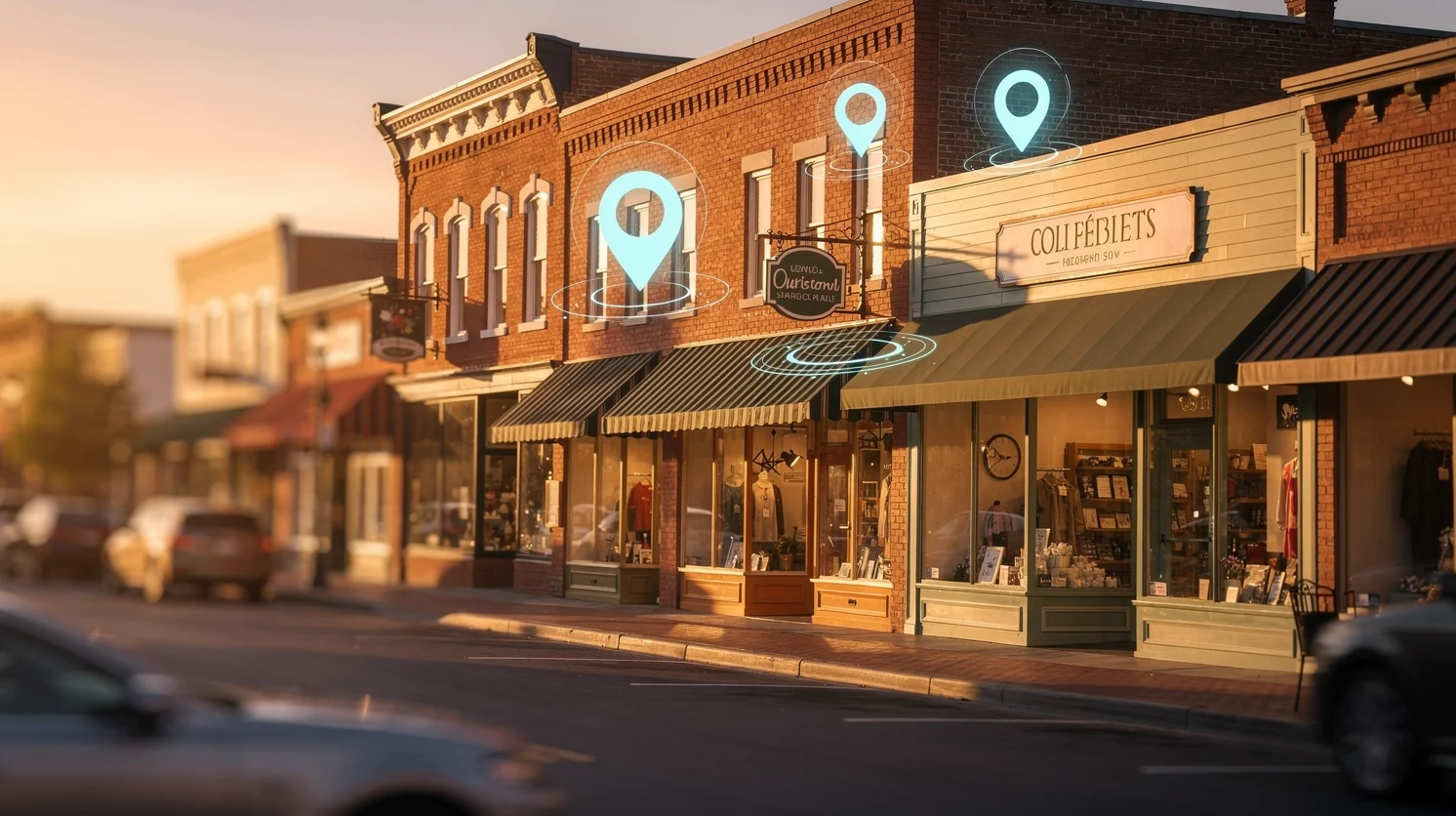
Local SEO in 2026 looks nothing like the keyword-stuffed playbook retailers ran in 2018. Google now blends AI summaries, map results, and traditional links on the same screen, and shoppers expect to see store hours, in-stock items, and same-day pickup before they click anywhere. For retailers with physical stores, the gap between sites that appear in those answers and sites that do not is widening every quarter.
In short
- Google Business Profile is still the single highest-leverage asset for physical retailers, but it now feeds AI Overviews, Maps, and Search Generative results, not just the local pack.
- Local intent has fragmented across Google, Apple Maps, ChatGPT Search, Perplexity, and TikTok, so retailers need consistent name, address, phone, hours, and product data on every surface.
- Inventory data wins clicks. Real-time product feeds connected to a store locator outrank generic category pages for “near me” queries.
- Review velocity matters more than review count. Stores collecting 5 to 15 fresh reviews per month rank above stores with 800 stale ones.
- Schema and store pages are non-negotiable. One indexable page per location, with LocalBusiness markup and opening hours, separates serious retailers from drop-ship competitors.
Why local SEO matters more in 2026, not less
It is tempting to assume that AI search collapses the long tail and removes the need for local optimization. The opposite is happening. When a shopper asks ChatGPT or Google for “best running shoe store in Austin that has Hokas in stock today,” the model has to pull from somewhere. That somewhere is structured retail data: Business Profile listings, inventory feeds, review corpora, and well-marked-up location pages.
Physical retailers who treat their stores as separate, indexable entities continue to capture high-intent traffic that pure e-commerce competitors cannot reach. The visit-the-store query is also the query that converts: foot traffic from local search closes at rates several times higher than cold paid social. That math has only improved as customer acquisition costs on Meta and Google Ads climbed through 2025.
The broader retail marketing picture is shifting just as fast, and our retail marketing in the age of AI search and social commerce guide lays out where local fits inside the larger budget. Local SEO is the lowest-cost channel in that mix when executed properly, with payback periods measured in weeks rather than quarters.
What “local SEO retail 2026” actually means now
The phrase covers four overlapping disciplines that used to be separate:
- Map and listings optimization. Google Business Profile, Apple Business Connect, Bing Places, and increasingly TikTok Business listings.
- Location page SEO. One indexable page per store with unique content, schema, and inventory tie-ins.
- Inventory and product feeds. Connecting your point-of-sale system to Google Merchant Center so “in stock near me” queries surface your products.
- Reputation and review management. Generating, responding to, and surfacing reviews across Google, Yelp, Trustpilot, and category-specific platforms.
Two years ago a retailer could excel at one or two of these and still win. In 2026, AI-powered ranking systems cross-reference all four. A store with a polished Business Profile but no inventory feed gets passed over for the “in stock today” question. A retailer with great inventory data but stale reviews loses to a competitor with fresher signal.
How AI Overviews changed the local game
When Google rolled out AI Overviews to the local pack in 2025, click-through rates on the top three map results shifted significantly. The overview itself often answers the basic question (hours, address, phone), so users only click when they want something specific: a product, an appointment, or directions. This means the pages that win are the ones that include those specifics above the fold. A homepage with a generic “Visit our stores” link no longer cuts it.
Google Business Profile in 2026: what changed and what to do
Business Profile is now the de facto home page for most physical retailers. Roughly 60 to 70 percent of branded local searches end without a click to the website, because the answer was already on the profile. The implication: your Business Profile is your storefront, and treating it as an afterthought costs revenue.
The 2026 Business Profile checklist
| Element | Why it matters | Update frequency |
|---|---|---|
| Primary category | Single biggest ranking factor; pick the most specific one | Set once, audit yearly |
| Secondary categories | Expands the queries you can match | Quarterly |
| Hours including holidays | Triggers “open now” eligibility | Weekly during seasonal periods |
| Products with prices | Surfaces in product carousels and AI answers | Sync via feed |
| Photos (interior, exterior, products) | Increases profile actions by 35 to 45 percent | Add 3 to 5 per month |
| Posts and offers | Fresh signals; appear in profile and search | Weekly |
| Q&A seeded by staff | Owns the answer before someone else writes it | Monthly review |
| Attributes (wheelchair access, Wi-Fi, payment) | Filter eligibility and AI mention triggers | Quarterly |
| Service area (if applicable) | Defines the radius you can rank in | Yearly |
| Booking or appointment links | Direct conversion path inside profile | Yearly |
The category trap
The most common mistake we see in audits: picking too broad a primary category. A specialty running store that selects “Sporting goods store” instead of “Running store” loses to competitors who match the more specific query. Google’s documentation is explicit that the primary category should be the single most accurate description, and AI ranking systems weight specificity heavily.
Location pages that actually rank
A page per location is non-negotiable. Each location page should be reachable in one click from the homepage, indexed, and structurally distinct from every other location page. Pages that are 95 percent identical with only the city name swapped get filtered as duplicate content.
What every location page needs
- Unique on-page copy: a few paragraphs describing the store, the neighborhood, parking, accessibility, staff specialties, and signature products.
- NAP block: name, address, phone formatted consistently and matched exactly to the Business Profile.
- Embedded map: ideally with the actual Google Maps embed, not a static image.
- Hours table: structured, ideally driven by the same source as the Business Profile to avoid drift.
- In-stock products: dynamic block pulling 12 to 24 popular items from local inventory.
- Reviews block: recent reviews surfaced on page, not behind a tab.
- Local events or local content: partnerships, sponsorships, community involvement.
- FAQ block: store-specific questions (parking, returns, special hours).
- LocalBusiness schema: with sub-type (ClothingStore, GroceryStore, ShoeStore, etc.) and openingHoursSpecification.
The schema piece deserves its own deep dive. Marking up store pages, products, reviews, and FAQs gives ranking systems explicit signals about what each page represents. Our walkthrough on structured data for retail, what to mark up and what to skip covers the specific JSON-LD patterns that work in 2026 and the ones to leave alone.
Avoiding the cannibalization trap
Retailers with many stores often run into a cannibalization problem: the homepage, the city landing page, and the individual store page all target the same query. The fix is a clear intent hierarchy: brand and category at the homepage, regional roundups at the city level, and individual store specifics at the location page. Internal links should reinforce that hierarchy, not flatten it.
Inventory feeds: the new local ranking moat
Connecting a point-of-sale or inventory management system to Google Merchant Center, with the local inventory ads feed enabled, unlocks the “in stock near me” surface. This is the highest-converting query type in 2026 for physical retailers, and it directly feeds into AI Overviews and Google’s Shopping Graph.
The setup requires three feeds working together:
- Main product feed describing each SKU.
- Local inventory feed mapping SKU to store and stock count.
- Store list feed reconciling internal store IDs to Business Profile listings.
Retailers who skip step three end up with inventory data that ranking systems cannot tie back to a real location, which defeats the purpose. Verifying the linkage in Merchant Center’s diagnostics page should be a weekly habit.
What if you do not have the engineering bandwidth?
Smaller chains can use intermediaries like Pointy (acquired by Google), Marsello, or Shopify‘s POS-to-Merchant-Center integration to get inventory data flowing without a custom build. The output is meaningfully worse than a tailored integration, but still much better than no feed at all.
Reviews in 2026: velocity, response, and surface coverage
Three review metrics matter to ranking systems, and only one of them is the total count.
| Metric | What it measures | 2026 target |
|---|---|---|
| Velocity | Fresh reviews per location per month | 5 to 15 minimum |
| Response rate | Percentage of reviews with an owner reply | 90 percent or higher |
| Response time | Hours between review and reply | Under 24 hours |
| Sentiment | Average star rating, ideally 4.5+ | Above 4.3 |
| Topic coverage | Reviews mentioning key products or services | Diverse mentions of top 10 SKUs |
| Cross-platform coverage | Reviews on Google, Yelp, Trustpilot, category sites | Active on 3+ platforms |
The shift in 2026 is that AI systems quote reviews verbatim when answering local product questions. A store with reviews that mention specific items (“they had the Brooks Ghost in size 11 in stock”) becomes a higher-quality source for the question “where can I buy Brooks Ghost size 11 near me.” This is not theoretical. It is observable in real Perplexity and ChatGPT Search outputs every day.
Asking for reviews without breaking guidelines
Google’s review guidelines have not changed but enforcement got tighter. Specifically prohibited: gating (only asking happy customers), incentivizing (offering discounts for reviews), and bulk-soliciting via third-party kiosks. What works in 2026 is post-purchase email or SMS asks sent 24 to 72 hours after the transaction, with a short link to the Business Profile, and no language conditioning the ask on the customer’s experience.
Faceted navigation and local: a subtle problem
For multi-location retailers running large product catalogs, faceted navigation (filtering by size, color, brand) can multiply indexable URLs into the millions. This dilutes ranking power and slows crawl. The interaction with location pages is what catches teams off guard: a location page that links to filtered product views can leak crawl budget into thin combinations that should never have been indexed.
The right approach combines noindex on most filter combinations, canonicals back to the unfiltered category, and selective indexing only on the high-value filter combinations that match real search demand. We unpack the specifics in our breakdown of how retailers should handle faceted navigation without killing SEO, including the rare cases where indexing filtered URLs is the right call.
Examples from US retail in 2026
Three patterns worth studying, drawn from observed leaders in their categories:
1. Specialty grocery: Wegmans and the deep store page
Wegmans runs detailed location pages that include weekly circulars, in-store events, prepared food menus that vary by store, and a list of specific local suppliers. The page for a single store can run 2,500 words or more, none of it boilerplate. The result is location pages that rank for “[product] Wegmans [city]” queries that competitors leave on the table.
2. Outdoor retail: REI and the community angle
REI’s store pages embed local class schedules, repair shop hours, and recurring community group rides or hikes. The community content updates frequently, which feeds the freshness signal, and the schedules themselves are highly searched. REI also leans into co-op member events, which generate both content and organic local mentions.
3. Small chain example: a 12-store running specialist
A regional running store chain in the Pacific Northwest moved from generic location pages to a model where each store page included staff bios with running credentials, gait analysis booking, training group schedules, and current local race results. Time on page roughly doubled and local query rankings improved across all twelve locations within two quarters. The investment was about 20 to 30 hours per location, one time, plus ongoing weekly maintenance.
Tools, platforms, and vendors worth knowing in 2026
The vendor landscape consolidated through 2024 and 2025. The current useful set:
- Yext, Uberall, and Synup for listings management across Google, Apple, Bing, and the long tail of directories. Choose based on integrations rather than feature lists; the core capability is similar.
- BrightLocal, Whitespark, and Local Falcon for local rank tracking and grid-based visibility maps. Essential for measuring “near me” performance at the neighborhood level.
- GatherUp, Birdeye, and Podium for review generation and response workflows. The differentiation is in CRM integration and SMS handling.
- Schema App and Merkle Schema Generator for JSON-LD at scale across hundreds of location pages.
- Pointy (Google) for the simplest path from POS to local inventory ads, especially for stores running Square, Lightspeed, or Shopify POS.
The tools matter less than the operating model. Retailers who treat local SEO as a continuous practice (weekly listings audit, monthly schema review, quarterly content refresh) outperform those who view it as an annual project, regardless of vendor.
How brand identity intersects with local in 2026
One of the under-discussed shifts is that strong brand signals now amplify local ranking. When AI systems decide which store to mention for a query, they cross-reference brand recognition signals (search volume for the brand, mentions in press, social conversation) with local presence. A well-known brand with a Business Profile outranks a stronger local optimizer with a weak brand for ambiguous queries.
This is one reason category coverage and brand work feed into local performance. Tracking the names that shoppers actually trust, and building presence around them, has compounding effects on local visibility. Our roundup of the 2026 brand profiles changing what retail looks like covers the names that are pulling away in this combined brand-plus-local game and what specifically they are doing differently.
Common mistakes that still cost retailers in 2026
- Inconsistent NAP across listings. Even small punctuation differences cause confidence drops. Audit quarterly with a listings tool.
- Using a call-tracking number on the Business Profile. If the tracking number is not also the main published number, ranking systems flag the inconsistency. Use Google’s call insights instead.
- Boilerplate location pages. Pages that are 90 percent template lose to anything with genuine local content.
- Skipping the Q&A section. Competitors and disgruntled customers fill the void with content the retailer would never want.
- Not claiming Apple Business Connect. Apple Maps drives meaningful traffic from iPhone users and the listing is free.
- Treating reviews as a marketing problem. They are an operations problem. Service quality drives sentiment; marketing only drives volume.
- Ignoring photo guidance. Listings with fewer than ten photos consistently underperform. Add interior, exterior, staff at work, and product close-ups.
- Letting the holiday hours field stay blank. A blank field on Thanksgiving morning sends customers to a competitor.
A 90-day local SEO action plan for a retail chain
| Phase | Days | Focus | Outcome |
|---|---|---|---|
| Audit | 1 to 14 | Listings audit, NAP consistency, schema check, review baseline | Gap list with priority scoring |
| Foundation | 15 to 45 | Fix NAP, claim missing listings, add LocalBusiness schema, set up Merchant Center | Clean data layer across surfaces |
| Activation | 46 to 75 | Launch review flow, refresh location page content, set up posts cadence | Active local marketing operations |
| Iteration | 76 to 90 | Measure ranking shifts, double down on top stores, document playbook | Repeatable system |
The plan is intentionally not too aggressive in the first month. Most retail local SEO failures come from launching tactics on top of broken data foundations. Spending two weeks on audit and four weeks on fundamentals before activating reviews and content prevents the most expensive type of mistake: scaling something that does not actually work.
Mobile-first local: what most retailers still miss
The majority of local queries happen on a phone, often within 100 meters of a competitor’s storefront. That changes the design constraints on a location page in ways many retailers have not internalized. The phone number must be tap-to-call without a tap-zoom-tap sequence. The hours must be visible without scrolling. Directions must be a single tap, ideally to the user’s preferred navigation app. The “in stock today” status must load before the rest of the page, because waiting two seconds on a mobile data connection sends the shopper to the next result.
Core Web Vitals matter here too, but in a specifically local way. A location page that loads slowly on a 4G connection in a low-signal area loses the click, full stop. Retailers who deploy a separate, lighter location-page template (rather than reusing the same heavy product page chrome) consistently see better mobile conversion. The cost is one templating decision; the upside is measured in foot traffic.
Voice and AI assistants
Voice search for local queries was overhyped in 2018 and underestimated in 2024. The current reality: somewhere between 12 and 18 percent of “near me” queries on mobile devices originate from a voice assistant (Siri, Google Assistant, Alexa). The implication for retailers is that the question format matters. A page that explicitly answers “what time does the Brooklyn store open on Sundays” with a clear sentence ranks higher in voice contexts than a page that only embeds an hours table. The fix is small: add a sentence-form answer alongside the table.
The seasonal local SEO calendar
Local SEO has a seasonal rhythm that retail teams should plan against. Missing the window costs traffic during exactly the periods that matter most.
| Month | Priority | Why |
|---|---|---|
| January | Refresh location page content, audit listings | Quiet traffic period, easy to A/B test changes |
| February | Schema audit, review response sprint | Building toward spring shopping |
| March | Spring product feed refresh, photo updates | Seasonal merchandise shifts |
| April to May | Local event tie-ins, community content | Outdoor and event marketing season |
| June to August | Hours accuracy (summer schedules), tourist-focused content | Travel and visitor traffic |
| September | Back to school, fall product feeds | Second-highest retail period |
| October | Holiday hours setup, gift guide content | Lead time before peak |
| November to December | Daily holiday hours verification, post velocity, review monitoring | Peak season, mistakes cost most |
One specific November practice that consistently helps: post on the Business Profile at least twice per week during the four-week peak. Profile posts have a short half-life but show prominently in branded local searches, which spike during gift-buying weeks. Most retailers stop posting in early November because the team is busy with operations; the ones that keep posting pick up clicks competitors leave behind.
Measuring local SEO that matters
Vanity metrics in local: total Business Profile views, average position. They move with seasonality and tell you little. The metrics that matter in 2026:
- Profile actions per store per month (calls, direction requests, website clicks).
- Local pack appearances for your top 50 commercial keywords, measured with grid tracking.
- Store visit attribution from Google Ads or organic, when available.
- Inventory-driven clicks from local inventory ads or free listings.
- Review velocity and response time per store.
- AI Overview citations for local product queries (track via Perplexity, ChatGPT Search, and Google’s AI Overviews).
The last metric is new in 2026 and worth instrumenting carefully. Manual sampling of 20 to 50 representative queries per quarter gives a directional read on whether your stores are being cited in AI answers, and that signal correlates strongly with future click traffic.
Reference data and further reading
For broader context on the US retail landscape, the US Census Bureau retail trade data is the canonical source for category-level trends that should inform which local queries to prioritize. The Local Search Ranking Factors survey (published annually by Whitespark) remains the best-documented practitioner consensus on what currently moves the needle.
For deeper coverage of how local fits inside the broader retail marketing budget and the AI search shift, return to our pillar guide on retail marketing in the age of AI search and social commerce. That piece ties together paid, social commerce, brand, and local into a single operating picture.
FAQ
Do I need a separate location page for every store, even if they sell the same products?
Yes. Each location is a distinct entity in Google’s index, with its own ranking signals (reviews, photos, links, citations). One page per location is the table stakes for competing in local search in 2026, and the content on each should be meaningfully different.
How many Google reviews do I need to rank in the local pack?
There is no fixed threshold. What matters is having more recent, higher-rated reviews than the competitors currently in the top three for your target query. Velocity matters more than absolute count: a store getting 8 fresh reviews per month outranks a store stuck on 400 reviews from 2022.
Is Yelp still relevant for retailers in 2026?
For most retail categories, less than it used to be, but still worth maintaining. Yelp drives some referral traffic and its data is still ingested by Apple Maps and certain AI assistants. The right investment is a claimed listing with current information, not active community engagement.
Should I worry about Apple Maps?
Yes. Apple Maps is the default on every iPhone, and Apple Business Connect (free to claim) gives you control over how your stores appear. The setup takes about 30 minutes per location and is one of the highest-ROI tasks in local SEO.
What is the single highest-impact change for a retailer just starting on local SEO?
Verify and complete every Google Business Profile for every location, with accurate categories, hours, photos, and products. Sixty percent of the value of local SEO sits inside that one task. Everything else compounds on top of a clean Business Profile foundation.
How do AI Overviews affect local SEO investment?
They raise the bar on data quality and lower the value of generic content. Retailers who already had complete profiles, fresh reviews, and structured location pages benefited from AI Overviews; retailers who skimped on those things lost visibility. The investment thesis did not change, but the consequences of underinvesting got harsher.
How often should I update location page content?
The structural elements (hours, address, schema) only when they change. The narrative content benefits from a refresh every six to nine months, with smaller updates monthly (new staff, seasonal product highlights, local events). Avoid the trap of weekly micro-edits, which yield no ranking benefit and consume bandwidth.
Can I rank in local search without a physical store?
Only as a service-area business, and only for service-area queries. Pure e-commerce retailers without a physical presence cannot win the local pack for shopping queries. This is one of the persistent advantages of the omnichannel retailer over the pure-play in 2026.