
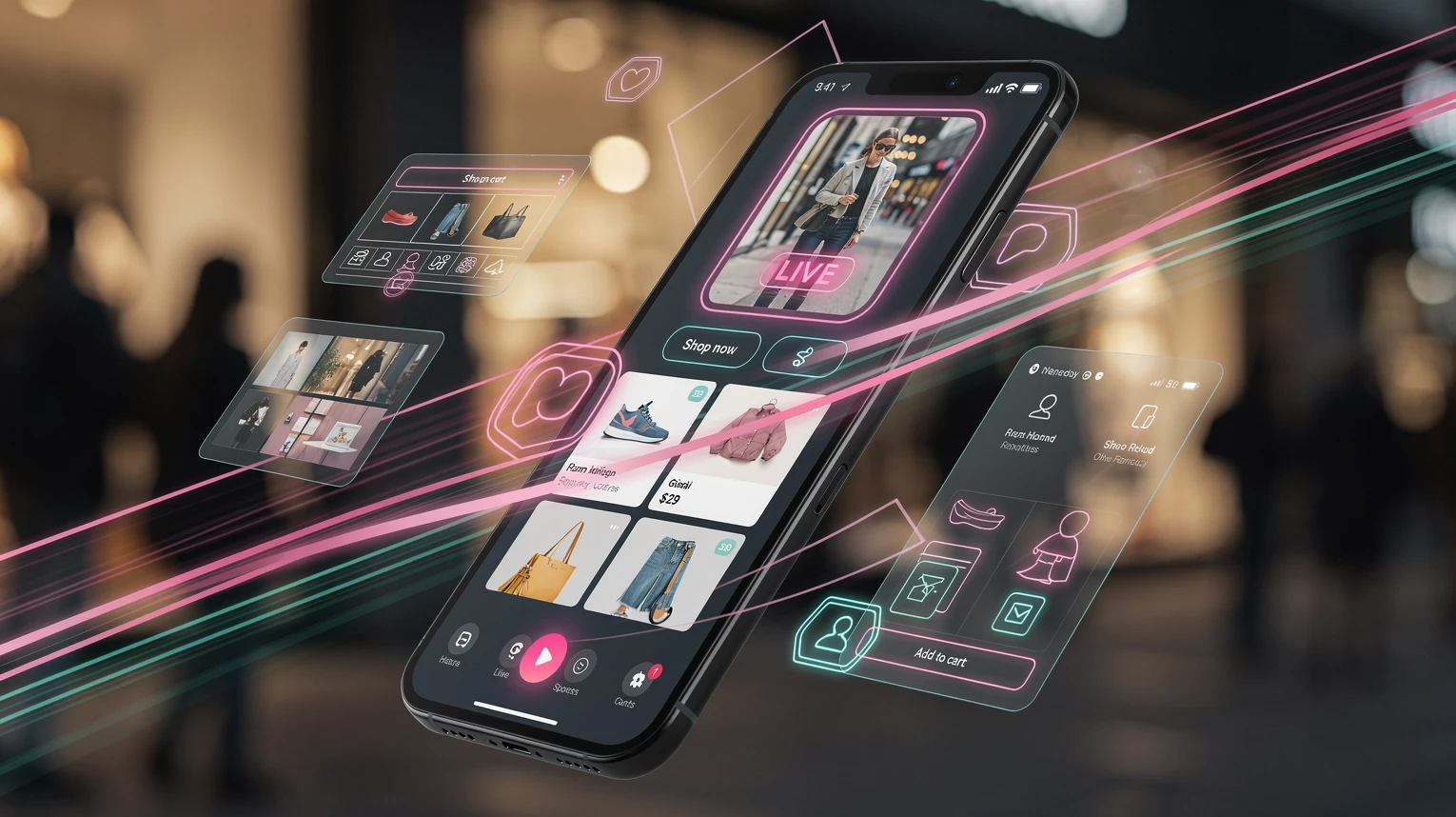
Gen Z social commerce has stopped being a side experiment. By early 2026 it is a primary acquisition channel for US retailers under 35 in apparel, beauty, snacks, and home goods, and the data finally tells a more nuanced story than the early narrative suggested.
In short
- Discovery, not checkout, is what Gen Z buys on social. Most still complete purchase on the brand site or app.
- TikTok Shop, Instagram Shopping, and YouTube Shopping dominate, but creator livestreams on smaller platforms are growing fastest.
- Returns rates from social-driven orders run 1.4x to 2x retail average in apparel; sizing and expectation gaps explain most of the gap.
- Loyalty signal is weak: repeat purchase from a first social touch hits roughly 18 to 24 percent within 90 days versus 35 to 45 percent for paid search.
- Trust beats reach: creators with 10,000 to 100,000 followers convert better than mega-influencers across most retail verticals.
This piece pulls together the most-cited US data points, separates them from marketing folklore, and gives retail and e-commerce teams a working playbook. It sits inside the broader picture covered in our pillar on the state of consumer behavior in retail and e-commerce, which is worth reading first if you want the cross-generational context.
Why gen z social commerce matters in 2026
Gen Z, born roughly between 1997 and 2012, now spans early teens to people in their late twenties with their own households. The older half holds buying power; the younger half shapes household influence. US Census Bureau population estimates put this cohort at well over 65 million people, and Pew Research has tracked their distinct media habits for nearly a decade.
What changed in 2025 and 2026 is platform maturity. TikTok Shop went from novelty to credible checkout. Instagram Shopping rebuilt around creator commissions. YouTube Shopping became default for long-form review content. Pinterest leaned into shoppable pins for home and beauty. Meanwhile, Snapchat and Twitch carved smaller but loyal commerce niches.
The result: Gen Z does not separate shopping from scrolling. The funnel does not start in Google for most discretionary spend in this group. It starts on a feed, often inside a video, and ends on a checkout that may or may not be the platform itself. Treating this as a media problem instead of a commerce problem is the single biggest mistake teams make.
Key terms and definitions
The vocabulary around gen z social commerce has drifted, and confused terms create confused strategy. A few quick definitions help.
- Social commerce: any retail transaction where discovery, consideration, or checkout happens inside a social platform. Native checkout (TikTok Shop) and off-platform completion both count.
- Live commerce: real-time selling, usually video, often with limited inventory drops or Q&A.
- Creator commerce: any social commerce flow led by an individual personality rather than the brand account.
- Shoppable content: posts, reels, or videos tagged with product so users can buy without leaving feed.
- Affiliate commission: pay-per-sale fee paid to creators, typically 5 to 20 percent in US retail.
One terminology trap worth flagging: industry reports often combine all social-influenced sales (including someone seeing an ad then buying later via paid search) with native social checkout. The first number is huge. The second is much smaller but more strategically interesting. When you read a stat, ask which one the analyst means.
How gen z social commerce actually works in practice
The classic funnel does not capture this. Gen Z shopping is closer to a loop: see, react, save, research, return, decide. Pretending it is linear leads to overweighted attribution on whichever channel sits at the end of the path.
Here is what a typical apparel purchase looks like for an older Gen Z shopper based on session-replay data and consumer panels reported by Statista and similar US trackers in 2025.
- TikTok scroll surfaces a creator hauling a brand. User watches, may save.
- Within 24 to 72 hours, user revisits via direct, search, or Instagram.
- They compare 2 to 4 reviews on TikTok, YouTube, and Reddit.
- They check sizing in a community thread or creator comment.
- They complete purchase on the brand site, on TikTok Shop, or sometimes in a marketplace.
- Post-arrival, they may post a try-on, return, or quietly keep.
That loop has three implications. First, single-touch attribution lies. Second, returns become a creator-relationship issue, not just a logistics one. Third, the people earning the most goodwill in this group are not the ones with the largest reach. The bigger picture across cohorts is laid out in the pillar on the state of consumer behavior in retail and e-commerce, which is worth bookmarking alongside this guide.
What that loop changes for retail teams is the budget conversation. If most of the value is created in the middle of the journey, the brands that fund creator partnerships, community management, and post-purchase content tend to capture more lifetime value than the brands that pour everything into top-of-funnel paid. Most US retailers in 2026 are still budgeting like the loop does not exist, and it shows in their cohort retention curves.
Platforms compared: where Gen Z actually buys
| Platform | Primary use | Native checkout | Strongest verticals | Typical creator commission |
|---|---|---|---|---|
| TikTok Shop | Discovery and impulse | Yes | Beauty, snacks, fast fashion, small home | 10 to 20 percent |
| Instagram Shopping | Aspirational and saved-for-later | Partial | Apparel, jewelry, beauty | 5 to 15 percent |
| YouTube Shopping | Long-form research and review | Partial | Tech, beauty tools, fitness gear | 5 to 10 percent |
| Pinterest Shopping | Planning and inspiration | Off-platform | Home, decor, weddings, DIY | 5 to 10 percent |
| Snapchat / AR try-on | Bottom-funnel preview | Off-platform | Eyewear, cosmetics | Variable, mostly CPM |
| Twitch commerce | Loyal subculture buying | Off-platform | Gaming, streetwear, energy drinks | 5 to 15 percent |
The platform mix matters less than the role each one plays. TikTok Shop is, today, the strongest single conversion engine for impulse and low-consideration categories. Instagram Shopping is the strongest middle-of-funnel tool because saves are an authentic preference signal. YouTube Shopping is the most underrated for higher-ticket items where customers want a 12-minute review before they spend $150 or more. Pinterest is the platform retail teams habitually undersell to their leadership; it is where Gen Z and younger Millennials plan moves, weddings, dorm rooms, and seasonal wardrobes.
Worth flagging: Threads, X, and Bluesky barely register for direct-response retail commerce as of mid-2026, even though some brand voices live there. Treat them as community surfaces, not commerce surfaces, until the data shows otherwise.
Data versus narrative: what the headline numbers really say
If you read industry coverage in 2024 and 2025 you saw three claims repeated until they felt true: Gen Z buys everything on TikTok, mega-influencers drive the most sales, and social ads are dying. The data does not back any of those at face value.
Claim one. Most Gen Z social-influenced purchases still complete off the social platform. Native checkout shares are growing, but in apparel and home they hovered between 22 and 38 percent of social-influenced sales through 2025 in US panels referenced by Statista. The brand site is still the primary checkout for everything above a casual price point.
Claim two. Mid-tier creators with 10,000 to 100,000 followers consistently outperformed mega-creators on conversion per impression in beauty, snacks, and lifestyle categories. Trust is the variable, not reach.
Claim three. Paid social retains a clear role for retargeting and lookalike acquisition. What changed is the diminishing return on cold-traffic creative without earned-content reinforcement. The teams that treat paid and creator content as one system, not two, outperform the rest.
The cleaner reading of the data: gen z social commerce is real, durable, and growing, but the value mostly accrues to brands that treat creators as partners and social as discovery rather than as a one-shot sales channel. The pillar on the state of consumer behavior in retail and e-commerce walks through how this compares to Millennials, Gen X, and Boomers if you need the full cohort picture.
Metrics that separate good from bad social commerce programs
| Metric | Weak program | Healthy program | Best-in-class |
|---|---|---|---|
| Creator-driven session share | Under 5 percent | 10 to 20 percent | 25 percent or more |
| Save rate on branded posts | Under 1 percent | 2 to 4 percent | 5 percent or more |
| 90-day repeat from social first-touch | Under 15 percent | 18 to 24 percent | 25 to 30 percent |
| Return rate from social orders | 2x retail average | 1.4 to 1.6x | Within 1.2x |
| Creator program retention (12 months) | Under 20 percent | 30 to 45 percent | 50 percent or more |
One number that often gets overlooked is creator retention. The brands that keep the same creators working with them across multiple campaigns build a kind of compounding trust that single-shot programs can never replicate. Industry coverage of social ad CPMs misses this entirely because it focuses on cost per impression rather than cost per durable relationship.
Common mistakes US retail teams make and how to avoid them
Five patterns show up repeatedly in 2026 audits of US retail brands trying to crack this audience.
- Treating creators as billboards. Buying a fixed deliverable and dictating script kills authenticity. Brief on intent, brand guardrails, and product truth; leave the voice alone.
- Underinvesting in returns and CX. Social-driven cohorts return more. Loose return policy is a customer acquisition tool, not a cost center, but only if reverse logistics can keep up.
- Confusing reach with relevance. A 2M-follower creator who has never bought your category will not convert. Audience fit beats follower count every time.
- Ignoring community signal. Comments, saves, and shares on creator posts are early conversion signals. Most analytics setups still optimize on view-throughs.
- Splitting paid and organic budgets. The strongest US programs in 2025 ran combined creator briefs across paid and earned with shared measurement, not separate teams.
One related question that comes up often: should the loyalty program live inside the social funnel or outside it? Our breakdown of tiered loyalty versus paid membership for retail covers the tradeoffs, including why most US retailers should not gate Gen Z access behind a paid tier in the first year of a program.
A subtler mistake is mismatching the brief to the platform. A TikTok video is not just a shorter Instagram reel, and a YouTube Shopping clip is not a long-form ad. Each platform has its own grammar. Briefs that ignore that grammar produce content that underperforms regardless of how well-known the creator is. Investing in a creative lead who actually scrolls these platforms (as a user, not a marketer) is one of the highest-ROI hires retail teams can make in 2026.
Another quiet mistake is not protecting creators from brand-driven script bloat. Procurement, legal, and brand teams all want a turn at the brief, and the end result is a sterile post that converts no one. The cleanest US programs centralize creator briefs through a single owner with explicit authority to push back on internal edits.
Examples from US retail and e-commerce
A few anonymized but representative cases that played out in US retail through 2025.
Beauty brand, $40M revenue, DTC plus Sephora. Shifted 35 percent of paid social budget into mid-tier creator commerce in late 2024. Native TikTok Shop checkout reached 28 percent of total online revenue by Q4 2025. Returns climbed initially, then stabilized after the brand added video sizing guides shot in the creator’s own format.
Apparel marketplace, multi-brand. Tried two strategies in parallel: one celebrity-led, one community-of-creators. The community model produced 2.3x the conversion per dollar by month six. The celebrity arm produced more aided recall but failed to move incremental purchase.
Snack brand, regional rollout. Used TikTok creators in three US cities ahead of grocery distribution. In-store sell-through in those cities outpaced national average by 41 percent. Worth noting: the brand also ran in-store sampling, so attribution was blended.
Home goods retailer. Built a Pinterest plus Instagram program for older Gen Z and younger Millennials. Average order value rose 19 percent, repeat purchase within 90 days rose 7 points. The lift came mostly from the planning behavior characteristic of Pinterest, not from feed activity.
The common thread across the winners is patience. None of them tried to make social commerce a quarterly miracle. All of them built creator relationships that ran for more than a single campaign.
One pattern worth pulling out: the brands that succeeded built their own evidence library. They tracked every creator collaboration, the brief, the asset, the platform, the spend, the conversion, the return rate, and the 90-day repeat. After a year they had the data to defend creator budgets against the next CFO review. Brands that did not track this lost their programs the first time finance went looking for cost cuts.
Tools, partners, and vendors worth knowing in 2026
The tooling stack for gen z social commerce matured a lot through 2025. A simplified, US-relevant stack looks like this.
- Creator discovery and CRM: CreatorIQ, Aspire, GRIN, Modash. Pick based on whether you need outbound discovery or relationship management.
- Affiliate and commission tracking: Impact, ShareASale, LTK for fashion, Levanta for Amazon-attached.
- UGC licensing and rights: Bazaarvoice, Stackla, native TikTok Spark Ads, Instagram Branded Content tools.
- Social analytics: Sprout Social, Dash Social, Tracksuit for brand lift, Triple Whale or Northbeam for blended attribution.
- Live commerce platforms: TikTok Live, Amazon Live, Whatnot for niche categories, Bambuser for hosted brand sites.
For US retail teams that want a deeper look at the specific tool mix, our reference list of tools and vendors for gen z and millennial in 2026 goes vendor by vendor with price ranges, US case examples, and the trade-offs that matter once you scale. And if you want the broader shifts that drove the 2026 stack, our companion piece on what changed in gen z and millennial behavior for retail teams in 2026 sets the scene.
One word of caution on tooling: do not buy more software than your team can operate. Most US retailers in the $20M to $200M revenue range can run a credible gen z social commerce program on a creator CRM, an affiliate tracker, and a blended-attribution layer. Anything more requires headcount that small and mid-sized brands rarely have. Right-sizing the stack to the team is more valuable than picking the most powerful platform.
Measurement: building a working dashboard
The single most useful thing a retail team can do is stop measuring social commerce with last-click attribution. The minimum viable dashboard for gen z social commerce in 2026 should include:
- Blended new-customer cost across all paid and creator spend.
- Creator-driven sessions, not just orders, segmented by tier.
- Save rate, comment rate, and share rate per branded post.
- Return rate by acquisition source, refreshed weekly.
- Repeat purchase rate at 30, 60, and 90 days by first-touch source.
- Cohort LTV by first-touch platform, refreshed monthly.
That set of metrics rewards the behaviors that actually compound for this audience. The 90-day repeat number, in particular, is the one that exposes whether you are building a loyal customer or just renting attention.
One add-on worth considering for retail teams that operate across both physical and digital channels: instrument in-store sell-through against creator activity in the same DMA. The lift signal is often clearer than online attribution because it captures the offline conversion the digital tools miss. Retailers with grocery, mass, or specialty store distribution should treat this as table stakes.
Dashboard cadence and rituals that actually work
The cadence matters as much as the metrics. Most US retail teams that get value from gen z social commerce dashboards run them on a strict weekly creator review and a monthly cohort review. The weekly review is operational: what is working, what is not, which briefs need adjusting. The monthly review is strategic: which creators are compounding, which platforms are underperforming, where to reinvest.
Calendars that mix creator reviews with paid media reviews tend to fail. The two cadences are different. Paid media looks at conversion lag in days; creator programs look at trust lag in months. Combine them at the executive layer, but keep the operating reviews separate at the team layer.
FAQ
Is TikTok Shop the only platform that matters for Gen Z?
No. TikTok Shop carries the most native discovery and impulse volume in beauty, snacks, and fast fashion, but Instagram Shopping, YouTube Shopping, and Pinterest each own distinct moments in the journey. Home, planning-driven, and higher-consideration categories often perform better on Pinterest and YouTube than on TikTok.
What kind of creator size works best?
For most US retail verticals in 2026, creators with 10,000 to 100,000 followers convert better per impression than larger accounts. Above 500,000 followers, conversion drops while reach and recall improve. The right answer depends on whether the campaign objective is awareness or conversion.
How do we handle higher return rates from social-driven orders?
Treat returns as a CX investment, not a leakage. Add video sizing guides shot in creator format, surface real review photos on product pages, and make the return flow self-serve and friction-free. Brands that invest here see returns stabilize within two to three quarters even as social volume grows.
Should we be running live commerce in the US in 2026?
For most categories, live commerce is still a supplement, not a primary channel, in the US. Beauty drops, limited streetwear, gaming gear, and collectibles show meaningful traction. Other categories should test small and avoid overcommitting platforms or staffing until the data supports a build-out.
How does Gen Z loyalty compare to older cohorts?
It runs lower on first social touch and higher on community-anchored brands. The signal that matters is not loyalty-program enrollment but 90-day repeat purchase. Programs that lean into community, creators, and access tend to outperform pure points-and-tiers structures with this group.
What is the right paid versus creator budget split?
There is no universal answer, but US brands that outperform their peers tend to run 40 to 60 percent of social spend through creators and creator-format paid amplification, with the remainder on pure direct-response and retargeting. The exact split should be a function of category, brand maturity, and creative capacity.
How do we avoid the classic mega-influencer trap?
Brief on intent rather than scripts, vet for audience fit and category history rather than follower count, and build measurement that rewards conversion and 90-day repeat instead of just reach. Run small-cohort tests before committing to multi-creator programs.
Next steps for retail and e-commerce teams
Set a 90-day pilot. Pick one platform, brief 8 to 12 mid-tier creators with shared product truth, run a measurement layer that captures save and 90-day repeat, and resist the urge to optimize too early. Pair the pilot with the deeper cohort context in our pillar on the state of consumer behavior in retail and e-commerce so the learnings feed a long-term strategy rather than a single campaign cycle.
Done well, gen z social commerce is one of the most durable acquisition channels available to US retailers in 2026. Done badly, it is an expensive way to learn what your brand is actually for. The difference, almost always, is patience and measurement discipline.