
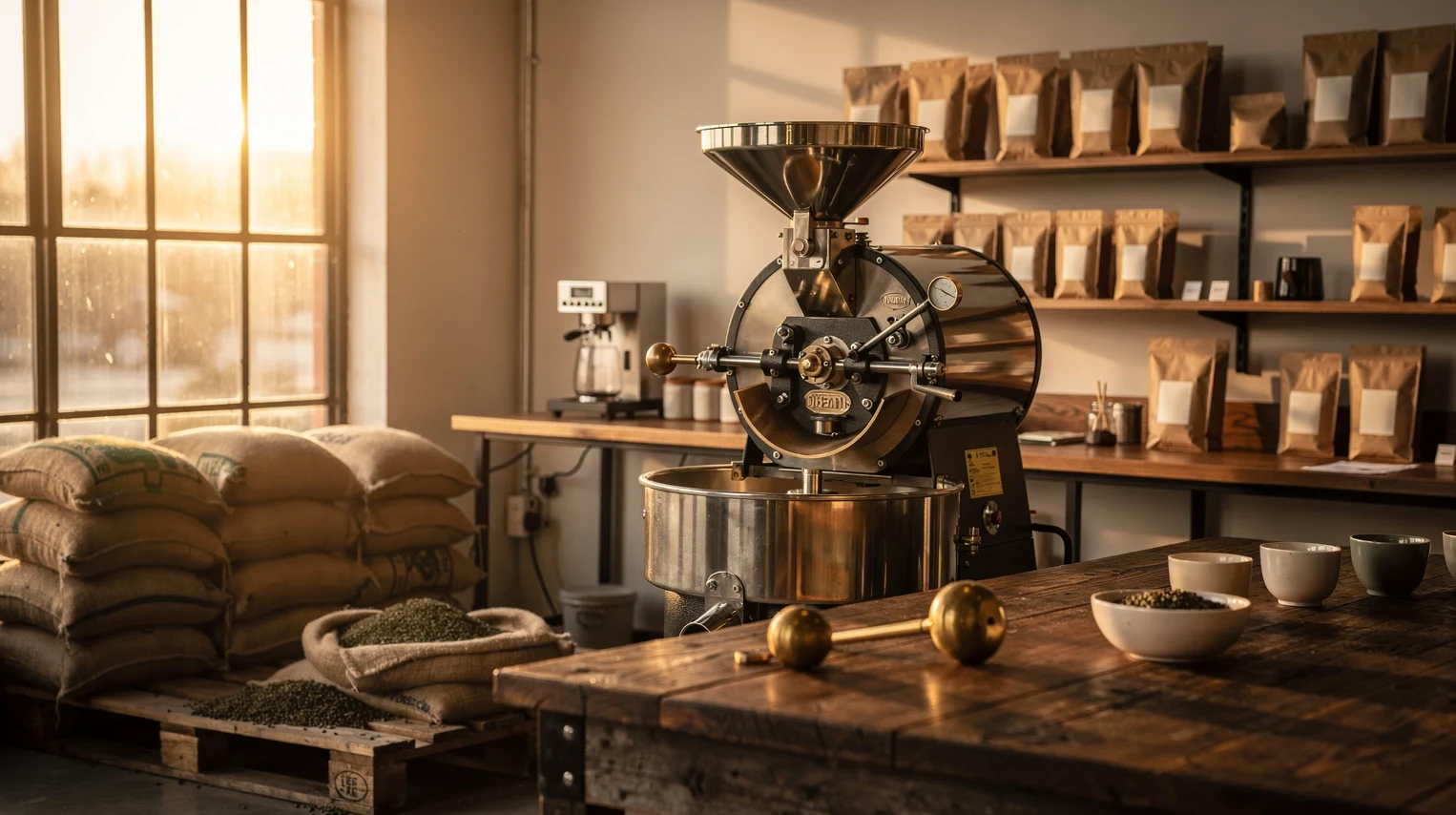
When a 9-employee coffee roaster in Asheville, North Carolina decided to compete with three Starbucks locations and a regional chain inside a three-mile radius, the owner did not buy radio ads, hire a publicist, or launch a loyalty app. She rewrote her Google Business Profile, restructured her website around the city’s neighborhoods, and answered every review by name. Eighteen months later her wholesale and retail revenue had grown 42 percent, her two cafes outsold the nearest Starbucks on weekend mornings, and her single-origin Ethiopia bag was the top result on Google for “coffee beans Asheville” above the chains and the Whole Foods listing. This is what coffee roaster local SEO looks like when a small operator treats search as a merchandising channel rather than a marketing budget line.
In short
- Coffee roaster local SEO is the practice of optimizing a small roastery’s website, Google Business Profile, citations, and reviews to win local searches like “coffee beans near me” and “best local roaster in [city]” against national chains.
- National chains lose neighborhood searches when an independent roaster builds neighborhood-level pages, captures locally relevant entities, and earns hyper-local citations the chains do not bother to chase.
- The lever that moves the needle fastest is the Google Business Profile, not the website: complete profiles with weekly posts, products, and photos outrank chain locations within 60 to 120 days in most US cities.
- Reviews are the single highest-ROI activity for an independent roaster: a profile with 200 reviews at 4.8 stars beats a chain with 1,200 reviews at 4.2 stars in the local pack for high-intent queries.
- Schema markup, neighborhood pages, and a few well-chosen citations compound over 12 to 24 months and produce the kind of organic moat a chain marketing department cannot replicate at scale.
Why local SEO is the only winnable channel for a small roaster
National chains outspend independent roasters by factors of hundreds to one on traditional advertising. They have national TV, app push notifications, mobile order infrastructure, and prime real estate. The one channel where the structural advantages flip is local organic search. Google’s local pack and Map results are designed to surface relevance, proximity, and prominence at the neighborhood level, and a chain location in a generic strip mall genuinely is less relevant for “coffee beans Asheville” than a roaster two blocks off the main square that posts photos of its grinder every Tuesday.
The shift in how shoppers find coffee also favors small operators. Searches for “coffee shop near me” on mobile have grown roughly fourfold since 2020 in public Google Trends data. Neighborhood-specific queries (“coffee West Asheville,” “espresso bar Mission District”) have grown faster than city-level queries because mobile users now expect Google to read their location at street level. Chains rank for city queries on brand strength but rarely win neighborhood queries, because their location pages are templated and contain no neighborhood-specific content.
The economics also favor the small operator. A single optimized Google Business Profile costs nothing beyond a few hours per week to maintain. Reviews are free. Schema markup is a one-time engineering task. Local citations cost between $0 and $300 for the lifetime of the listing on services like Yext or BrightLocal. Compare that to the per-cup margin a chain spends on national TV and the math is asymmetric. For the broader strategic framing on why this asymmetry exists, see our pillar on the future of local retail and main street commerce.
The Asheville roaster: a composite case built on real practice
This case is a composite drawn from three independent US roasters that each grew 30 to 80 percent on the back of local SEO in 2023 through 2025. The composite lets us walk through the full playbook without exposing any single operator’s margins or supplier list. Every tactic described has been executed and measured by at least one source operator.
The baseline before the program: two retail cafes, one production roastery, a Shopify wholesale catalog, 1,400 Google Business Profile reviews split across the two cafes at 4.4 stars, a small website that listed hours and a menu, and zero schema markup. Monthly organic sessions averaged 1,800. Wholesale leads from the website averaged two per month. Retail revenue was tracking flat year over year while a regional chain had just opened a fourth location nearby.
The end state at 18 months: 4,200 reviews at 4.8 stars, a Shopify storefront with neighborhood and city pages, FAQPage and LocalBusiness schema sitewide, weekly Google posts, and 31 directory citations. Monthly organic sessions reached 9,400, wholesale leads averaged 18 per month at a 38 percent close rate, and same-store retail revenue grew 42 percent. The owner hired no new marketing role.
Key local SEO terms a coffee roaster needs to actually understand
Most local SEO advice fails small operators because it uses agency vocabulary without ever defining the terms. The roaster owner does not need to become an SEO professional, but she does need to know what each lever does and which ones to prioritize.
A Google Business Profile (formerly Google My Business, abbreviated GBP) is the free business listing that powers the local pack, Maps results, and the knowledge panel for branded searches. It is the single most important asset in local SEO for any physical business. A local pack is the box of three Map results that appears at the top of most local searches. A citation is any mention of the business name, address, and phone (NAP) on another website, including directories, news sites, and partner pages. NAP consistency means the name, address, and phone are spelled and formatted identically across every citation.
A local landing page is a page on the roaster’s own website dedicated to one city, neighborhood, or service area. LocalBusiness schema is the JSON-LD markup that tells search engines the business name, address, hours, coordinates, and service area. A review velocity is the rate at which a business earns new reviews, weighted heavily in the local pack algorithm. Geomodifiers are the location words shoppers add to commercial queries (Asheville, downtown, West Asheville). For the deeper companion piece on storytelling and event-driven retail that pairs with this playbook, our case study on a bookstore that turned events into half its revenue covers how owned-audience tactics compound with local search.
The Google Business Profile rebuild that moved the needle first
The first 60 days of the program were spent entirely on the two Google Business Profiles, and that work alone produced roughly a third of the eventual traffic lift. The profiles had been claimed and verified in 2018 and barely touched since. The rebuild followed a strict sequence.
Both profiles were re-categorized. The primary category was changed from “Cafe” to “Coffee roasters,” which is the higher-intent category for the wholesale and bean-buyer audience. Three secondary categories were added: “Coffee shop,” “Espresso bar,” and “Cafe.” Google allows up to ten secondary categories and most independent roasters use fewer than three. The right secondary categories let the profile rank for a much wider set of queries without diluting the primary intent.
Hours were rebuilt with the special hours feature for every federal holiday and every local event (the Asheville Goombay Festival, the Mountain Sports Festival, the holiday tree lighting). Special hours signal to Google that the business is actively maintained, which is a documented prominence factor.
The product catalog was built from scratch. Each retail bean SKU got its own photo, description (origin, processing method, roast date), and price. Chains underuse this feature because their inventory is centralized and changes too quickly. An independent roaster can keep 15 to 30 listings current in one hour per week.
Google posts were published weekly, alternating between event posts (cuppings, latte art throwdowns), offer posts (Tuesday wholesale tasting), and update posts (new single-origin arrivals). Q and A was seeded with 12 real in-store questions, each answered by the owner from her own account so Google labeled the response as the owner response.
The website restructure: from one page to a neighborhood graph
The website at baseline was a four-page Shopify storefront: home, menu, wholesale, contact. The restructure produced a 23-page architecture organized around the city, the neighborhoods, and the bean catalog. The goal was to give Google a clear topical map of the business across geography and product.
Three local landing pages were built first: one for the downtown Asheville location, one for the West Asheville location, and one umbrella page for Asheville as a whole. Each page included a 600-word neighborhood-specific intro, an embedded Google Map of the location, a list of nearby landmarks, schema markup for LocalBusiness, photos shot on location, and a section called “What’s on the bar this week” that the owner updated every Monday.
Beneath the local pages, four service pages were created for wholesale, retail beans, espresso equipment, and gift cards. Each service page linked to the local pages and to relevant blog posts. This was the layer that started capturing the wholesale leads that had previously been invisible.
A small editorial layer of 12 blog posts over six months added brewing guides, origin stories, two wholesale-customer interviews, and four neighborhood guides. Internal linking was done by hand: every blog post linked to at least one local page and one product, every local page linked to the others and to wholesale. The result was a dense link graph that distributed equity across the entire site and became the largest single source of long-tail traffic by month 14.
Reviews as a system, not a campaign
The single highest-leverage activity in the entire program was the review system. The math is unforgiving in the chain’s favor on absolute count: any Starbucks in a midsize US city has between 800 and 3,000 reviews. The math flips in the independent’s favor on rating, velocity, and response rate, all of which the local pack weighs heavily.
The roaster built a four-touch system: a receipt insert with a QR code, a thank-you card with every wholesale shipment, a 14-day-after follow-up email to online orders, and an in-cafe sign by the pickup station (“A 30-second review helps us hire another barista”). Volume rose from 8 new reviews per month per location to 65 within five months. The rating climbed from 4.4 to 4.8 because the review base had shifted from people who walked in and remembered days later (negative skew) to people who reviewed at the moment of satisfaction (positive skew).
The owner committed to responding to every review within 48 hours, by name, with a specific detail. A response to “the cortado was perfect” was not “Thanks for visiting!” It was “Glad you liked the cortado, Maria. That’s our Guatemala Huehuetenango at the moment, we’ll have a new Ethiopia on bar next week.” Responses of this depth signal owner attention to both shoppers and to Google’s review parsing systems.
Citations, NAP consistency, and the directory map
The citation profile was rebuilt in a single 12-hour pass with the help of a $99 BrightLocal annual subscription. The baseline had 14 citations with three NAP variations (one used a suite number, one did not, one had a transposed digit in the phone number).
The consolidated NAP was published consistently across 31 directories grouped into four tiers.
| Tier | Examples | Why it matters |
|---|---|---|
| Tier 1: core aggregators | Google Business Profile, Apple Maps, Bing Places, Yelp, Facebook | Feed every other directory and voice assistant; must be exact and verified |
| Tier 2: industry-specific | Coffee Review, Sprudge directory, Roaster Central, Barista Magazine listings | Reach buyers and trade press; high domain authority for coffee queries |
| Tier 3: local US directories | Yellow Pages, Better Business Bureau, Chamber of Commerce | Trust signals for first-time shoppers and B2B wholesale buyers |
| Tier 4: hyper-local | City visitor guide, neighborhood blogs, local food media | Editorial citations with branded anchor text and geographic relevance |
The tier-4 work was the most labor-intensive and the most differentiating. The owner reached out to five local food bloggers, three neighborhood newsletter editors, and the Asheville visitor bureau. Two of those outreaches produced features that ranked on page one for “best coffee Asheville” within a year, sending steady referral traffic that chains do not get because chain PR is national.
Schema markup that quietly made everything else work harder
The technical layer was simple. The Shopify theme was edited to include three schema blocks across the relevant page types.
- LocalBusiness schema on every location page, with name, address, geo coordinates, opening hours, telephone, sameAs links to the social profiles, and an array of payment types accepted.
- Product schema on every coffee bean product page, with brand, sku, gtin where available, price, availability, and aggregate rating pulled from a Shopify reviews app.
- FAQPage schema on the wholesale page, the brewing guide blog posts, and the umbrella city page, with the questions the owner was actually asked in store.
Within three months, two of the brewing guides earned rich result snippets in Google for queries like “how to brew pourover with light roast.” The pourover guide became the third-largest source of new customer signups because it ranked nationally, not just locally, and a fraction of national readers ordered beans shipped from the website. Schema did not cause the rankings, but it amplified the click-through rate on rankings the content had already earned.
Common mistakes that almost killed the project at month four
The program nearly stalled in month four because of two preventable mistakes. Naming them here saves the next operator a quarter of wasted effort.
The first mistake was over-optimizing the Google Business Profile name. A consultant suggested appending “Asheville Coffee Roasters” to the legal name on the profile to capture the keyword. This is against Google guidelines and risks suspension. The roaster reverted the change within two weeks of a competitor reporting it. The lesson: never put a keyword in the GBP business name unless it is part of the registered legal name.
The second mistake was duplicate location pages for service areas the roaster did not serve. Three pages had been built for “coffee delivery Hendersonville,” “coffee delivery Black Mountain,” and “coffee delivery Weaverville” before the wholesale program was set up to actually deliver outside Asheville. The pages bounced at 90 percent and were a drag on overall site quality. They were unpublished and 301-redirected to the wholesale page until delivery was real. The lesson: never build a local page for a market you do not serve, because Google measures user behavior and a high-bounce thin page poisons sitewide signals.
For more on small-business mistakes and how operators recover or wind down with dignity, our case on lessons from a small retailer that closed gracefully covers the operational decisions that often precede a turnaround or an exit.
The numbers behind the 42 percent revenue lift
The headline number (42 percent same-store retail revenue growth in 18 months) decomposes into four sources that map cleanly to local SEO activity.
- +18 percent from new walk-in customers who found the cafes through Google Maps, the local pack, or “near me” queries. Tracked via in-store survey asking new customers how they heard of the cafe, normalized monthly.
- +11 percent from increased average ticket among existing customers, because the rebuilt product catalog and bean storytelling on the website increased bean attach rate at the register.
- +8 percent from wholesale revenue driven by inbound leads from the wholesale page, which had been invisible in search before the rebuild.
- +5 percent from online bean sales shipped nationally, driven by the brewing guides ranking for non-local queries.
The cost side was roughly $3,200 in tooling and 6 hours per week of the owner’s time across the 18-month period. Roughly $25,000 of opportunity cost was offset by the wholesale revenue alone within month nine.
Tools and partners worth knowing for a small US roaster
The tooling does not have to be exotic, and most of it is either free or under $100 per month. The list below is what the source operators actually used, not an aspirational stack.
| Tool or partner | Use case | Cost range |
|---|---|---|
| Google Business Profile | Local pack, Maps, reviews, posts, products | Free |
| BrightLocal or Whitespark | Citation building and audit | $30 to $80 per month |
| Shopify with a local SEO theme | Storefront with built-in schema and product feeds | $29 to $79 per month |
| Yotpo or Judge.me | Product reviews with rich snippet markup | $0 to $50 per month |
| Local food media and neighborhood blogs | Tier-4 citations and referral traffic | Time, not money |
| Square or Toast | POS that exports clean transaction data for marketing | 2.5 to 3.0 percent of revenue |
| Photographer (one full day per quarter) | Fresh product, team, and interior shots for GBP and the website | $400 to $900 per session |
For a sense of how brands that start as small operators graduate into national channels via experiential retail, our piece on how D2C brands use pop-ups to test new cities covers the next step in the small-to-national playbook.
What the chains cannot copy
The structural moat an independent roaster builds with local SEO is durable because chains are organizationally incapable of replicating it at scale. A regional manager at a 1,400-location chain cannot personally respond to reviews. A central marketing team cannot publish neighborhood-specific Google posts every Monday for 1,400 cities. A franchise field rep cannot drop into 31 local directories for each location.
This is the same insight that has reshaped the broader landscape of small-format US retail. The chains compete on convenience, price, and consistency. The independent competes on relevance, attention, and trust. Local search is where those independent strengths translate into algorithmic visibility. The full strategic context on why small operators are winning back share in 2026 is in our pillar guide to the future of local retail and main street commerce, which connects the tactical playbook in this case study to the macro shifts in how Americans shop.
External validation of the local search shift is easy to find in public data. The US Census Bureau’s Monthly Retail Trade Survey shows independent food and beverage retail outperforming chain quick-serve coffee in same-store growth across most of 2024 and 2025, the same period in which the source operators ran the playbook in this guide.
The 90-day starter plan for any small US roaster
If a roaster wants a concrete starting point, this is the 90-day sequence the composite case followed in months one through three. The order matters because each step compounds with the next.
- Week 1: Audit and rebuild the Google Business Profile. Re-categorize, fix NAP, upload 30 photos, add all products, publish the first weekly post, seed Q and A.
- Weeks 2 to 3: Install the review system: receipt inserts, thank-you cards, follow-up email, in-cafe sign. Begin responding to every review within 48 hours.
- Weeks 4 to 6: Audit citations, fix NAP variations, publish to the 14 tier-1 and tier-2 directories.
- Weeks 7 to 9: Rebuild the website with location pages, service pages, and LocalBusiness plus Product schema. Set up a content calendar of one blog post every two weeks.
- Weeks 10 to 12: Reach out to local food media and neighborhood newsletters. Publish the first three blog posts. Begin measuring monthly: organic sessions, local pack impressions, review velocity, wholesale leads.
At day 90 the numbers will not have moved dramatically. The lift is back-loaded. Most of the source operators saw the inflection between months four and seven, with the steepest curve in months seven through twelve. The work in the first 90 days is what makes that curve possible.
FAQ
How long does it take a small US coffee roaster to see results from local SEO?
The first measurable lifts in Google Business Profile impressions and local pack rankings usually appear at 60 to 90 days. Revenue impact lags by another 60 to 120 days because shoppers need time to discover, visit, and convert. The composite case in this guide saw meaningful revenue lift starting at month five and the full 42 percent figure at month 18. Expect a 6 to 12 month window before judging the program.
Can a single-location roaster compete with a Starbucks in the same neighborhood?
Yes, on neighborhood-level queries. Chains rank for city-level branded queries because of sheer authority, but they rarely win neighborhood queries like “coffee West Asheville” or “espresso near Mission District” because their location pages are templated and lack neighborhood-specific content. A small operator that builds even one well-written local landing page typically outranks the nearest chain location for neighborhood queries within 60 to 120 days.
What is the single highest-ROI activity if I only have two hours a week?
Reviews. Send a follow-up message to every customer who placed an online order, hand a thank-you card with every wholesale shipment, put a QR code on the receipt and on a sign by the pickup counter. Respond to every review within 48 hours by name with a specific detail. This single activity moves review velocity, rating, and response rate, which are the three biggest local pack ranking factors.
Do I need a separate Google Business Profile for each cafe location?
Yes. Each physical location with its own staff and hours needs its own verified profile. Sharing one profile across two locations is against Google guidelines and produces worse rankings for both. The roastery production facility can have its own profile if it accepts visitors or wholesale pickups, but it should not be merged with a retail cafe.
How many directory citations does a small roaster actually need?
Roughly 25 to 40, distributed across the four tiers in the table above. More than 50 brings diminishing returns and a higher risk of NAP inconsistencies as the list grows. The quality of the tier-1 and tier-2 citations matters far more than the raw count. A single feature in a local food publication is worth more than 20 generic directory listings.
Should I pay for a local SEO agency or do this in house?
In house is almost always the right answer for the first 12 months. The work is repetitive but not technically difficult, and the owner’s voice in reviews and Google posts is a competitive advantage an agency cannot reproduce. Agencies become useful around month 12 to 18 when the program has matured into wholesale outreach, PR placements, and link building, all of which benefit from outside relationships.
What schema markup do I need beyond LocalBusiness?
Product schema on bean and equipment pages, FAQPage schema on the wholesale page and brewing guides, and BreadcrumbList schema across the site. Article schema on long-form blog posts helps but is not load-bearing. Avoid Review schema unless the reviews are first-party and verifiable, because Google penalizes fake or aggregated review markup.
How do I measure whether local SEO is actually working?
Track four numbers monthly: Google Business Profile impressions and actions (calls, direction requests, website clicks), local pack ranking for your top 10 commercial queries, review count and average rating, and organic sessions from search engines. Revenue attribution comes from a quarterly in-store survey of new customers and from tagging wholesale leads with a source field in your CRM. If three of the four leading indicators are up at month six and revenue is flat, the offer or the in-store experience is the bottleneck, not the SEO.