
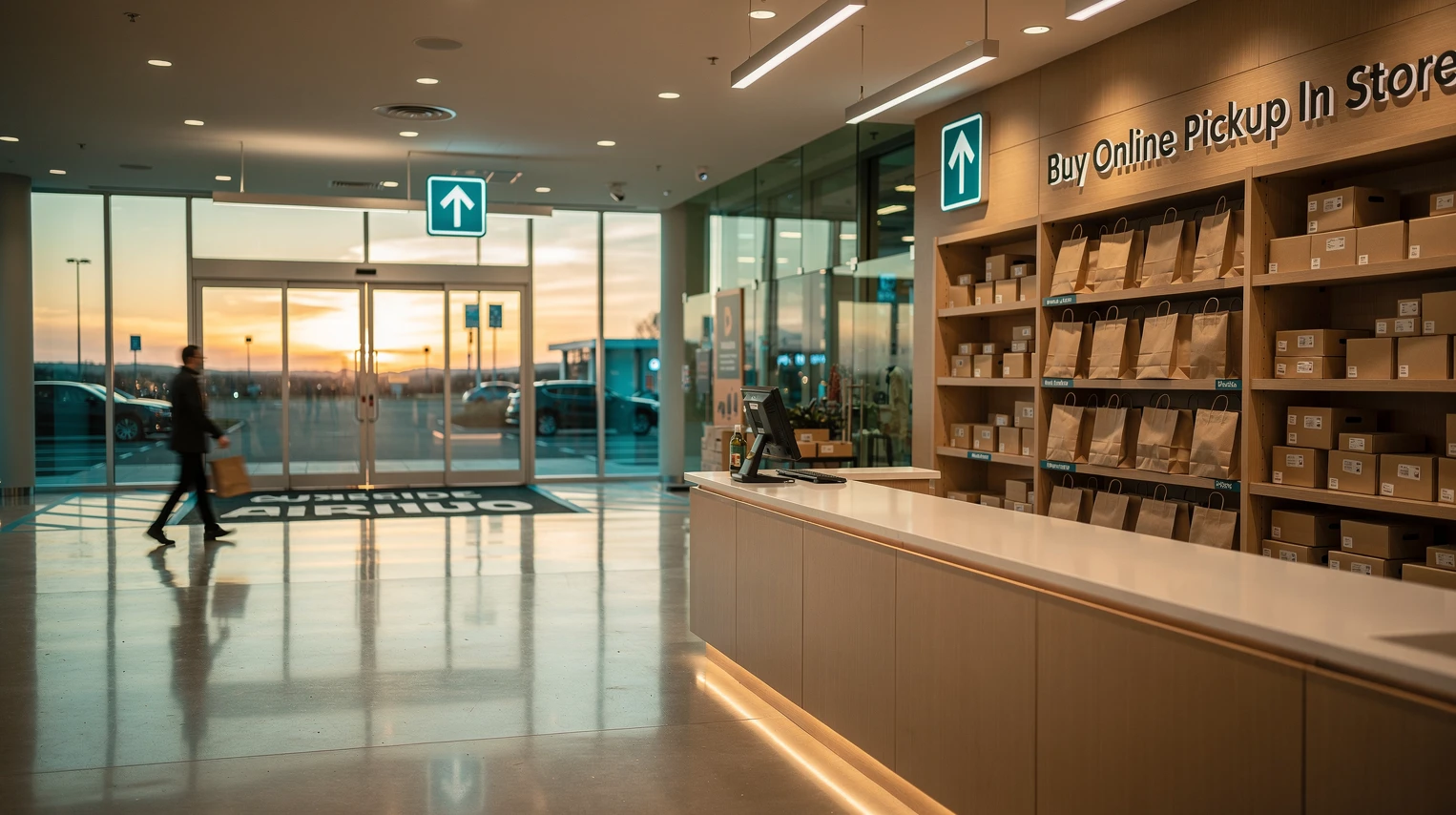
Buy online pick up in store (BOPIS) keeps quietly outperforming home delivery on the metrics retailers actually pay rent with: gross margin, basket size, and the share of customers who come back. Three years after every analyst declared “the death of the store,” the in-store pickup counter is busier than ever, and it is doing more for the P&L than the next-day box on the porch. For an honest view of where BOPIS sits inside the broader supply chain, start with our modern retail logistics guide, then come back here for the operating detail.
In short
- Margin advantage: BOPIS orders typically cost the retailer $1.50 to $3.50 to fulfill versus $8 to $14 for last-mile home delivery on a comparable basket.
- Basket lift: US chains report 20% to 35% higher average order value when customers add items at the pickup counter.
- Speed without the truck: Median ready-for-pickup time at top US grocers and big-box retailers is now 90 to 120 minutes, beating most same-day delivery promises.
- Return economics: In-store returns from BOPIS recover up to 70% of value the same day, against 30% to 45% for mailed returns.
- The catch: BOPIS only works if store inventory accuracy is above roughly 96%, pickers have proper tooling, and the handoff feels faster than the parking lot itself.
Why BOPIS still matters in 2026
The home delivery story sold itself in 2020 and 2021. Retailers spent the next four years discovering what it actually costs to staff dark stores, route trucks around dense suburbs, and absorb the porch-pirate refund rate. By contrast, BOPIS quietly compounded: it leans on the labor already on the floor, the inventory already on the shelf, and the rent already paid on the building. Walmart’s own filings in 2025 framed pickup, not delivery, as the most profitable growth lever in the General Merchandise segment.
The customer math is just as stubborn. Shoppers who use BOPIS three times in a quarter buy 1.7x more from the same retailer over the next twelve months than equivalent delivery-only shoppers, according to repeated panel data from Numerator and Coresight. That is the loyalty effect retailers chased for a decade with apps and points programs, and BOPIS produces it as a byproduct of the trip itself. The closer model in pricing terms is described well in our piece on same-day delivery economics, which gets at the same question from the opposite direction.
BOPIS is also defensive. When fuel prices spike, when carrier surcharges land, when the local last-mile labor market tightens, the pickup option absorbs demand that would otherwise push delivery costs through the unit economics floor. Many US retailers now use BOPIS as a release valve during the November to January peak: they cap delivery slots in dense ZIPs and steer the overflow to in-store pickup with small incentives.
Key terms and definitions
BOPIS sits inside a small family of fulfillment models that get blurred in trade press, so the vocabulary matters before the numbers do. The terms below are the ones most US retailers use internally in 2026.
| Term | What it means | Typical fulfillment time |
|---|---|---|
| BOPIS (in-store pickup) | Customer orders online, walks into the store, collects from a service counter or locker. | 1 to 4 hours |
| BOPAC / Curbside | Same as BOPIS, but the associate brings the order to the customer’s car in a marked parking spot. | 1 to 4 hours |
| ROPIS (reserve online, pay in store) | Customer holds an item without paying online, completes purchase at the counter. | Same day, no SLA |
| Ship-from-store (SFS) | Store inventory used to fulfill a home delivery order; not BOPIS. | 1 to 3 days |
| Dark store pickup | Pickup point that is not open to walk-in shopping; functions like a mini fulfillment center. | 1 to 3 hours |
“Buy online pick up in store” is the literal expansion most teams still use in customer-facing copy because it tests better than the acronym in usability research. Internally, however, the operations team usually folds BOPIS and curbside into one number on the dashboard because the picking workflow is identical; only the handoff differs.
One distinction matters more than the rest: BOPIS is not ship-from-store. SFS still puts a package on a carrier and costs the retailer last-mile freight. BOPIS pulls that cost out of the equation by replacing the truck with a customer who is already coming. That single substitution is the whole reason the model keeps winning on margin. If you want the broader picture of how that last mile breaks down, our explainer on last-mile delivery for retailers walks through where every dollar actually goes.
How BOPIS works in practice
A BOPIS order looks deceptively simple from the customer side: pick a store, add to cart, choose pickup at checkout, wait for the “ready” notification, drive over. Behind the curtain, six or seven systems have to agree in real time, and the failure points are not where most retailers expect.
- Inventory check at cart. The site queries store-level on-hand from the order management system (OMS). If accuracy is below ~96%, the customer is being lied to and the order will fail at the pick.
- Store eligibility filter. Not every store is BOPIS-capable. Some lack the backroom space; some are leased from landlords who restrict curbside; some are simply too understaffed during the window the customer wants.
- Order routing. The OMS assigns the order to the chosen store and creates a pick task in the store’s task management app, usually pushed to a handheld or a smartwatch worn by the picker.
- Pick walk. The picker scans each item; the system substitutes or short-picks where needed. Median pick time for a 5-item BOPIS order at a US big-box is now 9 to 14 minutes.
- Stage and notify. Picked items go to a labeled hold area (lockers, shelving, or a fridge for grocery). The customer gets a push notification, SMS, or email that the order is ready.
- Handoff. The customer arrives, the associate verifies the order code, the customer leaves. For curbside, the customer taps “I’m here” in the app and an associate brings the order to a marked spot.
- Reconciliation. Picked-but-not-collected orders are restocked after a hold window (usually 5 to 7 days), refunded, and pulled out of the BOPIS metrics.
The hidden variable in that sequence is step one. The whole model lives or dies on inventory accuracy, and most retailers running BOPIS poorly are running it on a perpetual inventory count that has not been audited at SKU level in months. The single highest-ROI fix in BOPIS is almost always RFID or cycle counting, not a slicker pickup app.
The economics that keep BOPIS ahead of delivery
BOPIS wins because it deletes the most expensive segment of e-commerce fulfillment: the last mile. A typical BOPIS unit-economics breakdown for a $60 mixed basket at a US big-box looks like this in 2026.
| Cost line | BOPIS | Home delivery (same-day) |
|---|---|---|
| Pick labor | $1.10 to $2.20 | $1.10 to $2.20 |
| Pack materials | $0.15 to $0.40 | $0.80 to $1.60 |
| Last-mile transport | $0.00 | $6.50 to $10.50 |
| Carrier surcharges and fuel | $0.00 | $0.40 to $1.20 |
| Customer service overhead | $0.20 to $0.45 | $0.60 to $1.10 |
| Returns handling (allocated) | $0.10 to $0.35 | $0.55 to $1.40 |
| Total per order | $1.55 to $3.40 | $9.95 to $18.00 |
On a $60 basket those numbers translate to a roughly 8 to 13 percentage-point margin gap in favor of BOPIS. That gap is what underwrites the small incentives some retailers offer ($5 off, 200 loyalty points) to steer customers toward pickup during peak weeks.
The basket-size effect is the second pillar. Roughly one in three BOPIS customers adds an item at the counter or in the aisles on the walk in. Target reported in its 2025 investor day that Drive Up plus pickup attach revenue was approaching 6% of total store volume on its own, almost entirely incremental to the original online order. That incremental revenue carries near-zero acquisition cost because the customer is already on the property.
Returns close the loop. A BOPIS shopper who walks an unwanted item back to the desk usually walks out with a different item rather than a refund. According to NRF’s 2025 returns report, in-store returns convert into immediate replacement purchases 38% of the time, against under 10% for mailed returns. The US Bureau of Labor Statistics’ work on the retail trade sector tracks the broader labor and productivity story behind these moves; the BLS retail data is a useful sanity check whenever the trade press gets ahead of itself: BLS retail trade industry overview.
Common BOPIS mistakes and how to fix them
Most US chains have run BOPIS for at least five years now, which means the easy wins are taken and the remaining gaps are operational rather than strategic. The patterns below show up in almost every retailer that complains BOPIS is “not delivering the numbers it used to.” Compare these against the broader operations playbook in our retail logistics overview before deciding which lever to pull first.
Mistake 1: Treating BOPIS as a website feature, not a store operation. The order management team owns the funnel; the store operations team owns the pick. When those two report to different VPs with different KPIs, pick accuracy and ready-time both slip. The fix is a single weekly meeting where both functions look at the same dashboard, and a shared bonus tied to the BOPIS NPS.
Mistake 2: Promising a 1-hour ready time the store cannot hit. Customers do not punish a 4-hour promise that is kept; they punish a 1-hour promise that slips. The fix is dynamic ready-time windows that flex with current store labor load, similar to how rideshare apps quote surge ETAs. A handful of US grocers introduced this in 2024 and saw cancellation rates drop by half.
Mistake 3: Pickup parking spots in the back of the lot. Curbside conversion drops by roughly 30% when the pickup spots are more than 80 feet from the door, because the associate walk eats the labor savings. Move the spots to the front. If the landlord pushes back, repaint the existing ADA-adjacent spaces.
Mistake 4: No locker fallback for off-hours. A surprisingly large share of BOPIS demand is “pick it up after work,” which means the store closes before the pickup happens. Indoor lockers in the vestibule, accessible during extended hours, recover that demand without any labor cost at the handoff.
Mistake 5: Treating BOPIS substitutions like grocery delivery substitutions. In delivery, the customer accepts a swap because the alternative is no order. In BOPIS, the customer is about to walk into a store full of inventory; a forced substitution feels insulting. The fix is to default to short-pick (partial fulfillment with a refund) and let the customer decide on the walk in.
Mistake 6: Treating the pickup counter as a punishment shift. The associate at the counter is the single highest-impact customer-facing role in the store and should be staffed with senior team members, not whoever drew the short straw. Retailers that promote “pickup specialist” to a named role with a small pay bump see BOPIS NPS rise by 10 to 15 points within two quarters.
Real US examples worth studying
The US retail landscape now has enough mature BOPIS programs that you can learn from public disclosures and store visits alone. The five below are worth pulling apart in detail because each made a different bet and most of the bets paid off.
Target’s Drive Up. Target’s curbside-first version of BOPIS, branded Drive Up, is the closest thing US retail has to a BOPIS reference architecture. Same-day services revenue, which is dominated by Drive Up, crossed $11 billion in 2024 and grew double digits again in 2025. The product moves include guest-arrival ETAs powered by phone GPS, a 30-second median trunk-handoff, and a “Drive Up Returns” feature that lets customers hand back a previous order at the same time. Target effectively turned curbside into the parking-lot version of the express checkout.
Walmart Pickup. Walmart’s version is volume-first: more stores enabled (over 4,500 in the US), simpler UX, less personalization. The bet is that ubiquity beats finesse, and the bet keeps winning in lower-density markets where Walmart is the only retailer offering pickup at all. Walmart pickup also doubles as a Marketplace and Sam’s Club fulfillment node, which gives the program a different unit-economics profile than Target’s.
Best Buy’s appointment pickup. Best Buy quietly launched scheduled-window pickup for higher-ticket items in 2023, and by 2025 was using it as the default for orders over $400. The model trades pickup-window flexibility for guaranteed associate availability and a brief consultation at the counter, which converts ~12% of pickups into attach sales (screen protectors, cables, Geek Squad plans).
Home Depot’s Pro Desk pickup. Home Depot built a separate BOPIS lane for Pro contractors with its own counter, its own parking, and a willing-call dispatch model for very large orders. The Pro Desk pickup workflow runs entirely off a separate task queue from consumer BOPIS, which keeps the contractor experience predictable on the busiest days.
DICK’S Sporting Goods and the curbside-as-conversion-channel play. DICK’S started using its curbside zones as fitting-room overflow in 2024, letting customers try on shoes from BOPIS orders in the parking lot via a small canopy. Return rate dropped, the average basket attached more accessories, and the program reportedly paid back the canopy capex inside two seasons.
None of these programs work without strong store inventory data. The retailers above invested heavily in RFID, cycle counting, and store-task management before scaling pickup. That sequencing matters: a BOPIS rollout on a 92% accuracy book is worse than no BOPIS at all, because every short-pick is a customer-visible failure.
Tools, partners, and vendors worth knowing
The BOPIS tech stack has consolidated since 2022, which is good news for retailers shopping for a platform in 2026. Four categories matter, and most retailers end up combining a “best-of-breed” point solution in one category with their incumbent OMS in another.
| Category | What it does | Vendors commonly seen in US BOPIS stacks |
|---|---|---|
| Order management system (OMS) | Routes BOPIS orders to stores, manages inventory promise, handles fulfillment status. | Manhattan Active, IBM Sterling, Oracle Retail, Fluent, Kibo |
| Store task management | Pushes pick tasks to associates, tracks pick times, surfaces exceptions. | Reflexis (Zebra), Theatro, Manhattan ProActive, Salesfloor |
| Curbside arrival and ETA | Detects guest arrival, tracks parking spot, alerts associate. | Radius Networks, Gladly, Bringg, Glympse |
| Inventory accuracy (RFID and cycle count) | Keeps store on-hand inventory above the 96% threshold BOPIS needs. | Impinj, Zebra, Nedap, Sensormatic, RetailNext |
Two practical tips when shopping this market. First, the OMS layer is where most BOPIS programs die; underinvesting here is the single biggest predictable mistake, and the cheap-but-functional choice in 2022 may be the bottleneck in 2026. Second, the inventory accuracy layer pays back fastest, often within nine months on a single category like apparel or electronics, because every percentage point of accuracy translates directly into BOPIS fulfillment rate.
For multi-vendor marketplace operators, BOPIS also intersects with the sourcing model. Resellers who fulfill from a domestic store of stock face a very different operational picture than those running a drop-ship operation. Our guide to AliExpress for resellers in 2026 covers the trade-offs on the other end of the spectrum: low overhead, no BOPIS, much longer lead times.
How to know if BOPIS is right for your store
Not every retail format benefits from BOPIS. Convenience stores, for example, get almost nothing out of it because customers are already optimizing for speed of trip, not avoidance of the trip. Specialty retail with a high consultation component (eyewear, mattresses, custom jewelry) similarly gets less lift because the in-store experience is the value. The honest filter is to answer three questions before any vendor demo: how accurate is store inventory, how much of the customer base lives within 15 minutes of a store, and how strong is the store labor model. If two of those three are weak, fix them first.
For most US chains in apparel, big-box, grocery, sporting goods, and home improvement, the answer is yes. The economics are clear, the customer demand is real, and the technology is mature. The retailers that win the next five years of BOPIS are the ones that treat it as a core operating discipline rather than a website feature, and that revisit the operating model annually as labor, fuel, and last-mile costs keep shifting. For the broader operational frame this all fits inside, the retail logistics guide remains the best place to keep zooming back out.
FAQ
Is BOPIS the same as curbside pickup?
Operationally they are the same workflow up to the handoff. BOPIS ends with the customer walking into the store; curbside (sometimes called BOPAC) ends with an associate bringing the order to the customer’s car. Most US retailers report them as one number internally and split them only for customer-experience metrics.
How does BOPIS make money if shipping is free?
BOPIS makes money by deleting the last-mile cost entirely, not by charging the customer for shipping. The customer absorbs the cost in their own trip, while the retailer keeps the 8 to 13 percentage points of margin that home delivery would have consumed.
What inventory accuracy do I need before launching BOPIS?
Practical threshold is roughly 96% on-hand accuracy at SKU level. Below that, the short-pick rate exceeds 5%, which is what customer research consistently identifies as the point where BOPIS NPS collapses. RFID or aggressive cycle counting is usually the path to that number for apparel and electronics; cycle counting alone often suffices for grocery and home improvement.
How long should a BOPIS ready-time promise be?
The honest answer in 2026 is “dynamic.” A flat 1-hour promise looks great in marketing but breaks the operation on busy days. The best US programs quote a window (60 to 240 minutes) that flexes with current pick load, and consistently meet the upper bound. Customers punish broken promises far more than they punish longer-but-honest ones.
Does BOPIS cannibalize regular store sales?
The data says no. BOPIS customers typically spend 20% to 35% more per order than pure-online customers from the same retailer, and a third of them add items at the pickup counter or on the walk in. The net effect is incremental revenue rather than substitution, although the mix may shift away from impulse buys near the front of the store.
What is the ROI on adding lockers for BOPIS?
For most US big-box and grocery formats, indoor pickup lockers pay back within 12 to 18 months on labor savings alone, before counting the demand recovery from after-hours pickup. The payback gets longer for low-volume stores or formats where the average basket is too large to fit a typical locker.
How do returns work in a BOPIS workflow?
The strong default is to let BOPIS customers return at the same counter where they pick up, with no shipping or carrier involvement. This recovers up to 70% of the returned dollar as same-day replacement purchase, against under 10% for mailed returns. The operational requirement is that the pickup counter is also enabled as a return point, which is a permission change in the POS, not a hardware project.
Does BOPIS work for grocery?
Yes, and grocery is in fact the format where BOPIS economics look best because basket sizes are large and substitution rates are predictable. US grocery BOPIS volumes more than doubled between 2022 and 2025, with Walmart, Kroger, and Albertsons leading on volume and Wegmans and HEB on customer satisfaction. The constraint is cold-chain infrastructure at the staging point; you need refrigerated holding, not just shelves.