
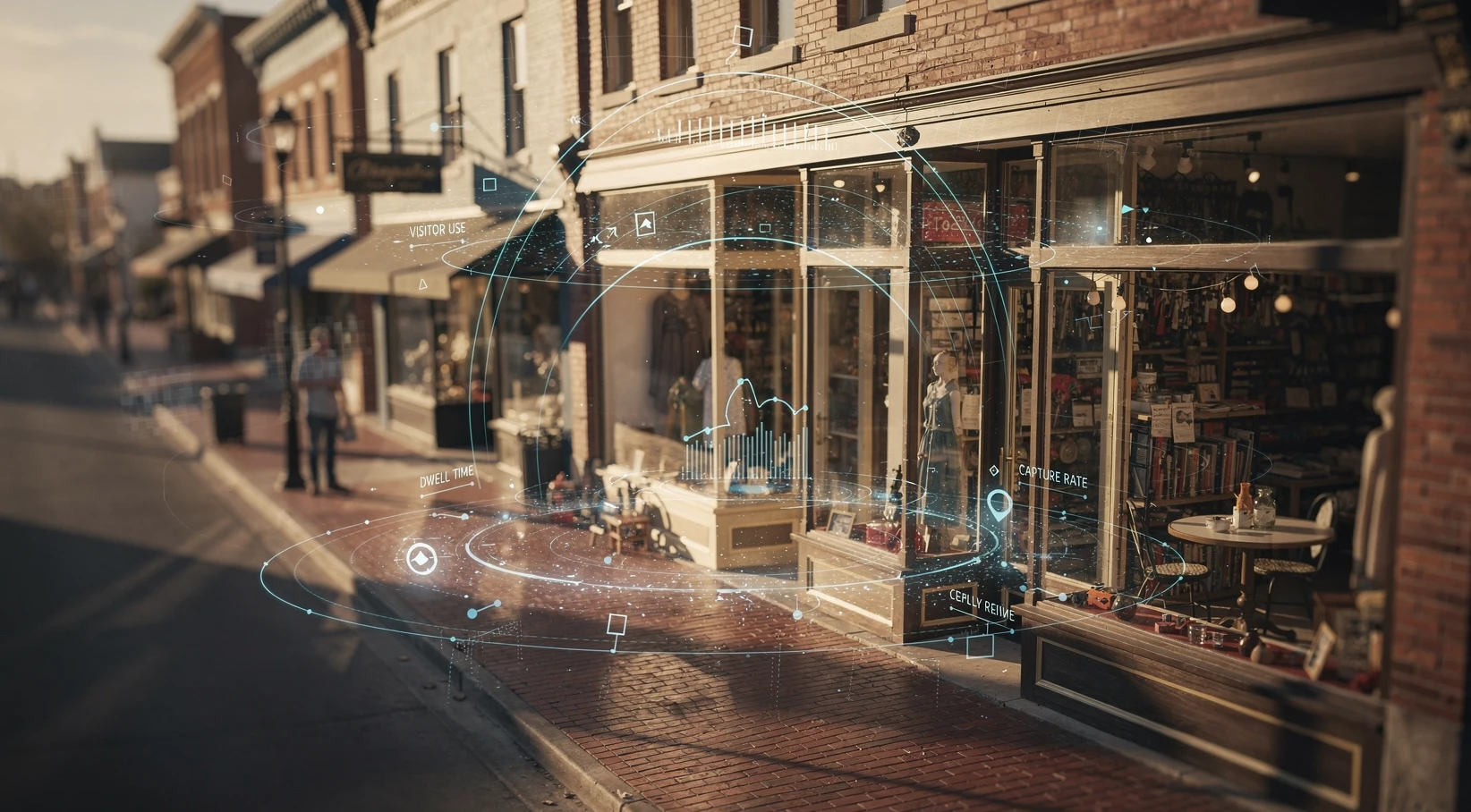
Main street retailers spend years watching the sidewalk and guessing what those passing shoppers really mean for sales. In 2026, the guessing is mostly optional. Modern main street foot traffic data turns the human stream outside your door into numbers you can act on, the same way an e-commerce dashboard turns clicks into a funnel. The question is no longer whether to track it; the question is which numbers actually move the needle for a small or mid-size storefront.
In short
- Foot traffic counts are useful only when paired with conversion, dwell time, and basket size.
- Hourly and weather-normalized data beats raw weekly totals for staffing and merchandising decisions.
- Catchment and capture rate show whether the problem is the street or the storefront.
- Privacy-safe counters (door beams, anonymous Wi-Fi probes, smartphone panel data) are the practical stack for 2026.
- The most underused metric is return visit rate, the storefront equivalent of e-commerce retention.
If you operate a single store or a small chain on a US main street, this guide is for you. It is part of the wider conversation about the future of local retail and main street commerce, and it focuses on the measurements you can install this quarter, not abstract academic models.
Why foot traffic data matters in 2026
The pandemic-era rebound stopped being a rebound a long time ago. By 2026, the US Census Bureau retail trade reports show a mature split: e-commerce continues to grow as a share of total retail, but physical stores still drive the majority of category sales in groceries, hardware, beauty, and specialty goods. What changed is the unit economics. Rent did not get cheaper, labor did not get cheaper, and shoppers became less tolerant of poorly merchandised stores. That makes every visit more expensive to acquire and more valuable to convert.
Foot traffic data is how a main street operator stops flying blind. Without it, a slow Tuesday is a vibe; with it, a slow Tuesday is a row in a spreadsheet that you can correlate with weather, school calendars, parking availability, and a competitor’s promo. The retailers who win on local streets in 2026 are usually the ones who behave like online merchants offline: they measure, they iterate, and they know their conversion rate to the decimal.
Key terms every main street operator should know
Before you buy any counter or platform, get the vocabulary straight. Vendors love to invent names for the same thing, which makes apples-to-apples comparisons painful.
Foot traffic vs. visits vs. unique visitors
Foot traffic is usually the raw count of people who cross a sensor line; visits are typically de-duplicated within a session window (a customer who steps out and back in counts once); unique visitors are de-duplicated across days or weeks using anonymous device IDs or panel data. Read every vendor contract for these definitions, because a “20 percent uplift in foot traffic” can mean three very different things.
Capture rate, conversion rate, and dwell time
Capture rate is the share of street passers-by who actually enter your store. Conversion rate is the share of visitors who buy. Dwell time is the average minutes each visitor spends inside. The three numbers together tell a story: weak capture means the window or signage is failing; weak conversion means the inside experience or assortment is failing; weak dwell time means the layout pushes people out before they explore.
Catchment area and trade zone
Your catchment is the geographic area that supplies the bulk of your customers. For a typical specialty main street store, that is often a 10 to 20 minute drive or a few blocks for walkable downtowns. Knowing the catchment lets you compare your performance to similar streets in similar towns, and it grounds every “we should advertise everywhere” conversation in reality.
How foot traffic measurement actually works
You have three practical layers of measurement, and most serious operators run at least two of them in parallel.
Sensors at the door
Beam counters, thermal counters, and stereo-vision cameras sit above your entrance and count entries and exits. Beam counters are cheap and reliable but cannot distinguish between two people walking close together. Thermal counters handle that better and are privacy-friendly because they do not capture identifiable images. Stereo-vision systems are the most accurate and can also estimate group size and direction, but they cost more and need careful installation.
Wi-Fi and Bluetooth probes
These passive sensors detect anonymized device identifiers as smartphones poll for networks. With proper anonymization and rotating MAC addresses now standard in iOS and Android, the numbers are statistical rather than census-level, but they are good enough for measuring trends, dwell time, and return visits. Treat them as a panel, not a census.
Smartphone panel and geolocation data
Companies like Placer.ai, Pass_by, and SafeGraph aggregate location data from opted-in smartphone panels and project it to the full population. The output is excellent for benchmarking against competing stores and corridors, and it works without you installing anything. It is less precise for tiny stores with few visitors, where panel sample size becomes the bottleneck.
The metrics that actually drive decisions
Counts alone are vanity. The following metrics, used together, are what experienced main street operators rely on.
| Metric | What it tells you | How to act on it |
|---|---|---|
| Hourly visit count | When demand actually shows up | Staff schedules, store hours, promo timing |
| Capture rate | How well the storefront pulls people in | Window display, A-frame signage, lighting |
| Conversion rate | How effective the inside experience is | Layout, assortment, staff training |
| Dwell time | Engagement depth per visit | Merchandising flow, seating, fitting rooms |
| Return visit rate | Loyalty and habit formation | Loyalty program, email capture, events |
| Weather-adjusted index | True performance net of conditions | Forecast staffing, evaluate promos fairly |
| Competitor share | Local market position | Pricing, range, hours, parking |
The pattern that emerges across thousands of main street stores is striking: capture rates typically sit between 8 and 18 percent for specialty retail, conversion between 20 and 35 percent for considered purchases, and return visit rates within 30 days hover around 12 to 22 percent for healthy independents. If you are far outside those bands without a good reason, the data is pointing at a fix.
Common mistakes that ruin foot traffic programs
Buying a counter is the easy part. Most programs fail not because the technology is bad but because the operator treats the data like decoration rather than a management tool.
Tracking counts without conversion
If you only measure how many people walked in, you will optimize for raw counts and miss the fact that your assortment, layout, or staff is leaking sales. Every count needs a matching point-of-sale figure so you can compute conversion daily.
Ignoring weather and seasonality
A 10 percent drop in visits during a heatwave week is not a marketing problem; it is a thermodynamics problem. Without weather-normalized comparisons, you will fire perfectly good staff and credit perfectly mediocre campaigns. Most modern platforms expose a weather index automatically; use it.
Counting employees and deliveries
Door counters that include staff and couriers can inflate visits by 20 percent or more in a small store with frequent restocks. Always configure a back-office calibration period and, where possible, segment the back door or service entrance separately.
Looking at weekly totals only
Weekly totals hide the patterns that matter, because they average across a Tuesday lull and a Saturday surge. Hourly data is where staffing, ordering, and even product launches should be planned.
Examples from US main streets
The clearest illustrations of foot traffic data done well come from independent operators, not big chains.
A boutique in Asheville, North Carolina
A women’s wear boutique with two staff installed a $400 thermal counter and synced it to its Shopify POS via a simple webhook. Within a month the owner discovered that the highest-converting hours were 11am to 1pm on weekdays, which had been understaffed because she assumed evenings drove sales. Reshuffling shifts lifted conversion by roughly 6 percentage points without any increase in payroll. Cost of the program: a counter plus an hour a week of analysis.
A hardware store in Bozeman, Montana
A family-owned hardware store layered Placer.ai onto its own beam counter to benchmark against the nearest big-box competitor. The panel data showed the chain captured significantly more weekend visitors but the independent had a higher dwell time and a higher return rate within 14 days. The owner stopped fighting on weekend price promos (which were unprofitable) and doubled down on contractor accounts and a paint mixing service, which built on the return rate advantage. Margin per visit went up while raw visits stayed flat.
A specialty grocer in Brooklyn, New York
A specialty grocer used Wi-Fi probe data to measure dwell time across sections of the store. Customers who visited the cheese counter had a 38 percent higher basket. The team relocated the wine display next to cheese, retrained two staff on pairings, and watched basket size move up over six weeks. None of this required a fancy AI model; it required a tape measure, a floor plan, and the discipline to actually read the dwell map.
Building a practical foot traffic stack on a small budget
You do not need an enterprise platform to start. A realistic, working stack for a single store in 2026 looks like this:
- One thermal door counter ($300 to $800 hardware, $20 to $50 monthly software).
- POS integration that exports daily visits and transactions to the same dashboard (Shopify, Square, Clover, and Lightspeed all support webhooks or APIs).
- A free weather data feed (NOAA or a low-cost API) to normalize daily comparisons.
- A quarterly subscription to a panel data tool like Placer.ai or Pass_by for catchment and competitor context (skip this if budget is tight; it is a luxury, not a necessity).
- A simple Google Sheet or Looker Studio dashboard with seven KPIs and a weekly review meeting.
If you sell through a website as well as your storefront, your foot traffic data also needs to talk to your e-commerce data. Most independents underestimate how much their site shapes physical visits. A clear, fast, mobile-friendly site is now part of the storefront, which is why we cover it separately in the post on how main street retailers should think about online presence. Treat the two channels as one funnel and the foot traffic numbers start making more sense.
Tools, vendors and partners worth knowing in 2026
The category has consolidated, but there are still meaningful differences in pricing, integrations, and accuracy. Use this as a starting checklist, not a ranking.
| Type | Vendor | Best for | Approximate cost |
|---|---|---|---|
| Door counter (thermal) | V-Count, Sensormatic, RetailNext | Mid-size stores wanting accuracy | $$ to $$$ |
| Door counter (beam) | Dor, Tally, Trafsys | Tiny budgets, single entrance | $ |
| Stereo-vision | Vemco, Xovis | Multi-entrance or large floor plates | $$$ |
| Panel/geolocation | Placer.ai, Pass_by, SafeGraph | Benchmarking and catchment | $$ to $$$ monthly |
| Wi-Fi/Bluetooth analytics | Cloud4Wi, Cisco Meraki, Aruba | Existing Wi-Fi infrastructure | $ to $$ |
| BI layer | Looker Studio, Power BI, Mode | Combining POS, visits, weather | Free to $$ |
Whatever you choose, write down what “accurate” means to you before signing. Some vendors quote 98 percent accuracy under controlled conditions and deliver 88 percent in real stores with busy doorways. A 30-day pilot with a manual hand-count check on at least two days is a small investment that prevents large regrets.
What a good weekly review looks like
The hardest part of running a foot traffic program is not collecting the data; it is making sure someone actually looks at it on a regular cadence. The single highest-leverage habit for a main street operator is a 30-minute weekly review with three or four numbers and a notepad. Anything longer becomes a meeting people skip; anything shorter misses the patterns.
A workable agenda runs like this. Open with last week’s hourly visit chart and circle any hour that deviated more than 20 percent from the trailing four-week average. Pair that with weather and any local events (school holidays, sports games, parades) so deviations are explained, not just observed. Then look at conversion by daypart and basket size by daypart together; if conversion is flat but basket is down, the issue is mix and assortment, while if conversion is down and basket is flat, the issue is service or layout. Close the review with one and only one operational decision for the coming week. The single-decision rule prevents the most common failure mode, which is running so many simultaneous changes that nothing can be attributed.
Operators who keep this rhythm for a year describe the same outcome: they make fewer changes, the changes they make are smaller, and the cumulative impact is bigger. It is the opposite of the social-media-driven retail playbook of trying new things constantly. Discipline beats novelty when the data is finally good enough to support discipline.
Integrating foot traffic data with marketing spend
Foot traffic data also reshapes how a main street store thinks about marketing. Most independents allocate their small marketing budget by feel, splitting it across local print, social ads, and the occasional sponsorship. Once you can read the storefront like a funnel, you can do something far more powerful: attribute campaigns to capture rate, not just to coupon redemptions.
Practically, that means tagging campaigns by date and corridor, then looking at whether the capture rate on the storefront moved during the campaign window, controlled for weather and seasonality. A Facebook campaign that increases street-level capture by 2 percentage points across two weeks is worth far more than a coupon promotion that drives the same number of redemptions but cannibalizes existing customers. The point is not to abandon coupons; it is to stop confusing redemption with incremental demand. Foot traffic data, paired with POS data, is the only way to tell the difference in a small store.
Scaling foot traffic measurement across multiple sites
If you operate two, three, or ten storefronts, the analytical opportunity multiplies but so does the noise. Comparing across sites without normalization is dangerous because every storefront has its own catchment, corridor, and competitive context. The healthy pattern is to compute each store’s own trend (conversion, return rate, weather-adjusted visits) and then compare the trends, not the raw levels. A store with a 12 percent capture rate that is climbing is more interesting than a store with an 18 percent capture rate that has been flat for a year.
Multi-site operators also benefit from a single dashboard that everyone reads in the same way. Store managers tend to invent their own metrics if no shared definition exists, and within months you have three stores running three different definitions of “visit.” A short, written measurement charter (one page, listing every metric and how it is calculated) saves more arguments than any expensive software.
How foot traffic ties to rent, parking, and zoning decisions
Once you have a year of clean foot traffic and conversion data, the real strategic conversations become possible. The data quietly informs whether the current location is worth the rent, whether a parking ordinance change in your downtown is hurting you more than the city admits, and whether a side-street unit would actually be better. This is the same dataset that should sit on the table when a landlord asks for a 12 percent rent bump at renewal. We go deeper into those operational realities in the post on rent, parking and zoning: the boring truths of main street retail.
The cross-cluster lesson is that physical retailers are not in a different business from big chains; they are running the same playbook with smaller numbers. Just as department stores are reinventing themselves in 2026 around catchment, conversion, and category economics, an independent main street store benefits from the same disciplines on a proportional budget. The big-box version uses dashboards from RetailNext and Microsoft; the independent version uses a spreadsheet and a door counter. The thinking is identical.
How to roll out a foot traffic program in 60 days
For operators who want a concrete plan, this sequence works for most single-store and small-chain businesses.
- Week 1: Install the door counter, configure quiet hours, and run a manual hand-count audit for two peak days to validate accuracy.
- Week 2: Connect your POS to the same dashboard. Even a CSV export and a daily import is fine to start.
- Week 3: Pull a 12-month weather feed and start computing weather-adjusted visits and conversion.
- Week 4: Identify the three KPIs that will drive your weekly review (typical winners: hourly visits, conversion, return visit rate).
- Weeks 5 to 8: Make one operational change per week and measure its effect. Common early wins: extend or trim hours, move the highest-margin category to a high-dwell zone, and add a window display refresh on the lowest-converting day.
By day 60, you will have something most independents never have: an objective baseline. From there, every promo, every staff change, and every layout tweak becomes an experiment with a measurable outcome. That is the moment foot traffic data stops being a report and starts being a competitive advantage, the same way conversion rate optimization became a non-negotiable for serious online sellers. For the broader strategic picture, keep returning to the pillar on the future of local retail and main street commerce, where this stack fits inside a wider operating model.
FAQ
What is main street foot traffic data exactly?
It is the set of measurements about how many people walk past a storefront, how many enter, how long they stay, and what they do inside, usually collected through door counters, Wi-Fi or Bluetooth probes, and aggregated smartphone panel data.
How accurate are door counters in 2026?
Modern thermal and stereo-vision counters typically reach 92 to 98 percent accuracy in standard retail entrances when properly installed; beam counters are closer to 85 to 92 percent. Always run a manual hand-count audit on a couple of peak days before signing a long-term contract.
Is collecting foot traffic data legal and privacy-safe?
Anonymous counters (thermal, beam, stereo-vision without face recognition) and aggregated smartphone panel data are generally compliant with US privacy law, including state laws like CCPA in California. Avoid anything that stores identifiable images or raw MAC addresses without anonymization.
How does foot traffic data improve store operations?
It lets you match staffing to demand by the hour, see which displays and storefront changes actually pull people in, compare promo effectiveness fairly, and detect leaks in conversion that no anecdote would ever surface.
What is a good capture rate for a main street store?
Specialty retail typically sees capture rates of 8 to 18 percent on a normal trading day. Anchor categories like grocery or pharmacy can be higher; luxury and considered-purchase categories are usually lower. The right benchmark is your own corridor and category, not a global average.
Do I need a panel data subscription like Placer.ai?
No. A door counter plus POS integration is enough to run your store. Panel data is most useful for benchmarking, catchment analysis, and competitive context, and it becomes more valuable as you scale to multiple sites.
How long until a foot traffic program pays for itself?
Most independents report payback in three to six months from staffing optimization alone, before any merchandising or marketing changes. The single biggest one-time win is usually realigning hours and shifts to match actual hourly demand.
Can foot traffic data help with lease renewal negotiations?
Yes. A year of clean, weather-normalized data showing the relationship between your sales, the corridor’s traffic, and competitor benchmarks gives you a credible position when a landlord proposes a rent increase, and it sharpens your own decision about whether to renew, relocate, or downsize.