
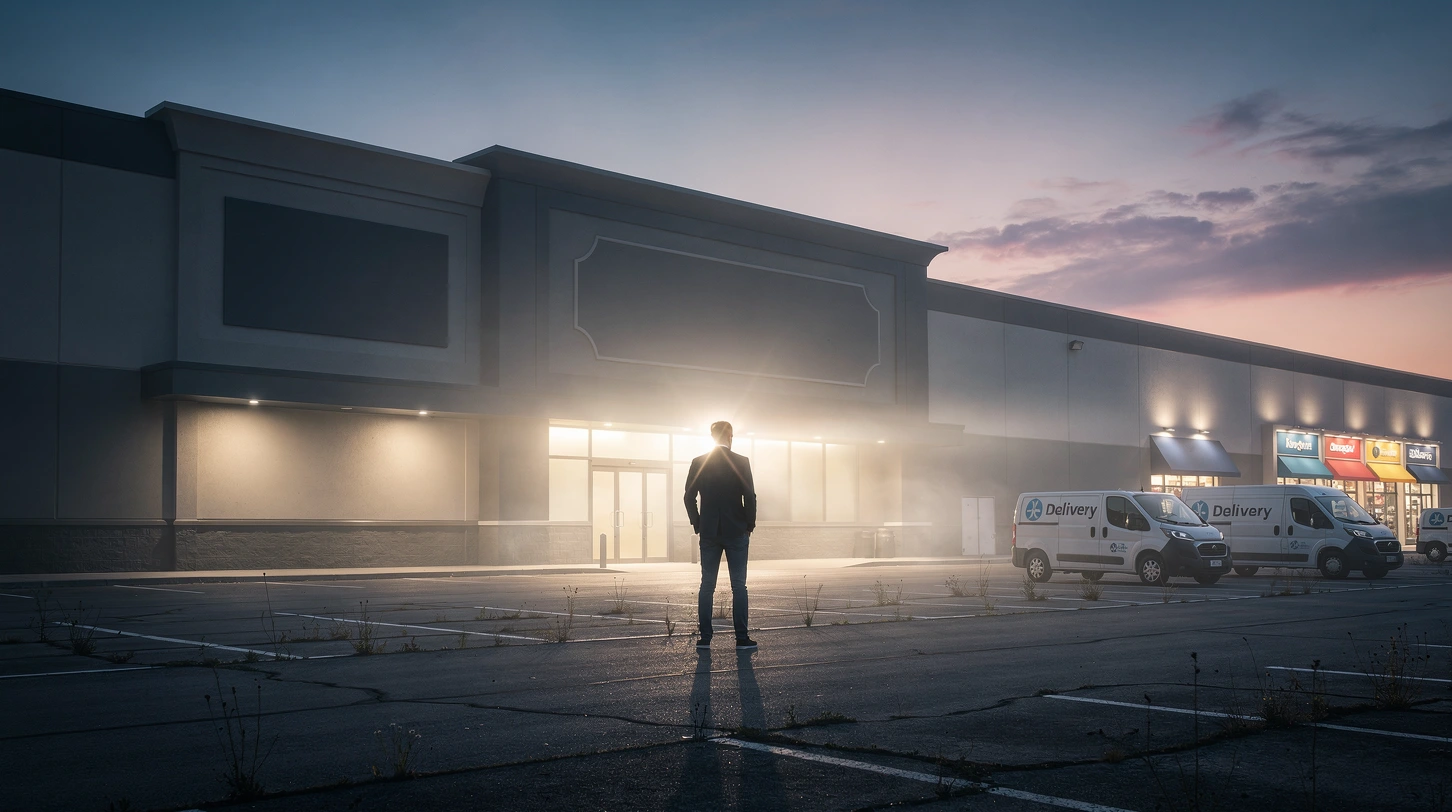
Retail rebuild after channel collapse is the story behind almost every U.S. consumer brand that survived the last decade. When a category killer (a big-box chain or a vertical marketplace) decides your product line is a loss leader, the channel does not just shrink. It vanishes, often inside a single quarter, and the founders left holding inventory have to invent a new way to reach the same customer with less margin and less time.
In short
- Channel collapse rarely arrives as a surprise; founders usually see two or three warning signs (chargebacks, slotting fee hikes, planogram cuts) before the channel truly closes.
- The rebuild plan that consistently works in U.S. retail is a three-leg stool: direct to consumer, diversified marketplaces, and a small set of independent or specialty wholesale accounts.
- Cash flow is the binding constraint. A 60 to 90 day terms gap can sink an otherwise viable brand, so founders renegotiate factoring, freight terms, and ad spend before they touch the product roadmap.
- Retail media networks (Amazon Ads, Walmart Connect, Target Roundel) absorb a meaningful share of post-collapse advertising budgets, but they only pay back when paired with an owned-channel funnel.
- Founders who recover fastest treat the rebuild as a brand operating model change, not a marketing campaign.
This guide walks through what a credible retail business landscape rebuild actually looks like in 2026, based on the patterns we see across U.S. consumer brands that lost their primary wholesale partner and came back with a healthier P&L on the other side.
Why a channel killer hits harder in 2026 than it did in 2018
The mechanics of a channel killer have not changed much since Toys R Us closed its doors. A dominant retailer or marketplace decides a category is no longer strategic, pulls space, or files Chapter 11, and the brands that depended on that channel for distribution and demand generation are stranded with inventory, open POs, and a customer list they never owned.
What has changed is the underlying economics. Customer acquisition costs on paid social have roughly doubled since 2021, according to industry surveys tracked by trade groups like the National Retail Federation. Freight rates are higher and more volatile than they were a decade ago. Tariffs on consumer goods imported from Asia widened margin pressure for many categories in 2025. And venture capital for early-stage consumer brands contracted sharply after the 2022 correction, so the easy money that used to fund a pivot is no longer easy.
The result is that a founder who loses a major channel today has fewer subsidies, slower fundraising paths, and tighter unit economics than the same founder would have had in 2018. The rebuild is harder, the timeline is shorter, and the margin for tactical error is thinner.
What channel collapse usually looks like in the wild
Across the U.S. retail and e-commerce brands we track, channel collapse rarely arrives as a single event. It accumulates. A typical sequence runs roughly like this:
- Slotting fees, MDF (market development funds), and chargebacks creep upward over two to three planogram cycles.
- The retailer asks for “category innovation,” which translates to lower price points or exclusive SKUs at razor-thin margins.
- Reorders slow, replenishment lead times stretch, and the buyer rotates out.
- The brand is moved to a smaller fixture or off the planogram entirely.
- Within one to three quarters, the channel produces less revenue than the founder spends managing it.
By the time founders feel the collapse, the data has been visible for months. That is the first lesson of retail rebuild after channel collapse: the rebuild begins long before the channel actually disappears, because the warning signs precede the closure by a year or more.
Key terms every founder should be fluent in before the rebuild
Founders who survive a channel killer tend to speak retail finance with the same fluency as their CFO. The vocabulary matters because the rebuild is largely a negotiation, and the parties on the other side (factors, freight forwarders, ad platforms, contract manufacturers) treat ambiguity as a credit risk premium they will pass back to the brand.
- Sell-in vs. sell-through: Sell-in is what the retailer bought; sell-through is what the consumer actually purchased. Channel collapses almost always show up in sell-through first.
- Open to buy (OTB): The dollar amount a retailer has budgeted to spend on new inventory in a given period. When OTB shrinks for your category, your reorders go with it.
- Markdown allowance: Funds the brand owes the retailer when product is discounted. In a collapsing channel, markdown allowances spike just before the channel closes.
- Factoring: Selling your receivables to a third party at a discount to get cash sooner. The factor’s appetite for your invoices is a leading indicator of your perceived credit health.
- Retail media network (RMN): The on-platform advertising business a marketplace or chain runs, such as Amazon Ads, Walmart Connect, or Target Roundel.
- MAP (Minimum Advertised Price): The floor your wholesale partners agreed not to advertise below. When a collapsing channel breaks MAP to clear inventory, every other channel suffers.
- Contribution margin: Revenue minus variable costs, before fixed overhead. The rebuild plan stands or falls on this single number.
If any of these terms feel unfamiliar, that is the first thing to fix. Founders who try to rebuild without the vocabulary end up making decisions on gut instinct, and gut instinct in a collapsing channel tends to be wrong because the data is moving faster than the founder’s intuition.
How the rebuild works in practice
There is no single playbook, but the founders we have watched recover successfully tend to run the same five steps, in roughly the same order, in the first 180 days after they accept that the channel is gone.
Step 1: Triage the inventory and the receivables
Before anything else, the founder needs to know two numbers cold: how much inventory is sitting in (or destined for) the collapsing channel, and how much money the channel still owes. Inventory that was earmarked for a now-closing retailer rarely sells at full price elsewhere. Receivables from a Chapter 11 filer become unsecured claims that may pay pennies on the dollar, if at all.
This is the moment to renegotiate freight terms, push back on any future shipments that have not landed yet, and start a conversation with the brand’s factor about the realistic value of those receivables. A founder who acts in the first 30 days has options. A founder who waits 90 days has obligations.
Step 2: Pick the new revenue mix and commit to it
The classic rebuild revenue mix in U.S. retail is roughly 40 percent direct to consumer, 40 percent marketplaces (Amazon, Walmart, Target Plus, and sometimes specialty marketplaces like Faire for independent retailers), and 20 percent independent or specialty wholesale. Those numbers are not magic, but they reflect the fact that no single channel should ever again represent more than 50 percent of the brand’s revenue.
This is also where founders should look closely at how a retail founder bootstraps to seven figures without VC, because the bootstrap discipline that prevents over-reliance on any one channel is exactly the discipline that protects against the next channel killer.
Step 3: Rebuild the unit economics from the contribution margin up
The wholesale P&L and the DTC P&L are different businesses. Wholesale lives on 40 to 55 percent gross margin and very low marketing spend. DTC lives on 65 to 75 percent gross margin and 20 to 35 percent marketing spend. If a founder simply ports the wholesale cost structure into a DTC business, the unit economics will not work.
The rebuild requires re-engineering the cost of goods (often through fewer SKUs, smaller pack sizes, or contract manufacturer renegotiation), the freight model (often through 3PLs instead of self-fulfillment), and the ad mix (often through a small set of channels worked deeply rather than a wide spread).
Step 4: Invest in owned media before paid media
Founders who recover quickly tend to spend the first 60 days of the rebuild on email lists, SMS lists, content, and community, not on paid acquisition. Paid acquisition is rented; owned audiences are durable. A 50,000 person email list with a 25 percent open rate is worth more in a downturn than three months of Meta spend.
The supporting infrastructure for this stage (CRM, helpdesk, loyalty, reviews) increasingly overlaps with the tools and vendors for POS and in-store tech in 2026, because the post-collapse founder often re-enters specialty wholesale and needs unified data across DTC and the remaining brick-and-mortar accounts.
Step 5: Add paid media surgically, not broadly
Once the owned channels are working and the contribution margin is positive on the DTC side, the founder can layer paid acquisition on top. The mistake to avoid is starting paid before the funnel is ready, which burns cash on traffic that will not convert.
Common mistakes founders make in the first 90 days
The pattern of mistakes is remarkably consistent across categories. Apparel founders, food and beverage founders, and home goods founders all tend to make the same five errors in the first 90 days after a channel collapse.
| Mistake | What it looks like | Cost |
|---|---|---|
| Discounting too fast | 40 to 60 percent off sitewide to clear collapsed-channel inventory | Trains the customer base to wait for sales; destroys MAP across remaining wholesale |
| Spreading paid budget too thin | Running Meta, TikTok, Google, Amazon, and Pinterest simultaneously with sub-scale budgets on each | No channel ever reaches the learning threshold; CAC stays above LTV |
| Skipping the brand audit | Assuming the collapsed channel’s customer is the same as the DTC customer | Product-market mismatch; high return rates; brand confusion |
| Holding onto the old SKU count | Trying to sell 200 SKUs in DTC the way the channel sold them | Inventory drag, fulfillment complexity, ad creative spread too thin |
| Waiting for the next big retail account | “If we can just land Target, we will be fine” | Recreates the original concentration risk |
Most of these mistakes share a common root: founders treat the rebuild as a return to the prior state, when it is in fact a transition to a new operating model. The brand that sold into a single big-box partner is structurally different from the brand that sells across DTC, marketplaces, and specialty wholesale. Pretending otherwise prolongs the recovery.
Examples from U.S. retail and e-commerce
Several recent U.S. brand recoveries illustrate the patterns above. Names are intentionally generic, but the dynamics are drawn from public filings, founder interviews, and trade press over the last 24 months.
A home goods brand after a big-box bankruptcy
A mid-sized home textiles brand had roughly 65 percent of its revenue concentrated in one national chain when that chain entered Chapter 11. The brand had a small DTC site (about 4 percent of revenue) and a stalled Amazon business. Within 18 months of the bankruptcy filing, the brand had rebuilt to roughly the same top-line revenue, but with 38 percent DTC, 34 percent Amazon, 14 percent Walmart.com, and 14 percent specialty independents.
The two pivotal decisions: the founder cut SKUs from 180 to 42 in the first six months, and reinvested the freed-up working capital into an Amazon Brand Registry strategy that doubled organic visibility over 12 months.
A food and beverage brand after a category killer marketplace shift
A specialty pantry brand depended on a vertical marketplace that abruptly deprioritized its category in favor of private label. The marketplace did not disappear, but the brand’s revenue from it dropped 70 percent in two quarters. The founder rebuilt by leaning into independent natural grocers (the brand’s original distribution before the marketplace) and adding a subscription DTC channel.
What made the difference was the founder’s willingness to lose 20 percent of historical revenue permanently to escape the marketplace’s pricing pressure. The smaller, more diversified business produced higher contribution margin within 12 months than the larger, marketplace-dependent business had ever produced.
An apparel brand after a department store consolidation
A contemporary apparel brand lost a department store account that represented 45 percent of revenue when two chains consolidated and the new buyer cut the brand’s planogram. The founder pivoted to direct retail (two owned stores), a stronger e-commerce site, and a small wholesale book of independent boutiques. The owned stores took 14 months to break even, but produced operating leverage that the wholesale business never had.
The pattern under all three stories
The three cases above span different categories, but the pattern under each one is the same. The founders who recovered did three things almost identically: they accepted a smaller revenue base, they rebuilt around contribution margin rather than top-line volume, and they invested in customer relationships they could own rather than channel relationships they could only rent.
The founders who did not recover (and there are many) tended to chase the lost revenue back, usually by signing a new wholesale partner of similar scale to the one they lost. Within 18 to 30 months, the same dynamics reasserted themselves: a single account exceeded 40 percent of revenue, the brand’s negotiating leverage eroded, and the cycle repeated. The pattern is so common that the seasoned operators in the U.S. consumer industry have a name for it: re-concentration. Avoiding re-concentration is the single most important strategic decision a founder makes during a rebuild.
The first 90 days: a week-by-week checklist
The macro plan is useful, but founders in the middle of a channel collapse rarely have the bandwidth to think in 18 month horizons. What they need is a near-term checklist that buys them time and stabilizes the business. The version below has been refined across multiple U.S. brand recoveries and works for most consumer categories.
| Week | Primary action | Secondary action |
|---|---|---|
| 1 to 2 | Freeze all in-flight POs to the collapsing channel; verify status of receivables | Notify factor and freight forwarder; document inventory in transit and in warehouses |
| 3 to 4 | Build the 12-month cash flow forecast under three channel-mix scenarios | Open conversations with two or three inventory financing partners |
| 5 to 6 | Cut SKU count to the top 20 to 40 percent of contribution margin | Renegotiate 3PL or fulfillment contracts to fit the new volume |
| 7 to 8 | Launch or relaunch the DTC site with the focused SKU list | Stand up the Klaviyo or Attentive flows that capture the existing customer base |
| 9 to 10 | Open or expand Amazon, Walmart.com, and Target Plus listings on the focused SKU set | Begin Pacvue or Perpetua campaigns on the marketplaces |
| 11 to 12 | Pitch Faire, NuORDER, and 10 to 20 targeted independents | Measure week-over-week contribution margin; lock the operating plan for months four to six |
Founders who stick to a checklist like this tend to feel disoriented by the small scale of each step, especially compared to the size of the channel they lost. The discipline is to recognize that 12 small wins compound into a working business, while one big bet on a new wholesale partner usually does not. The brands that come out the other side healthier almost always describe the first 90 days the same way: it felt slow until it suddenly was not, and the slowness was actually the work paying off.
One more nuance worth flagging: the checklist assumes a single-founder or small-team brand. Larger brands (50 plus employees) need to layer in an internal communications cadence and a board-level decision framework, because the speed of decisions in a rebuild is gated by the slowest stakeholder in the loop. The founders who succeed at scale tend to centralize rebuild authority in two or three people for the first 180 days, then re-decentralize once the new operating model is stable.
Tools, partners and vendors worth knowing during a rebuild
The vendor stack for a post-collapse rebuild is meaningfully different from a typical DTC stack. The founder needs partners that can handle complexity (multi-channel data, inventory across channels, EDI for the remaining wholesale) without the enterprise pricing that a typical Series B brand would tolerate.
A current overview of the broader vendor landscape lives in the tools and vendors for founder stories in 2026 roundup, which covers the categories below in more depth.
- Inventory and order management: Cin7, Fishbowl, Brightpearl, and Cogsy are common picks for brands that need to manage stock across DTC, marketplaces, and wholesale.
- 3PL partners: ShipBob, Stord, Deliverr (now part of Shopify), and regional 3PLs like Quiet Logistics handle DTC fulfillment with multi-warehouse footprints.
- Retail media operators: Pacvue, Skai, and Perpetua manage Amazon Ads, Walmart Connect, and Target Roundel campaigns at a sub-enterprise budget.
- Email and SMS: Klaviyo and Attentive dominate the U.S. DTC market; Postscript is a credible Shopify-native alternative for SMS.
- Wholesale platforms: Faire for independent retail; NuORDER and JOOR for traditional wholesale; RangeMe for getting in front of buyers.
- Working capital: Wayflyer, Settle, Parker, and Ampla for inventory financing; traditional factoring firms for receivables.
None of these vendors will save a founder from a bad rebuild plan, but the wrong vendor stack can prevent a good plan from executing. Brands routinely lose 90 days of rebuild momentum to a 3PL migration or an order management system change that should have happened pre-collapse.
What the rebuild looks like 12 to 24 months later
Founders who execute a credible rebuild tend to land in a similar place after two years: smaller than they were at peak, more profitable, and significantly less exposed to any single channel. The classic shape of a recovered brand looks roughly like this:
- Revenue: 70 to 85 percent of pre-collapse peak.
- Contribution margin: meaningfully higher, often 5 to 12 points better than pre-collapse.
- Channel mix: no single channel above 50 percent; usually two channels in the 25 to 40 percent range and a long tail.
- Inventory turns: 1.5 to 2x faster than pre-collapse.
- Marketing efficiency: blended ROAS in a sustainable range (typically 2.5 to 4.0) across paid and organic channels.
These are not aspirational numbers. They are the realistic outcomes for founders who treat the rebuild as a structural reset rather than a marketing pivot. The brand that emerges is smaller and tougher, and the founder who runs it has a much clearer view of how the channels actually work together, which is the most durable competitive advantage available in U.S. retail in 2026.
For the broader context that connects channel risk to founder financing, exits, and the longer arc of brand-building, see the cluster pillar on the retail business landscape: funding, founders and exits, which frames where this story fits in the wider ecosystem.
FAQ
How long does a typical retail rebuild after channel collapse take?
Most U.S. consumer brands need 18 to 24 months to rebuild to a sustainable revenue base after losing a primary channel. The first 90 days are triage; months four through 12 are operating model changes; months 13 through 24 are scaling the new mix. Founders who shortcut this timeline usually relapse into a new concentration problem within a year.
Should I keep the failing channel as long as it produces any revenue?
Only if the contribution margin is positive after all chargebacks, slotting, and markdown allowances. Many channels look like revenue on the top line but are actually subsidized by the founder’s working capital. Audit the channel P&L on a fully loaded basis before deciding.
Is Amazon a safe channel to lean on during a rebuild?
Amazon is safer than a single big-box partner because the channel itself is not at risk of disappearing, but it carries its own concentration risk: a suspension, a private label competitor, or an algorithm change can compress revenue quickly. Treat it as one strong leg of the stool, not the whole stool.
How much cash do I need to fund a rebuild?
A useful rule of thumb is 12 months of fixed overhead plus enough working capital to fund inventory for the new channel mix at the new ad spend ratio. For a brand doing 10 million dollars in pre-collapse revenue, that is often 1.5 to 3 million dollars in committed capital, blended across cash, factoring lines, and inventory financing.
Do I need to raise outside capital to rebuild?
Not necessarily. Many founders rebuild on internal cash flow plus inventory financing, especially if they cut SKUs aggressively and lean into owned media before paid. Outside capital is most useful when the brand has a credible path to a new growth channel that needs upfront investment, such as owned retail or a new manufacturing relationship.
How do I keep the team motivated during the rebuild?
Be transparent about the situation, communicate the rebuild plan in writing, and tie roles to specific outcomes in the new operating model. Most defections during a rebuild happen because the team cannot see a future, not because the situation is hopeless. A written 12-month plan with quarterly milestones tends to retain the people you most need.
What is the single biggest predictor of a successful rebuild?
Founder honesty about the prior concentration risk. Founders who blame the channel for the collapse tend to recreate the same risk with a new partner. Founders who recognize that the original strategy depended on a single point of failure tend to build something more durable on the other side.