
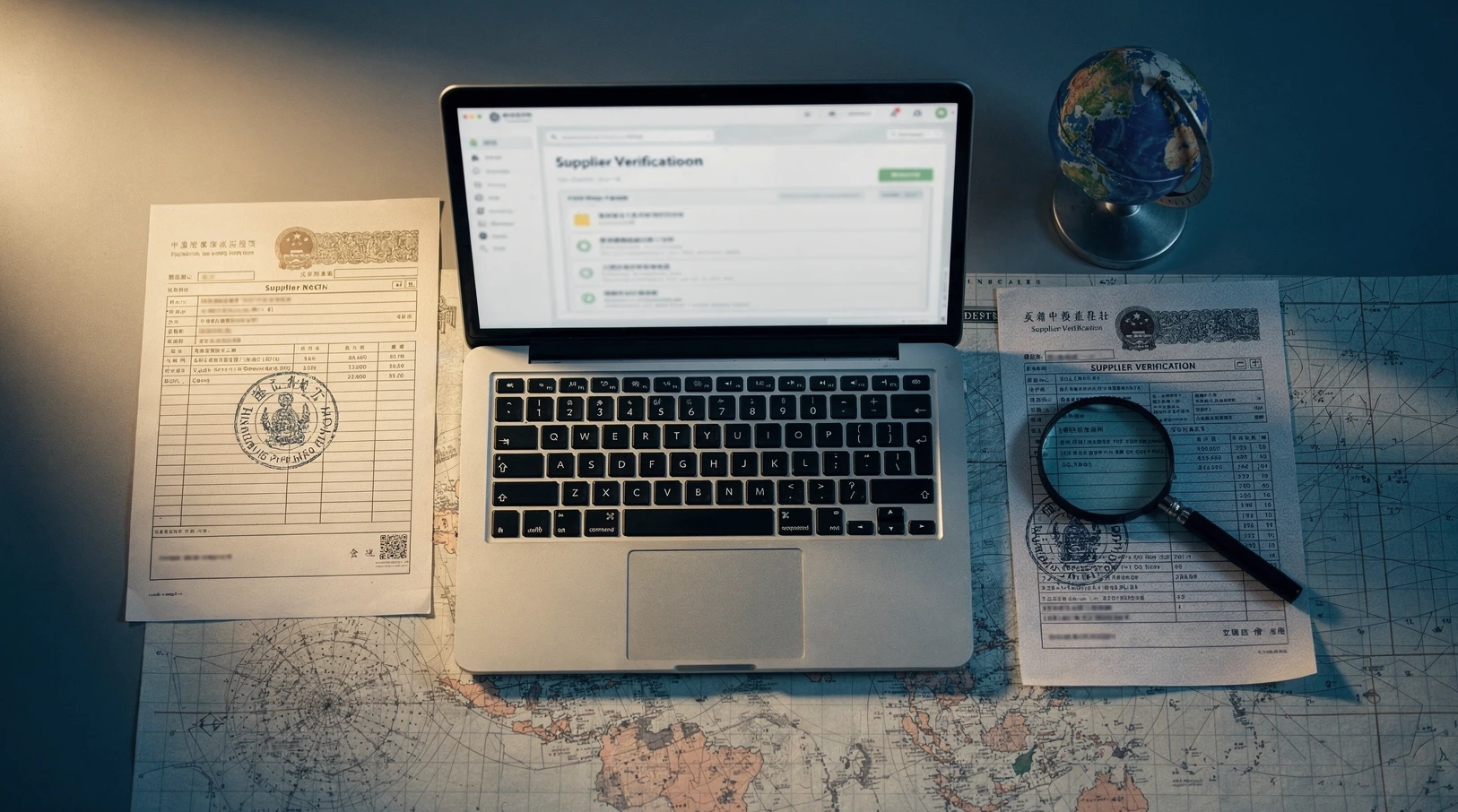
Sending the first wire to an Alibaba supplier is the moment a sourcing project stops being theoretical. Up to that point you have screenshots, chat threads, and PDF catalogs. After the wire clears, you have a counterparty in a different jurisdiction who already controls your money. The single most expensive sourcing mistake US buyers still make in 2026 is treating verify alibaba supplier as a checkbox on the platform rather than a process that runs across business records, factory reality, banking, and references.
This guide walks through the practical playbook used by experienced retail buyers, marketplace sellers, and importers who have run Alibaba purchase orders into the millions of dollars. It is grounded in the same fundamentals covered in The complete guide to selling on global e-commerce marketplaces, but tightens focus on the pre-payment verification step that determines whether the rest of the supply chain ever functions.
In short: the verify alibaba supplier checklist
- Business identity first: confirm the legal entity name, address, and registration in China’s National Enterprise Credit Information System before touching banking.
- Badges are signals, not guarantees: Gold Supplier, Verified Supplier, and Trade Assurance each mean specific things and none of them prove product quality.
- Bank account must match the verified company name exactly. Personal accounts, Hong Kong shells, and “agent” accounts are the single biggest fraud vector.
- A third-party audit or video factory tour beats any amount of online chat for first orders above roughly 5,000 USD.
- Trade Assurance plus staged payment terms beats prepayment, even with a supplier you trust.
Why verification matters before any wire transfer
Alibaba.com is a marketplace, not a vetting agency. It hosts roughly 200,000 active suppliers and processes orders into nearly every country. The platform offers tooling to reduce risk, but the legal and operational reality is that once funds leave a US bank account toward a Chinese supplier, recovery is slow, expensive, and frequently impossible. Chargebacks do not exist for wire transfers. A cross-border lawsuit over a 12,000 USD purchase order is rarely worth filing.
The asymmetry is the point. The buyer carries almost all of the upfront risk, while the supplier carries production cost only after deposit. That structure is normal in international trade, but it is the reason every serious buyer builds a verification routine that runs before, not after, the first invoice. The cost of one hour of due diligence is always lower than the cost of a single bad order.
The same logic shows up in adjacent channels. Buyers who source from Alibaba often use 1688 or Made-in-China for specific categories, and the trade-offs are spelled out in Alibaba versus 1688 versus Made-in-China for serious buyers. The verification process described below is portable across all three platforms, with small adjustments for what each one exposes publicly.
The four pillars of supplier verification
Treat verification as four separate workstreams, not a single document review. Each pillar can pass while another fails, and a fraudulent supplier almost always has at least one pillar in good shape to create the illusion of legitimacy.
| Pillar | What you verify | Primary source | Typical time |
|---|---|---|---|
| Business identity | Legal name, registration, ownership, business scope | NECIS, Qichacha, Tianyancha | 30 to 60 minutes |
| Factory reality | Physical address, production capability, workforce | Third-party audit, video tour, satellite imagery | 3 to 10 days |
| Payment integrity | Bank account matches legal entity, currency, country | Bank confirmation letter, SWIFT details | 2 to 5 days |
| Commercial references | Past buyers, export volume, shipping records | References, import records via ImportGenius or Panjiva | 1 to 3 days |
Each pillar feeds the next. There is no point requesting bank details from a company you have not yet confirmed exists, and there is no value in a factory audit until you have confirmed the factory belongs to the entity you are paying. Buyers who skip steps almost always do it on the third or fourth order, after fatigue sets in. That is when the losses happen.
Pillar one: confirming the legal business identity
Every legitimate Chinese supplier is registered with a Unified Social Credit Code, an 18-character identifier that functions like a US EIN. The first eight digits encode the issuing authority and registration class, and the remainder identifies the entity. Ask for this code in writing, then verify it against the National Enterprise Credit Information Publicity System, the official registry maintained by China’s State Administration for Market Regulation. The system is available in Mandarin only, so most buyers run searches through the English-language interfaces of Qichacha or Tianyancha, which mirror the same public data.
What you are checking, in order:
- The legal entity name in Mandarin matches the name on the Alibaba storefront.
- The registration is active, not “revoked,” “cancelled,” or “in liquidation.”
- The registered business scope includes the product category you intend to buy. A company registered for “textile trading” cannot legally export injection-molded electronics.
- The registered capital is consistent with the order sizes you plan to place. A supplier with 100,000 CNY registered capital quoting a 500,000 USD order is a structural mismatch.
- The legal representative’s name matches the contact you have been talking to, or that contact has a documented role within the company.
For a deeper view of the trading-company versus factory distinction that comes up at this step, see Sourcing from Alibaba without getting burned: a buyer playbook, which covers how to read business scope and capital fields when deciding who you are actually paying.
Pillar two: what Alibaba’s own badges actually prove
Alibaba layers several trust signals over each supplier profile. Buyers routinely treat these as interchangeable, which is the mistake. Each badge proves something specific and narrow.
| Signal | What it proves | What it does NOT prove |
|---|---|---|
| Gold Supplier | Paid annual membership, basic identity verification | Product quality, factory ownership, financial health |
| Verified Supplier | On-site inspection by SGS, Bureau Veritas, or TUV Rheinland | That every product matches the inspection report |
| Trade Assurance | Alibaba escrow with dispute mediation up to a stated coverage cap | Refund certainty; mediation decisions favor documented terms |
| A&V Check | Authentication and verification of business license | Operational scale or current activity |
| Years on Alibaba | Length of platform tenure | Continuous ownership; storefronts are sometimes resold |
The most useful badge for a first transaction is Trade Assurance, because it routes the payment through Alibaba’s escrow system rather than direct to the supplier’s bank. If product or shipment terms are breached, Alibaba mediates, and the buyer has a recovery path that does not depend on Chinese courts. Coverage caps are listed on each supplier profile and can be increased on request, often up to several hundred thousand US dollars for established storefronts.
Trade Assurance does not, however, replace verification. The escrow only triggers when an order is placed through the official Alibaba contract template. Payments wired outside the platform, or with terms substituted mid-conversation, fall outside coverage. Roughly one in five disputes that buyers think are covered turn out not to be, because the order was routed off-platform after the initial quote.
Pillar three: bank account integrity
This is the single most important pre-payment check, and the one where fraud is concentrated. Once a supplier passes the business identity check, request a proforma invoice that includes full SWIFT banking details. Three fields must match exactly:
- Beneficiary name equals the registered Chinese legal entity name from pillar one. Not a similar name, not a parent company, not an abbreviation. Exact match.
- Beneficiary bank country is mainland China for mainland Chinese suppliers, or Hong Kong only if the supplier has explicitly disclosed a Hong Kong subsidiary in writing.
- Currency is USD or RMB, billed from a corporate account. Personal accounts under a director’s name are not acceptable on any order above a few hundred dollars.
The most common fraud pattern in 2026 is the “redirected invoice” attack. A buyer has worked with a legitimate supplier for months, then receives an email claiming the company changed banks. The new account is in a different country, often Hong Kong or Singapore, and registered to a different name. The email looks identical to previous correspondence. Roughly 60 percent of large-loss cases reported by US e-commerce buyers in the past three years trace back to this pattern, according to FBI Internet Crime Complaint Center data.
The defense is procedural, not technical. Any banking change must be confirmed by a video call with the verified contact, plus a fresh bank confirmation letter on the supplier’s letterhead, plus a re-check of the new account against the company’s Chinese registration. If any step is skipped, the wire does not leave.
Pillar four: factory reality and references
Documents alone never prove that a factory makes what its catalog claims. Three options exist for first-order buyers, in increasing cost and reliability.
Live video tour: schedule a 30 to 60 minute video call during local Chinese business hours, with the supplier walking through the production line, warehouse, and quality control area. Ask for unscripted moments: serial numbers on equipment, the current day’s production board, employees at workstations. Suppliers who refuse, who insist on pre-recorded footage, or who only show generic factory views are screening themselves out. For orders under 5,000 USD this is often enough.
Third-party inspection: services like SGS, Bureau Veritas, TUV Rheinland, AsiaInspection, and QIMA offer fixed-price factory audits ranging from 300 to 1,200 USD. The auditor visits the address on the business license, confirms machinery exists, checks workforce size, and produces a report with photos and serial documentation. For orders between 5,000 and 50,000 USD, this is the standard. The buyer pays. Suppliers who ask the buyer not to commission an audit are providing a red flag, not a suggestion.
Trade reference calls: ask for two or three current US or EU customers and call them. Real suppliers have real references and offer them without resistance. The questions to ask are operational, not promotional: how long is the lead time in practice, how does the supplier handle defects, how often have shipments been late, what does dispute resolution look like. Two ten-minute calls reveal more than fifty pages of catalog.
Import records add a fourth layer. Services like ImportGenius, Panjiva, and US Census Bureau bill-of-lading data show which US companies have actually received shipments from the supplier in the past 12 to 24 months. A supplier claiming significant US business with zero matching import records is misrepresenting volume.
Document checks every buyer should run
Beyond the four pillars, six documents form the standard verification packet. Request all six up front, and treat any pushback as data. Legitimate exporters respond to this list within 48 hours.
- Business license with Unified Social Credit Code clearly visible, both in Mandarin and an English translation.
- Tax registration certificate confirming the entity is current on Chinese tax obligations.
- Export license or customs declaration history, proving the company is legally allowed to handle export documentation rather than routing through a separate agent.
- Bank confirmation letter on bank letterhead, dated within the past 90 days, naming the beneficiary and account in full.
- Quality certifications appropriate to product category: ISO 9001 for general manufacturing, CE for electronics destined for EU markets, FCC for radio devices, FDA registration for food contact items, BSCI or SA8000 for labor compliance.
- Proforma invoice with Incoterms 2020 clearly stated, payment schedule, and product specifications in writing.
Each document carries verification touchpoints. The Unified Social Credit Code matches the registry. The bank letter matches the proforma invoice. The export license number can be cross-checked against China Customs data. Quality certifications carry certificate numbers that the issuing body can validate. Buyers who collect documents but skip the cross-checks are doing paperwork, not verification.
Red flags that should stop a deal cold
Pattern recognition matters as much as document review. Across thousands of disputed orders, a small set of warning signs predicts the majority of bad outcomes.
- Pressure to pay outside Trade Assurance “for a better price” on a first order.
- A bank account in a country that does not match the registered entity, with no documented subsidiary.
- Refusal to do a video factory tour, or insistence on pre-recorded footage only.
- Prices that are 30 percent or more below the platform median for comparable goods.
- Communication only through WhatsApp, WeChat, or a personal Gmail account, never through the supplier’s company domain.
- A storefront less than 12 months old quoting wholesale terms that suggest a much older operation.
- Sample requests routed to a different address than the proforma invoice.
- Resistance to a third-party inspection of the goods at the supplier’s facility before shipment.
- Unsolicited offers of large discounts or “exclusive distribution” on first contact.
- Inconsistent product photography, particularly the same product shot appearing on multiple supplier profiles.
Two or more red flags on the same supplier almost always indicate the deal will fail somewhere in the process. The cost of walking away is one or two weeks of sourcing time. The cost of proceeding is the entire order value.
Payment structures that survive a bad supplier
Even after a clean verification, payment structure protects the buyer. The goal is to keep funds at risk roughly proportional to production progress. Three patterns work in practice.
| Structure | How it works | Best for | Risk profile |
|---|---|---|---|
| Trade Assurance escrow | Full payment held by Alibaba until buyer confirms shipment terms met | First orders up to coverage cap | Lowest, but limited by coverage cap |
| 30/70 with pre-shipment inspection | 30 percent deposit, 70 percent after independent QC report | Established suppliers, mid-size orders | Moderate; deposit is at risk |
| L/C at sight | Letter of credit issued by buyer’s bank, paid against shipping documents | Orders above 50,000 USD | Bank-mediated, paperwork-heavy |
| Net 30 or net 60 | Buyer pays after receiving goods, on credit terms | Long-term relationships only | Lowest for buyer, rare for new accounts |
Buyers who default to “100 percent prepayment for a discount” lose roughly four cents on the dollar in expected value once fraud rates and quality disputes are factored in. The discount almost never compensates for the risk on a first order. The math changes after 3 to 5 successful transactions with the same supplier, by which point 30/70 or net terms become viable.
For US sellers shipping into Amazon, Walmart Marketplace, or Shopify storefronts, payment structure also intersects with downstream platform requirements. The broader marketplace context is laid out in The complete guide to selling on global e-commerce marketplaces, which is the right next read for buyers who have completed verification and are planning their listing strategy.
What to do in the 72 hours before sending the wire
By this point, the supplier has cleared the four pillars and provided the document set. The final 72 hours are a procedural cooldown that catches problems that surfaced late in the process. The sequence:
- Re-verify the bank account against the business registry one more time. Account changes that arrive 24 to 48 hours before payment are the textbook fraud signature.
- Confirm the proforma invoice has not been amended since the final approval. Pull both copies and diff them.
- Place the order through Trade Assurance if available, with the official contract template. Do not accept a substituted template “for legal reasons.”
- Use a wire from a corporate account that allows recall, not a personal account or instant-settlement service.
- Notify your bank’s fraud desk of the planned wire, including beneficiary and amount, before sending. Most US business banks will hold the wire briefly if the beneficiary appears in their fraud database.
- Send a small first wire if the supplier is brand new to you. A 500 to 1,000 USD test payment confirms the routing works before the full deposit moves.
Sample orders as a verification tool
A paid sample order is the cheapest functional test of a supplier’s operations. It exercises the same systems that will handle a full purchase order: order acknowledgment, production scheduling, packaging, export documentation, courier handoff, and customer service. A 50 to 300 USD sample order reveals more about how a supplier actually works than any number of catalog reviews.
Three things to watch during the sample cycle. First, the lead time the supplier quotes for the sample versus what they deliver. A supplier who quotes 7 days and delivers in 18 will do the same on a 10,000-unit order, just multiplied. Second, the courier they choose. Established exporters use DHL, FedEx, or UPS with traceable air waybills. Suppliers who quietly ship via local Chinese postal services on a small sample are signalling they will do the same on the production order, with a much worse delivery experience. Third, the packaging and documentation. Commercial invoices, packing lists, and harmonized tariff codes that arrive correctly on a sample are a strong predictor for production shipments.
Buyers who run two or three different sample orders, sometimes from the same supplier and sometimes from competitors quoting similar specs, build a baseline of what “normal” looks like in a given product category. That baseline is the only honest reference point when a future order goes wrong and the supplier insists the issue is unusual.
Verification beyond Alibaba: small-store context
The same verification logic applies whether a buyer is sourcing for an Amazon FBA business, a Shopify storefront, or a Wix or Squarespace site selling to a local US audience. The platform you sell on does not change the supplier risk you carry. For small retail operators thinking about that store-front decision in parallel with sourcing, Wix versus Squarespace for small retail stores in 2026 covers the trade-offs that often come up at the same time as a first Alibaba order.
Frequently asked questions
How long does a full Alibaba supplier verification take?
Plan for 7 to 14 calendar days for a first order. Business identity and document review take 1 to 2 days. A third-party factory audit takes 5 to 10 days from booking to report. Reference calls take another 1 to 3 days. Buyers who try to compress this to 48 hours are routinely the ones who file fraud complaints later.
Is Trade Assurance enough on its own?
No. Trade Assurance protects against breach of contract terms inside the Alibaba ecosystem, but it does not verify the supplier’s identity, factory, or banking. It also has coverage caps and only applies when the order is placed through Alibaba’s official contract template. Use Trade Assurance as the payment rail, not as the verification step.
What is the difference between a Verified Supplier and a Gold Supplier?
Gold Supplier is a paid membership tier with basic identity checks. Verified Supplier means an independent inspection firm such as SGS, Bureau Veritas, or TUV Rheinland has visited the supplier’s facility and confirmed it exists at the stated address with the claimed equipment. Verified Supplier is the stronger signal, but neither badge proves product quality for any specific order.
Can I trust a supplier that only accepts payment to a Hong Kong account?
Only if the supplier has explicitly disclosed a Hong Kong subsidiary, the subsidiary appears on documentation, and the Hong Kong entity name matches the beneficiary on the wire. Unexplained Hong Kong routing for a mainland Chinese supplier is the single most common fraud signature. When in doubt, decline the wire and request a mainland account.
How much does a third-party factory audit cost?
For a standard one-day audit by SGS, Bureau Veritas, TUV Rheinland, AsiaInspection, or QIMA, plan on 300 to 1,200 USD depending on factory location and scope. The buyer pays. For orders above roughly 5,000 USD, the audit cost is small relative to the risk it removes. Suppliers who object to a buyer-commissioned audit are providing useful information.
What if the supplier asks for payment outside Trade Assurance for a discount?
Decline. The discount, typically 2 to 5 percent, does not compensate for the loss of escrow protection. Suppliers who pressure for off-platform payment on a first order are filtering for buyers who skip verification. Real volume discounts come from repeat orders, not from waiving payment protection.
Are import records a reliable verification source?
Yes, with caveats. Services like ImportGenius, Panjiva, and US Census Bureau bill-of-lading data show actual shipments into US ports, including consignee, shipper, and rough volumes. A supplier claiming significant US business with zero matching shipping records is overstating their scale. Some suppliers ship under freight forwarder names, so absence is not always proof of fraud, but presence is strong confirmation.
What should I do if I think I have already paid a fraudulent supplier?
Within 24 hours: contact your sending bank’s fraud department and request a wire recall, file a complaint with the FBI Internet Crime Complaint Center at IC3.gov, and open a dispute with Alibaba if the transaction went through Trade Assurance. Recovery rates drop sharply after 72 hours. Document every communication and screenshot the supplier’s profile before they have a chance to delete or modify it.