
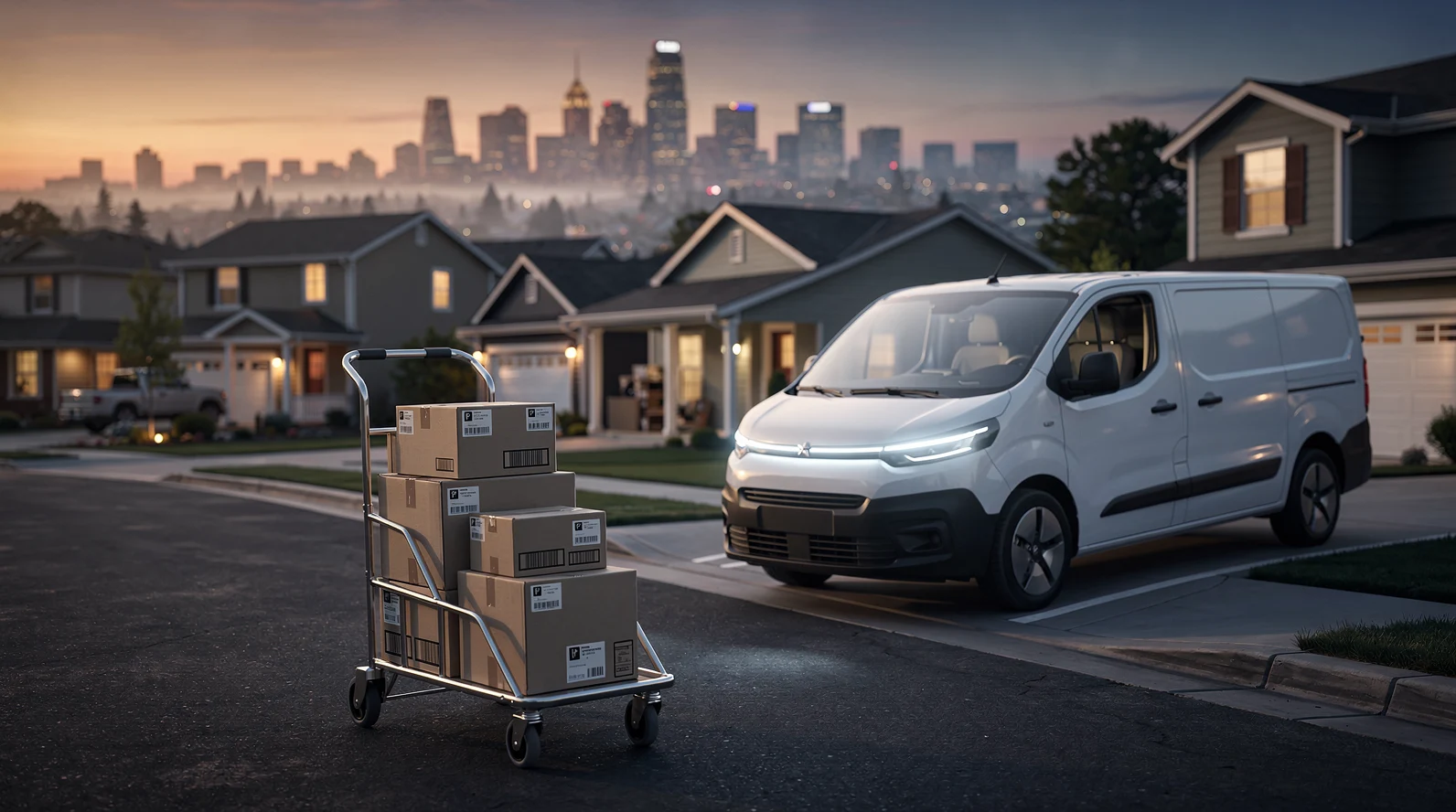
Last mile outlook 2026 for US retailers is no longer a question of who can deliver fastest. It is a question of who can deliver predictably, profitably, and without burning out the people behind the wheel. After two years of carrier reshuffles, gig-fleet experimentation, and quiet pricing increases, 2026 is the year operating discipline starts to matter more than promotional speed.
In short
- Predictability beats speed. Two-day windows that hit on time outperform one-day windows that miss.
- Carrier mix is plural. A US retailer in 2026 typically blends USPS, UPS, FedEx, regional parcel carriers, and gig fleets across the same SKU base.
- Density is the unit economic. Cost per stop falls fast when routes carry more than 90 packages; below 60 it climbs sharply.
- EVs arrive at the curb. Battery vans become a normal sight in metro routes, mostly through fleet leases rather than retailer ownership.
- Returns get a dedicated lane. Reverse logistics is no longer an afterthought layered onto forward delivery.
Why the 2026 last-mile outlook matters now
The last mile sits at the intersection of three pressures that all peaked at roughly the same time. Wage growth for delivery roles outpaced overall retail wage growth between 2023 and 2025. Diesel and electricity prices both ticked up after the brief 2024 trough. And shoppers, accustomed to two-day Prime windows, started rating retailers on the gap between promise date and actual doorstep arrival rather than on absolute speed.
The result is that last-mile cost moved from a quietly absorbed line in the freight budget to a board-level KPI for any retailer doing more than a few thousand parcels a week. The modern retail logistics playbook from warehouse to doorstep now starts with the question of who hands the box over at the door, and works backward to the dock from there.
For most US retailers the 2026 outlook is shaped less by a new technology than by a refusal to keep absorbing the margin hit. Carriers have raised general rate increases by mid-single digits two years in a row, dimensional pricing has tightened, and surcharges for residential, peak, and oversize deliveries have piled on top. Operations leaders enter 2026 with a clear mandate: defend the unit economics or trim the promise.
Key terms shaping the last mile outlook 2026
Before diving into tactics it is worth pinning down the vocabulary, because last-mile conversations in 2026 often stall on terminology that means different things at different retailers.
- Last mile. The final leg from a fulfillment center, store, or local depot to the customer doorstep. In urban areas it can be three blocks; in rural ZIPs it can be 40 miles.
- Cost per stop. Total route cost (driver, vehicle, fuel, overhead) divided by the number of delivered packages on that route.
- Stop density. Packages delivered per route mile or per route hour. The single biggest lever on cost per stop.
- On-time-in-full (OTIF). Percentage of orders that arrive on or before the promised date with all items intact. The reliability metric customers feel.
- Reverse logistics. The flow of returned goods from doorstep back into inventory, refurbishment, or disposal.
- Microfulfillment. Small, often automated fulfillment nodes placed close to demand, typically inside or behind retail stores.
These terms come up in every operations review, vendor pitch, and quarterly earnings call. Standardizing them inside one organization saves more time in 2026 than any new routing optimizer can.
How the carrier mix is settling out in 2026
The single biggest shift since 2023 is that almost no large US retailer relies on a single carrier for residential parcels anymore. The 2026 norm is a four or five carrier rotation, with software picking the cheapest compliant lane at the moment the label is generated. A full breakdown of who wins what lane lives in our comparison of last-mile carriers from USPS to gig fleets, but the headline picture for 2026 looks like this.
| Carrier type | Typical 2026 share | Best for | Watch out for |
|---|---|---|---|
| USPS | 25 to 35 percent | Lightweight residential, rural ZIPs, Saturday delivery | Service variability by district, declining priority for very large parcels |
| UPS | 15 to 25 percent | B2B, oversize, high-value with signature | Highest residential surcharges, peak season caps |
| FedEx | 15 to 20 percent | Air, time-definite, healthcare | Ground Economy variability after the SmartPost rebrand cycle |
| Regional carriers | 15 to 25 percent | Dense metro and ring suburbs, same-day in their home regions | Capacity ceilings during peak, geographic gaps |
| Gig fleets | 5 to 15 percent | Same-day, scheduled windows, returns pickup | Driver turnover, claim handling on damaged or stolen items |
The shares add up to more than 100 percent because retailers usually overlap services on the same ZIPs to keep optionality. A box destined for Phoenix on Monday morning might cost a dollar less by USPS and arrive a day faster by a regional like OnTrac. The label decision is made by rate-shopping software in milliseconds, not by a human dispatcher.
For smaller retailers the picture is simpler but the logic is the same. A Shopify merchant doing 500 orders a week can plug into a rate-shopping app and access most of these carriers through aggregators. The financial difference between a single-carrier setup and a four-carrier rotation tends to be five to twelve percent of total shipping spend in 2026, which is real money on thin retail margins.
Speed promises and the new reliability premium
Two-day shipping became the implicit US baseline in the mid-2020s. What changed by 2026 is that customers are sharper about what two-day actually means. A retailer that promises Wednesday and delivers Wednesday outscores a retailer that promises Tuesday and delivers Thursday, even though the second one technically offered a faster window.
This is the reliability premium, and it shows up in repeat-purchase data. Our deep dive on delivery promise reliability and how it shapes repeat purchase walks through the numbers, but the short version is that a ten-point gain in OTIF correlates with a measurable lift in 90-day repeat orders across categories from apparel to consumables.
In 2026 the operating implication is that retailers tighten their promised windows in two stages. First they audit what they actually hit (often two to four days slower than what the checkout page implies). Then they re-promise to that real number, with a small buffer. Counterintuitively, sales go up. The conversion penalty from a longer promised window is more than offset by the retention gain from hitting it.
The retailers who refuse to do this exercise tend to be the ones still chasing a one-day badge in metro ZIPs while OTIF in the rest of the country sits in the low 80s. In 2026 that imbalance becomes increasingly hard to defend in front of a finance team that has finally connected promise reliability to lifetime value.
Cost pressure points: fuel, labor, and density
Three line items dominate last-mile P&L in 2026, and each one moved against retailers between 2023 and 2025.
- Driver labor. Median wages for parcel delivery roles rose roughly 18 percent from 2023 to 2025 according to US Bureau of Labor Statistics occupational data. Benefits, training, and turnover costs followed.
- Fuel and energy. Diesel ranged from $3.40 to $4.20 per gallon nationally through most of 2025. Electricity costs for fleet charging climbed in California, the Northeast, and Texas urban grids.
- Insurance and accidents. Commercial auto premiums for delivery operators rose faster than general commercial insurance, driven by a rise in nuclear verdicts and higher repair costs for newer vehicles.
The only meaningful counterweight is density. A route that delivers 110 packages in eight hours has a fundamentally different cost structure from a route delivering 55 in the same window. The math is unforgiving: every additional stop adds maybe two minutes of driver time but spreads the fixed cost of the vehicle, the driver, and the depot across one more box.
This is why 2026 last-mile strategy is mostly a density story dressed up as a technology story. Microfulfillment, store-based fulfillment, and consolidation deals with neighboring retailers all chase the same goal: more packages per route hour, in tighter geographies.
Sustainability and EV adoption at the curb
By the start of 2026, electric delivery vans are no longer a pilot in most large metros. Amazon and UPS both crossed meaningful EV milestones in 2024 and 2025, regional fleets followed, and city governments in California, New York, and several Northeast states tightened low-emission zone rules around dense delivery corridors.
For most retailers the practical answer is not to buy EVs but to ask carriers about them. Three questions tend to come up in 2026 RFPs:
- What share of your routes in our top ten metros is served by zero-emission vehicles today, and what is the trajectory through 2027?
- How are you handling charging capacity constraints, and does that affect our service windows?
- Are there incentive or premium structures we can join that pass through Scope 3 reductions to our sustainability reporting?
The honest 2026 answer from most carriers is that EVs are concentrated on dense, predictable urban routes where vehicle utilization is high enough to amortize the upfront cost. Long rural routes remain diesel. The implication for retailers is that sustainability claims should be specific to the lane, not blanket. A box delivered to Manhattan probably traveled the last mile electrically. A box delivered to rural Idaho almost certainly did not.
Microfulfillment and store-as-node strategies
If density is the unit economic, then the question for 2026 becomes a real estate question: where do you put inventory so routes are dense by default. The dominant answers for US retailers fall into three buckets, and most large operators are running pilots in all three.
- Dedicated microfulfillment centers (MFCs). Small footprint buildings, 10,000 to 40,000 square feet, often partially automated with goods-to-person systems. Placed in dense suburban rings around major metros. Best for high-velocity SKUs and same-day promises.
- Store-as-node fulfillment. Existing brick-and-mortar locations doubling as fulfillment points. Inventory accuracy and labor scheduling become the constraints, not real estate. Best when store footprint already overlaps with online demand.
- Dark stores. Former retail spaces converted to online-only fulfillment, no walk-in shoppers. A middle ground between MFCs and full stores, popular for grocery and convenience but spreading into general merchandise.
The 2026 lesson from operators that have run these for a couple of years is that the technology stack is the easy part. The hard parts are inventory positioning (which SKUs to stock where, refreshed weekly), labor model (cross-training store associates to pick orders without slowing the front of the store), and ring sizing (how far to commit to same-day or next-day promises). Get any of those wrong and the node bleeds money.
For retailers without a physical footprint, third-party MFC operators offer a way in. The economics depend on volume commitment: below roughly 800 to 1,200 orders per day per metro the pure MFC route rarely beats a well-run national parcel flow. Above that threshold the math starts to favor the node, especially in metros where same-day or scheduled-window promises drive incremental conversion.
One nuance worth flagging in 2026 is that store-as-node and MFC strategies interact with carrier mix. Once inventory sits 15 miles from the customer, gig fleets and regional carriers become disproportionately useful for the last leg. National carriers stay in play for longer-distance fulfillment from regional DCs. This is why most 2026 carrier RFPs ask vendors to bid at the lane level, not at the network level.
Returns get a dedicated lane
Returns are the part of last-mile logistics that retailers tried hardest to ignore for a decade. In 2026 that is no longer an option. Return rates for apparel, footwear, and home goods sit between 20 and 35 percent, and a single round trip on a returned item can erase the gross margin on three or four sold ones.
Three operating patterns are becoming standard:
- Box-free returns at retail partners. Networks like Happy Returns, Kohl’s-Amazon, and FedEx Office desks turn a customer return into a consolidated batch that travels back as palletized freight, not as individual parcels. Cost per return drops by half or more compared to a courier pickup.
- Keep-it refunds at low value thresholds. When the cost of getting an item back and reselling it exceeds the recoverable value, the math favors refunding without recovery. Most large US retailers now run this rule on items under $15 to $25, with category-specific thresholds.
- Reverse logistics scoring at SKU level. Merchandising teams now see return rates and reverse-logistics cost alongside gross margin when they evaluate vendors and styles. A high-margin SKU with a 40 percent return rate is no longer a win.
Cross-border returns add another layer of complexity. Shoppers who buy from international marketplaces increasingly expect domestic return addresses, which puts pressure on third-party logistics providers to offer reverse-logistics hubs in the US. For shoppers themselves, learning to read product feedback closely matters more than ever, which is why we wrote a guide on reading AliExpress reviews critically without getting tricked; a careful review pass at the cart stage prevents a costly return later.
Operating playbook for US retailers in 2026
The retailers most ready for 2026 share a few habits. They are not always the biggest. In fact mid-size retailers with focused operations teams often outperform giants saddled with legacy carrier contracts and old promise pages.
The playbook tends to look like this. It assumes you already have the basics from our pillar guide on modern retail logistics; here we extend it into specific 2026 moves.
| Move | Why now | Expected impact |
|---|---|---|
| Audit and republish your delivery promise | Most published windows are 1 to 3 days more optimistic than reality | OTIF up 8 to 15 points, retention up modestly |
| Add a regional carrier in your top three metros | National rate increases keep outpacing regional ones | 3 to 7 percent shipping spend reduction in those metros |
| Stand up box-free returns in 100+ locations | Customer expectation, plus reverse cost halves | 15 to 30 percent reverse-logistics cost reduction |
| Pilot one store as a microfulfillment node | Captures last-mile density without new real estate | Same-day capability in a 15 mile ring |
| Negotiate Scope 3 reporting clauses into carrier contracts | Sustainability reporting is becoming required, not optional | Cleaner CSR data, fewer scramble drills at year end |
| Move from FOB destination to FOB origin on inbound where the math works | Reclaims control over inbound parcel rates | Modest, but compounds |
None of these moves are revolutionary. The reason they show up on the 2026 playbook is that they are now table stakes rather than competitive differentiators. Retailers that have not done them by mid-2026 will pay the gap in margin, in OTIF, or in both.
What to watch through the rest of 2026
A few signals are worth tracking because they will shape the 2027 picture more than anything else.
- USPS pricing and service redesigns. The Postal Service continues to rebalance its parcel pricing and route structures. Any major reset ripples into the rate-shopping software that most retailers depend on.
- Regional carrier consolidation. Private equity activity in the regional parcel space has been steady. A wave of mergers would compress the regional advantage that retailers count on today.
- Gig worker classification rulings. Ongoing court cases and state ballot initiatives could reclassify gig delivery drivers as employees in additional states, with knock-on cost effects.
- Drone and sidewalk robot pilots. Still niche by volume, but the FAA and city rules are evolving fast enough that 2027 may see real commercial deployments rather than press releases.
- Tariff and trade flow shifts. Cross-border parcel volume into and out of the US is sensitive to tariff policy. Sharp changes redirect carrier capacity and pricing.
None of these signals on their own will rewrite the last mile in 2026. Together they will set the agenda for the next planning cycle. A retailer that watches them through the year is in a much better position to budget than one that scrambles to react in January 2027.
FAQ
What is the single most important metric for last-mile delivery in 2026?
On-time-in-full (OTIF) against the promised delivery date. Speed and cost matter, but reliability against the published promise is what customers measure and what repeat-purchase data tracks against. A retailer with 95 percent OTIF on a three-day promise outperforms one with 80 percent OTIF on a two-day promise across almost every category.
Should small retailers still use a single carrier in 2026?
For most merchants shipping more than a few hundred orders a week, a multi-carrier setup through an aggregator pays for itself within a quarter. The cost difference between a single-carrier rate card and a rotated rate-shopped flow is typically five to twelve percent of total shipping spend, plus a meaningful OTIF improvement in metros where regional carriers shine.
How do gig fleets fit into the 2026 carrier mix?
Gig fleets are strongest on same-day, scheduled-window, and returns-pickup work in urban and dense suburban areas. They are weaker on consistency and claim handling for damaged or lost packages. Most retailers use them as a supplement for specific use cases rather than as a primary carrier for standard residential parcels.
Are electric delivery vehicles really making a difference yet?
In dense urban routes the answer is yes. Amazon, UPS, and major regional fleets have meaningful electric vehicle footprints in cities like Los Angeles, New York, and Seattle, and California regulation is accelerating adoption. In rural and long-haul last-mile routes diesel still dominates because of charging and range constraints. Sustainability claims should be lane-specific in 2026.
How can a retailer reduce returns cost without hurting customer experience?
The biggest wins come from box-free return drop-off networks (which cut reverse cost in half), keep-it refund rules on low-value SKUs, and tighter merchandising decisions that flag chronic high-return SKUs. None of these reduce customer flexibility. They just route the return through a cheaper, more consolidated pipe and avoid moving items where the math is hopeless.
What is microfulfillment and is it worth piloting in 2026?
Microfulfillment puts small, often partially automated fulfillment capacity close to the customer, typically inside or behind retail stores. For retailers with a physical footprint and meaningful e-commerce volume in the same metros, it can unlock same-day delivery in a 15 mile ring without standing up new buildings. The pilot cost is moderate; the operational lift on inventory accuracy and store labor planning is real.
How should sustainability targets shape last-mile decisions in 2026?
Treat them as a contract requirement, not a press release. Get specific Scope 3 reporting from each carrier, broken down by lane and vehicle type. Use that data in RFPs and in annual carrier reviews. Vague green claims age badly; lane-level data ages well.
What is the cheapest realistic delivery promise a US retailer can make in 2026?
For standard parcels under five pounds going to residential ZIPs, a published two to four day promise hit at 95 percent OTIF is realistic for most retailers using a rate-shopped multi-carrier setup. Faster promises require either premium spend or specific node placement (microfulfillment, store fulfillment). The right answer is the slowest promise that customers will tolerate, hit consistently.