
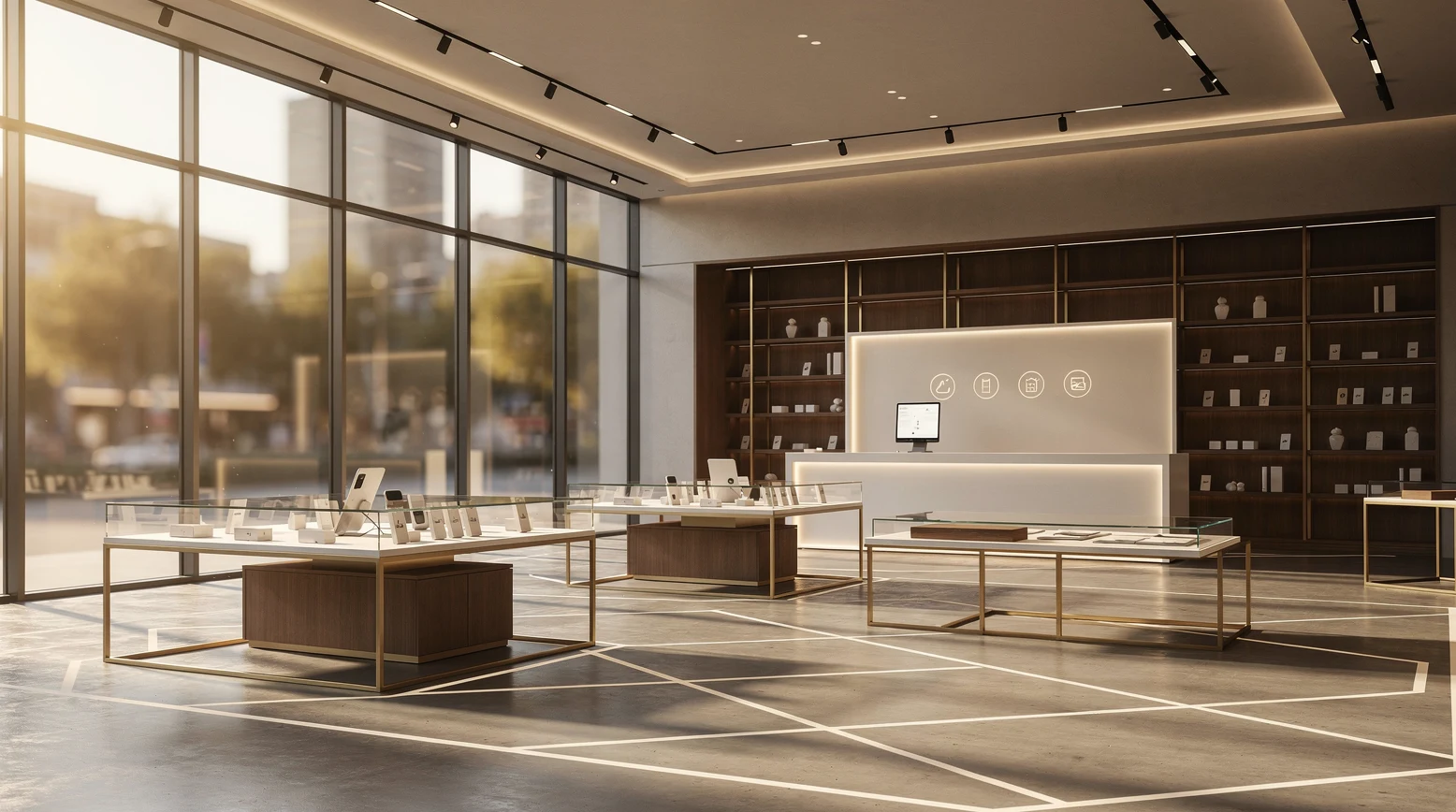
Brick mortar 2026 looks nothing like the obituaries written for it a decade ago. US physical retail is still the largest single channel for consumer spending, but the formats, economics, and operating playbooks have all shifted. The stores that thrive in 2026 act less like warehouses with cashiers and more like sensory billboards, fulfillment nodes, and community anchors rolled together.
In short
- Physical stores still drive roughly 80% of US retail sales, according to US Census Bureau monthly trade data.
- Store formats are bifurcating into experiential flagships and small fulfillment-forward outposts, with the mushy middle disappearing.
- Unit economics now factor in store-fulfilled online orders, BOPIS pickups, and returns processing, not just walk-in basket sizes.
- Staffing models reward associates who can sell, fulfill, and create content, not just ring a register.
- Brick mortar 2026 is not a survival story, it is a reinvention story with a clear playbook for retailers willing to stop treating stores like cost centers.
Why brick mortar 2026 still moves the needle
The headline number that ends most arguments about physical retail is share of wallet. Even after two decades of e-commerce growth, the majority of US consumer goods spending happens inside a building with a roof, lights, and a payment terminal. The Census Bureau pegs e-commerce at roughly 18% of total retail sales in early 2026, which means more than four in every five dollars still cross a physical counter.
That math matters because too many strategy decks treat stores like a legacy line item. Inside our state of retail pillar, we lay out why the channel mix in 2026 is best understood as digital wrapped around a physical core, not the other way around. Stores are where brand discovery, trial, and tactile decisions still happen for categories like apparel, beauty, grocery, home goods, and durables.
What changed is that the store no longer has to do the whole job alone. A 2026 location can capture a sale that finishes on a phone three days later, fulfill an order placed at 11 p.m. the night before, and serve as a return desk for a marketplace seller in another state. The right way to read brick mortar 2026 is as a multi-purpose physical node, not a single-purpose sales floor.
There is also a generational story playing out under the headline numbers. Gen Z, the cohort everyone assumed would skip physical retail entirely, turns out to be the most enthusiastic in-store shopper in two decades. ICSC and McKinsey surveys from 2025 both showed Gen Z visiting physical stores more often per month than millennials, with a particular pull toward beauty, apparel, and food retail concepts that lean into the social and sensory side of shopping. That demand floor is one reason brick mortar 2026 looks healthier than the 2020 forecasts suggested.
What actually changed since the pandemic
Three big shifts separate the 2026 store from the 2019 store. First, online and offline finally merged at the operating level. Inventory visibility, customer identity, and promotions now share a single backbone in most chains over $500 million in revenue.
Second, fulfillment moved into the store. Buy online, pick up in store (BOPIS), ship from store, curbside, and same-day delivery are no longer pilots. They are line items on the P&L and have their own labor models, software, and KPIs. Target, Walmart, Best Buy, and DICK’S all credit store-based fulfillment for protecting margins during the 2022 to 2024 freight inflation cycle.
Third, the role of an associate changed. Selling is still core, but the highest-performing stores now expect associates to fulfill digital orders, shoot short-form video, run loyalty sign-ups, and host community events. We cover this shift in detail in our guide to staffing brick and mortar retail in a tight labor market, including how compensation and scheduling have evolved.
The fourth shift, less talked about but just as consequential, is the change in lease economics. Many landlords who survived 2020 to 2023 came out with leaner cost structures and more flexibility on terms. Percentage rent, shorter durations, and shared media or services packages are now common in deals that would have been take-it-or-leave-it five years ago. Retailers with disciplined real estate teams have used this window to upgrade locations and trim unprofitable leases at the same time, which has quietly improved the average store quality across most national chains.
The fifth shift is regulatory and tax. State-level laws on organized retail crime, return fraud, and minimum wages have all changed the cost model for operating physical stores in the US, in ways that vary sharply by state. A 2026 multi-state operator without a real-time view of these jurisdictional differences is leaving money on the table, both in compliance penalties avoided and in pricing or labor decisions that match local realities.
How the new store formats are bifurcating
Walk down any high-traffic US shopping street in 2026 and the format split is visible. On one end sit experiential flagships from brands like Nike, Apple, Glossier, and Lululemon, often 8,000 to 25,000 square feet, designed for dwell time, content creation, and category storytelling. On the other end sit small-footprint outposts of 1,500 to 4,000 square feet, optimized for pickup, returns, and quick replenishment trips.
The middle tier, the 30,000 square foot specialty box that defined the 2000s mall, is the format under the most pressure. Bed Bath & Beyond, Tuesday Morning, and Express all closed hundreds of these footprints between 2023 and 2025. The survivors in that size range, like Best Buy and Macy’s, are aggressively shrinking selling space and converting square footage to fulfillment, services, or third-party concessions.
| Format | Typical size | Primary job | Key KPI |
|---|---|---|---|
| Experiential flagship | 8,000 to 25,000 sq ft | Brand discovery, content, community | Dwell time, social mentions, new customer rate |
| Standard mall or strip box | 3,000 to 8,000 sq ft | Sales plus light fulfillment | Sales per square foot, conversion |
| Small-format outpost | 1,500 to 4,000 sq ft | Pickup, returns, replenishment | Orders fulfilled per hour, pickup window adherence |
| Dark store or micro fulfillment | 5,000 to 15,000 sq ft | Online order fulfillment only | Cost per order, on-time rate |
| Pop-up or shop-in-shop | 300 to 2,000 sq ft | Test, launch, seasonal | Sell-through, new customer rate |
The new unit economics of a 2026 store
The math behind a store opening or closing decision is no longer a clean comparison of in-store sales to occupancy plus labor. Modern P&Ls allocate value to stores for digital orders fulfilled, returns processed for the broader network, loyalty enrollments captured, and brand impressions delivered. A store that looks unprofitable on walk-in sales alone can be a high-value node once those contributions are credited.
Target gives the cleanest public version of this math. The company reports that more than 95% of total sales are fulfilled by stores in some way, whether the shopper walked in, picked up an online order, or had a same-day delivery driver shop the aisles. That single statistic reframes the whole real estate portfolio as a fulfillment grid, not a chain of retail outlets.
The catch is that not every retailer has the systems to allocate this value correctly. Many still book the digital sale to the e-commerce channel and charge the store with the labor cost of fulfilling it. That accounting choice quietly makes stores look unprofitable and pushes leadership toward closures that destroy network value. Fixing the allocation model is now table stakes for any chain with meaningful BOPIS volume.
Another underappreciated economic shift is the role of stores in returns. E-commerce returns now run 20% to 30% across most apparel and home categories, and processing those returns through stores is meaningfully cheaper than reverse logistics through a central facility. Stores recapture margin by reselling returned product on the floor, often within hours, and they pull return customers back into a browsing environment where average attach rates run two to three times the original ticket. Read carefully, returns are no longer a pure cost line, they are an acquisition channel hiding in the back of the store.
Capital allocation logic has shifted with the math. In the 2010s, the comp-sales question dominated boardroom debates about whether to invest more in stores. In 2026, the dominant question is network coverage: where do we need a physical node within 30 minutes of a customer to deliver same-day, accept returns, and protect the brand? That question rewards opening stores in markets where the conventional sales-per-square-foot test would say no, and it punishes leaving white space in dense delivery zones to competitors who do open.
How merchandising and visuals adapted
Store layouts in 2026 are designed around three jobs at once: walk-in browsing, fast pickup, and content capture. The front of the store leads with hero product moments that photograph well on a phone, the middle holds the editorial story of the season, and the back combines clearance with the pickup counter to pull online customers past full-price merchandise.
The visual language has tightened. Fewer SKUs on the floor, larger gaps between fixtures, and bolder graphics are the norm. Our guide to visual merchandising rules that still work in every store walks through the specific tactics, from sight-line management to color-blocking, that consistently lift conversion in 2026 conditions.
Lighting and sound get more budget than they did five years ago. Brands like Aesop, Lush, and Warby Parker treat the sensory layer as a primary investment, not a finishing touch. The reason is straightforward: if the store has to justify a trip in a same-day delivery world, the in-store experience must offer something a phone screen cannot.
Signage has gone quieter and bolder at the same time. Walls of price tickets and starburst promotional signs have given way to a few large statements per zone, with the digital ticket layer doing the granular price work via electronic shelf labels. Electronic shelf labels also unlock dynamic pricing, BOPIS pickup messaging, and quick recall handling, all of which save labor hours that used to be spent reprinting and replacing paper tickets.
Music, scent, and even temperature are part of the merchandising plan in 2026, not afterthoughts. Beauty and athleisure retailers in particular have learned that a consistent sensory signature increases dwell time, basket size, and the likelihood that a customer recognizes the brand on a phone screen later. The discipline is closer to hospitality operations than to traditional retail, which is why several rising chains have hired hotel or restaurant veterans into store experience leadership roles.
Common mistakes retailers still make with stores
- Treating every store like the same store. A flagship on Fifth Avenue and an outpost in a suburban strip center should not share the same assortment, labor model, or KPIs. The cleanest 2026 operators run three to five distinct store playbooks under one brand.
- Underfunding store technology. Mobile POS, RFID inventory, and clienteling tools pay back in months, not years, but get cut first in capex squeezes. Stores running 2018-era hardware in 2026 cannot deliver the omnichannel experience customers expect.
- Ignoring the labor model shift. Hiring for cashiering when the job is selling, fulfilling, and content-making is a recipe for high turnover and weak conversion. The job description, training, and pay band all need to match the actual work.
- Letting the digital and store teams compete. When the e-commerce P&L and the store P&L fight over who gets credit for a sale, the customer experience suffers. A single unified P&L by customer or by trade area solves this.
- Closing stores on walk-in data alone. A store that looks weak on in-person sales may be the fulfillment hub for a high-density delivery zone. Always model the network effect before pulling a footprint.
Examples from US retail in 2026
Target has become the reference case for the integrated model. Same-day services (Drive Up, Order Pickup, and Shipt) accounted for more than $11 billion in sales in fiscal 2025, and the company credits stores for nearly all of that volume. The implication is that closing stores would directly damage the digital business, which is the opposite of the conventional wisdom from 2018.
Best Buy took the harder path of shrinking the box. The chain reduced average selling space per store by roughly 20% between 2023 and 2025, converted the reclaimed footage to fulfillment and Geek Squad services, and exited about 50 underperforming locations. Comparable sales held up despite the smaller footprint, validating the bet that depth of service can offset breadth of inventory.
On the other end of the spectrum, Glossier opened a network of small experiential stores in cities like New York, Los Angeles, Atlanta, and Seattle that look more like art installations than shops. Each location is a content engine first, with sales as a downstream effect. The model would not pencil out on traditional sales-per-square-foot math, but it consistently outperforms paid digital acquisition for new customer cost.
Walmart and Costco occupy a third, much larger lane. Both are growing their physical footprints in 2026, betting that scale, low prices, and trip frequency still compound into a defensible moat. Walmart in particular has used its 4,600-plus US locations as the operating advantage that lets it compete with Amazon on same-day delivery, while pulling members into Walmart+ for the digital tail. Costco has done the same with paid membership and a curated assortment, proving that a 150,000 square foot warehouse is still a winning format when the value proposition is sharp.
Independent and regional retailers are quietly outperforming many of the national headlines as well. Strong city-level grocers like H-E-B in Texas, Wegmans in the Northeast, and Publix in the Southeast keep posting comparable sales growth that outpaces the national chains, in part because they tune assortments and store labor models to the trade area rather than rolling out a single corporate template. The lesson for any operator is that proximity to the customer, both physical and operational, still beats theoretical scale in many categories.
For deeper context on how analysts track these shifts, our reference guide to retail industry data sources analysts actually trust covers the public and private datasets that inform credible store-level analysis in 2026.
Tools, partners, and vendors worth knowing
The technology stack behind a 2026 store is no longer a single POS plus a back-office PC. The serious operators run a layered stack with a clear owner for each layer. Inventory visibility from Manhattan Associates, Aptos, or NewStore underpins everything, because no other system works without trustworthy stock data.
Clienteling and one-to-one outreach tools like Endear, Tulip, and BSPK turn store associates into remote sellers who can transact across channels. Fulfillment orchestration from Fluent Commerce, Kibo, or in-house systems decides which node ships which order. Workforce management from Legion, Workday, or UKG matches staffing to forecasted demand by hour and by task.
For chains under $200 million in revenue, the integrated platforms from Shopify POS, Square for Retail, and Lightspeed cover most of these jobs in one suite. The trade-off is less optimization at the edges, but for many regional operators that is the right call given IT capacity. The state of retail playbook covers the full stack in more depth, and you can find the channel-mix logic inside our state of retail pillar.
Customer data platforms (CDPs) from Twilio Segment, mParticle, and Salesforce Data Cloud sit alongside the operational stack and are increasingly seen as a store technology, not just a marketing tool. The reason is that in-store associates use the unified customer profile in the clienteling app, and store loyalty enrollments push back into the CDP within minutes. When the CDP is broken or out of sync, the store experience visibly degrades, which has elevated the CDP to a tier-one investment for any chain pursuing serious omnichannel work.
Returns and reverse logistics tools deserve a separate mention. Players like Loop Returns, Happy Returns (now part of UPS), and Optoro have built infrastructure that lets a customer drop a return at a third-party location, get an instant refund or store credit, and have the item routed back to whichever node has the best disposition economics. For retailers without their own dense store network, plugging into these partners is a way to capture the return-as-acquisition benefit without owning the physical footprint.
What to do in the next 90 days
If you operate stores in 2026 and you have not done these five things, start this quarter. They are the minimum bar to compete, not a stretch agenda.
- Audit your store P&L allocation and confirm that digital orders fulfilled by the store are credited to that store.
- Map every store by primary job (flagship, standard, outpost, dark, pop-up) and rebuild the assortment plan accordingly.
- Re-spec the associate role to include digital fulfillment, clienteling, and content capture, then update pay bands to match.
- Install or upgrade inventory visibility so every channel sees the same number for every SKU in every location.
- Model network value before any closure, including delivery coverage, return volume, and brand reach in the trade area.
FAQ
Is brick and mortar retail actually growing in 2026?
In absolute dollar terms, yes. US in-store retail sales hit a record high in 2025 and grew again in early 2026, even as e-commerce continued to take share. The share decline is real, but the underlying dollar volume is still expanding with the economy.
What store size is winning right now?
The two ends of the size spectrum are outperforming the middle. Small fulfillment-forward outposts of 1,500 to 4,000 square feet and experiential flagships of 8,000 to 25,000 square feet are both showing strong returns. The 30,000 square foot specialty box format is the one shrinking fastest.
How important is BOPIS to store economics in 2026?
For most chains over $200 million in revenue, BOPIS now drives 15% to 35% of total store labor hours and a meaningful share of network profitability. Retailers that route pickups, returns, and same-day delivery through stores tend to show stronger same-store sales than those that run separate fulfillment centers.
Are mall stores dead in 2026?
Class A malls in dense, affluent trade areas are thriving and command record rents. Class B and C malls continue to lose anchors and convert to mixed-use redevelopment. The story is location-specific, not a blanket mall verdict.
How do I justify a new store opening in 2026?
Build the case on three layers: direct in-store sales, digital sales lift in the trade area after opening, and network value (fulfillment, returns, brand exposure). Most credible 2026 store models include a 12 to 18 month digital halo assumption, supported by data from comparable openings.
What is the biggest store-level investment with the fastest payback?
Inventory accuracy. Whether through RFID, cycle counts, or a combination, getting stock accuracy above 95% pays back faster than almost any other store investment because it directly improves BOPIS reliability, ship-from-store economics, and lost-sale rates.
Where can I track US retail performance data reliably?
The US Census Bureau publishes monthly retail trade data, the National Retail Federation aggregates industry forecasts, and earnings reports from public retailers give granular store-level color. Our retail data sources guide collects the full list with notes on what each source is good for.
The forward view: what 2027 and beyond likely look like
Three forces will shape brick mortar 2026 into 2027 and beyond. The first is AI inside the store, both customer-facing through smart mirrors and assistants, and operator-facing through demand forecasting, planogram automation, and shrink detection. Early deployments at Walmart, Sephora, and Decathlon suggest meaningful labor productivity gains, but only when paired with clean inventory data and a willingness to retrain associates rather than just install tools.
The second force is the maturation of retail media networks. The largest US retailers now monetize their store traffic through digital signage, sampling programs, and shopper marketing partnerships in ways that were marginal in 2020. Retail media inside physical stores is on track to become a billion-dollar line for several national chains by 2027, and that revenue flows almost entirely to operating income because the incremental cost is low. This shifts the store P&L from a pure cost-of-revenue calculation to something closer to a media platform with retail attached.
The third force is sustainability and circularity. Resale, rental, and repair programs are quietly moving from niche pilots into mainstream store operations. Brands like Patagonia, REI, and Levi’s have proven that secondhand and repair counters drive traffic, lengthen customer relationships, and meet rising regulatory pressure around extended producer responsibility. By 2027, expect a circularity desk inside more flagship and standard-format stores, not as a marketing gesture but as a real revenue contributor.
The bottom line on brick mortar 2026 is that the physical store is not the channel under threat, the lazy version of the physical store is. Operators who treat stores as living, multi-purpose nodes inside an integrated network will keep winning share. The ones who treat them as static cost centers will keep closing them and wondering why the digital business stops growing. For the long-form context on where the channel mix is headed across the wider US retail market, the state of retail pillar remains the best place to start.