
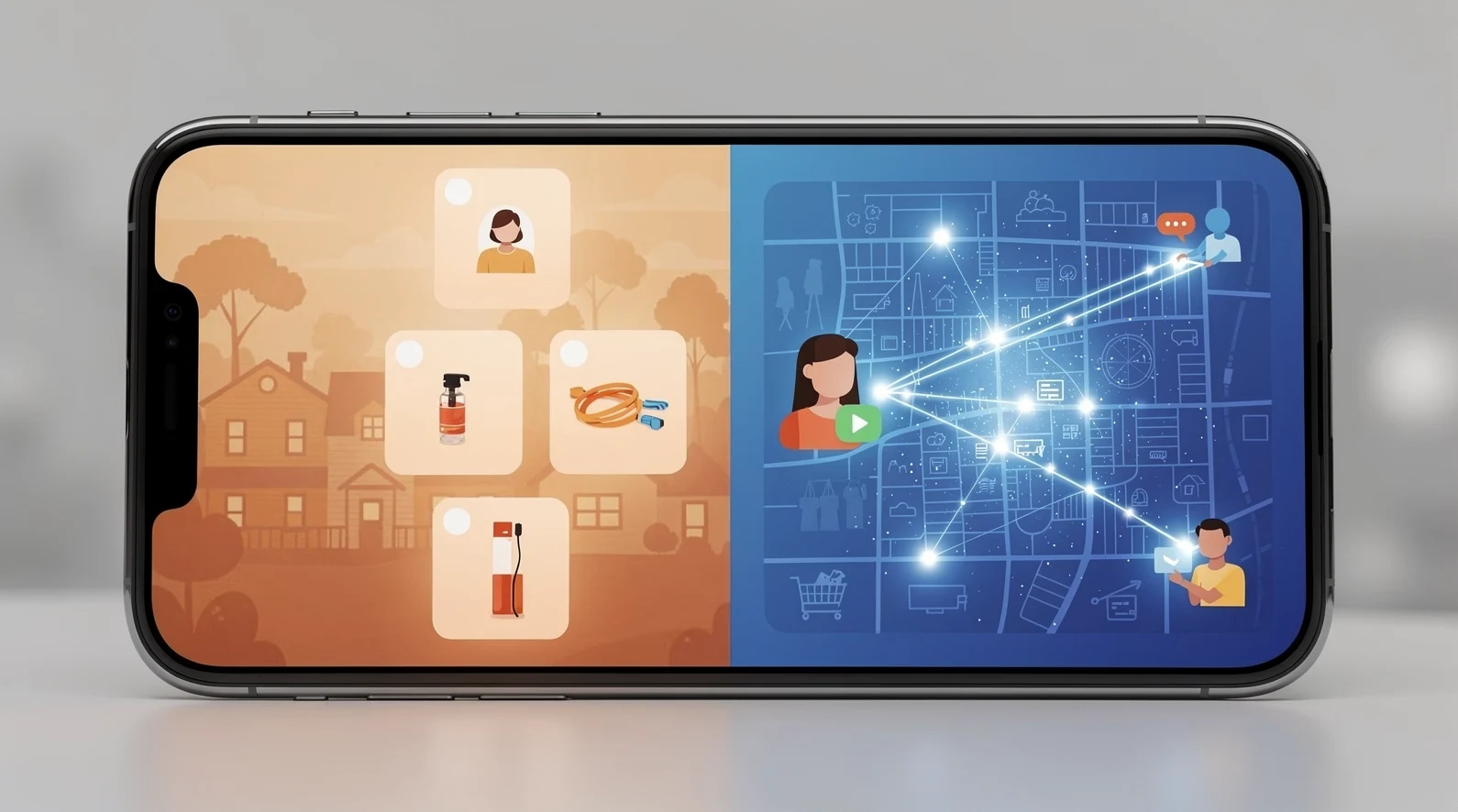
Nextdoor and Facebook Marketplace dominate hyperlocal selling in the United States, but they reward very different sellers. Nextdoor leans on verified neighborhoods and slower, trust-driven conversations. Facebook Marketplace pulls a larger crowd, faster turnover, and a wider product mix. For Main Street shops, side-hustle resellers, and small e-commerce teams, the choice is rarely about which platform is “better.” It is about which one matches your inventory, your margins, and the patience of your customers.
In short
- Audience reach: Facebook Marketplace serves a vastly larger US user base, while Nextdoor reaches roughly one in three US households inside verified neighborhood feeds.
- Trust signals: Nextdoor requires address verification, which lifts buyer confidence on higher-ticket items. Facebook offers profile history and ratings but allows looser identity checks.
- Best inventory fit: Furniture, baby gear, garden, and services skew to Nextdoor. Electronics, fashion, and impulse buys still favor Facebook Marketplace.
- Conversion speed: Facebook listings move faster on average; Nextdoor produces fewer but warmer leads with lower no-show rates.
- Right answer: Most local sellers should run both, with different photography, pricing tiers, and reply scripts on each. This guide explains how, and where each platform breaks down.
This article sits inside the Local Retail cluster on ShopAppy. If you want the wider strategic picture first, read the future of local retail and main street commerce, then come back for the platform-by-platform breakdown below.
Why nextdoor vs facebook marketplace matters in 2026
Hyperlocal commerce in 2026 is no longer a side channel. Independent retailers, neighborhood resellers, and even franchise operators now treat Nextdoor and Facebook Marketplace as a primary sales funnel for excess stock, returns, and slow movers. Both platforms removed most listing fees for peer-to-peer sales years ago, and both have invested heavily in messaging, pickup logistics, and seller verification. The competitive distance between them has shrunk on features, and widened on culture.
Facebook Marketplace, owned by Meta, claims more than a billion monthly users globally and serves as the default classifieds layer for younger US shoppers. Nextdoor’s audience is smaller in absolute terms but extraordinarily concentrated: every user is tied to a physical address, which produces a different commercial atmosphere. That difference shapes everything that follows, from how you price an item to how aggressively you can promote a small storefront.
If you sell physical goods locally, the practical question is no longer “should I list?” It is “how do I split my catalog, my photography, and my response time between the two platforms without burning out?” The rest of this guide is built around that question.
Key terms and definitions
Before comparing the two, a quick vocabulary refresh helps. Local commerce on social platforms uses overlapping but non-identical terms, and that is where many sellers get tripped up.
- Nextdoor for Business / Nextdoor for Sale: Two distinct features. “For Sale & Free” is the peer listing feed. “Nextdoor for Business” is the claimed-page product for shops and service providers.
- Facebook Marketplace: The classifieds tab inside the Facebook app and web product. It is separate from Facebook Shops, which is a Meta storefront tied to a Business Page and often connected to Instagram Shopping.
- Verified neighborhood: A Nextdoor-specific construct. Users are mapped to a polygon based on a verified mailing address, and most listings only reach a defined radius of nearby neighborhoods.
- Local pickup vs shipping: Facebook Marketplace supports both. Nextdoor For Sale is almost entirely pickup-only by design.
- Boost / promote: Facebook lets sellers pay to promote a listing across Marketplace and the main feed. Nextdoor has limited paid promotion for peer listings and instead pushes paid reach through Business pages.
The takeaway is that “selling on Nextdoor” and “selling on Facebook Marketplace” sit inside very different product stacks. Treat them as two distinct sales channels with their own merchandising rules, not as twin classifieds boards.
How nextdoor vs facebook marketplace works in practice
The day-to-day workflow tells you more than the marketing pages. On Facebook Marketplace, a typical seller snaps three to five photos, sets a price, picks a category, and pushes the listing live in under two minutes. The listing appears in nearby buyers’ feeds based on Meta’s interest graph and recent searches. Most replies arrive through Messenger within hours, and meetups happen quickly, often the same day. Cash, Venmo, and Cash App still dominate for pickup, while shipped listings can use Marketplace Checkout where available.
On Nextdoor, the rhythm is slower. Listings appear in the For Sale feed of verified neighbors inside a configurable radius. Replies arrive through Nextdoor’s private messaging, often with full first and last names attached, and the buyer is statistically more likely to follow through. The flip side is reach: a niche item that would draw twenty Messenger inquiries on Facebook within an hour may sit for several days on Nextdoor before the right neighbor sees it.
For shops with a physical address, Nextdoor offers an extra layer through its Business pages, where you can post updates, run neighborhood-targeted campaigns, and accumulate recommendations that act as social proof. Facebook’s equivalent runs through your Business Page and, separately, Facebook Shops. The two are not interchangeable, and many small retailers run all three: a Marketplace listing for clearance, a Facebook Shop for full-price catalog, and a Nextdoor Business page for community trust.
Side-by-side comparison for local sellers
Numbers shift quarter to quarter, but the structural differences are stable. The table below captures what most US sellers will notice in 2026.
| Dimension | Nextdoor For Sale | Facebook Marketplace |
|---|---|---|
| US household reach | Roughly 1 in 3 households in covered neighborhoods | Majority of US adult internet users |
| Identity verification | Address verification required for most users | Profile-based, ratings, no address check |
| Default fulfillment | Local pickup | Local pickup or shipping |
| Average reply quality | Fewer but warmer leads | High volume, more no-shows |
| Best inventory fit | Furniture, kids gear, garden, services | Electronics, fashion, vehicles, household |
| Paid promotion | Limited for peer listings, robust for Business pages | Boost on individual listings, broad ad inventory |
| Time-to-sale (median) | 3 to 7 days | Under 48 hours for popular categories |
| Effective price tolerance | Slightly higher prices accepted | Heavier negotiation pressure |
| Community risk | Public neighbor visibility, light moderation | Pseudonymous chats, scam volume |
Read across the table and a pattern emerges. Nextdoor optimizes for fewer transactions at slightly higher prices with less friction per buyer. Facebook Marketplace optimizes for volume, speed, and broad inventory mix. Your job is to align the channel with the item.
Where each platform wins by inventory type
The single biggest mistake small sellers make is treating both platforms as one undifferentiated classifieds layer. Inventory type predicts outcome more than any clever copywriting trick.
- Large furniture and home goods: Nextdoor wins. Buyers are local, they bring trucks, and they pay the asking price more often.
- Baby gear, strollers, toys: Nextdoor wins on trust. Parents prefer buying from a verified neighbor over a Marketplace handle.
- Electronics and small appliances: Facebook Marketplace wins. The category has scale, comparison shopping is easy, and shipping is supported.
- Fashion and accessories: Facebook Marketplace wins on volume, but Nextdoor outperforms on premium brands sold to local style communities.
- Vehicles and parts: Facebook Marketplace wins. Buyers expect it, and the Marketplace vehicle category is mature.
- Services and labor: Nextdoor wins outright. Lawn care, tutoring, dog walking, and handyman work convert dramatically better on Nextdoor.
- Free items and giveaways: Both work. Nextdoor tends to deliver respectful pickups, Facebook delivers faster claims.
None of this is absolute. A seasoned reseller in Phoenix may move twenty mid-century chairs a month on Facebook through sharp photography and aggressive boosting. A first-time seller in Burlington may move the same chairs faster on Nextdoor because three neighbors share the listing in their own feeds. Local reality always overrides the playbook, which is why testing both is the default recommendation.
Common mistakes and how to avoid them
Most local sellers leak money in the same five places. Knowing them ahead of time saves weeks of frustration.
- Copy-pasting identical listings: Nextdoor neighbors expect a personal tone with neighborhood context. Facebook buyers expect tight, keyword-rich copy. The same paragraph underperforms on both.
- Underpricing on Nextdoor: Sellers anchor to Facebook Marketplace prices and leave money on the table. Nextdoor tolerates 5 to 15 percent higher pricing on furniture, kids gear, and home goods.
- Ignoring time-of-day: Facebook Marketplace traffic peaks midday and again after dinner. Nextdoor traffic peaks at lunchtime and on weekend mornings. Post accordingly.
- Skipping the pickup script: Both platforms attract no-shows. A short script confirming address, time, payment method, and a courtesy reminder ninety minutes before pickup eliminates most of them.
- Forgetting to refresh: Both algorithms decay listings within 48 to 72 hours. A small price drop or photo swap pushes the listing back up the feed without creating a duplicate.
If you only fix one of these, fix the pickup script. The bottleneck on hyperlocal sales is rarely demand. It is the friction of the last hundred yards between buyer and front porch.
Examples from US retail and e-commerce
The clearest pattern in 2024 to 2026 is that local commerce has stopped being a hobby category and started shaping how independent retailers manage inventory. Three examples make the point.
A vintage furniture shop in the Hudson Valley uses Facebook Marketplace for clearance pieces under three hundred dollars, where speed matters more than margin. The same shop reserves restored mid-century items for Nextdoor For Sale, where neighborhood buyers are more willing to pay near the in-store sticker. The store reports that Nextdoor produces fewer leads but higher average order value, and almost no haggling on pieces with a documented restoration story.
A garden center in suburban Atlanta runs its end-of-season plant clearance through Facebook Marketplace, with Boost spending on top categories such as fall mums and ornamental grasses. For its drip irrigation install service, the same business runs a Nextdoor Business page and almost never advertises on Facebook. The split mirrors a broader trend, where physical goods follow Facebook reach and local services follow Nextdoor trust.
A baby gear reseller in Portland deliberately lists strollers and car seats on Nextdoor first, holding back from Facebook for 48 hours. Parents on Nextdoor read the verified-neighbor signal as a safety cue, and the reseller closes 70 percent of stroller listings without ever crossing over to Marketplace. Items that do not sell are then mirrored to Facebook with broader keywords and a small price reduction. For a deeper view of how independent operators stitch together hyperlocal channels, see buy local campaigns that actually shift consumer behavior, which covers the demand-generation layer that sits above platform tactics.
Tools, partners, and vendors worth knowing
Neither platform forces you to use anything beyond their built-in tools, but a few external services materially improve outcomes for sellers moving more than a handful of items per month.
- Photo apps: Lightroom Mobile and the native iOS or Pixel camera in HDR mode produce listing photos that outperform stock smartphone shots, especially on furniture and electronics.
- Listing managers: Tools such as List Perfectly and Vendoo let resellers crosspost from a single template to Facebook Marketplace, eBay, Poshmark, and Mercari. Nextdoor is rarely included, so plan to post there manually.
- Pickup logistics: Roadie and GoShare provide on-demand local delivery for items too big for a sedan, which unlocks a wider buyer pool on furniture and appliances.
- Payments: Venmo and Cash App remain dominant for in-person pickup. PayPal Goods and Services adds buyer and seller protection for shipped Facebook Marketplace orders.
- Trust and safety: Always meet for high-ticket pickups at a public safe-exchange location, often a police-station parking lot. Both platforms link to them inside their safety help pages.
Larger retailers integrating hyperlocal channels into their broader operations should also look at the inventory and storefront stack used by chain operators. The tools and vendors for department stores and chains in 2026 guide covers the upstream systems that make multi-channel local selling sustainable rather than chaotic.
Risk, payments, and trust on each platform
Local marketplaces are statistically safer than tabloid coverage suggests, but the failure modes are real and worth designing against. The risks split by platform.
On Facebook Marketplace, the top complaints involve scam buyers offering to overpay and ship, phishing for verification codes, and last-minute price renegotiations on arrival. The defense is mechanical: never share a verification code, never accept off-platform payment apps you do not control, and price your item with a small buffer so a courteous five-dollar concession still hits your target. Meta has steadily tightened account verification, but the platform’s scale guarantees a long tail of low-effort scams.
On Nextdoor, the bigger risk is reputational. Because your real name, neighborhood, and often street are visible, a botched transaction can show up in a public thread that lingers in search. Sellers who treat every interaction as semi-public, who reply promptly, and who refund without argument on minor disputes accumulate goodwill that compounds. For a deeper breakdown of where local marketplace payments and trust break down first, see local marketplace payments and trust: what fails first, which is a useful companion piece to this comparison.
For background on how US e-commerce volumes are measured against brick-and-mortar baselines, the US Census Bureau quarterly retail e-commerce report remains the authoritative public dataset and a useful sanity check whenever a platform’s own statistics feel inflated.
Regional and demographic differences worth knowing
Hyperlocal commerce is not uniform across the United States. Where you sell shifts the math, and ignoring those differences is the second most common reason a textbook playbook stalls in real life. Coastal urban markets, where Nextdoor adoption among homeowners is well above the national average, tilt the verified-neighbor advantage even higher. In dense Brooklyn and Bay Area neighborhoods, mid-tier furniture and lightly used baby gear can sell on Nextdoor at retail-like prices, while the same item on Facebook Marketplace draws bargain hunters from a 30-mile radius.
Sun Belt and exurban markets show a different pattern. In sprawling metros such as Houston, Phoenix, and Tampa, Facebook Marketplace dominates because the buyer is willing to drive 45 minutes for the right item, which essentially defeats Nextdoor’s hyperlocal premise on most categories. Vehicles, tools, and outdoor gear are particularly Facebook-dominant in these markets. Sellers in smaller Midwestern cities sit somewhere in the middle, often reporting that Nextdoor wins on services and Facebook wins on goods, with little overlap.
Demographics matter as much as geography. Buyers over 45 are disproportionately active on Nextdoor and tend to close on traditional household categories. Buyers under 30 still skew to Facebook Marketplace and increasingly to category-specific apps such as Depop and Poshmark for fashion. None of this should drive you off either platform, but the demographics should shape which items you list where, and which photos you use to lead. A bassinet listed with a soft, lifestyle photo will outperform a clinical product shot on Nextdoor and slightly underperform it on Facebook.
Putting it together: a playbook for 2026
A working setup for a small or mid-size local seller in 2026 looks something like this. Keep the structure light and adjust to your category mix.
- Audit your inventory and tag each item as “speed wins” or “trust wins.” Speed-wins go to Facebook Marketplace first. Trust-wins go to Nextdoor first.
- Build two photo templates. One bright and high-contrast for Facebook, one warmer and contextual (in your living room, not on a white sweep) for Nextdoor.
- Write two short copy templates. Facebook copy leads with the keyword. Nextdoor copy leads with a neighborhood reference and a sentence of personality.
- Set a 72-hour rule. If a Nextdoor listing has not produced a serious lead in 72 hours, mirror it to Facebook with a 5 to 10 percent discount. If a Facebook listing stalls, refresh price and photos before crossposting.
- Use one calendar reminder per week to refresh listings, log no-shows, and adjust pricing. Twenty minutes a week is enough for catalogs under fifty items.
- Track average sale price per platform per category for a quarter. Patterns will surprise you, and the data justifies where you invest more time.
The broader context behind these tactics, and how they connect to neighborhood revitalization, BOPIS pickup, and the wider shift back to local spending, is covered in the future of local retail and main street commerce. Read it once a quarter to keep your platform tactics aligned with where local commerce is actually heading.
FAQ
Is Nextdoor better than Facebook Marketplace for selling furniture?
For mid-range and higher-end furniture in 2026, yes. Verified neighbors are more willing to pay close to asking price and follow through on pickup. Use Facebook Marketplace as the second wave for items that do not sell on Nextdoor within 72 hours.
How big is Nextdoor’s audience compared to Facebook Marketplace?
Facebook Marketplace reaches the majority of US adult internet users. Nextdoor reaches roughly one in three US households in covered neighborhoods. Nextdoor’s audience is smaller but address-verified, which changes the quality of every interaction.
Are there listing fees on either platform?
Local pickup listings on both platforms are free for peer sellers. Facebook Marketplace charges fees on shipped sales processed through Marketplace Checkout, and both platforms offer paid promotion for businesses.
Which platform handles scams better?
Nextdoor’s address verification structurally reduces low-effort scams. Facebook Marketplace has more sophisticated automated detection but a far larger attack surface. In practice, sellers report fewer suspicious messages on Nextdoor and more on Facebook.
Can a small retail shop use both platforms at once?
Yes, and most successful local retailers do. A typical setup uses Facebook Marketplace for clearance and high-volume categories, Nextdoor for premium or service-oriented inventory, and a Facebook Shop or Business Page for full-price catalog.
Do paid promotions work on Nextdoor?
Nextdoor offers strong paid reach for claimed Business pages but limited paid promotion for peer listings. Facebook Marketplace allows direct Boost spend on individual listings, which is one of its most underused features for resellers.
What is the safest way to take payment at pickup?
Cash remains the simplest. Venmo and Cash App are widely accepted but require confirming the payment lands before handing over the item. Avoid Zelle for buyers you do not know, since reversals are difficult to dispute.
Should I list shipping on Facebook Marketplace?
For small, valuable items such as electronics, collectibles, or fashion, yes. Marketplace Checkout adds buyer protection and broadens your reach beyond local. For anything bulky or heavy, stick to local pickup and let Roadie or GoShare bridge longer distances if needed.