
In short
- Profit beat: Inditex, the owner of Zara, reported first-quarter net profit of EUR 1.37 billion, up 5.4% year on year, on net sales of EUR 8.75 billion (about USD 10.15 billion at a EUR/USD rate near 1.16).
- Margin surprise: Gross margin widened 67 basis points to 61.2%, more than double the improvement analysts had pencilled in, the single figure that drove the share reaction.
- Hot summer start: Store and online sales rose 11.5% in constant currency between 1 May and 1 June, a pace well above the headline quarter and the clearest signal in the release.
- Shares higher: The stock rose around 5% as the company beat consensus on sales, margin and the early second-quarter trading update.
- Strategy intact: Management leaned on in-season proximity sourcing, a smaller but larger store estate, and rising technology spend, while reporting little disruption so far from Middle East tensions.
What Inditex reported
Inditex, the Spanish group behind Zara, Pull&Bear, Massimo Dutti, Bershka, Stradivarius, Oysho and the value banner Lefties, published results for the first quarter of its 2026 financial year on 4 June. The quarter covers the three months to 30 April 2026.
Net sales rose 5.8% to EUR 8.75 billion, edging past a sell-side consensus of about EUR 8.72 billion. On a constant-currency basis, which strips out the effect of a weaker basket of trading currencies, sales grew 8.8%, ahead of a consensus near 8.3%.
Net profit climbed 5.4% to EUR 1.37 billion. Earnings before interest and tax, which the company reports as net operating profit, advanced 7% to EUR 1.75 billion. Profit before tax rose 5.5% to EUR 1.76 billion, holding the pre-tax margin at a high 20.1%.
The headline numbers matter for one reason above the others. Inditex is the largest listed apparel retailer in the world, so its quarter is read as a proxy for global discretionary fashion demand. A clean beat across sales, margin and early second-quarter trading set a confident tone for the sector.
| Metric (Q1 FY2026) | Result | Change year on year | Versus consensus |
|---|---|---|---|
| Net sales | EUR 8.75bn | +5.8% (reported) | Beat (cons. EUR 8.72bn) |
| Net sales, constant currency | n/a | +8.8% | Beat (cons. +8.3%) |
| Gross profit | EUR 5.35bn | +6.9% | Beat |
| Gross margin | 61.2% | +67 bps | Beat (cons. +25 bps) |
| EBITDA | EUR 2.56bn | +7.3% | In line to ahead |
| Net operating profit (EBIT) | EUR 1.75bn | +7.0% | Ahead |
| Profit before tax | EUR 1.76bn | +5.5% | Ahead |
| Net profit | EUR 1.37bn | +5.4% | Ahead |
All figures are as reported by the company. Constant-currency growth is shown where Inditex disclosed it, because the gap between the reported 5.8% and the underlying 8.8% is itself part of the story.
How to read an Inditex quarter
Inditex runs a financial year that ends on 31 January, so its first quarter covers February to April. That timing makes the period a read on the spring transition, when retailers swap winter ranges for spring and summer collections and discover whether new product is landing with shoppers.
Three things move the share price on results day. The first is reported sales growth, the simplest measure. The second is constant-currency growth, which removes exchange-rate distortion and is the truer gauge of underlying demand. The third, and often the most important, is the trading update for the opening weeks of the next quarter, because it is the freshest data the company discloses.
Margin sits alongside those three as the profitability check. Investors want to know not just that Inditex sold more, but that it sold at full price. This quarter delivered on all four measures, which is why the reaction was positive even though headline sales growth of 5.8% was, on its own, unremarkable.
Why constant currency keeps coming up
Inditex earns sales in dozens of currencies but reports in euros. When the euro strengthens, each unit of foreign sales converts into fewer euros, dragging down reported growth even if local demand is strong. Constant-currency figures hold exchange rates flat to isolate volume and price. The 3 percentage point gap between 8.8% constant-currency growth and 5.8% reported growth this quarter is entirely that translation effect, not a demand shortfall.
Why the gross margin beat matters most
The number that moved the stock was not sales. It was the gross margin. At 61.2%, the gross margin improved 67 basis points on the same quarter last year, against a consensus that had looked for roughly a 25 basis point gain to about 60.8%.
Gross margin is the share of each sale left after the cost of goods. For a fashion retailer it is the cleanest read on pricing power, markdown discipline and sourcing efficiency. A beat here suggests Inditex sold more of its spring range at full price and discounted less than the market feared.
That is significant in a year when many Western retailers have warned about promotional pressure. According to a research note from Deutsche Bank, the quarter represented a “solid start” to the year, with the margin line doing more work than the top line.
What the company guided for the full year
Inditex reiterated that it expects the full-year gross margin to be broadly stable, within a band of plus or minus 50 basis points. A flat-margin guide after a 67 basis point first-quarter gain implies the company is not banking on the same pace of improvement through the rest of the year, a conservative framing it has used before.
Capital expenditure is guided at about EUR 2.3 billion for the year, directed at commercial space, logistics and technology. The group is targeting gross space growth of roughly 5% in 2026, a figure that captures store openings, enlargements and relocations rather than a simple count of new doors.
How the summer start changed the story
The most forward-looking line in any Inditex release is the trading update for the start of the following quarter. This time it was unusually strong. Store and online sales rose 11.5% in constant currency between 1 May and 1 June, comfortably above the 8.8% underlying pace of the first quarter.
That acceleration is what analysts seized on. A first quarter is a record of the past; the trading update is the company telling investors how the current weeks are going. An 11.5% start to the spring and summer season points to healthy early demand for the new collections.
Inditex attributed the momentum to strong reception for its spring and summer ranges and to favourable calendar effects, including the timing of holidays. The company cautioned, as it always does, that early-quarter trends are not a forecast for the full period.
Why this matters for omnichannel demand
The 11.5% figure combines physical and online sales rather than splitting them, which is deliberate. Inditex runs an integrated model in which a single inventory pool serves both the shop floor and the website, and it increasingly judges performance at the level of the customer rather than the channel.
That integration is the backbone of its fulfilment economics, and it is one reason the group has resisted the heavy discounting that pure-play rivals often use to clear stock. For context on how fulfilment speed is reshaping the wider market, see our analysis of why the US 30-minute delivery race is intensifying through the 2026 holiday season.
Inside the store optimisation strategy
Inditex ended the quarter with 5,456 stores. The headline number understates the activity beneath it, because the group is running a continuous programme of openings, closures, enlargements and relocations across 44 markets at once.
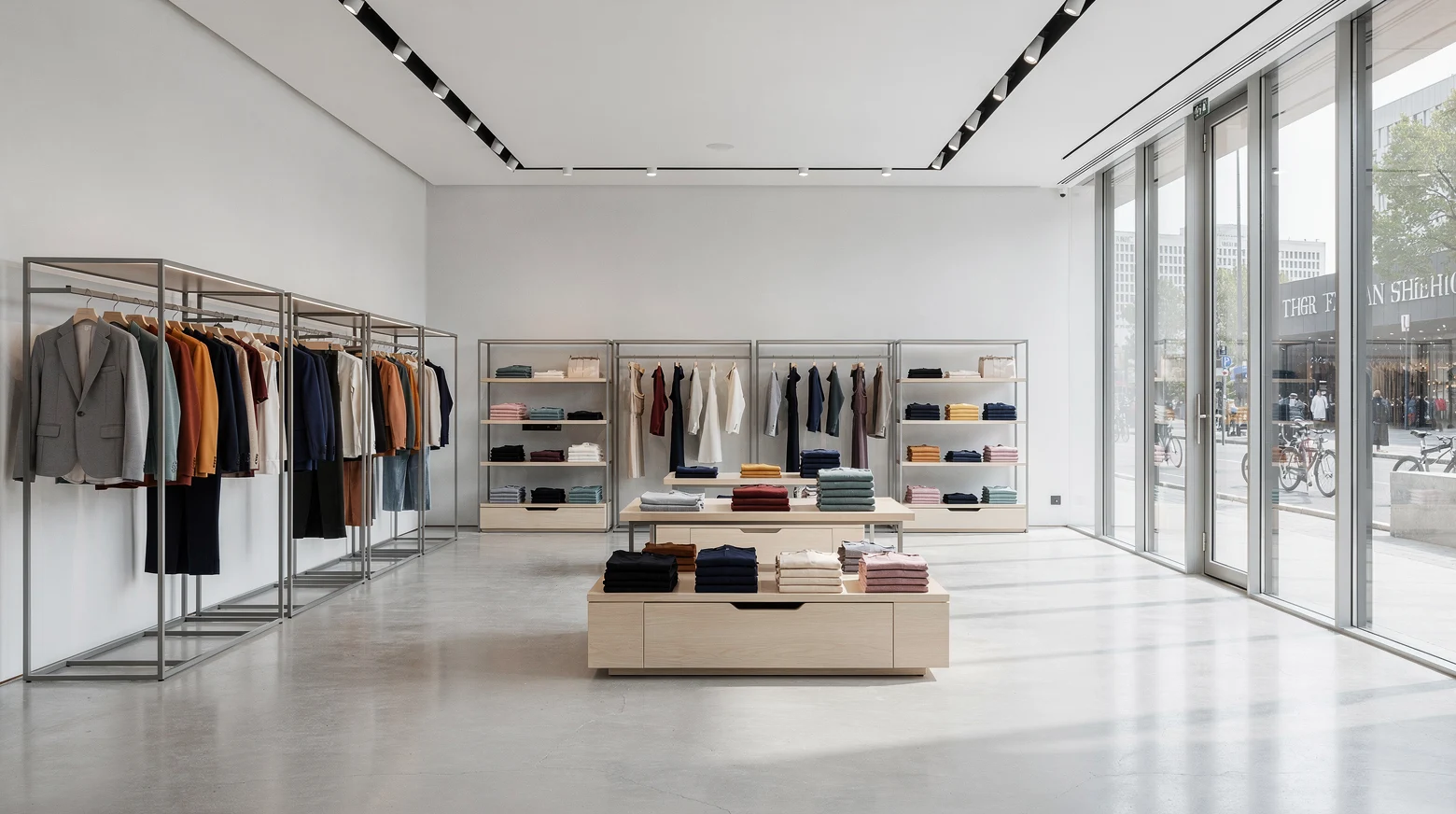
The strategy is often summarised as fewer but bigger stores. Inditex closes small, older units and concentrates selling space in larger, better-located flagships that can hold the full range and double as fulfilment nodes for online orders.
In-season proximity sourcing
The competitive core of the model is speed. Inditex sources a large share of its products from suppliers close to its Spanish logistics hubs, in markets such as Spain, Portugal, Morocco and Turkey, rather than relying solely on long lead-time Asian production.
That proximity lets the company react to fashion trends within weeks rather than months. In its statement, the company said: “The flexibility and responsiveness of our business in conjunction with in-season proximity sourcing allows a rapid reaction to fashion trends and reinforces our unique market position.”
Technology, AI and inventory
A growing share of capital spending is going into technology. Inditex has invested in integrated stock management, radio-frequency identification tagging and, more recently, artificial intelligence tools to forecast demand and allocate inventory across stores and warehouses.
Management framed AI and supply-chain technology as one of the levers that offset currency headwinds during the quarter. The point is not novelty for its own sake; it is that better demand prediction reduces markdowns, which feeds straight back into the gross margin that investors rewarded.
Where new space is opening
Recent openings illustrate the value-led tilt of the estate. The group opened a third UK store for its discount banner Lefties at the Gateshead Metrocentre, and added Stradivarius and Pull&Bear units at Sheffield’s Meadowhall shopping centre. The UK push for Lefties signals an attempt to capture value-conscious shoppers without diluting the core Zara brand.
The currency and geopolitical backdrop
The gap between reported sales growth of 5.8% and constant-currency growth of 8.8% is almost entirely a currency story. A stronger euro against several trading currencies translated foreign sales back into fewer euros, shaving roughly three percentage points off the headline rate.
Currency is a translation effect rather than a demand problem, but it still flows through to reported profit, which is why management highlighted technology and sourcing efficiencies as offsets. For a fuller treatment of how exchange-rate swings move retail results, the dynamics sit alongside broader currency and trade pressures shaping cross-border sellers this year.
On geopolitics, the company reported little impact so far from heightened tensions in the Middle East, including the conflict involving Iran that has rattled energy markets and some supply routes. Inditex has limited direct exposure to the most affected markets, and its diversified sourcing base provides some insulation, though management did not rule out future disruption.
How Inditex compares with H&M and Uniqlo
Inditex’s quarter looks stronger still when set against its two closest global rivals. H&M, the Swedish group, has reported softer trading, with recent first-quarter sales slipping around 1% in local currencies as it repositions its assortment and upgrades stores. Japan’s Fast Retailing, the owner of Uniqlo, continues to grow at a double-digit pace and is gaining share through international expansion.
The three groups sit at different points on the same map. Inditex leads on absolute size and margin, Fast Retailing leads on growth rate, and H&M is the one fighting hardest to stabilise.
| Group | Lead banner | Home market | Most recent annual revenue | Recent trend |
|---|---|---|---|---|
| Inditex | Zara | Spain | About EUR 39.9bn (FY to Jan 2026) | Mid-single-digit reported growth, margin expansion |
| Fast Retailing | Uniqlo | Japan | About JPY 3.4tn (about USD 22bn) | Double-digit growth, FY2026 guided up about 10% |
| H&M | H&M | Sweden | About USD 21bn | Broadly flat, Q1 local-currency sales down about 1% |
Annual figures are drawn from the most recent reported fiscal years for each company and are not directly comparable because the financial calendars differ. They are shown to frame relative scale rather than to rank a single quarter.
Why the comparison favours Inditex
The structural advantage is the proximity model. Where H&M and many peers commit to large Asian production runs months ahead, Inditex keeps a meaningful share of production close to home and replenishes best-sellers in-season. That reduces the markdown risk that compresses rivals’ margins, which is exactly what the 61.2% gross margin demonstrated.
Online sales add another layer. In its most recent full year, Inditex reported online sales of roughly EUR 10.7 billion, a level few apparel peers match, and one that lets the group treat e-commerce as a profit centre rather than a defensive cost. Because the same inventory serves both channels, the group avoids the duplicate stock and standalone fulfilment overhead that drag on many omnichannel retailers.
The contrast with discount-led Asian platforms is sharpest here. Where ultra-low-price marketplaces compete on headline price and shipping subsidies, Inditex competes on speed-to-trend and full-price sell-through. That positioning has so far insulated it from the price war reshaping the bottom of the market, and the first-quarter margin suggests the strategy is holding.
The Inditex business model explained
Inditex’s results are easier to interpret with the model in view, because almost every number traces back to how the group designs, makes and moves product. The company is vertically integrated to an unusual degree, controlling design, a large slice of manufacturing, logistics and retail in a single loop.
Vertical integration and the design loop
Zara designs in-house and produces in short, frequent batches rather than committing to a full season months ahead. New designs can move from sketch to shop floor in a matter of weeks. The company deliberately under-produces relative to demand, then reorders the items that sell, which trains customers to buy quickly and keeps the range feeling fresh.
That scarcity-by-design approach is the foundation of the margin. Because Inditex does not flood stores with stock it must later discount, it preserves full-price sell-through, and full-price sell-through is what showed up as a 61.2% gross margin in the quarter.
The logistics backbone
Most product flows through centralised distribution centres in Spain, from which the group ships to stores worldwide several times a week. The model is logistics-intensive by design, trading higher freight and handling costs for speed and low markdowns. The continued capital spend, guided at about EUR 2.3 billion for 2026, is in large part about extending that backbone with automation and added capacity.
The single-inventory data loop
Inditex treats store and online stock as one pool, so an online order can be fulfilled from a nearby shop and a shop can pull from a warehouse in real time. Radio-frequency identification tagging tracks individual garments, feeding a data loop that informs both replenishment and design. The artificial intelligence tools management highlighted plug into that loop to sharpen demand forecasts, which is how technology spend turns into margin protection rather than just cost.
What it means for suppliers and the sourcing map
The quarter is also a statement about geography. Inditex’s proximity model concentrates a meaningful share of production in Spain, Portugal, Morocco and Turkey, markets close enough to its Spanish hubs to support in-season reordering. The rest comes from Asia, where lead times are longer and costs are lower.
That balance is increasingly a competitive moat as trade rules tighten. The unwinding of low-value import exemptions in several markets, and rising tariff friction on cross-border parcels, weigh most heavily on rivals that depend on long Asian supply chains and direct-to-consumer shipping. A retailer that can replenish from nearer to home carries less exposure to those shocks.
It also changes the supplier relationship. Proximity sourcing rewards flexible, fast-turnaround factories over the cheapest possible unit cost, and it gives Inditex leverage to demand speed and compliance from a relatively concentrated supplier base. For the sector, the lesson of this quarter is that supply-chain design, not just brand or price, is now a primary driver of margin.
What it signals for the wider retail sector
Inditex is reporting into a first-quarter season that has been mixed but, at the top end, resilient. Several large operators have posted beats, suggesting consumers are still spending on the right product even as sentiment surveys stay cautious.
In the United States, department-store group Macy’s beat first-quarter estimates and raised its outlook, a result we covered in detail in our report on how Macy’s beat Q1 estimates as Bloomingdale’s lifted the 2026 outlook. The read-across is that premium and well-run formats are outperforming the middle of the market.
In fashion specifically, the rental platform Rent the Runway posted a 29% jump in sales in its first results after founder Jenn Hyman’s exit, which we analysed in our piece on the Rent the Runway Q1 beat. Taken together with Inditex’s summer acceleration, the data points to apparel demand holding up better than the gloomier macro narrative implies.
The margin and retail-media read-across
Inditex’s margin strength also speaks to a wider shift in how retailers defend profitability. Where some chains are leaning on retail media and marketplace fees to protect margins, Inditex is doing it through sourcing and inventory control. We examined the media-and-marketplace route in our analysis of why Best Buy’s margin story is shifting to marketplace and ads, a useful contrast with the vertically integrated path Inditex has taken.
Risks and what to watch next
The result was strong, but several risks sit behind the headline numbers, and the company itself flagged the need for caution on early-quarter momentum.
Currency and comparison bases
If the euro stays strong, reported growth will keep lagging constant-currency growth, which can make a healthy operating performance look softer in the headline figures. The second half also laps tougher comparison periods, so the 11.5% start is unlikely to hold for the full quarter.
Consumer sentiment and geopolitics
Discretionary fashion is sensitive to confidence. A sharper slowdown in Europe, or an escalation in Middle East tensions that lifts energy costs and dents sentiment, would test the resilience the company reported. Management has acknowledged the risk while noting limited impact so far.
Regulation and the European backdrop
European retailers face a thickening rulebook on consumer protection, sustainability claims and digital design. We set out the consumer-facing rules to watch in our analysis of why the EU Digital Fairness Act will target retail UX later in 2026. For a vertically integrated, EU-headquartered group like Inditex, compliance is manageable, but it adds cost and complexity across dozens of markets.
What the outlook looks like over the next year
On the strength of this quarter, the near-term path looks supportive. The margin beat, the 11.5% summer start and the flat-margin guide together suggest a company growing earnings steadily rather than chasing volume at the expense of profitability.
The longer-term question is whether Inditex can keep widening margins from an already high base while investing heavily in space and technology. The 2026 capital plan of about EUR 2.3 billion and the 5% space-growth target indicate management is willing to spend to defend its lead, betting that proximity sourcing and integrated retail keep outrunning lower-cost, slower rivals.
There is also a capital-return dimension. Inditex has a long record of returning surplus cash to shareholders through dividends funded by strong free cash flow, and a consistent margin underpins that policy. A quarter that protects profitability while still funding roughly EUR 2.3 billion of investment is, in effect, a quarter that protects the dividend story too.
For investors and the wider sector, the message of the quarter is consistency. In a year of uneven retail results, the world’s largest fashion group delivered a beat on the metric that matters most and pointed to an even faster start to the season ahead.
FAQ
What did Inditex report for the first quarter of its 2026 financial year?
Inditex reported net sales of EUR 8.75 billion, up 5.8% (and up 8.8% in constant currency), with net profit of EUR 1.37 billion, up 5.4%. Gross margin widened 67 basis points to 61.2%, and the company said sales rose 11.5% in the first month of the second quarter.
Why did Inditex shares rise?
The stock rose around 5% because the company beat consensus on three fronts at once: sales, gross margin and the early second-quarter trading update. The 67 basis point margin gain, well above the roughly 25 basis points analysts expected, was the main driver.
What is the 11.5% summer figure?
It is Inditex’s trading update for the start of its second quarter. Combined store and online sales grew 11.5% in constant currency between 1 May and 1 June 2026 compared with the same period a year earlier, signalling strong early demand for the spring and summer collections.
Which brands does Inditex own?
Inditex owns Zara and Zara Home, Pull&Bear, Massimo Dutti, Bershka, Stradivarius, Oysho and the value banner Lefties. Zara is by far the largest contributor to group sales.
Why is the reported sales growth lower than the constant-currency figure?
A stronger euro against several trading currencies reduced the value of foreign sales when translated back into euros. That currency effect cut roughly three percentage points off the headline growth rate, taking constant-currency growth of 8.8% down to a reported 5.8%.
How does Inditex compare with H&M and Uniqlo?
Inditex is the largest of the three by revenue and leads on margin. Fast Retailing, the owner of Uniqlo, is growing fastest, at a double-digit pace, through international expansion. H&M has been the weakest recently, with first-quarter sales down about 1% in local currencies as it repositions.
What is in-season proximity sourcing?
It is Inditex’s practice of sourcing a large share of its products from suppliers close to its Spanish logistics hubs, in markets such as Spain, Portugal, Morocco and Turkey. The short lead times let the company react to trends within weeks and reorder best-sellers during the season, which limits markdowns and protects margins.
Did Middle East tensions affect the results?
The company reported little impact so far from heightened Middle East tensions, including the conflict involving Iran. Inditex has limited direct exposure to the most affected markets and a diversified sourcing base, though management did not rule out future disruption.
What should investors watch next?
Key items are whether the 11.5% summer pace holds as comparison periods toughen, how a strong euro affects reported growth, the trajectory of European consumer sentiment, and progress on the 2026 plans for about 5% space growth and EUR 2.3 billion of capital spending.