
India’s quick commerce sector is still expanding at a pace that would flatter almost any consumer business anywhere in the world, yet the newest data lands with an asterisk. A report from brokerage Equirus, circulated on Tuesday, estimates that the country’s quick commerce market is growing at roughly 40 percent year on year, while the combined dark store network of the three largest platforms, Blinkit, Swiggy Instamart and Zepto, has swelled by close to 48 percent over the past twelve months. Business Standard, which first detailed the note, reported that the trio’s collective store count reached 5,026 sites in May 2026, up from 3,405 a year earlier.
The headline growth number is the kind of figure that has drawn billions of dollars of capital into 10-minute grocery delivery since 2021. The asterisk is the weather. Equirus flagged that June 2026 was one of the driest Junes in more than a century across large parts of India, a demand drag that arrives just as Amazon and Walmart-owned Flipkart pour money into their own rapid-delivery arms. The result is a market that is booming and bracing at the same time.
In short
- Growth intact: India’s quick commerce market is expanding at about 40 percent year on year, according to Equirus, roughly twice the pace of overall digital commerce.
- Dark stores surging: The combined network of Blinkit, Swiggy Instamart and Zepto grew nearly 48 percent to 5,026 stores in May 2026, from 3,405 a year earlier.
- Scale in dollars: Quick commerce is pegged at around Rs 1.08 lakh crore (about USD 12.5 billion at roughly Rs 86 to the dollar) within a digital commerce market of about Rs 8 lakh crore (near USD 93 billion).
- Weather headwind: A record-dry June, with rainfall running about 46 percent below normal in the first three weeks, threatens the summer demand that powers cold drinks, ice cream and staples.
- Big Tech arrives: Amazon Now and Flipkart Minutes are scaling fast, reshaping a fight that was, until recently, a three-way contest among venture-funded specialists.
What the Equirus report actually says
The core of the Equirus note is a snapshot of momentum. Quick commerce, defined loosely as the delivery of groceries and everyday goods within 10 to 30 minutes from neighborhood micro-warehouses, is compounding at about 40 percent a year. That is roughly double the growth rate of India’s broader digital commerce market, which the brokerage sizes at around Rs 8 lakh crore in 2026.
Within that total, quick commerce accounts for about Rs 1.08 lakh crore, or close to USD 12.5 billion when converted at the prevailing rate near Rs 86 to the US dollar. That figure sits comfortably inside the range other research houses have published this year, and it implies quick commerce now represents something on the order of one-eighth of all money spent through India’s digital channels.
Context matters for that number. Even at roughly USD 12.5 billion, quick commerce remains a small slice of India’s total retail economy, which is dominated by the neighborhood stores that serve most households. What excites investors is not the current size but the slope of the curve: a category compounding at 40 percent doubles in scale in a little over two years, and it is concentrated in exactly the affluent urban cohorts that brands most want to reach.
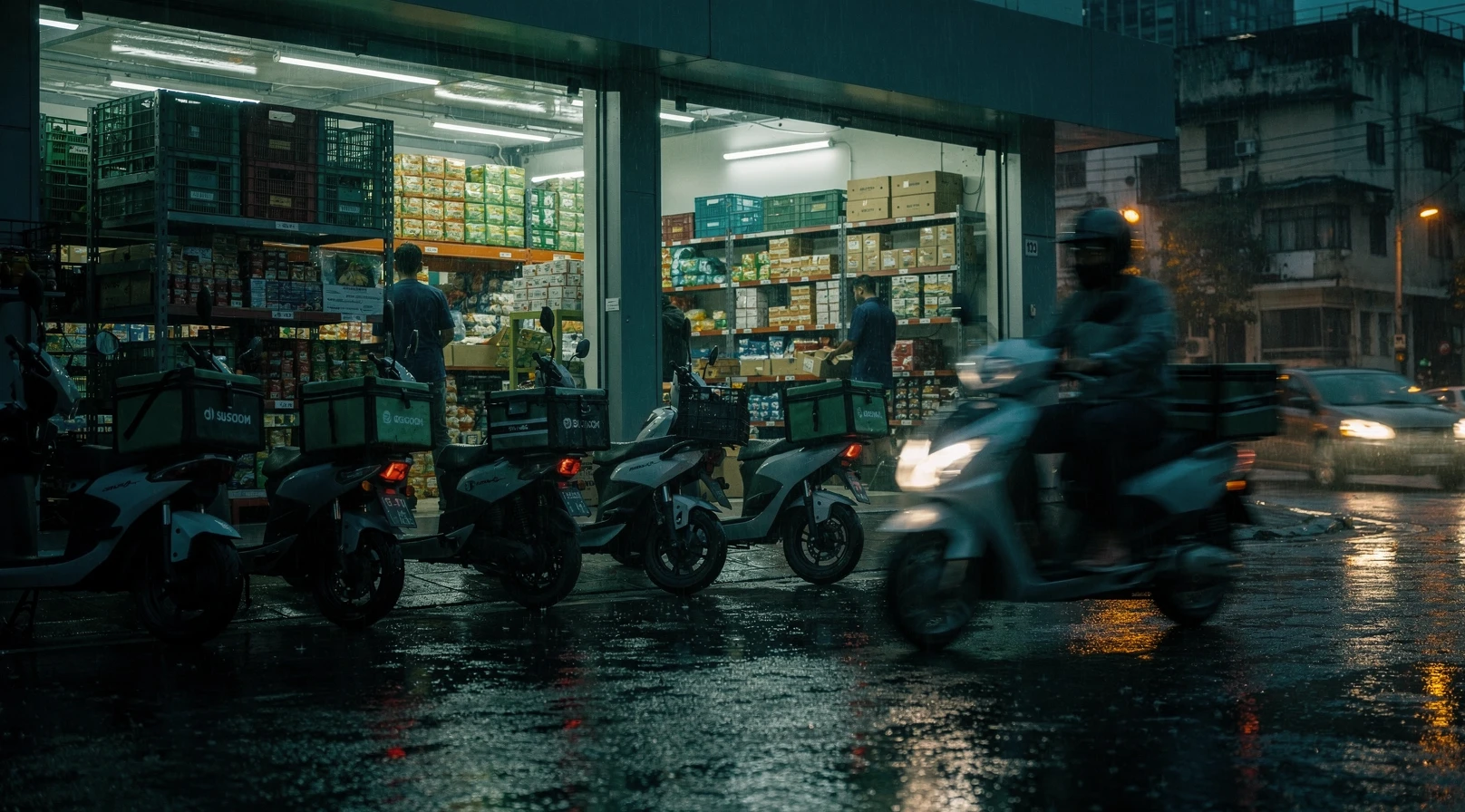
The second pillar of the report is infrastructure. Equirus tracked the physical footprint of the three leading pure-play operators and found the combined dark store count climbing to 5,026 in May, an increase of nearly 48 percent over the year. Dark stores are the small, delivery-only warehouses, often 2,000 to 4,000 square feet, that make sub-15-minute promises possible. The faster that network grows, the more households fall inside a serviceable delivery radius, and the more categories a platform can stock close to the customer.
Why the store count is the number that matters
Order volumes and gross merchandise value get the headlines, but the dark store map is the leading indicator. Each new store extends coverage into a fresh cluster of pin codes, and it also deepens assortment in areas already served. A platform cannot promise a 10-minute bottle of shampoo to a customer who lives outside the delivery radius of any of its warehouses.
That is why the 48 percent expansion is telling. It signals that the category leaders still believe demand justifies more capital expenditure, even after several quarters of investor pressure to show a path to profit. The pace also raises the stakes on utilization: a store that does not generate enough orders per day is a fixed-cost anchor, so the industry is effectively betting that demand will keep pace with the concrete it is pouring.
How the three-way race stacks up
For most of the past three years, India’s quick commerce story was a contest among three venture-backed names. Blinkit, owned by the listed group Eternal (the company formerly known as Zomato), has generally been regarded as the scale and profitability leader. Zepto, still private, has grown aggressively and is preparing a stock market debut. Swiggy Instamart, part of the listed Swiggy, has spent heavily to close the gap.
The table below summarizes where analysts broadly place the three players. The share figures are estimates that vary by source and by whether they are measured on orders or gross merchandise value, so they should be read as directional rather than precise.
| Platform | Parent | Estimated market share | Positioning |
|---|---|---|---|
| Blinkit | Eternal (formerly Zomato) | Roughly 45 to 50 percent | Scale and margin leader, listed parent |
| Swiggy Instamart | Swiggy | Roughly 20 to 25 percent | Heavy investment, listed parent |
| Zepto | Zepto (private) | Roughly 20 to 25 percent | Growth-first, IPO in preparation |
Blinkit’s profit-first playbook
Blinkit has become the reference point for what a maturing quick commerce business can look like. According to company disclosures from its parent, the unit reported small adjusted earnings before interest, taxes, depreciation and amortization in the closing quarters of its most recent fiscal year, a swing that management has framed as evidence the model can pay for itself at scale. The details of that trajectory sit alongside a broader shift in the sector that our earlier analysis described as a move from land grab to margin discipline, a theme explored in our piece on how India’s quick commerce pivots toward margins.
The advantage Blinkit is pressing is a combination of order density, average basket value and network maturity. Stores that have been open longer tend to run at higher utilization, which spreads fixed rent and staffing costs across more orders. That is the flywheel every operator is chasing, and Blinkit has had a head start on it.
Zepto’s growth-and-IPO gamble
Zepto is the pure expression of the growth-first thesis. The company has filed updated draft papers with the Securities and Exchange Board of India and is widely expected to pursue an initial public offering during 2026. Reported financials compiled from its filings point to a top line that has scaled rapidly alongside heavy losses, a profile that public-market investors will scrutinize closely.
Analyst compilations of Zepto’s most recent fiscal year suggest revenue in the region of Rs 22,600 crore (about USD 2.6 billion) against losses reported near Rs 5,900 crore (about USD 690 million). Those figures should be treated as reported estimates rather than audited certainties, but the direction is clear: Zepto has been buying growth, and the IPO will test how much patience the market extends for that strategy.
Swiggy Instamart’s costly catch-up
Swiggy Instamart occupies the most exposed position. As part of a listed company, its economics are visible every quarter, and the numbers have shown the price of chasing scale. Reported figures point to fast revenue growth paired with a sizable adjusted operating loss, and per-order economics that have lagged the leader.
Industry compilations have suggested that both Zepto and Instamart were still losing money on a per-order basis in the most recent fiscal year, with figures reported in the region of Rs 79 to Rs 85 per order. Blinkit, by contrast, is the one widely credited with turning the corner. The gap explains why the profit conversation now dominates every earnings call in the sector.
The drought that could cool the boom
The most surprising element of the Equirus note is meteorological. The brokerage highlighted that June 2026 delivered one of the driest starts to the monsoon in over a century across swathes of the country. Rainfall in the first three weeks of June ran roughly 46 percent below the long-period average, according to the data cited in the report.
That matters for quick commerce because summer is a peak season for exactly the products the format sells best: chilled beverages, ice cream, bottled water, electrolytes and quick-turn staples. A cooler, drier stretch can dampen impulse demand, and a weak monsoon can also weigh on rural incomes and sentiment more broadly, feeding through to urban consumption over time.
How weather feeds into order volumes
Quick commerce demand is unusually sensitive to short-term conditions. Heat waves drive beverage and cold-storage orders, while heavy rain tends to boost delivery because customers avoid going out. A dry, mild patch removes both triggers, softening the very impulse purchases that lift basket sizes.
None of this changes the structural growth story, but it is a reminder that the sector’s quarter-to-quarter numbers can be noisy. The same demand volatility is visible in slowing consumption signals elsewhere in Indian retail, a dynamic underlined when Trent’s shares fell sharply on a first-quarter revenue miss earlier in the season, cooling expectations for fashion-led value retail.
Big Tech crashes the party
The competitive backdrop has changed decisively over the past year. What was a three-horse race among venture-funded specialists is now a contest that includes two of the deepest-pocketed players in Indian commerce. Amazon and Flipkart, the Walmart-owned marketplace, have both moved rapid delivery from experiment to strategic priority.
That shift raises the ceiling on how much capital the category can absorb, and it lowers the odds that the incumbents can coast to profitability. It also changes the strategic map, because the newcomers can subsidize delivery from far larger balance sheets and can bundle quick commerce with their existing marketplace, advertising and logistics assets.
Flipkart Minutes and the 100-stores-a-month sprint
Flipkart Minutes has been the more visible of the two challengers. Industry reporting indicates the service has been adding roughly 100 dark stores a month through 2026 and was on track to reach around 1,200 stores by mid-year, a footprint that would broadly match Zepto and Instamart on physical scale. That is an aggressive build for a service that did not exist at scale a year ago.
Flipkart’s advantage is distribution: it already reaches tens of millions of shoppers through its marketplace app, and it can cross-sell rapid delivery into that base. The same competitive intensity is visible across Indian online retail more broadly, a dynamic captured in our coverage of how Amazon and Flipkart escalated their July sale war.
Amazon Now’s late but deep-pocketed push
Amazon has been more deliberate, but it is not standing still. Its rapid-delivery service has scaled its own dark store network into the hundreds, and the company can lean on its established logistics backbone and Prime membership base to accelerate. For a business that treats India as a priority long-term market, quick commerce is a segment Amazon cannot afford to concede.
The arithmetic for the incumbents is unforgiving. More well-funded entrants means more discounting, more advertising and more pressure on the unit economics that Blinkit has only recently brought into balance. The next several quarters will show whether the category can support five or more players at national scale, or whether consolidation becomes inevitable.
The economics under the 10-minute promise
Quick commerce lives and dies on unit economics, the profit or loss on a single delivered order. The promise of goods in 10 minutes requires a dense network of small warehouses, a large fleet of riders on standby and enough order volume per store to cover it all. When any of those levers is out of balance, losses widen quickly.
The table below outlines the main cost drivers that determine whether an order makes money, and the levers operators pull to improve them.
| Cost driver | Why it hurts margins | Lever to improve it |
|---|---|---|
| Rider cost per order | Idle riders on standby are paid whether or not orders arrive | Higher order density per store, batching nearby drops |
| Dark store fixed costs | Rent and staffing are fixed regardless of volume | Raise orders per store per day, mature the network |
| Average order value | Small baskets spread delivery cost over few items | Add high-margin categories, larger packs, private labels |
| Discounts and marketing | Customer acquisition and promotions erode take rate | Retention, advertising income, subscription programs |
Why loss per order still bleeds for some
The reported per-order losses at Zepto and Instamart illustrate the challenge. When a platform pays a rider, staffs a store and offers a discount to win an order that carries a thin margin, the math only works at high volume and disciplined pricing. Blinkit’s reported swing toward positive adjusted operating profit shows the model can work, but it took years of scale to get there.
Advertising is emerging as the release valve. Brands pay to appear in search results and on category pages inside these apps, and that high-margin income can offset the thin margins on the groceries themselves. The operators that build the largest advertising businesses on top of their delivery networks are likely to reach durable profitability first.
The margin pivot from land grab to discipline
The broad direction of travel this year has been away from unconstrained expansion and toward measured growth with an eye on the bottom line. Investors who once rewarded pure order growth now ask about contribution margin, orders per store and the path to group-level profit. That reframing has not stopped the dark store build, as the Equirus data shows, but it has changed the language executives use.
It is a familiar arc for high-growth delivery businesses. Speed still sells, and the format has clearly earned a permanent place in Indian urban life, but the question has shifted from whether quick commerce can grow to whether it can grow profitably against far larger competitors.
What it means for kirana stores and FMCG brands
The rise of quick commerce is reshaping how fast-moving consumer goods reach Indian households. For decades, the country’s distribution ran through millions of small neighborhood shops, the kirana stores that remain the backbone of Indian retail. Quick commerce inserts a new, data-rich channel between brands and shoppers, and it is capturing a growing slice of urban grocery spend.
For large FMCG companies, the channel is both an opportunity and a threat. It offers rich first-party data, fast product launches and premium placement, but it also concentrates bargaining power in a handful of platforms and can cannibalize traditional trade. Many brands are now building teams and packs designed specifically for the quick commerce shelf.
The kirana question
For small independent retailers, the competitive pressure is real, especially in the dense urban neighborhoods where dark stores cluster. Some kiranas are responding by joining distribution networks or adopting digital tools, while policymakers watch the balance between consumer convenience and the livelihoods of millions of small shopkeepers.
The tension is not unique to India. Every market that has embraced instant delivery has wrestled with the same trade-off between speed for consumers and disruption for incumbents. What is distinctive is the sheer scale of India’s traditional retail base and the political weight it carries.
How India compares with global instant-delivery markets
India is now one of the largest and most closely watched instant-delivery markets in the world, and its trajectory diverges from the boom-and-bust seen elsewhere. In the United States and parts of Europe, the first wave of venture-funded rapid grocery startups largely collapsed or consolidated, and the format is increasingly delivered by established grocers and platforms. That evolution is visible in our reporting on how US grocery delivery is racing toward 15-minute windows.
The table below sketches how the major markets compare on structure and maturity. It is a qualitative comparison, since definitions and data sources differ widely across regions.
| Market | Dominant model | Stage | Key dynamic |
|---|---|---|---|
| India | Standalone dark store platforms | Rapid growth, early profitability | Big Tech entry raises the stakes |
| China | Super-app and platform integration | Mature, intensely competitive | Instant retail folded into giants |
| United States | Grocer and marketplace delivery | Consolidated after startup shakeout | Speed windows compressing |
| Europe | Grocer partnerships, fewer pure-plays | Post-shakeout, selective | Regulation and rider status in focus |
The comparison underscores why India stands out. It is growing fast, it has at least one player approaching sustainable economics, and it is attracting rather than repelling its largest technology companies. The convenience bar keeps rising everywhere, and in many markets sub-30-minute delivery is fast becoming an expectation rather than a novelty, a shift we examined in our look at how sub-30-minute grocery delivery is turning into table stakes.
What to watch next
Several near-term catalysts will shape the next chapter. The most immediate is Zepto’s planned public offering, which will put a hard market valuation on a growth-first quick commerce business and set a benchmark for the sector. A strong debut would reopen the funding taps, while a weak one would harden the shift toward profitability.
The monsoon is the second. If the dry spell flagged by Equirus persists, quarterly demand could disappoint even as the structural story stays intact. A normal or above-normal recovery would lift the summer and post-summer quarters that matter most for staples and cold categories.
Consolidation and the profit clock
The third variable is competitive endurance. With Amazon Now and Flipkart Minutes scaling, the market may not sustain five or more national players indefinitely. Consolidation, whether through exits, mergers or capital exhaustion at the weaker operators, is a plausible outcome over the medium term. The platforms that pair dense, mature networks with high-margin advertising income are best placed to outlast the fight.
For now, the picture the Equirus report paints is of a category still firing on growth, still building furiously, and newly crowded with heavyweight rivals, all under a summer sky that has, inconveniently, refused to rain.
Frequently asked questions
How fast is India’s quick commerce market growing?
According to the Equirus report circulated on July 7, 2026, India’s quick commerce market is growing at roughly 40 percent year on year, about twice the pace of the broader digital commerce market. The report sizes quick commerce at around Rs 1.08 lakh crore, close to USD 12.5 billion at prevailing exchange rates.
How many dark stores do the top platforms operate?
The combined dark store network of Blinkit, Swiggy Instamart and Zepto reached 5,026 stores in May 2026, up from 3,405 a year earlier, an increase of nearly 48 percent, per the Equirus data reported by Business Standard. Dark stores are small delivery-only warehouses that make sub-15-minute delivery possible.
Who leads India’s quick commerce market?
Blinkit, owned by the listed group Eternal, is widely regarded as the leader on both scale and profitability, with an estimated market share in the region of 45 to 50 percent. Swiggy Instamart and Zepto each hold roughly 20 to 25 percent, according to analyst estimates that vary by methodology.
Why is a dry monsoon a problem for quick commerce?
Summer is peak season for the chilled drinks, ice cream, bottled water and quick-turn staples that quick commerce sells best. Equirus noted that June 2026 was one of the driest in over a century, with rainfall roughly 46 percent below normal in the first three weeks, which can soften impulse demand and weigh on order volumes.
How are Amazon and Flipkart changing the market?
Amazon Now and Flipkart Minutes have moved rapid delivery from experiment to strategic priority. Reporting indicates Flipkart Minutes has been adding around 100 dark stores a month and was on track for about 1,200 stores by mid-2026, while Amazon has scaled its own network. Their deep balance sheets raise the pressure on the venture-funded incumbents.
Is quick commerce profitable in India?
It is becoming profitable for the leader. Blinkit’s parent has reported small positive adjusted operating earnings in recent quarters, while Zepto and Swiggy Instamart have reportedly still been losing money on a per-order basis, with figures cited in the region of Rs 79 to Rs 85 per order. Advertising income is emerging as a key path to durable profit.
When is the Zepto IPO expected?
Zepto has filed updated draft papers with the Securities and Exchange Board of India and is widely expected to pursue an initial public offering during 2026. The listing is seen as a bellwether for how public markets value a growth-first quick commerce business.
How does India compare with other instant-delivery markets?
India is distinctive for its rapid growth, its standalone dark store operators and its attraction of Big Tech, whereas the United States and Europe saw their first wave of pure-play startups consolidate into grocer and marketplace delivery. China folded instant retail into its platform giants. India is one of the fastest-growing and most closely watched markets in the format.
What is a dark store?
A dark store is a small warehouse, typically a few thousand square feet, that fulfills online orders only and is closed to walk-in shoppers. Placed densely across urban neighborhoods, dark stores hold fast-moving inventory close to customers so that platforms can promise delivery in 10 to 30 minutes.