
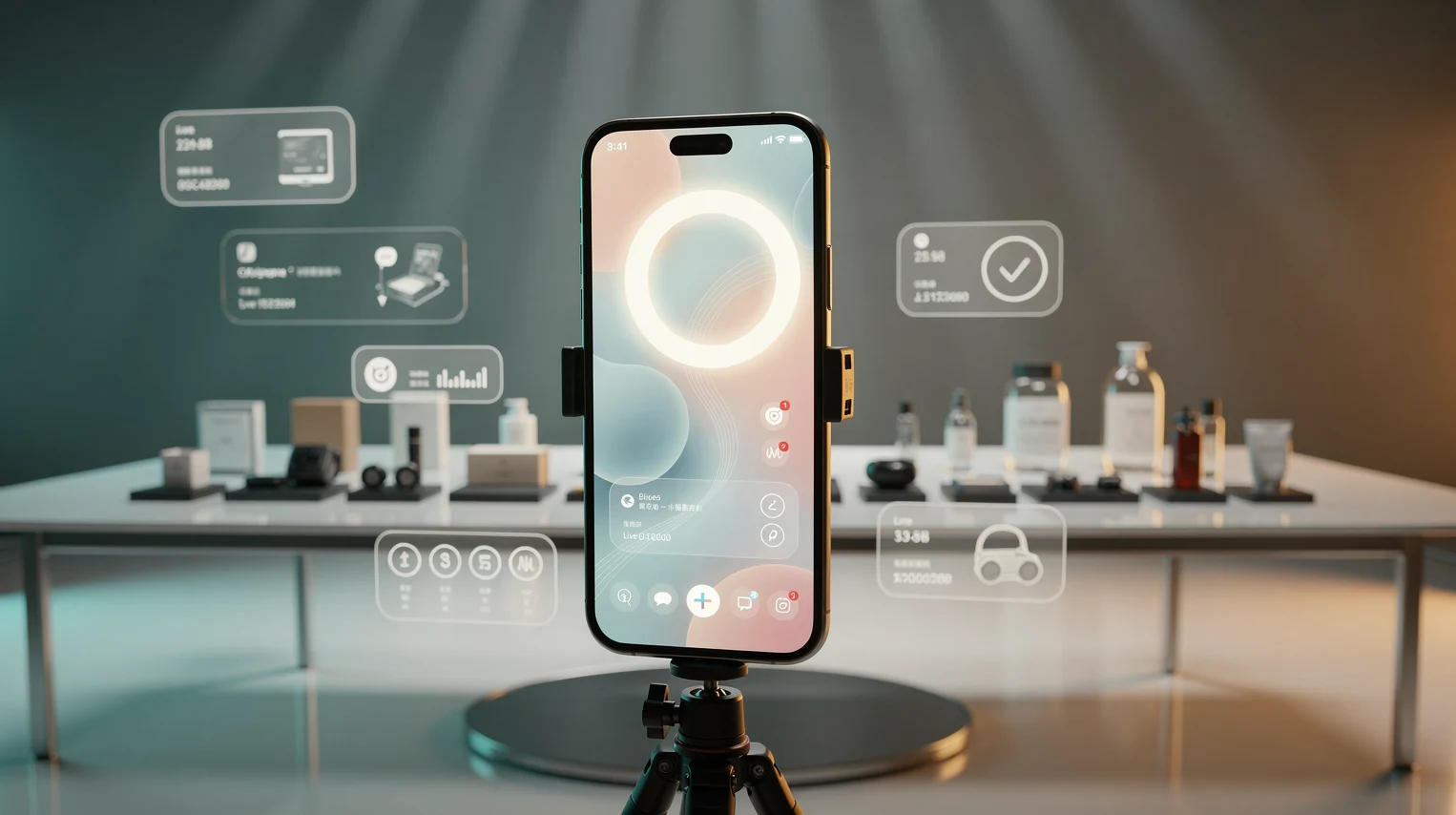
In short
- Live selling is a merchandising format, not a broadcast format. The streams that convert are built around a pinned product, a clear offer window, and a repeatable segment structure, not around personality alone.
- Session length beats production value. Long streams give the algorithm time to find buyers, and most sales on a well-run stream arrive after the first hour rather than in the opening minutes.
- Four formats do most of the work: the product demo drop, the bundle and bargain stream, the expert Q&A, and the co-hosted creator collab. Each has a different cost base and a different margin profile.
- Affiliate creators scale reach; owned streams protect margin. Most brands that make live selling work run both, with a house schedule for baseline volume and creator streams for spikes.
- The unglamorous parts decide profitability: inventory sync, return rates on impulse purchases, moderation, and a storefront that survives a traffic spike.
Live selling on TikTok Shop has moved past the novelty stage. What started as an experiment borrowed from Chinese livestream commerce is now a scheduled, staffed channel for a growing set of US and European retail brands, with its own production norms, its own economics, and its own failure modes.
This guide covers what actually converts on a TikTok Shop live stream: the format archetypes, the segment structure inside a stream, how the offer mechanics work, what the numbers tend to look like, and where brands most often lose money. It is written for retail and e-commerce operators who need to decide whether to staff this channel, and how.
Why live selling on TikTok Shop matters in 2026
The strategic case for live selling rests on a simple observation: discovery and checkout have collapsed into the same surface. A shopper who sees a product demonstrated, asks a question in the comments, and taps a pinned product card never leaves the app. That compression removes several steps where conventional e-commerce funnels leak.
TikTok’s own positioning of Shop as a full commerce layer rather than an ad product has pushed live into a first-class slot in the app. Live streams get their own discovery surface, they surface inside the For You feed, and they carry product cards natively. The result is a channel where the content is the storefront.
The behavioural shift underneath the format
Search behaviour on social platforms has changed what a product page is for. A significant slice of younger shoppers now begins a product search inside a social app rather than a search engine, treating video results as the primary evidence about whether something is worth buying. That pattern is strongest among younger cohorts, who increasingly treat the app as a first-stop product search engine rather than an entertainment feed.
Live selling sits at the sharp end of that shift. It answers the questions a static product page cannot: how big is it really, how does the fabric move, what does it look like on someone who is not a model, does the thing actually do what the listing claims.
That is why demonstration-heavy categories outperform. Beauty, apparel, home goods, kitchen tools, and collectibles all reward a host who can show rather than describe. Categories where the buying decision is spec-driven rather than sensory tend to convert poorly regardless of production quality.
Where live fits in the wider channel mix
Live selling is rarely a replacement for existing channels. In most operator accounts it behaves like a high-variance incremental layer: modest baseline volume from a regular schedule, punctuated by outsized days when a stream catches algorithmic distribution or a creator collab lands.
Brands treating it as a substitute for paid social or marketplace listings usually get disappointed. Brands treating it as a new merchandising surface, comparable to a pop-up shop or a home shopping slot with better targeting, tend to build something durable. The broader context sits in our complete guide to selling on global e-commerce marketplaces, which maps how these surfaces relate to one another.
Key terms and definitions
Live commerce has accumulated jargon quickly, and much of it is used loosely. The definitions below are the ones that matter operationally, because each maps to a decision someone on your team has to make.
- Pinned product: the single item highlighted on screen during a segment, shown as a tappable card. Only one product is genuinely in focus at a time, which is why stream planning is really pin-sequence planning.
- Showcase: the full catalogue attached to the live session, which viewers can browse independently of what is pinned. A large showcase with a disciplined pin sequence is the usual setup.
- Live-only offer: a discount, bundle, or gift available for the duration of the stream or a defined window inside it. The mechanism that converts watching into buying.
- Co-host: a second account joined to the stream, typically a creator, sharing screen time and audience.
- Affiliate creator: a creator who promotes products for commission through the platform’s affiliate marketplace, either in short-form video or in their own live streams.
- GPM: gross merchandise value per thousand views, the standard efficiency metric for a stream. It normalises performance across sessions of wildly different reach.
- Watch-to-cart: the share of viewers who add a pinned product to cart, the cleanest early signal that a segment is working.
Why GPM is the number to watch
Raw revenue from a single stream tells you almost nothing, because reach on any given session can vary by an order of magnitude. GPM strips that out and tells you whether the content is doing merchandising work.
A stream that pulls large viewership and low GPM has a merchandising problem: wrong products, weak offer, unclear pinning, or a host who entertains without selling. A stream with high GPM and low viewership has a distribution problem, which is a much easier thing to fix by scheduling, creator collabs, or paid amplification.
How live selling works in practice: the four formats that convert
Most successful TikTok Shop streams are versions of four archetypes. Knowing which one you are running matters, because each carries a different production cost, a different margin structure, and a different staffing requirement.
The product demo drop
A single hero product, demonstrated repeatedly across a long session, with a live-only price or gift attached. The host runs the same demonstration loop every 10–15 minutes because the audience is constantly turning over, so the fifth repetition is the first time most current viewers have seen it.
This is the highest-margin format because it needs no discounting beyond a modest live incentive, and it concentrates all attention on one SKU. It works best when the product has a visible transformation: before and after, folded and unfolded, dirty and clean.
The bundle and bargain stream
High volume, fast pin rotation, aggressive value framing. The host moves through many SKUs, each with a bundle or a steep live price, creating urgency through scarcity claims and countdowns.
Volume can be very large. Margin usually is not. This format is where brands most often discover that a strong revenue number hides a weak contribution number once discounts, commission, and returns are counted.
The expert Q&A
A knowledgeable host, often a founder or a specialist, answers questions and pins products as they become relevant to the conversation. Conversion per viewer tends to be high, absolute reach tends to be low, and average order value is usually the best of the four.
This format suits considered purchases: skincare with an ingredient story, tools, technical apparel, supplements, anything where the barrier is uncertainty rather than price.
The co-hosted creator collab
A brand stream joined by a creator, or a creator stream featuring the brand. It buys reach and credibility at the cost of commission and control. This is the format most likely to produce an outlier day and most likely to produce a compliance headache, because the creator is making claims on your behalf in real time.
| Format | Typical stream length | Margin profile | Best-fit categories | Main risk |
|---|---|---|---|---|
| Product demo drop | 2–4 hours | High | Home, kitchen, cleaning, gadgets | Host fatigue, repetition going flat |
| Bundle and bargain | 4–8 hours | Low | Apparel, accessories, FMCG | Discount dependence, high returns |
| Expert Q&A | 1–2 hours | High | Beauty, supplements, technical gear | Low reach without amplification |
| Creator collab | 1–3 hours | Medium | Beauty, fashion, collectibles | Commission cost, claim compliance |
The pattern across operator accounts is that brands start with the bundle format because it produces the fastest visible revenue, then migrate toward demo drops and Q&A once they measure contribution margin rather than gross sales. Our analysis of which live shopping formats actually convert traces the same migration across a wider set of platforms.
Anatomy of a stream that sells
Inside any of the four formats, the streams that perform share a structure. It is closer to a radio show clock than to a video shoot: repeating segments, fixed beats, and a deliberate rhythm of offer and release.
The repeating segment loop
Because viewership churns continuously, a live stream cannot have a beginning, middle, and end in the conventional sense. It needs a loop, typically 10–20 minutes long, that a viewer arriving at any moment can enter without feeling lost.
A workable loop looks like this: welcome and reset (what we are showing, what the offer is), demonstration, social proof (comments, questions, prior orders), offer restatement with the pin, then a short bridge to the next product or the next repetition. Every element repeats because the audience does not.
Offer mechanics and the urgency window
Live-only pricing works when it is credible and bounded. An offer that runs the entire stream and reappears every week trains the audience to wait. An offer bounded to a defined window, with stock genuinely limited, converts because waiting has a cost.
The most reliable mechanics are limited-quantity flash pricing, a gift with purchase that has visible standalone value, and bundles that are only assemblable during the stream. Blanket percentage discounts are the weakest, because they are the easiest to find elsewhere.
Comment handling as a conversion surface
Comments are where objections surface, and unanswered objections are lost sales. A stream running at scale needs a dedicated moderator reading questions to the host, filtering spam, and posting pinned answers to the same five questions that always recur.
Sizing, shipping time, return policy, material, and compatibility account for most of the question volume in nearly every category. Having crisp scripted answers to those five removes the most common reason a viewer taps away.
Session length and the algorithmic warm-up
Short streams underperform for a structural reason: the distribution system needs time and signal to identify who should see the session. A 30-minute stream often ends before that process has meaningfully begun.
Operators who move from one-hour to three-hour sessions frequently report that the majority of orders arrive in the back half. That is not a statement about host stamina; it is a statement about how long it takes a recommendation system to find the buyers.
Common mistakes and how to avoid them
The failure modes in live selling are consistent enough to list. Almost all of them come from treating the stream as content production rather than as a retail operation.
Treating the stream as a broadcast rather than a shift
Brands often assign live selling to the social team as a campaign, run four streams, and conclude the channel does not work. Live selling rewards schedule consistency the way a physical store rewards opening hours. An audience cannot form a habit around an irregular event.
The practical fix is a fixed weekly slot held for at least eight to twelve weeks before judging the channel. Consistency also compounds on the supply side, because creators and affiliates can plan around a known schedule.
Pinning too many products
A host who rotates pins every two minutes gives no product enough airtime to accumulate the watch-to-cart signal that drives further distribution. Fewer pins, held longer, almost always outperform a rapid catalogue tour.
Ignoring the returns tail on impulse purchases
Live selling produces genuine impulse buying, and impulse buying returns at higher rates than considered buying. A stream that looks profitable on gross sales can be unprofitable once returns land two to four weeks later, especially in apparel where fit is the dominant return reason.
The discipline here is to judge streams on a delayed contribution basis rather than on same-day revenue, and to size sizing guidance heavily in apparel streams.
Letting inventory drift out of sync
Selling stock you do not have is the fastest route to account health problems and a damaged buyer rating. Live sessions concentrate demand into minutes, which is precisely the condition under which a slow inventory sync between your storefront and the marketplace breaks.
Under-resourcing the storefront for spike traffic
Live streams create sharp, short traffic spikes on any linked owned property. Brands running their own storefront alongside marketplace listings often find that a stream is the first real load test the site has ever had, which is why our guide to hosting OpenCart without performance headaches is worth reading before you schedule a large session rather than after.
Making claims that the compliance team has not seen
Live is unscripted by nature, which makes it the highest-risk surface for product claims. Health, safety, efficacy, and comparative claims made casually on a stream carry the same regulatory exposure as claims made in an advertisement.
Brands that scale this channel typically build a short list of approved claims and prohibited phrases, and brief every host and creator on it before the session. That briefing matters more for creator collabs, where the person speaking does not work for you.
Examples from US retail and e-commerce
Live commerce in the US took longer to establish than in China, and the shape it eventually took is different. The lesson from the last few years is that the format did not translate directly; it had to be rebuilt around Western shopping habits and a different creator economy.
The category-specialist marketplaces
The clearest US proof point is the rise of category-focused live marketplaces in collectibles, trading cards, sneakers, and vintage fashion. Whatnot’s growth into a multibillion-dollar valuation demonstrated that live works extremely well where the product is scarce, graded, or one-of-a-kind.
The mechanism is auction dynamics plus community. In categories where every item is unique, live is not a marketing layer over a catalogue; it is the only sensible way to sell.
Beauty and personal care
Beauty remains the strongest mainstream category on TikTok Shop in the US. Demonstration is inherent to the product, results are visible on camera, average order values support creator commissions, and the audience already treats the platform as a discovery engine for the category.
The characteristic beauty playbook is a house stream two or three times weekly for baseline volume, plus a rotating roster of affiliate creators whose short-form videos drive traffic into the product pages between sessions.
Home, kitchen, and problem-solving products
Products that solve a visible, irritating problem convert unusually well because the demonstration does the entire selling job in about 40 seconds. This category has produced many of the platform’s breakout sellers, often from brands with no prior retail presence at all.
Apparel, where the economics are hardest
Apparel generates large gross numbers and the most difficult contribution math, because of returns. The US brands making it work tend to lean into fit content: multiple body types on camera, explicit measurement callouts, and a host who talks about sizing constantly rather than once.
The broader read on how Western live selling matured, and which assumptions imported from Asian markets turned out to be wrong, is set out in our piece on what finally works in live shopping in the West.
What the economics actually look like
The reason live selling divides operators is that the gross numbers and the net numbers often point in opposite directions. Building a defensible view requires counting costs that a campaign-level report tends to omit.
The full cost stack of a stream
A realistic per-stream cost includes host time, a moderator, a producer or operator running the pins and the offer switches, studio space and lighting amortised across sessions, sample and giveaway stock, platform commission, affiliate commission where applicable, payment processing, fulfilment, and the returns provision.
Brands that only count host time conclude that live selling is nearly free. Brands that count the full stack usually find that a three-hour stream costs meaningfully more than a comparable spend on paid social, and therefore has to clear a higher revenue bar to justify itself.
| Cost line | Owned house stream | Creator collab stream | Notes |
|---|---|---|---|
| Host | Salaried or hourly | Commission, sometimes plus a flat fee | Commission converts a fixed cost into a variable one |
| Production crew | Moderator plus operator | Often creator-supplied | Two people is the practical minimum for a serious stream |
| Discount depth | Controlled by brand | Frequently pushed deeper by creator | Main hidden margin leak in collabs |
| Returns provision | Category baseline | Usually above baseline | Impulse-heavy sessions return more |
| Reach | Builds slowly, compounds | Immediate but rented | Owned audience is the durable asset |
| Claim risk | Controllable | Higher, needs briefing | Written claim guidance is the mitigation |
How to judge whether a stream worked
Three numbers settle it. GPM tells you whether the merchandising is sound. Delayed contribution margin, calculated after the return window closes, tells you whether the session made money. Repeat purchase rate from live-acquired buyers tells you whether the channel is building anything or simply renting demand.
A channel with acceptable GPM, positive delayed contribution, and a repeat rate at or above your site average is a real channel. If the repeat rate is far below site average, live selling is functioning as a discount clearance surface, which may still be useful but should be managed as such.
Tools, partners and vendors worth knowing
The supporting stack around live selling has matured considerably. Most brands assemble from four categories rather than buying a single platform.
Streaming and production software
Multi-camera switching, overlay graphics, and stable encoding matter more than camera quality. Software encoders that let a producer cut between a wide shot and a product close-up materially improve demonstration clarity, which is the thing that actually sells.
Affiliate and creator management
Once a brand works with more than a handful of creators, spreadsheet management fails. Dedicated creator relationship tools handle sample seeding, commission tiers, content rights, and performance tracking. The selection criteria that matter most are commission-tier flexibility, sample-seeding workflow, and whether performance data exports cleanly into your own reporting.
Inventory and order sync
The connector between your source-of-truth inventory system and the marketplace is the least glamorous and most consequential piece of the stack. Near-real-time sync is not a nice-to-have during a live session; it is the thing that prevents overselling when a pinned SKU moves hundreds of units in five minutes.
Analytics beyond the native dashboard
Native reporting is adequate for session-level performance and inadequate for cohort economics. Brands serious about the channel export order-level data and join it to their own returns and repeat-purchase data, because that join is where the honest answer lives.
For a fuller operational view of how these pieces fit into a brand’s overall approach to the platform, including catalogue setup and creator sourcing, see our TikTok Shop playbook for retail brands.
How to start without wasting a quarter
A sensible pilot is narrow and long rather than broad and short. The most common mistake is testing many formats briefly instead of one format persistently.
The first eight weeks
Pick one format, one weekly slot, and a shortlist of six to ten SKUs with genuine demonstration value. Run the same slot every week without exception. Keep the loop structure fixed so that changes in performance are attributable to merchandising rather than to format churn.
Measure GPM per session and watch-to-cart per pinned product. Cut the SKUs that never generate cart adds, and give more airtime to the ones that do. Resist adding a second weekly slot until the first is consistently clearing your contribution bar.
Weeks nine to twenty
Introduce creator collabs once the house stream is stable, so you have a baseline to compare against. Brief every creator on approved claims and on your sizing or usage guidance. Track collab sessions separately, because blending them into house-stream averages obscures both.
At this stage add the second weekly slot if the numbers support it, and begin repurposing stream highlights into short-form video, which feeds product pages between sessions and lowers the cost of the next live audience.
What to do if it is not working
If GPM is weak across many sessions, the problem is almost always merchandising: the products do not demonstrate well, or the offer is not credible, or the pin sequence is too fast. If GPM is healthy but reach is small, the problem is distribution, and creator collabs or paid amplification are the lever.
Diagnosing which of those two you have is the single most useful thing a team can do before spending more money on the channel. The wider strategic framing, including how live selling relates to marketplace listings and cross-border expansion, sits in our guide to selling on global e-commerce marketplaces.
FAQ: TikTok Shop live selling questions worth answering
How long should a TikTok Shop live stream be?
Longer than feels natural. Sessions under an hour rarely give the distribution system enough time to find buyers. Two to four hours is a common working range for a demo drop, and high-volume bundle streams often run considerably longer. Length matters more than polish.
Do I need a professional studio to sell live?
No. Consistent lighting, a stable connection, clear audio, and a clean background covering the frame are enough. Production value correlates weakly with conversion; demonstration clarity correlates strongly. A ring light and a tripod outperform an expensive camera in a badly lit room.
How many products should I pin in one session?
Fewer than most brands expect. For a demo drop, one hero product plus two or three supporting items across several hours is typical. Bundle streams rotate faster by design, but even there, pins held for under two minutes rarely accumulate enough signal to convert.
What commission do affiliate creators typically take?
Rates are set by the seller and vary widely by category and by how much reach the creator brings. They are negotiated, not fixed, and current standard ranges shift over time, so check the platform’s own seller documentation for the prevailing structure rather than relying on figures quoted in third-party guides.
Is live selling worth it for high-consideration or expensive products?
Often yes, but in the expert Q&A format rather than the bundle format. Expensive products convert on the removal of uncertainty, which a knowledgeable host answering questions does well. Expect lower viewership and higher average order value.
How do returns from live selling compare to normal e-commerce?
Generally higher, because live selling generates genuine impulse purchases and because urgency mechanics compress the deliberation that normally filters out poor-fit orders. Apparel sees the sharpest effect. Judge sessions after the return window closes rather than on same-day revenue.
Can I run live selling without appearing on camera myself?
Yes. Many brands use hired hosts, staff members, or creator co-hosts. What matters is that whoever hosts knows the products well enough to answer detailed questions without hesitation. Product fluency beats on-camera charisma in most categories.
How does live selling interact with paid advertising?
They are complementary. Paid amplification is the standard fix for a stream with strong GPM and weak reach. Running paid behind a session that has not yet proven its merchandising simply buys a larger audience for a stream that does not convert.
What is the single most common reason brands give up too early?
Inconsistent scheduling. Audiences build habits around fixed slots, and the algorithmic learning that drives distribution needs repeated sessions to work with. Brands running four scattered streams and concluding the channel is dead have usually not run the test they think they ran.
What to read next
Live selling is one surface inside a much larger shift in how social platforms function as retail infrastructure. For background on the underlying model, see the general reference material on live commerce, and for US channel context, the US Census Bureau’s quarterly e-commerce sales data provides the baseline against which any new channel should be sized.
Figures, commission structures, and platform policies described here reflect general industry practice at the time of writing and change frequently. Verify current rates, fees, and policy requirements directly with the platform’s official seller documentation before building a business case on them.