
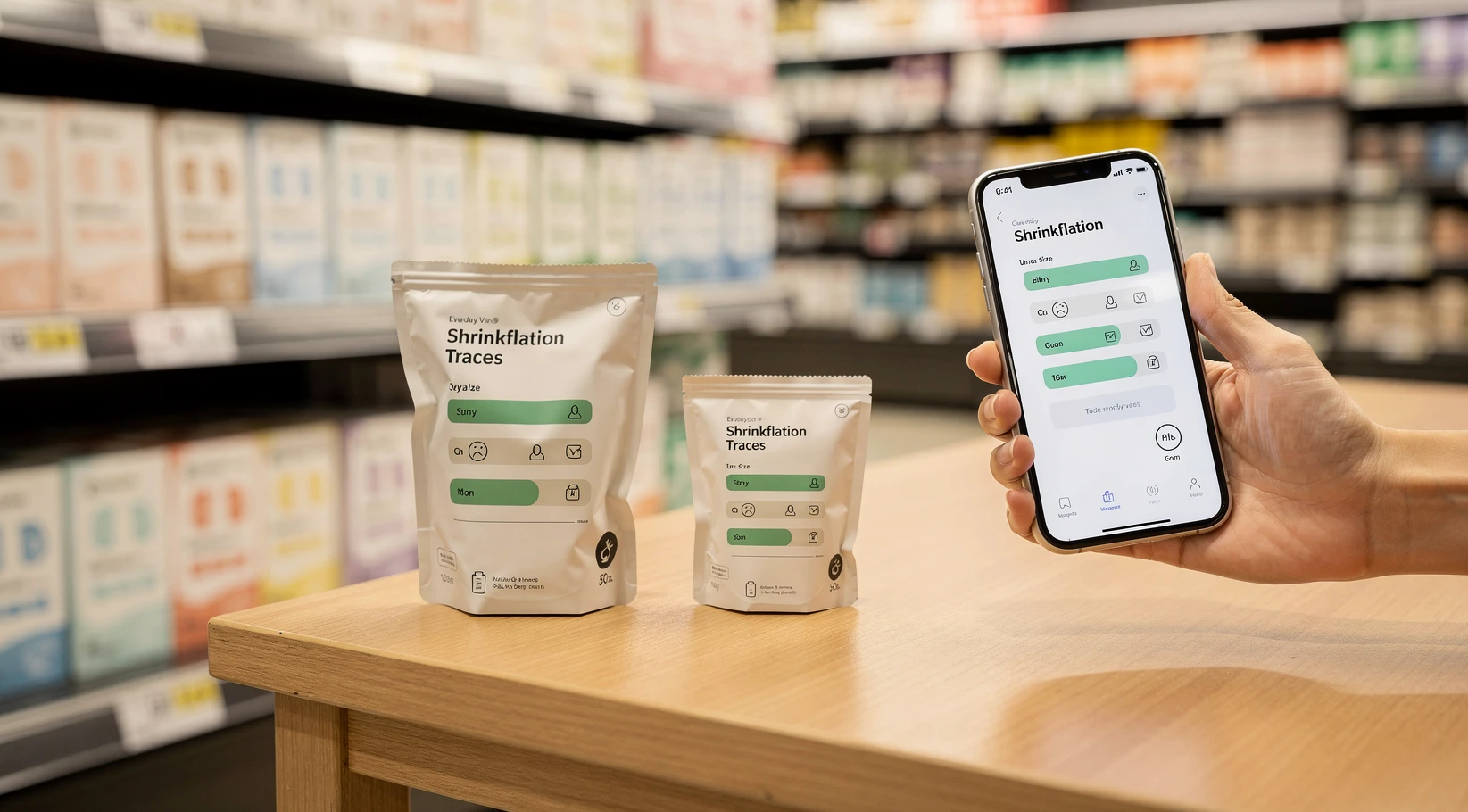
Shrinkflation stopped being a quiet margin lever the moment a viral side-by-side of two cereal boxes could reach ten million people before a brand’s PR team finished their coffee. The mechanics are simple: hold the price, cut the net quantity, and let the unit-cost increase hide in a package that looks identical. The problem is that the math no longer hides. Unit pricing apps, Reddit threads, and shelf-edge labels now expose a 12 percent fill cut in hours, and the discount value shopper, the segment growing fastest across grocery and consumer goods, treats that cut as a breach of an unspoken contract.
This piece is for retail merchants, private-label buyers, and brand managers who have to decide, this quarter, whether to shrink a pack, raise a price, or hold the line and eat the input cost. We will work through what the backlash actually punishes, when shrinkflation is defensible, and the disclosure and assortment moves that keep a value reputation intact. The state of consumer behavior in retail and e-commerce has shifted toward suspicion of any price tactic that feels like a trick, and shrinkflation reads as the most personal trick of all.
In short
- Shrinkflation is now detected within weeks, not quarters, so the old assumption that a quiet pack cut buys you a year of cover is dead.
- The backlash punishes concealment far more than the price increase itself, which means transparent reformulation often outperforms a silent shrink.
- Unit price (price per ounce, per 100g, per sheet) is the number that exposes you, so manage it deliberately rather than letting it surface as a surprise.
- A tiered response works best: hold flagship sizes, shrink only where elasticity is high, and pair any cut with a visible benefit such as recyclable packaging or a multipack value lane.
- Private label is a defensive weapon here, because a credible value tier lets you protect the brand pack while still capturing the trade-down shopper.
What shoppers actually punish, and what they tolerate
The headline finding from the last two years of grocery data is that consumers do not punish higher prices nearly as hard as they punish feeling deceived. A straightforward price increase on a stable pack reads as inflation, which shoppers blame on the economy. A pack that quietly drops from 16 ounces to 14 while the front label stays glossy reads as the retailer’s choice to fool them, and that attribution is what burns loyalty.
Concretely, the tolerated path is reformulation or resizing that comes with a stated reason and a visible trade. Shoppers will accept a smaller bar if the wrapper now says “30 percent less sugar” or “now fully recyclable.” They will not accept a smaller bar that pretends nothing changed. This is the same trust dynamic that shapes how sustainable retail actually works beyond the marketing: a benefit only counts when the shopper can verify it, and a hidden cut only counts against you when they catch it, which they now reliably do.
The other variable is category. Staples with strong price memory (eggs, milk, coffee, paper towels) carry the sharpest unit-price awareness, so shrinkflation there generates the loudest backlash. Discretionary and impulse categories, where the shopper rarely tracks per-unit cost, absorb resizing more quietly. The mistake is applying one shrinkflation rule across the whole assortment instead of segmenting by how closely each category is watched.
Timing compounds the category effect. A resize that lands during a visible inflation spike, when shoppers are already scanning every shelf tag, gets caught and resented faster than the same change made in a calm pricing environment. The cynical reading is that crisis periods are cover for quiet cuts; the accurate reading is the opposite, because heightened attention during those periods is exactly when concealment is most likely to be exposed and punished. If you must resize, the calmer the surrounding pricing news, the lower the detection heat.
When shrinkflation is defensible (and when it is not)
Shrinkflation is defensible when three conditions hold together: the input-cost shock is real and documentable, the alternative price point would break a psychological threshold (the jump from $3.99 to $4.49 that collapses volume), and you can disclose the change without burying it. Under those conditions a modest resize is often the least bad option, and honest communication converts a potential scandal into a non-event.
It is not defensible when the cut is opportunistic, repeated, or stacked on top of a price increase in the same window. “Double-dipping,” raising price and cutting size at once, is the single fastest way to manufacture a viral backlash, because it removes any benefit-of-the-doubt the shopper might extend. The table below frames the decision by scenario.
| Scenario | Recommended move | Disclosure level | Backlash risk |
|---|---|---|---|
| Real input spike, price near threshold | Modest resize, hold price | Front-of-pack note plus shelf talker | Low if disclosed |
| Real input spike, price has headroom | Raise price, keep size | None needed | Very low |
| High-awareness staple (eggs, coffee) | Raise price, never shrink | None | High if shrunk |
| Discretionary or impulse item | Resize acceptable | Pack-size update only | Low |
| Margin grab, no cost basis | Do nothing | N/A | Severe, do not proceed |
Notice that in two of the five rows the right answer is to raise price rather than shrink. The reflex to protect a price point at all costs is exactly what drives teams into the indefensible quadrant, and the regulatory mood reinforces that. Several jurisdictions now require pack-size-change labeling, and the broader compliance picture is part of what changed in sustainability and ethics for retail teams in 2026, where disclosure obligations and shopper expectations have moved in the same direction at once.
A response playbook you can run this quarter
If you are staring at a cost increase and a fixed shelf price, work the decision in a fixed order rather than defaulting to a shrink. The sequence below keeps the trust-destroying options last.
- Quantify the unit-price impact first. Calculate the new price per ounce or per 100g for every option on the table, because that is the number shoppers and journalists will quote. If a resize pushes unit price up more than a price increase would, the shrink is the worse choice on its own terms.
- Test the price threshold before assuming it is fixed. Run a regional price test for two to four weeks. Threshold effects are often weaker than merchandising lore claims, and a clean price increase beats a concealed shrink almost every time it is actually measured.
- If you must resize, pair it with a visible benefit. New recyclable packaging, a cleaner formulation, or a resealable closure gives the shopper something to receive in exchange for the size cut, which reframes the change.
- Disclose at the shelf and on pack. A simple “new size” flag and a unit-price callout remove the ambush. Shoppers forgive a change they were told about and punish one they discovered.
- Open a clear value lane. Make sure a larger multipack or a private-label option captures the trade-down shopper instead of losing them to a competitor, which is where assortment strategy earns its keep.
Running these in order matters because each step you skip pushes risk downstream. Teams that jump straight to step three without doing step one routinely shrink a pack only to discover the unit price now looks worse than the price increase they were avoiding, and they have spent trust for nothing. The brand-side discipline behind this sequencing mirrors the broader modern brand playbook for retail and e-commerce, which treats every pricing signal as a brand promise rather than a tactical lever.
How to use private label and assortment as a hedge
The smartest shrinkflation response is often structural rather than tactical: build the assortment so that no single pack-size decision can blow up your value image. A credible private-label or store-brand tier gives the price-sensitive shopper somewhere to land, which means you can hold national-brand flagship sizes steady and let trade-down happen inside your own four walls instead of at a competitor.
Practically, that means maintaining at least three rungs on the value ladder in watched categories: an opening price point (usually private label), a mainstream brand pack held at its historic size, and a premium or bulk option. When input costs spike, you adjust the rung most insulated from price memory, not the flagship. Independent watchdogs and consumer groups, including Consumer Reports, actively track and name shrinkflation offenders, so the assortment hedge also reduces your odds of becoming the case study in someone else’s exposé.
The value lane is not only defensive. Discount-oriented shoppers reward retailers who make the cheapest credible option easy to find, and a well-run private-label program builds loyalty that survives the next inflation cycle. The shrinkflation question, framed correctly, is really an assortment-architecture question wearing a packaging costume.
The economics: what a shrink actually buys you
Run the numbers before you run the strategy, because the margin a shrink delivers is usually smaller than teams assume and the cost it imposes is usually larger. Take a snack item retailing at $3.49 with a 38 percent gross margin. A 10 percent net-weight reduction does not hand you a clean 10 percent of revenue: packaging, labor, and freight are partly fixed per unit, so the realized margin gain on that pack typically lands somewhere between 4 and 6 percentage points, not 10. That is the upside.
The downside is measured in repeat rate. A single percentage point of lapsed repeat purchase on a fast-moving SKU usually erases the entire margin gain within two to three quarters, and a viral shaming event can knock several points off in a week. So the real trade is a few points of unit margin now against a probability-weighted hit to lifetime value later, and the longer your customer relationship, the worse that trade looks. The brands that get this right model it explicitly rather than approving the shrink on the strength of the headline margin number alone.
There is also a cumulative cost most spreadsheets miss: trust is spent per event, and it does not refill on the same schedule it drains. A retailer who shrinks three SKUs across a year may survive each one in isolation, yet still find that the pattern, not any single cut, is what shoppers remember and repeat. Treat your shrink decisions as a portfolio with a shared trust budget, not as independent line items.
Communicating a change without making it worse
If you decide a resize is the right call, the communication is not an afterthought, it is the part that determines whether the change is a footnote or a flashpoint. The governing principle is to be the first source the shopper hears it from. A change you announce is a business decision; a change a customer discovers is an accusation you now have to answer on someone else’s terms.
The on-pack and shelf execution does most of the work: a plain “new size, same recipe” flag, an updated unit-price label, and where relevant a one-line reason that does not insult anyone’s intelligence (“reflecting higher cocoa costs” beats “to serve you better”). Avoid the two communication failures that reliably backfire: pretending nothing changed, and over-explaining with corporate language that reads as a confession. Shoppers want acknowledgment, not a press release.
Brief frontline and social teams before the change hits shelves, not after the first complaint, so the answer is consistent everywhere a customer might raise it. A retailer who can calmly point to a clear label and a stated reason defuses most of the anger, because the offense was never really the smaller pack, it was the feeling of being played. Remove that feeling and the change becomes ordinary.
Common mistakes
The first mistake is double-dipping: cutting size and raising price in the same window. It doubles the perceived offense and triples the screenshot potential, and it is the most common trigger of a named-and-shamed backlash. If both moves are genuinely necessary, separate them by at least a full purchase cycle and disclose each one.
The second is assuming concealment buys time. It used to buy a year, then a quarter, and now it buys roughly the time it takes one shopper to post a photo. Budgeting your strategy on the old detection lag is planning for a market that no longer exists.
The third mistake is applying a single rule across every category. Shrinking a high-awareness staple and a low-awareness impulse item carry completely different risk profiles, and a uniform policy guarantees you over-expose the staples while leaving easy resizing on the table elsewhere.
The fourth is treating the response as a packaging decision owned by one function. Pricing, merchandising, supply chain, and communications all hold a piece of it, and a shrink approved by procurement without merchandising sign-off is how a unit-price disaster reaches the shelf unnoticed.
FAQ
What exactly is shrinkflation?
Shrinkflation is the practice of reducing the quantity or size of a product while keeping its retail price the same, which raises the effective price per unit without changing the number on the shelf tag. It differs from a straightforward price increase because the change is embedded in the package rather than displayed in the price. Shoppers experience it as a hidden cost increase, and because the unit price still rises, it produces the same margin effect as a price hike with added reputational risk when it is discovered.
Is shrinkflation illegal?
In most markets the practice itself is legal, but the labeling around it is increasingly regulated. Several jurisdictions now require clear unit-price display and, in some cases, explicit notice when a pack size changes, so concealment that misleads shoppers can cross into deceptive-practice territory. The safest posture is to assume disclosure is mandatory even where it is not yet, because both regulators and consumer advocates are moving toward treating an undisclosed size cut as a form of misleading pricing.
Why does shrinkflation generate more backlash than a price increase?
Shoppers attribute a price increase to the economy and a size cut to the brand. Inflation feels like an external force nobody chose, while a quiet pack reduction feels like a deliberate decision to deceive a loyal customer. That attribution gap is the whole story: the same effective cost increase reads as bad luck when it is on the price tag and as betrayal when it is hidden in the package. The emotional charge, not the dollar amount, drives the backlash.
Should a value retailer ever use shrinkflation?
Rarely, and only with disclosure. A retailer whose entire positioning rests on value has the most to lose from a concealed cut, because the discovery directly contradicts the promise. If costs force the issue, a disclosed resize paired with a visible benefit, or a price increase on a watched staple, protects the value image better than a silent shrink. The value shopper forgives honesty and punishes tricks more harshly than any other segment.
How fast do shoppers actually notice a pack-size cut?
Far faster than most planning assumes. Unit-pricing apps, shelf-edge per-unit labels, and social media mean a noticeable fill or count reduction in a popular product is often flagged within days of hitting shelves. High-awareness staples get caught almost immediately, while obscure or impulse items can go unnoticed longer. The practical rule is to assume any change to a frequently purchased product will be public knowledge within the first selling week.
What is the single best alternative to shrinking a pack?
Raising the price while holding the size, when the price point has headroom. A transparent price increase carries the lowest backlash risk because shoppers read it as inflation rather than deception, and it avoids the unit-price math that exposes a shrink. Where a price threshold genuinely blocks that, a disclosed resize paired with a real benefit is the next best option. The worst alternative is always a silent shrink, which trades durable trust for short-term margin.
What’s next
Audit your watched categories this month and tag each SKU by price-memory intensity, then pre-decide the response rule for each tier before the next cost shock forces a rushed call. Pair that audit with a refresh of your value lane so the trade-down shopper stays inside your assortment, and revisit how the broader shift in consumer behavior toward price transparency should reshape your disclosure defaults across the whole shelf.