
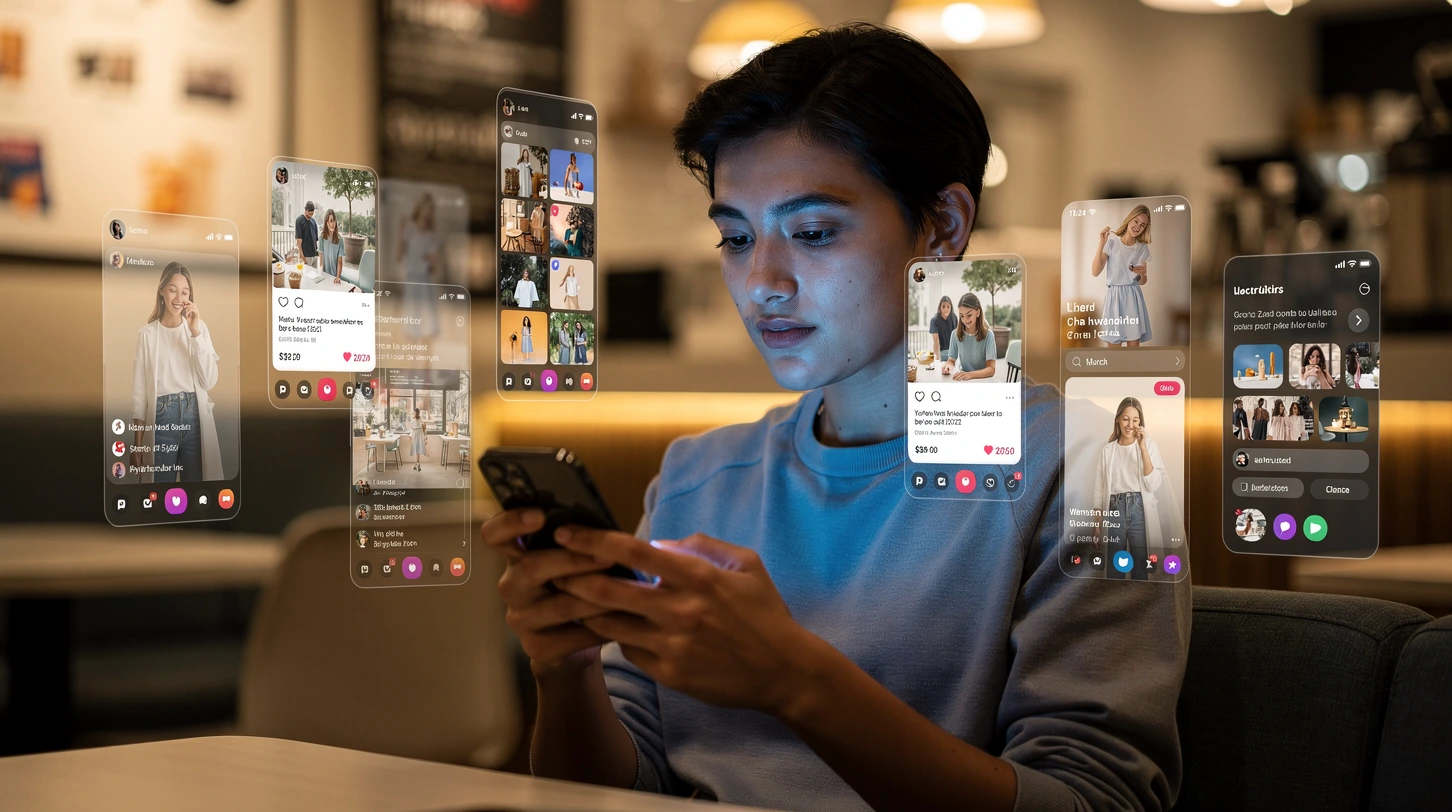
Why gen z and millennial changes 2026 matter for retail teams
Gen Z and millennial shoppers now drive a controlling share of US online retail spend, and the pace of behavioral change picked up sharply this year. Retail teams that mapped customer journeys back in 2024 are finding those flows already stale. The shift is not just about new channels; it is about how trust, attention, and purchase intent get built in the first place.
This guide breaks down the gen z and millennial changes 2026 that matter most for category managers, ecommerce leads, and CRM teams. We focus on what has actually moved in the data, not the marketing slogans. For broader context, see the pillar overview, the state of consumer behavior in retail and e-commerce, which sets the wider frame this cluster sits inside.
In short:
- Discovery moved decisively into short video and creator-led feeds, with search engines used later in the funnel.
- Trust shifted from brand ads to peer review aggregates and creator commentary, especially among Gen Z under 25.
- Conversion is happening inside apps and social surfaces, not always on retailer dot-coms.
- Price sensitivity jumped for millennials in 2026 as housing costs squeezed disposable income.
- Loyalty is increasingly tied to identity and values, not points and tiers.
Key terms and what they actually mean in 2026
Definitions drift, so it helps to set baselines before reading any vendor deck. Below are the working definitions our editorial team uses across the cluster.
| Term | Working definition (2026) | Why it changed |
|---|---|---|
| Gen Z | Born 1997 to 2012; the older half (29 and under) drives most of the trackable retail behavior. | The youngest cohort entered the credit and rent economy this year. |
| Millennial | Born 1981 to 1996; in 2026 the youngest are 30 and the oldest are 45. | Life stage is now firmly family or first-home focused for the median millennial. |
| Social commerce | Purchase initiated inside a social or short-video app, completed without leaving that surface. | In-app checkout matured across TikTok Shop, Meta, and YouTube in 2025. |
| Creator-led discovery | Product awareness driven by a specific person, not a brand campaign. | Algorithmic feeds reward personality over polish. |
| Identity loyalty | Repeat purchase because the brand reflects the buyer’s values or self-image, not because of points. | Younger shoppers see traditional tiered programs as transactional friction. |
For a deeper look at how purchase loyalty actually forms in this cohort, our piece on what Gen Z expects from a brand it loves enough to repurchase walks through the trigger sequence in detail.
How discovery actually works for these shoppers now
The biggest single change in 2026 is where product discovery starts. Internal panels and third party trackers agree: short video is the dominant top-of-funnel surface for shoppers under 35. Search is still important, but it now sits in the middle of the funnel, used to verify rather than to discover.
The new discovery stack
- Trigger: a creator video, often unscripted, mentions or shows a product in context.
- Verification: viewer searches the brand or product on the same platform to read comments and watch other creators discuss it.
- Cross-check: a quick Google or Reddit search for “is X worth it” or “X vs Y” to confirm the consensus.
- Conversion: purchase either inside the app, on Amazon, or on the brand site, in roughly that order of preference.
The retail teams that adapted fastest stopped treating their own dot-com as the discovery surface. They build for the verification and cross-check stages instead, making sure product pages, FAQ content, and review aggregates do the heavy lifting once interest already exists. The brand site is now a closer, not an introducer.
Our analysis of social commerce behavior among Gen Z: data versus narrative goes deeper on which platform surfaces actually drive measurable revenue versus which ones look busy but convert poorly.
Common mistakes retail teams are making this year
Plenty of brands read the same trend reports and react identically. That synchronized reaction creates predictable mistakes. The five below come up in nearly every account review we sit on.
Mistake 1: Treating creator content as paid media
Booking creators through a managed influencer agency, running approval cycles, and forcing scripted talking points kills the format. Audiences spot the seams in under three seconds and scroll past. The brands seeing real lift are giving creators a product and a deadline, then getting out of the way.
Mistake 2: Ignoring the comment section
For Gen Z, comments are the review section. A creator video can drive thousands of clicks, but if the top comments say the product disappointed, conversion collapses. Brand teams that monitor and respond inside the comment thread, not just on their own channels, are seeing measurable conversion lift on the same video views.
Mistake 3: Overinvesting in tiered loyalty
Five-tier programs with status levels still work for older millennials and Gen X, but they actively repel younger shoppers. The cost to design, market, and operate those tiers often exceeds the incremental revenue they generate. Simpler models (cash-back, surprise unlocks, community access) are outperforming on both retention and unit economics.
Mistake 4: Personalization without context
Behavioral personalization that recommends a winter coat in May because the shopper browsed coats in November signals that the brand is not paying attention. Younger shoppers tolerate less of this than the industry assumes. Recency and intent windows need to be tighter than the defaults most platforms ship with.
Mistake 5: Ignoring the household economics shift
Millennials in 2026 are running tighter monthly budgets than they were in 2023, mostly because of rent, mortgage rates, and childcare. Brands still merchandising aspirational price points without an entry option are leaving conversion on the table. The fix is not a discount; it is a credible entry SKU that maintains brand integrity.
One quiet pattern reinforces all five mistakes. Each of them is comfortable for the team that built the old program: the agency relationship, the loyalty platform contract, the personalization vendor, the merchandising calendar. Unwinding any one of them requires admitting that something that worked in 2021 simply does not in 2026. The brands that recognize that explicitly tend to be the ones that move first; the rest spend the year explaining last quarter’s results to their boards.
Examples from US retail and e-commerce
Specifics ground abstract trend talk, so here are concrete moves from this year that illustrate the patterns above.
Beauty: a mass brand wins by handing the brief to creators
A mid-tier mass-market beauty brand shipped a new lip line in Q1 2026 with no traditional campaign. They sent the product to about 120 micro creators (10k to 100k followers) with one instruction: “show how you use it, on yourself, in your real bathroom lighting.” The launch outperformed their previous celebrity-led launch by a wide margin on first-90-day sell-through, and the cost was roughly a fifth.
Apparel: a DTC brand collapses its loyalty program
A direct-to-consumer apparel company killed its four-tier loyalty system in February 2026 and replaced it with a flat 5 percent cash-back wallet that any returning customer accumulates automatically. Returning customer revenue rose because the friction of redeeming points went away. Customer service tickets about loyalty fell by more than half.
Grocery: a regional chain ships a real entry tier
A US grocery chain noticed millennial basket sizes dropping through 2025. Rather than discount across the board, they introduced a 200-SKU value private label with honest packaging (not premium-looking, not deliberately ugly), and ran in-store plus app placement that explicitly said it was for budget-conscious shoppers. Traffic and basket frequency both rose, and the value range did not cannibalize the premium private label.
Tools, partners, and vendors worth knowing in 2026
The vendor landscape consolidated a bit this year. A few categories are worth a focused look if your team is building or rebuilding the stack to fit how these cohorts actually behave.
| Category | What it does | Why it matters in 2026 |
|---|---|---|
| Creator discovery platforms | Surface and contract micro creators by audience match. | Replaces the old influencer agency layer for most mid-market brands. |
| Social listening (comment-level) | Aggregates and surfaces comments across creator content. | Where Gen Z reviews actually happen. |
| Lightweight loyalty wallets | Cash-back style accumulation without tiers. | Replaces the heavy points platforms of 2018 to 2023. |
| Recency-weighted personalization | Drops historical signals after short windows. | Stops the creepy or stale recommendation problem. |
| Entry SKU merchandising tools | Highlights value SKUs without devaluing the rest of the catalog. | Critical for the millennial budget squeeze. |
If your discovery work is starting from the influencer side rather than the platform side, our guide on influencer marketing for retailers without burning your budget covers the contract, brief, and measurement patterns that actually hold up.
How the data has shifted: a closer look at the numbers
It is easy to talk about gen z and millennial changes 2026 in vague terms. The harder, more useful exercise is naming what has actually moved in measurable ways since 2023. Five shifts come up consistently across panel data, payment network reports, and retailer first-party analytics.
1. Share of e-commerce by cohort
Gen Z grew its share of US e-commerce GMV by roughly 6 to 8 percentage points between 2023 and 2026. Millennials remained flat in share but grew in absolute spend because the cohort got older and richer at the median. Older shoppers (50+) lost relative share online for the first time in five years, mostly because their share of categories like apparel and beauty migrated to younger cohorts.
2. Channel of first product exposure
In 2023, search and direct still accounted for over half of first-touch product discovery for shoppers under 35. By 2026, short video and creator-led feeds combined are the single largest first-touch channel for this cohort, with search dropping to roughly a quarter. The implication is direct: SEO is still important but is no longer the entry door.
3. Path to purchase length
The number of touchpoints from awareness to purchase grew for younger shoppers, from about 5 in 2023 to between 7 and 9 in 2026. That is not because shoppers are slower to decide; it is because they actively verify across more surfaces before paying. Retail teams that count only last-click attribution will systematically undervalue the verification stages, and underfund the content that drives them.
4. Mobile basket size and return rate
Average mobile basket sizes for millennials shrank by about 11 percent versus 2023, while return rates rose modestly. Both are downstream of the household budget squeeze. Buyers are placing smaller, more deliberate orders, and sending back items that fall short rather than holding onto them. The fix is not friction (longer return windows do not help here); it is better product page information and sizing tools.
5. Trust scores for legacy brand advertising
Survey-based trust in traditional brand advertising fell again in 2026 for Gen Z, continuing a multi-year slide. Peer reviews, creator commentary, and even comments under creator videos now outrank brand-owned messaging on trust metrics by a wide margin. None of this is a surprise; what is new is that the gap is now wide enough that allocating budget the old way (heavy brand media, light creator) systematically underperforms.
What to do this quarter: a practical checklist
Reading the trends is the easy part. Translating them into specific moves your team can ship this quarter is what separates teams that close 2026 well from those that spend it in deck cycles.
- Audit your top 10 creator placements from the past 90 days. Score each on whether the format was creator-native or brand-scripted.
- Pull the top 50 comments on your three best-performing creator videos. Map sentiment and the most-asked questions; feed those into product page FAQ.
- Model the operating cost of your current loyalty program against a flat cash-back equivalent. Be honest about the headcount and platform fees.
- Cut your personalization lookback windows in half on one test segment for 30 days. Measure conversion and unsubscribe rates side by side.
- Identify your three most aspirationally-priced categories. Confirm each has a credible entry SKU. If not, decide who owns shipping one by end of quarter.
For the wider strategic frame these moves sit inside, the pillar reference the state of consumer behavior in retail and e-commerce ties this cluster back to spending power shifts, generational handoffs, and channel economics across the broader US retail picture. Use it as the lens; use this article as the action layer.
The brands quietly winning with these cohorts in 2026 are not the loudest. They are the ones that read the discovery shift early, took the friction out of loyalty, respected that household budgets are tighter than the trend reports admit, and treated their own organization as a thing to redesign rather than a fixed input. None of those choices require a bigger budget; they require a clearer reading of what has actually changed in the last 24 months. Reference data on US consumer demographics from the US Census Bureau is a useful sanity check whenever a vendor pitch leans hard on a specific cohort size.
How to organize the team to keep up with the change
Tools and tactics are only half the battle. The other half is whether the team is structured to act on what these shoppers are signaling. Most retail organizations are still built around channel silos (paid social, SEO, CRM, retail media) that map poorly onto how a Gen Z or millennial shopper actually moves through discovery and verification.
Combine creator, social, and product page workflows
The teams getting the most out of creator-led discovery have a single working group that touches the creator brief, the comment thread response, and the product page updates that downstream traffic lands on. When those three handoffs sit inside one weekly meeting (not three different teams emailing across a calendar), the loop closes in days rather than quarters.
Move the loyalty conversation out of CRM alone
Loyalty in 2026 is a finance and merchandising question, not just a CRM question. If the program is going to shift from tiered points to cash-back, the finance team has to model the cost differently, and merchandising has to think about whether the cash-back inflates margin pressure on bestselling SKUs. Keeping loyalty entirely inside CRM produces designs that look elegant in a deck and quietly cost more than the old program did.
Build a recurring “household economics” review
A monthly or quarterly review of how household budgets are moving in your core customer segments, fed by external data plus your own purchase frequency and basket size trends, is one of the cheaper and higher-ROI rituals a retail team can institute in 2026. It catches the millennial budget squeeze before it shows up as a revenue miss, and it forces merchandising to keep entry SKUs honest rather than letting them quietly drift upmarket.
Looking ahead: what to watch in the second half of 2026
Trends do not stop moving. A few signals are worth keeping on the dashboard for the rest of this year.
- The maturation of AI shopping agents. Younger shoppers are early adopters, and an agent that can compare price, ingredients, or sustainability claims across retailers in seconds will reshape verification behavior again.
- Continued de-platforming risk on social. Any one creator surface losing 20 percent of its US audience overnight is no longer unthinkable. Diversified creator strategies are insurance, not over-engineering.
- The slow normalization of subscription fatigue. Younger millennials in particular are cancelling more subscriptions than they did in 2024. Retailers running subscription products should plan for higher churn and design retention specifically for that cohort.
- Honest sustainability claims. The bar for what counts as a credible sustainability claim keeps rising, and casual greenwashing now produces measurable trust damage rather than being ignored.
- Macro household income trends. Watch wage growth versus rent inflation for the under-35 cohort each quarter. The gap between the two is the strongest single predictor of basket size and category mix in this group.
None of these are unique to one category. Whether your team sells beauty, apparel, food, electronics, or services, the same five signals will show up in your data. The brands that close 2026 strongest are the ones that watch the signals quarterly and adjust the operating model, not just the campaign calendar.
FAQ
How much of US retail spend do Gen Z and millennials actually control in 2026?
Combined, they represent roughly half of household consumer spending in the United States this year, with millennials still the larger spending block and Gen Z growing fastest in share of e-commerce.
Is TikTok still the dominant social commerce surface?
For Gen Z under 25, yes. For older millennials, Instagram and YouTube remain stronger surfaces. Most brands need a multi-platform plan rather than betting on a single app.
Are tiered loyalty programs really finished?
They still work for older customers, but the operating cost rarely justifies them for brands skewing under 35. A simple cash-back wallet beats a four-tier program for most DTC and mid-market retailers in 2026.
How fast should we react to a creator video that goes viral with our product?
Inventory and reply windows matter most in the first 48 hours. Have a small response budget pre-approved, a stock buffer for the SKU featured, and a brand voice ready to comment without sounding corporate.
Do younger shoppers actually care about brand values?
They care about consistency between stated values and observed behavior. A brand that publishes a values statement but contradicts it visibly loses trust faster than a brand that never made the claim at all.
What is the single biggest mistake mid-market retailers make with these cohorts?
Treating creator marketing as a campaign line item rather than an ongoing always-on motion. Audiences expect a steady cadence; one-shot bursts barely move the needle.
How do we measure social commerce performance without obsessing over last-click attribution?
Use incrementality tests and matched-market designs where you can. For smaller brands, holdout audiences plus pre and post lift on branded search are practical proxies that hold up over a quarter.