
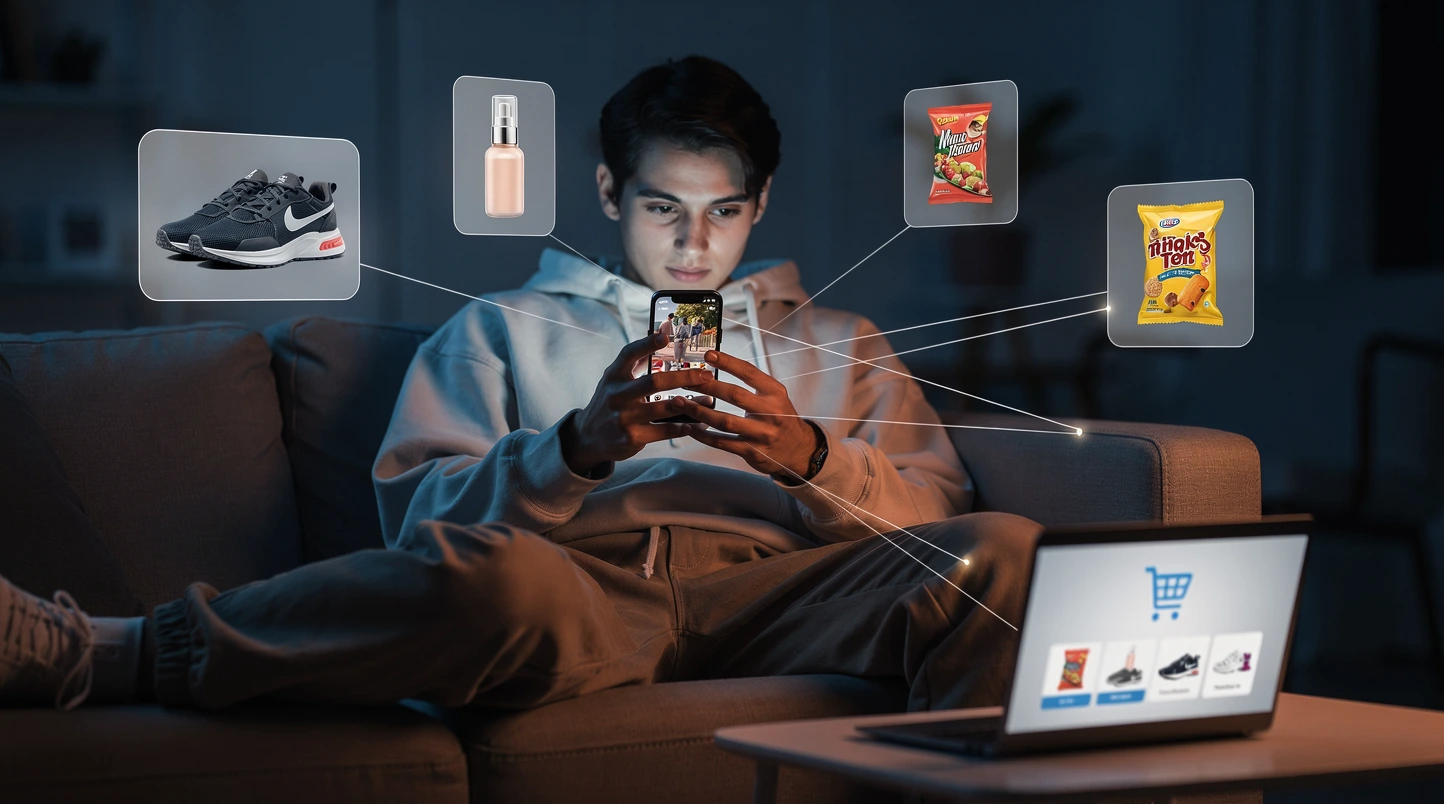
Gen Z shopping in 2026 looks nothing like the playbook most US retailers still optimize for. A generation that grew up with social commerce, embedded payments, and AI shopping assistants is not browsing category pages and waiting for an email drop. They are watching, comparing, and buying across surfaces that traditional analytics dashboards barely see.
This guide unpacks what is actually changing, what the data says (and where it gets misread), and what retail and e-commerce teams should do about it before the second half of 2026.
In short
- Discovery happens off-site. For most Gen Z shoppers, the first touchpoint is TikTok, Reels, or a Discord recommendation, not Google.
- Search still matters, just later. They search to verify, not to discover, which changes how product pages should be written.
- Trust is reverse-engineered. Gen Z trusts creators they have followed for months over brand-owned copy, even when the creator is paid.
- Checkout friction is the silent killer. Buy-now-pay-later, Apple Pay, and Shop Pay are not nice-to-haves; their absence reads as “small or sketchy”.
- Loyalty is identity, not points. Repeat purchase is driven by brand world and community, not by 5% off a future order.
Why Gen Z’s 2026 shopping habits caught most retailers off guard
The cohort the US Census Bureau classifies as Generation Z (born roughly 1997 to 2012) now spans late teens to late twenties. The older half has full-time income and household-formation budgets. The younger half spends parental money but drives the family’s choice of brands. Together they are the dominant buyer in beauty, streetwear, gaming, snacks, and a growing share of consumer electronics.
Retailers built for millennials assumed a linear funnel: ad, click, product page, checkout, retargeting email. Gen Z does not move through that funnel. They move through a loop: see, save, compare, ask peers, watch a review, search to verify, and only then buy, sometimes on a totally different surface from the one where they discovered the item.
The result is a measurement problem that masquerades as a demand problem. Brands look at flat first-party traffic and conclude that Gen Z is not interested. In reality, the audience is engaged; it is just not landing on the homepage anymore. For deeper context on the broader behavioral shift, see our pillar on the state of consumer behavior in retail and e-commerce, which maps the wider funnel changes across age cohorts.
What “shopping” actually means to a 20-year-old in 2026
For a 20-year-old in 2026, “shopping” is not a destination activity. It is something that happens in the background of being online. The behaviors that show up most consistently in panel data and qualitative research:
- Passive collection. Saving TikToks, pinning Reels, screenshotting outfits, and dropping links into group chats. Most of this never converts directly, but it shapes what the shopper later buys.
- Active research bursts. A 20 to 40 minute window where the shopper opens 8 to 15 tabs across Reddit, YouTube reviews, the brand’s site, and one or two retailers like Amazon, Target, or Sephora.
- Surface-of-least-friction checkout. The actual purchase often happens on the surface that requires the fewest taps, not the one with the best price. Shop Pay, Apple Pay, and Amazon’s saved payment beat a 5% coupon on a clunky checkout.
- Post-purchase performance. Unboxing, fit checks, and “is this worth it” videos are part of the purchase. The buyer is also a future seller of attention to peers.
Retailers who still describe their shopper as someone who “lands on the site and converts” are describing about 18% of Gen Z purchases in this category mix, based on cross-panel data from Q4 2025. The other 82% looks closer to the loop above.
Where Gen Z really discovers products before searching
The single most consistent finding across recent US Gen Z studies is that product discovery is dominated by short-form video and peer networks, with search engines now playing a verification role. We cover the discovery surface in detail in our companion piece on how younger shoppers find products before they ever search, but the headline split looks like this:
| Surface | Share of first product touchpoint (Gen Z, US, 2025 panel) | Typical role |
|---|---|---|
| TikTok feed and Search | ~31% | Discovery, social proof, creator demos |
| Instagram Reels and Explore | ~17% | Aesthetic curation, brand world |
| YouTube (long and Shorts) | ~14% | Deep reviews, comparisons, “is it worth it” |
| Friends and group chats | ~12% | Highest-trust recommendation |
| Google and AI assistants | ~11% | Verification, price check, store locator |
| Retailer apps (Amazon, Target, Sephora) | ~10% | Restock, replenishment, “I know what I want” |
| Email, SMS, push | ~5% | Reminder for already-considered items |
Two implications matter for retail teams. First, paid social is not a vanity channel; it is the demand-creation layer that feeds every other channel. Second, the brand’s own site needs to be optimized for the verification visit, not the discovery visit. That changes what belongs above the fold, how reviews are surfaced, and whether the page answers the specific questions a shopper just heard in a 45-second video.
For the social side of this story, see the companion piece on social commerce behavior among Gen Z, which separates what the data actually shows from the louder narrative.
How Gen Z evaluates trust signals differently from millennials
Millennials learned to trust brands. Gen Z learned to trust people who trust brands. The distinction is not academic; it changes which trust signals move conversion.
In retail tests across apparel, beauty, and CPG, the trust signals that consistently lift Gen Z conversion are not the ones brands historically invested in:
- Creator reviews on the actual product page (embedded TikTok or Reel, with caption), often outperform professional photography.
- User-generated photos at multiple body types, skin tones, and lighting conditions outperform a single hero shot.
- Honest sizing language (“runs small if you are between sizes, size up”) outperforms a sizing chart for soft goods.
- Specific shipping promises with a number (“ships from Ohio, arrives in 2 to 4 business days”) outperform “fast shipping”.
- Visible return policy in plain language, ideally with the actual cost (“free returns within 30 days, no restocking fee”).
What does not move the needle as much as brands assume: press logo bars, “as seen on” sections, generic five-star aggregate ratings without a recent review feed, and influencer drops with creators the audience does not already follow.
The reason is not cynicism. Gen Z has grown up with the assumption that anything on a brand-owned surface is marketing copy. They are not rejecting it; they are weighting it. A creator they have followed for two years is worth more than a celebrity they have heard of for two weeks, and far more than a brand-written tagline.
The checkout patterns that quietly kill conversion
If the discovery story is about reach, the checkout story is about trust at the moment of payment. Gen Z abandons faster than any prior cohort, and the abandonment is rarely about price. It is about three specific friction patterns.
1. Required account creation. Forcing an account before checkout still drops Gen Z conversion by double digits in most A/B tests. Guest checkout with optional account-after-purchase is the dominant winning pattern.
2. Missing wallet payments. Apple Pay, Google Pay, Shop Pay, and PayPal are no longer a “nice list” of options. In Gen Z carts under $80, wallet payments now make up the majority of completed purchases on mobile. A site without them reads as either out of date or untrustworthy.
3. Surprise costs at the final step. Shipping, tax, and “small order fees” surfaced only on the last step are the single most cited reason for abandonment in recent US Gen Z panels. The fix is not removing the costs; it is showing them earlier, ideally on the product page or cart.
The pattern that makes the largest difference is what some teams now call the “two-tap checkout”: product page to cart, cart to wallet payment, done. Brands that have rebuilt around this pattern routinely report 15% to 30% higher mobile conversion among under-25 shoppers, with no change in average order value.
Why mobile checkout flow matters more than desktop in 2026
Roughly four out of five Gen Z e-commerce sessions in the US now start on a phone, and a meaningful share never leaves mobile. That single fact reshapes how a retail team should prioritize testing budget. A win on a desktop A/B test that does not replicate on mobile is, for this audience, not a win.
The mobile-specific friction patterns that show up most often in retail audits go beyond the obvious “make buttons bigger” advice:
- Hidden cart totals. Drawer carts that collapse the subtotal, taxes, and shipping behind a tap add a step at the exact moment hesitation peaks.
- Form autofill that fights the browser. Custom address widgets often break iOS and Android autofill. Sticking to standard HTML inputs with correct autocomplete attributes typically lifts mobile completion more than any redesign.
- In-app browsers. A large share of Gen Z traffic from TikTok, Instagram, and Reddit lands in the platform’s in-app browser, where cookies, wallet APIs, and analytics behave differently than in Safari or Chrome. Sites that have not tested checkout inside those browsers tend to leak conversion silently.
- Slow third-party scripts. Heatmap tools, chat widgets, and consent banners can each cost 200 to 600ms on first interaction. On mobile, that compounds into a meaningful drop-off before the shopper even reaches “add to cart”.
A useful diagnostic: pull last 30 days of mobile checkout data, separate Safari (Apple Pay capable), Chrome (Google Pay capable), and the TikTok and Instagram in-app browsers. If completion rate inside the in-app browsers is more than 25% lower than in native Safari or Chrome, the loss is almost always a payment or script-loading issue, not a design issue.
Common mistakes retailers still make in 2026
Most of the mistakes are not new ideas. They are old assumptions that survived because nobody re-tested them after 2022. The five that show up most often in retail audits:
- Assuming search intent is the start of the journey. It is usually the middle or end. The product page should answer the question the shopper already has, not introduce the brand.
- Treating TikTok and Reels as awareness channels only. Both are now direct-response channels with measurable, near-bottom-funnel performance when the creative and landing experience match.
- Over-investing in points-based loyalty. A 5% future discount is a weak incentive for a shopper who weighs brand identity heavily. Community access, early drops, and creator collaborations move more.
- Ignoring the comments section. The comments under a brand’s own TikTok or Reel are the single richest source of objection data the brand has. Most retailers do not feed this into product or merchandising.
- Writing product copy for SEO bots, not for verification. The shopper arrives at the page already half-convinced. The copy should confirm, not pitch. Specifics, sizing, materials, and a clear return policy beat adjectives.
What loyalty looks like when it is not built on points
Points-based loyalty programs were designed for a shopper who valued discounts above identity. Gen Z largely inverts that. The brands that retain Gen Z buyers in 2026 share a few patterns:
- Identifiable brand world. The brand stands for something specific (sustainability, craft, a subculture), and that stance is visible across product, packaging, and content.
- Access, not discount. Early access to drops, limited collaborations, and members-only product variants outperform percentage-off rewards.
- Community surface. Discord servers, private Instagram Broadcast Channels, or a creator-led group chat give the brand a place to exist between purchases.
- Recognition over reward. A handwritten note in the order, a personalized restock notification, or a “we noticed you’ve been with us a year” message often beats a transactional discount.
None of this is incompatible with a points program. The point is that for Gen Z, the points are not the loyalty mechanism; they are paperwork. The loyalty mechanism is identity. For retailers building or rebuilding a loyalty program around these patterns, our guide on how retailers should design a loyalty program that earns repeat sales walks through the practical structure.
Examples from US retail and e-commerce
The pattern is easier to see in action than in the abstract. A few illustrative examples from US retail in the last 18 months:
- A mid-market beauty brand rebuilt its product pages around embedded creator video and below-the-fold “honest sizing” copy. Conversion among under-25 shoppers rose roughly 22%, with no change in paid spend.
- A streetwear label moved its email program from weekly promo to twice-monthly story emails (brand world, collabs, mill visits) and saw repeat purchase rate among Gen Z buyers rise meaningfully over two quarters, even as discounting fell.
- A national specialty retailer added Shop Pay and Apple Pay to its mobile checkout, surfaced shipping cost on the product page, and removed required account creation. Mobile checkout completion among under-25 shoppers rose by a sustained double-digit percentage.
- A CPG snack brand built a small Discord server seeded by 200 superfans and used it to soft-launch flavors before retail. The launches outsold the brand’s previous flagship by a wide margin on first-week sell-through.
None of these examples relied on a viral moment. Each one was a structural change to how the brand met an audience that already existed. That is the pattern worth copying.
Tools, partners, and vendors worth knowing
The vendor stack that supports Gen Z-focused commerce in 2026 has narrowed around a few categories. Retailers do not need every tool below, but most need at least one solid choice in each row.
| Category | What it does | Why it matters for Gen Z |
|---|---|---|
| Wallet and BNPL | Apple Pay, Google Pay, Shop Pay, Affirm, Klarna | Cuts checkout taps, reads as legitimate at a glance |
| UGC and creator content | Influencer platforms, UGC widgets, embedded TikTok and Reels | Provides the trust signal the brand itself cannot generate |
| Reviews and Q&A | Verified review feeds with photos, on-page Q&A | Answers verification questions without leaving the page |
| Headless content and CMS | Composable storefronts, fast PDPs | Lets the brand iterate on the verification page quickly |
| Community | Discord, Geneva, Broadcast Channels | Holds the brand together between purchases |
| Analytics | Server-side tracking, cross-surface attribution | Restores visibility lost to dark social and in-app browsers |
For broader context on how these patterns sit inside the rest of the consumer journey, the pillar on the state of consumer behavior in retail and e-commerce ties Gen Z behavior into millennial and Gen X patterns, which still drive the majority of category volume in 2026.
A practical 6-month roadmap for retailers
If the above feels like a lot, here is a sequenced plan that most US retail teams can run with their existing headcount.
- Month 1: instrument and observe. Add server-side tracking, set up dark-social referral capture, and pull the comments from your own social posts into a single document. Read them.
- Month 2: fix checkout. Guest checkout, wallet payments, transparent shipping and tax, no required account creation. Measure mobile conversion among under-25 shoppers as a separate cohort.
- Month 3: rebuild the verification page. Treat the top-selling product page as a landing page for someone who already saw a video about it. Embedded creator content, real photos, honest sizing, plain-language returns.
- Month 4: shift paid social. Move at least 30% of paid social budget into creator-led, native-format work. Brief on objections, not features.
- Month 5: build a small community surface. One channel (Discord or Broadcast), 200 to 500 superfans, weekly cadence. Use it to test product and content, not to sell.
- Month 6: rebuild loyalty. Layer access, recognition, and community on top of (or instead of) points. Track repeat purchase rate, not redemption.
None of these moves require a re-platform. Most require permission to retire old assumptions and the discipline to measure the right cohort separately.
How AI shopping assistants are changing the verification step
The other shift retail teams should plan for in 2026 is the rapid normalization of AI shopping assistants in the verification window. A growing share of Gen Z shoppers now ask ChatGPT, Gemini, Perplexity, or in-app assistants from retailers like Amazon and Walmart questions like “is this brand actually sustainable”, “what is the difference between X and Y”, or “what do real reviews say about this jacket”. For many shoppers, that conversation has replaced the second or third Google query.
This changes two practical things for retailers. First, the source content these assistants quote tends to come from a small set of sources: the brand’s own product page (when it is specific), Reddit threads, YouTube reviews, and a handful of editorial outlets. Vague brand copy gets summarized into generic answers; specific, factual, well-structured copy gets cited closer to verbatim. Second, the assistants do not click through to the brand site in the same way a Google search does. The brand needs to optimize the page for what is quoted, not just for what is clicked.
Practical implications:
- Use clear, specific product copy with measurable claims (materials, dimensions, country of origin, certifications) rather than adjective-led marketing language.
- Add an on-page FAQ that answers the questions a verification-stage shopper actually asks, in plain language.
- Encourage real reviews and Q&A on the product page, since assistants pull from these heavily when summarizing.
- Treat your product page as if it might be summarized by a model that cannot see your photography. If only the text were quoted, would a shopper get an accurate picture?
None of this replaces classic SEO. It layers on top: the page still needs to rank for search; it now also needs to be quote-worthy for assistants.
How retailers should think about budget allocation in 2026
Most US retail teams entered 2026 with a budget split that still reflects a 2019 worldview: paid search dominant, paid social secondary, retention via email, with creator and community as line items the CMO defends every quarter. For Gen Z categories, that mix usually underperforms a rebalanced split.
A more defensible 2026 mix for a US brand selling primarily to under-25 shoppers looks roughly like this, with the obvious caveat that every category and brand stage shifts the numbers:
| Channel | Typical 2019 share | Defensible 2026 share (Gen Z heavy) | Why the shift |
|---|---|---|---|
| Paid search | ~45% | ~25% | Still captures verification demand, but is no longer demand-creation for this cohort |
| Paid social (creator-led) | ~20% | ~35% | Demand-creation now lives here; creator-led performance has matured |
| Organic content and SEO | ~10% | ~15% | Still meaningful, especially for AI-assistant citations and brand search |
| Email and SMS | ~15% | ~10% | Effective for already-converted shoppers; ceiling is lower than 2019 assumed |
| Community and loyalty | ~5% | ~10% | Drives repeat rate, which is the variable that compounds |
| Brand and PR | ~5% | ~5% | Still useful, but rarely the marginal dollar that moves Gen Z |
The exact percentages are less important than the direction: away from “capture intent that already exists” and toward “create intent and convert it inside a trust-rich environment”. Retailers that have made this shift typically see customer acquisition cost stabilize or fall in the second year, even as paid social costs rise, because the contribution from organic and repeat lifts the average.
External context worth reading
For background on the demographic structure underlying these patterns, the US Census Bureau publishes the most reliable cohort-size data. For year-over-year tracking of teen and young-adult technology use, the Pew Research Center remains the most cited source in retail strategy decks.
FAQ
Is Gen Z really shopping less in 2026, or just shopping differently?
Differently. Total category spend in beauty, apparel, snacks, and gaming has held up or grown among under-25 shoppers. The change is where discovery and purchase happen, not how much is being spent.
Does SEO still matter for reaching Gen Z?
Yes, but its role has shifted from discovery to verification. Gen Z shoppers often arrive at a search result already half-decided; the page needs to confirm the question they brought with them, not pitch the brand.
How important is TikTok specifically versus other short-form video?
TikTok still leads on first product touchpoint for Gen Z in the US, but Reels and YouTube Shorts together approach a similar share. The discipline is to design for short-form video as a category, not for one platform.
Are points-based loyalty programs dead for Gen Z?
Not dead, but no longer the loyalty mechanism. Points are paperwork; the actual loyalty mechanism is brand identity, access, and community. Programs that combine both still work.
Should retailers prioritize app downloads for Gen Z?
Only if the app delivers real ongoing value (restock, early access, community), not just push notifications. A weak app is worse than no app because it signals neglect.
What is the single highest-ROI change a retailer can make this quarter?
For most US retailers, it is removing required account creation and adding wallet payments to mobile checkout. The change is small, the lift on under-25 mobile conversion is consistently double-digit.
How should small retailers compete with Amazon for Gen Z shoppers?
Not on convenience; on identity and trust. Smaller retailers win by being specific (a clear point of view, a real founder voice, a real community) in ways Amazon structurally cannot match.