
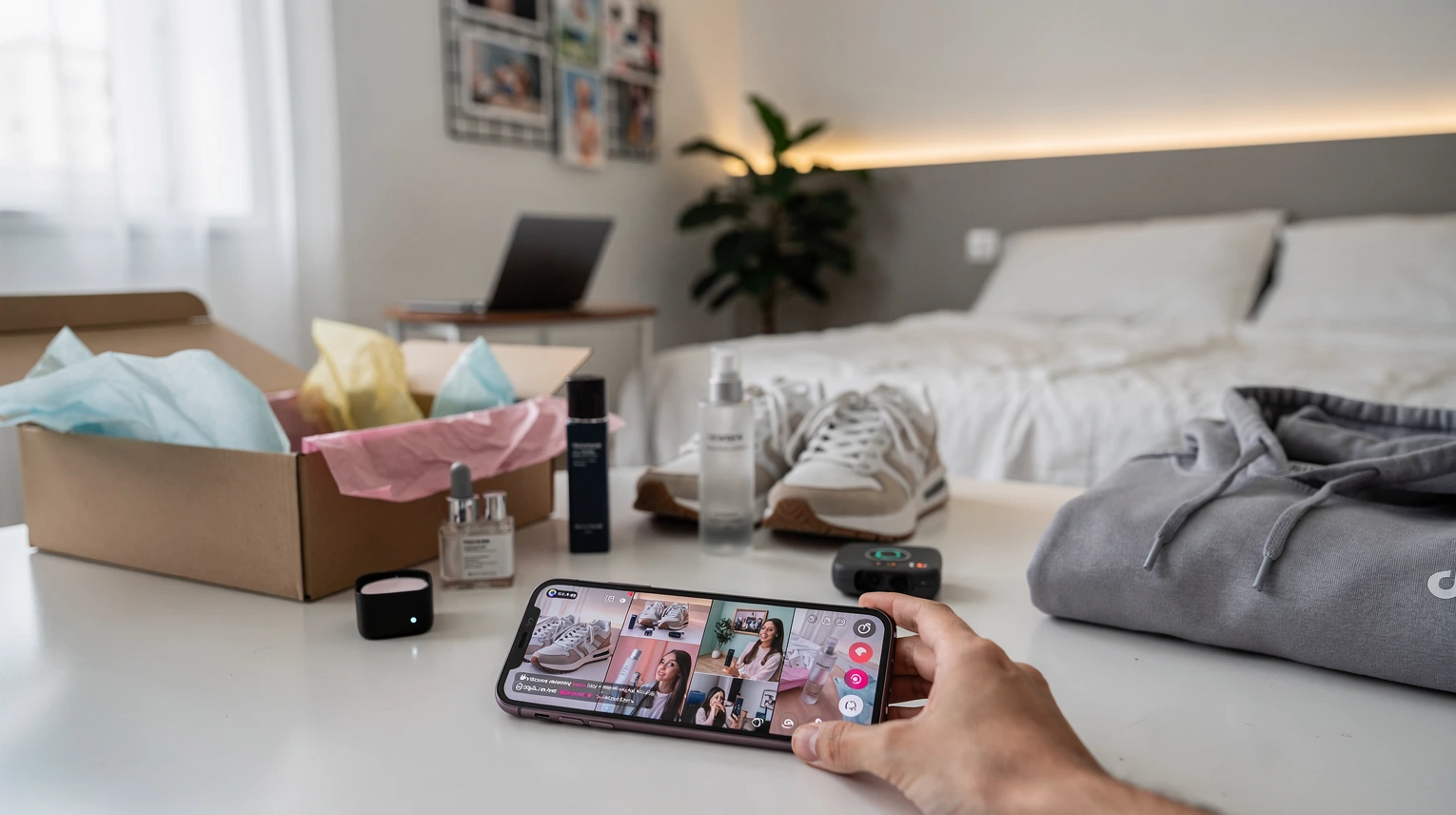
For roughly 40% of Gen Z shoppers, the first move when they want a product is not Google and not Amazon: it is the TikTok search bar. That single behavioral shift rewires how retail brands earn discovery, because the platform now functions as a visual answer engine where short clips, creator reviews, and comment threads stand in for the old blue-link results page. Retailers who still treat TikTok as a brand-awareness channel are measuring the wrong thing while a younger cohort quietly routes its purchase intent through a feed they trust more than a search index.
This guide breaks down exactly how Gen Z and younger millennial buyers query TikTok, what ranks inside its search results, what the buying loop looks like in practice, and the concrete steps a retail or e-commerce team should take in 2026 to show up at the precise moment intent is highest. The framing matters: this is not a social-media-marketing problem, it is a search-visibility problem that happens to live inside a video app.
In short
- Around 40% of Gen Z reach for TikTok or Instagram before a traditional search engine when researching products, and TikTok search has become a primary discovery surface, not a vanity metric.
- TikTok ranks search results on relevance, watch-through, recency, and engagement signals like saves and comments, so optimization looks more like video SEO than paid social.
- The buying loop is research heavy: discovery on the feed, verification in comments and creator reviews, then a checkout that may happen in-app, on a marketplace, or in a physical store.
- Captions, on-screen text, spoken keywords, and hashtags all feed the search index, so retailers must seed all four with the language their buyers actually type.
- The biggest mistakes are chasing viral reach over searchable intent and ignoring the comment section, which acts as the trust layer that closes the sale.
Why Gen Z treats TikTok as a search engine
The short answer: speed and trust. A typed query on TikTok returns a stack of 15 to 60 second demonstrations, real-mouth reviews, and unboxing clips faster than a buyer can parse a page of text results, and the format shows the product in use rather than describing it. For a generation that grew up inside video feeds, watching a thing work is more persuasive than reading a spec sheet.
This is not a fringe habit. As we covered in our analysis of the state of consumer behavior in retail and e-commerce, the under-27 cohort increasingly anchors product research to social video, and the gap between social discovery and search-engine discovery keeps narrowing each quarter. Google’s own internal research, widely reported, found that close to 40% of young users go to TikTok or Instagram first for things like lunch spots and, increasingly, physical products.
The behavior compounds because TikTok’s recommendation system learns from the same signals that searchers generate. When a buyer searches a category, watches three reviews, saves one, and reads the comments, the platform treats that session as intent and surfaces tighter results next time. The feed and the search bar feed each other, which is why a single well-optimized review video can keep earning impressions for months after upload.
There is also a generational distrust of polished marketing at work. Gen Z buyers have learned to discount brand-controlled messaging and to weight peer evidence heavily, and TikTok’s format makes peer evidence the default. A shaky phone video from a stranger who clearly bought the product with their own money outperforms a studio ad on the same query, because it reads as testimony rather than persuasion. That preference flips the traditional funnel: the brand’s job is no longer to make the most beautiful asset, it is to be present and credible in the results a real person already trusts.
The same logic extends to younger millennial buyers, who bridge two habits. They still run a confirmatory Google search and read written reviews, but they increasingly open TikTok first to see the product move, then validate the price and specs elsewhere. Treating the two cohorts as one undifferentiated audience is a mistake, but the shared thread is clear: video-first discovery is now the front door for both.
How TikTok search ranking actually works
Answer first: TikTok ranks search results on a blend of textual relevance, behavioral engagement, and freshness, and it indexes far more than the hashtag. The platform reads the caption, the on-screen text overlays, the spoken audio (auto-transcribed), the sounds used, and the hashtags, then weighs those against watch-through rate, completion, shares, saves, and comment velocity.
That makes TikTok optimization a discipline that sits closer to video SEO than to paid social buying. The practical implication is that a clip needs to say its target keyword out loud, show it as text on screen, and repeat it in the caption, because the index pulls from all three channels independently. A video that demonstrates a product perfectly but never names the query it answers is invisible to a searcher, no matter how good the footage.
| Ranking signal | What feeds it | Retailer action |
|---|---|---|
| Textual relevance | Caption, on-screen text, auto-transcribed speech, hashtags | Say and write the exact query terms buyers type |
| Watch-through | Average view duration, completion rate | Hook in the first 2 seconds, demonstrate the payoff fast |
| Engagement depth | Saves, shares, comment volume and speed | Prompt a save (“keep this for later”), answer comments quickly |
| Recency | Upload date, trending sound usage | Refresh evergreen topics on a cadence, ride relevant sounds |
| Creator trust | Niche consistency, follower-to-engagement ratio | Partner with mid-tier niche creators over broad celebrities |
Note the weight on saves: a save is the clearest research signal a shopper can send, because it means “I intend to act on this later.” Retailers who explicitly ask viewers to save a comparison or sizing clip tend to outrank flashier videos that chase raw views. Shares carry similar weight because they imply the content was useful enough to pass to someone with the same problem, which the algorithm reads as a strong relevance vote.
Freshness deserves its own emphasis. Unlike Google, where a well-aged page can rank for years, TikTok search visibly favors recent uploads, especially when paired with a sound that is trending in the moment. This means the same high-intent topic, say a sizing guide for a popular sneaker, benefits from being re-shot every few months rather than published once and abandoned. The cost of a refresh is low, and the visibility payoff is disproportionate.
The auto-transcription layer is the most overlooked lever. Because TikTok transcribes spoken audio and indexes it, the words a creator actually says become searchable text even when they never appear in the caption. A practical discipline is to script the first two sentences of every product video so they contain the literal query a buyer would type, then deliver them naturally on camera. This single habit lifts a video into searches the team never explicitly targeted.
The Gen Z buying loop, step by step
The purchase journey on TikTok is rarely a straight line from ad to checkout. It is a research loop, and understanding the order matters because each stage demands different content and a different success metric. Here is the sequence most younger buyers follow.
- Trigger: a problem or want surfaces, often seeded by a passive feed clip the buyer did not search for.
- Active search: the buyer types a category or problem query (“best running belt,” “jeans for curvy fit”) into the TikTok search bar.
- Verification: they watch three to five clips, then drop into the comments to check for complaints, dupes, and sizing notes.
- Cross-check: high-consideration items get a second pass on Google, Reddit, or a marketplace review section.
- Purchase: checkout happens in TikTok Shop, on the brand site, on a marketplace, or in store, depending on price and urgency.
- Post-purchase loop: the buyer may post their own review, feeding the next person’s search and closing the cycle.
The verification stage is where most retailers lose the sale, and it is the least controllable: the comment section is a public verdict written by strangers. The data on this is messier than the marketing suggests, a point we examine in detail in our piece on social commerce behavior among Gen Z, data versus narrative, where in-app checkout adoption lags well behind discovery. Discovery on TikTok is near universal among young buyers; the actual transaction frequently migrates elsewhere, and conflating the two leads to badly designed measurement.
Each stage rewards a distinct content type. The trigger stage rewards pattern-interrupt hooks and lifestyle context. The active-search stage rewards keyword-matched, problem-named videos. The verification stage rewards honest demonstrations and, crucially, a brand presence in the comments. The cross-check stage rewards consistency: if the TikTok claim survives a Google search and a Reddit thread, the sale holds; if it does not, the buyer drops out and rarely returns. Mapping content to the loop, rather than producing one generic clip per product, is the difference between a feed that decorates and a feed that sells.
It is worth stressing how comment-driven the verification stage is. A typical sequence is: the buyer pauses a promising review, taps into comments, sorts implicitly by what TikTok surfaces, and scans for the words “runs small,” “broke after,” “better dupe,” or “worth it.” Whatever sits at the top of that thread effectively becomes the product page. A brand that has answered the runs-small question in a pinned reply has authored its own product description; a brand that has not has ceded that page to whoever complained loudest.
What retailers should publish to win TikTok search
Answer first: publish searchable, problem-led content that names the query, not branded hype that names the company. The buyer typing “is this worth it” does not search your brand, so the video has to match the question, not the campaign. This is the single most common reframe a retail team needs to internalize, because it inverts the instinct to lead with logos and taglines.
Concrete formats that perform in search results include side-by-side comparisons, honest sizing and fit breakdowns, “three things nobody tells you about X” lists, and demonstrations of the single most-doubted feature. Each of these maps to a query a shopper actually types during verification. The sustainability angle is its own searchable lane, and getting it right means substance over slogans, which we unpack in what sustainable retail actually means beyond the marketing rather than greenwashed claims that invite a comment-section backlash.
Creator selection is the other half of the equation. Mid-tier niche creators with 10,000 to 100,000 followers and a consistent vertical typically convert search intent better than mass-reach celebrities, because TikTok’s index associates their account with a topic and surfaces them on relevant queries. A creator who only posts about running gear ranks for running-gear searches; a generalist with ten times the following ranks for nothing in particular. Building those relationships is a team-and-trust question as much as a media-buying one, the kind of partnership thinking explored in our look at co-founders in retail and who you bring in.
Cadence beats spectacle. A steady stream of searchable, problem-led clips trains the index to treat an account as authoritative on its category, while a single big-budget viral attempt rarely sustains visibility. A realistic operating rhythm is two to four high-intent videos a week per priority category, with the top performers re-shot quarterly to keep the freshness signal alive. The production bar can be modest: clarity, honesty, and keyword discipline outrank gloss.
For credibility on claims, lean on third-party data rather than self-reported reach. Platforms like the Pew Research Center publish independent figures on teen and young-adult platform use that hold up better in a board deck than vendor case studies, and citing them inside your own content also builds the kind of authority that survives the cross-check stage.
Finally, design every video for the save and the comment, not the like. Close each clip with a reason to save (a promised follow-up, a sizing chart, a price-watch) and a question that invites a comment, because those two signals do more for search ranking than a passive like ever will. The retail teams that treat the call-to-action as a ranking input, not a courtesy, are the ones that climb the results page.
Common mistakes
The first and most expensive mistake is optimizing for views instead of searchable intent. A clip with two million impressions and zero keyword in the caption ranks for nothing and converts nobody who was actually looking. Reach is a vanity number when the goal is discovery at the moment of intent, and chasing it often pulls a team toward trend-bait that has nothing to do with the products it sells.
The second mistake is treating the comment section as a support inbox to be ignored. Comments are the trust layer: an unanswered complaint at the top of a video kills the sale for every subsequent viewer, while a fast, human reply can flip skepticism into a purchase. Staffing comment response within the first hour of an upload is not optional, because the early comments often calcify into the thread everyone else reads.
The third is forcing in-app checkout when the buyer’s habit points elsewhere. Pushing TikTok Shop on a category where your audience prefers to buy on a marketplace or in store adds friction and depresses conversion. Map the checkout to the behavior, and remember that retail discovery and retail transactions increasingly happen on different surfaces, a dynamic that ripples across the industry as discussed in how retail news shapes the global e-commerce industry today.
A fourth, quieter mistake is publishing once and walking away. Because recency is a live ranking input, evergreen high-intent topics decay in search visibility if they are never refreshed. Teams that treat a sizing guide or comparison as a permanent asset, the way they would a blog post, watch it sink while a rival’s freshly re-shot version takes the slot. The fix is a refresh calendar, not a one-time shoot.
Frequently asked questions
Is TikTok really replacing Google for Gen Z product search?
Not replacing, but supplementing and often leading. Roughly 40% of young users start product and local research on TikTok or Instagram before a traditional search engine. For low-to-mid consideration items, TikTok frequently closes the research loop on its own. For higher-consideration purchases, buyers still cross-check on Google, a marketplace, or Reddit. The accurate framing is that TikTok now owns the discovery and early-verification stages, while search engines retain a role in the final due-diligence step.
What ranks a video in TikTok search results?
TikTok blends textual relevance with behavioral and freshness signals. It indexes the caption, on-screen text, auto-transcribed speech, sounds, and hashtags, then weighs them against watch-through rate, completion, saves, shares, and comment velocity. Recency and the creator’s topical consistency matter too. The practical takeaway is to state your target keyword out loud, place it as on-screen text, and repeat it in the caption, then earn saves and comments, because saves are the strongest signal that a viewer intends to act later.
Do I need TikTok Shop to benefit from TikTok search?
No. TikTok Shop helps when your audience already buys in-app, but discovery on TikTok drives sales across every channel, including your own site, marketplaces, and physical stores. Forcing in-app checkout on a category where buyers prefer to purchase elsewhere adds friction. Treat TikTok search as a discovery and verification engine first, then route the transaction to wherever your specific audience already completes purchases, measuring assisted conversions rather than only in-app sales.
Which creators should retailers work with for search visibility?
Mid-tier niche creators, roughly 10,000 to 100,000 followers, with a consistent vertical, usually outperform mass-reach celebrities for search intent. TikTok’s index associates a consistent account with its topic and surfaces it on relevant queries, so a creator who only posts about running gear will rank for running-gear searches. High engagement-to-follower ratios and authentic, demonstration-style content convert verification-stage viewers far better than polished, broad-appeal endorsements that read as advertising.
How do I measure whether TikTok search is working?
Move past raw views. Track saves, comment sentiment and volume, search-tab impressions if available in analytics, and assisted conversions across channels using post-purchase surveys that ask where customers first discovered you. A rising save rate and growing branded-plus-category search volume signal genuine discovery traction. Cross-reference with on-site traffic spikes that follow video uploads. The goal is to connect a searchable clip to downstream revenue, not to celebrate impressions that never reached anyone with intent.
How often should we refresh TikTok content for search?
Recency is a ranking input, so evergreen, high-intent topics deserve a refresh cadence rather than a single upload. Re-shoot core comparison, sizing, and “is it worth it” videos every few months, especially when product lines or pricing change, and ride relevant trending sounds to pick up a freshness boost. Consistency beats volume: a steady stream of searchable, problem-led clips trains the index to treat your account as authoritative on your category.
Does this behavior apply to millennial buyers too, or only Gen Z?
It applies to both, with a difference of degree. Younger millennials increasingly open TikTok first to see a product in motion, then confirm price and specs on Google or a marketplace, blending video-first discovery with their older habit of reading written reviews. Gen Z is further along, often completing the entire research loop inside TikTok for lower-consideration items. Plan for both: lead with searchable video, but keep the cross-check stage well served with credible, consistent information elsewhere.
What’s next
The near-term move is to audit which queries your category buyers actually type, then map one searchable video format to each high-intent question and assign someone to own comment response within the hour. As the discovery-to-transaction split widens, the retailers who win will be the ones who treat TikTok search as an answer engine and measure assisted conversions across channels, the broader shift we track in the state of consumer behavior in retail and e-commerce. Pair that with the verification-stage realities laid out in our social commerce data analysis, and you have a discovery strategy grounded in how younger buyers actually behave rather than how the platform markets itself.