
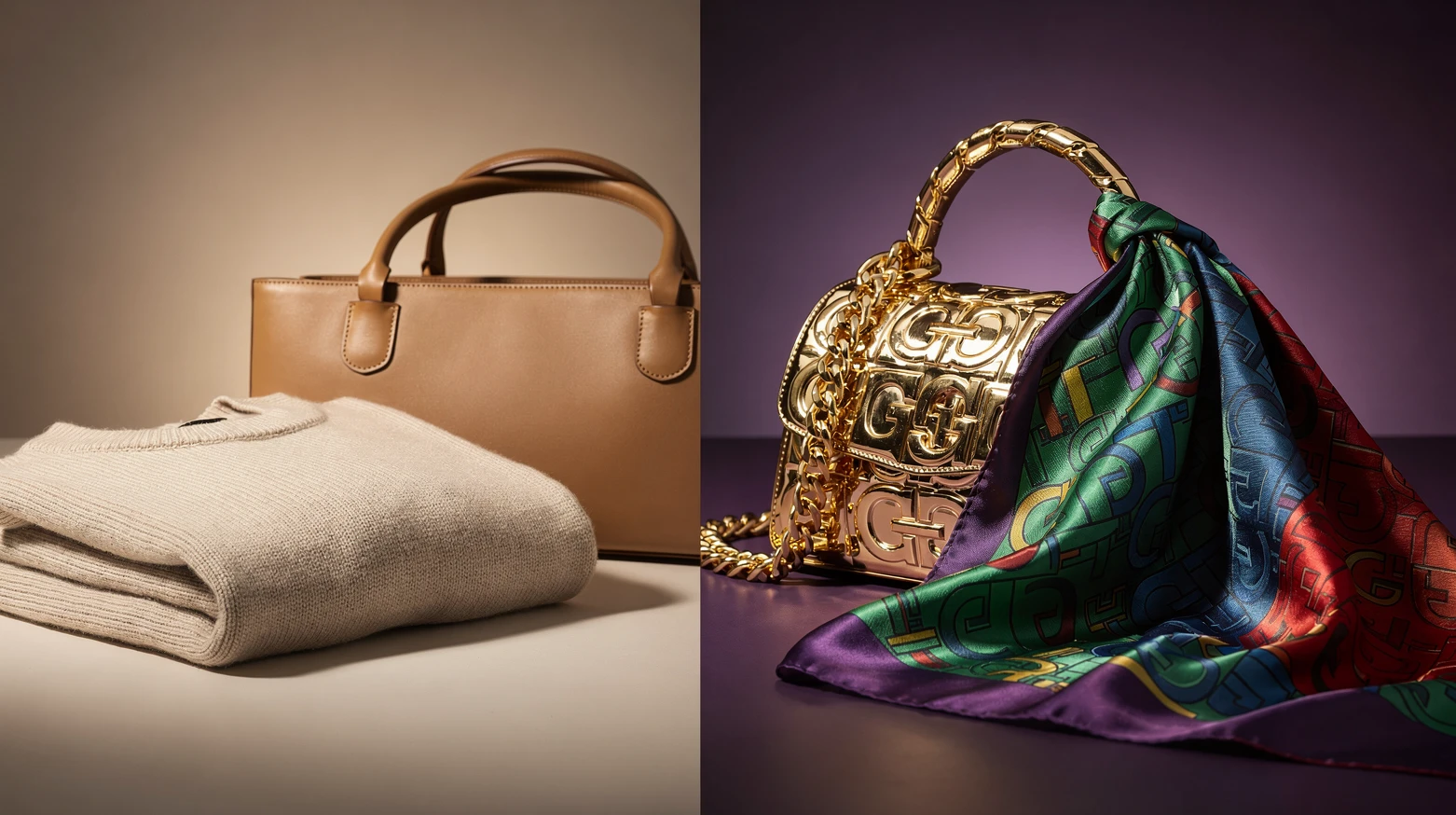
The loudest debate in consumer retail right now is, paradoxically, about quietness. Quiet luxury, the muted, logo-free aesthetic of expensive simplicity, has spent two years reshaping how affluent shoppers signal status. Loud luxury, its maximalist counterpart of visible logos, saturated color and unmistakable branding, never went away and is reasserting itself in 2026. For US retail and e-commerce teams, the split between these two impulses is not a styling footnote. It changes assortment, pricing, photography, search strategy and the entire merchandising calendar, and it maps directly onto the broader shifts covered in our pillar on the state of consumer behavior in retail and e-commerce.
In short
- Quiet luxury sells status through restraint: premium materials, no visible logos, neutral palettes and craftsmanship that only insiders recognize. It rewards quality cues over branding.
- Loud luxury sells status through visibility: prominent logos, bold color, statement silhouettes and instantly legible brand codes. It rewards recognition and aspiration.
- The split is not a trend cycle replacing one with the other. In 2026 both run in parallel, often inside the same customer’s wardrobe and the same shopping cart, segmented by occasion and mood.
- For retailers, the operational impact lands on assortment architecture, product photography, search and category strategy, and pricing tiers, not just marketing copy.
- The biggest mistake is treating the two as a binary and picking a side. The winning approach reads the signal per category and per customer moment, then merchandises for both.
Why the quiet versus loud luxury split matters in 2026
For most of the past decade, luxury merchandising followed a fairly predictable logo cycle. Branding intensity rose and fell with the macro economy, with visible logos peaking in confident years and receding in cautious ones. What changed by 2026 is that the two modes stopped taking turns and started running simultaneously, served to overlapping audiences across the same channels.
This matters because the merchandising decisions behind quiet and loud luxury point in opposite directions. A quiet luxury program optimizes for fabric weight, construction detail, tonal photography and a calm, editorial site experience. A loud luxury program optimizes for color blocking, logo placement, hero product drama and high-contrast imagery built to stop a thumb mid-scroll. Trying to run both through a single template flattens both.
The financial stakes are concrete. Affluent and aspirational shoppers represent a disproportionate share of full-price sell-through and basket value, and they are the customers most sensitive to whether a brand reads as credible in its chosen register. Get the signal wrong and the product feels either pretentious or cheap. Get it right and the same SKU can carry a meaningfully higher price and a lower markdown rate.
There is also a discovery dimension. Quiet luxury and loud luxury surface differently in search, on social platforms and in AI shopping assistants, because the language, imagery and intent behind each are distinct. A retailer that understands the split can structure categories, tags and metadata so that both kinds of shopper find the right products through the channel that fits their intent.
Key terms: what quiet luxury and loud luxury actually mean
Before the merchandising implications make sense, the definitions have to be precise. These terms get used loosely in fashion press, but for retail teams they carry specific, testable attributes that show up in product attributes, imagery and copy.
Quiet luxury, defined
Quiet luxury is status expressed through restraint. The product communicates value through material quality, construction and silhouette rather than through any visible mark of the brand. Think undyed cashmere, full-grain leather without hardware branding, precise tailoring and a palette built from camel, ivory, charcoal, navy and stone. The broader cultural framing is well documented in the Wikipedia entry on quiet luxury, which traces the aesthetic from old-money dressing to its current mainstream moment.
The defining promise is connoisseurship. The value is legible to people who know what they are looking at, and invisible to everyone else. That makes quiet luxury inherently a knowledge game, which is why the category leans so heavily on storytelling about provenance, mills, ateliers and materials.
Loud luxury, defined
Loud luxury is status expressed through visibility. The brand mark is the product, or close to it: monogram canvas, oversized logos, signature hardware, instantly recognizable color codes and silhouettes engineered to be identified from across a room. The value is recognition, and the promise is unmistakable membership in an aspirational world.
Loud luxury is not the same as low quality, and conflating the two is a common analyst error. Many of the most expensive products in the market are loud by design, because their buyers want the signal to be seen. The register is about communication strategy, not price tier or construction quality.
The middle and the overlap
Most real assortments live between the poles. A tonal bag with discreet but present hardware, a sweater with a small embroidered mark, a sneaker with a recognizable but subtle silhouette: these are hybrids, and they often outsell the purist versions of either extreme. The split is better understood as a spectrum with two gravitational centers than as two sealed boxes.
How the split shows up in real consumer behavior
The most important insight for 2026 is that quiet and loud luxury are not two tribes of people. They are two modes that the same shopper switches between depending on occasion, audience and mood. The professional who wears unbranded tailoring to the office buys a bold logo bag for travel and weekends, and sees no contradiction in it.
This mode-switching has direct merchandising consequences. It means a single customer profile can convert on both registers, so segmenting purely by demographic or even by past purchase misses the pattern. The better segmentation is by occasion and intent, which is closer to how shoppers actually decide.
The split also intersects with the value economy in interesting ways. The same restraint that drives quiet luxury also feeds the dupe and value-shopping behavior reshaping the mass market, where shoppers chase the look of quality without the logo premium. We covered that adjacent dynamic in our analysis of how dupe culture and value shoppers shifted retail in 2026, and the merchandising lessons rhyme: legibility of quality matters more than the label.
On the loud side, the behavior is driven by social visibility and aspiration. Loud luxury performs in environments built for display, where a product needs to be recognized to do its job. That is why loud pieces over-index in social commerce, gifting and travel retail, while quiet pieces over-index in considered, research-led purchases.
Generation and channel cut across the split
The quiet versus loud divide does not map neatly onto age, which is what makes it tricky to plan against. Younger shoppers are often assumed to favor loud, social-friendly pieces, yet a large segment of them drives the quiet movement through a craft-and-sustainability lens. Older affluent shoppers, long associated with discreet taste, increasingly buy loud statement pieces as self-reward purchases.
Channel behavior is a cleaner predictor than age. Loud luxury converts hardest where products are seen by an audience, which means short video, livestream and influencer feeds. Quiet luxury converts hardest where products are researched in private, which means search, considered browsing and editorial content. A retailer can read the likely register of demand from the channel a session arrives through, then tailor the landing experience to match.
That channel signal is operationally useful. A visitor arriving from a video platform is more receptive to bold hero imagery and statement framing, while a visitor arriving from organic search for a material term is more receptive to a calm, detail-rich page. Matching the page register to the arrival channel lifts conversion on both sides without changing the underlying assortment.
Why economic mood shapes the mix
The relative weight of quiet and loud shifts with consumer confidence, but not in a simple way. In uncertain periods, some shoppers retreat to quiet luxury as a hedge that reads as tasteful rather than ostentatious, while others lean into loud pieces as affordable doses of optimism. Both impulses can rise at once in different categories, which is exactly what makes 2026 unusual.
For US retailers, tracking this mix against macro indicators is worth the effort. Spending patterns in discretionary apparel and accessories are visible in public data such as the Bureau of Labor Statistics Consumer Expenditure Surveys, which can anchor assortment planning in real spend behavior rather than runway narrative.
Quiet versus loud luxury: a side-by-side comparison
The clearest way to operationalize the split is to lay the two registers against the attributes a retail team actually controls. The table below maps the difference across the levers that matter for assortment and site experience.
| Attribute | Quiet luxury | Loud luxury |
|---|---|---|
| Core signal | Restraint, craftsmanship, insider recognition | Visibility, branding, instant recognition |
| Palette | Neutrals: camel, ivory, charcoal, navy, stone | Saturated and contrast: red, gold, monochrome logo prints |
| Logo treatment | Absent or discreet, often tonal | Prominent, repeated, central to the design |
| Hero attribute in copy | Material, mill, construction, provenance | Brand codes, iconic silhouette, statement |
| Photography | Tonal, editorial, texture-forward, calm | High-contrast, bold, thumb-stopping, dramatic |
| Primary discovery channel | Search and considered research, editorial | Social commerce, video, influencer feeds |
| Purchase trigger | Quality reassurance, long consideration | Visibility, aspiration, impulse |
| Markdown sensitivity | Lower if quality story holds | Higher if hype cycle fades |
The point of the table is not to choose a column. It is to recognize that almost every operational lever, from the words in a product title to the lighting in a photo, has a quiet setting and a loud setting, and that those settings should be deliberate per product rather than applied as a house default.
Common mistakes and how to avoid them
The split is easy to describe and hard to execute, because most retail systems push toward a single house style. These are the failure patterns that show up most often when teams try to serve both registers, and the practical corrections for each.
Treating the split as a binary brand decision
The most expensive mistake is deciding the whole brand is quiet or loud and forcing every product through that filter. Real assortments need both registers, weighted by category. A retailer can run a quiet-leaning tailoring line and a loud-leaning accessories line under one roof, as long as the photography, copy and merchandising are tuned per line rather than per brand.
The correction is to set the register at the category or collection level, not the brand level. Define which clusters lean quiet, which lean loud, and which are deliberate hybrids, then enforce that consistently within each cluster.
Letting one photography template flatten both
Quiet and loud products need different light, different backgrounds and different crops. A single studio template, usually built for whichever register launched first, makes quiet products look cheap and loud products look muted. Both lose.
The correction is to maintain two photography recipes and route products to the right one by attribute. Texture-forward, tonal shots for quiet pieces, high-contrast and color-forward shots for loud ones, with consistent rules so the site still feels coherent.
Using the same copy and metadata for both
Quiet and loud shoppers search with different language and respond to different hooks. Quiet buyers search for material, fit and provenance terms, while loud buyers search for brand, model and statement terms. Generic copy serves neither well and weakens organic discovery.
The correction is to write product copy and structure metadata around the register. This is where category and search strategy intersect directly with merchandising, and it is worth reading alongside our guide to category page SEO as the hub of a healthy retail site, because the category layer is where these signals get organized for both shoppers and search engines.
Ignoring the markdown asymmetry
Loud luxury carries more markdown risk because it is tied to hype cycles that can fade, while quiet luxury holds value longer if the quality story is real. Buying both registers on the same open-to-buy assumptions leads to overstock on loud pieces when a trend turns.
The correction is to plan inventory depth and markdown cadence per register. Hold tighter buys and faster markdown triggers on loud, trend-driven pieces, and allow longer sell-through windows on quiet, quality-led ones.
Examples from US retail and e-commerce
The split is visible across the US market in 2026, from luxury houses to mass retailers borrowing the codes. Looking at how different tiers handle it makes the merchandising lessons concrete.
At the top of the market, established houses run dual-track assortments deliberately. Their tailoring and outerwear lean quiet, photographed in tonal editorial style and sold on craftsmanship, while their accessories and seasonal capsules lean loud, photographed in bold color and sold on iconic codes. The same brand, same site, two registers, segmented by category.
In the contemporary and premium tier, the clearest winners are the brands that built an unmistakable quiet identity and own the material story. Their entire site experience reinforces restraint, from muted photography to copy that foregrounds fabric and fit. That coherence is itself the competitive moat, and it is hard for a logo-driven competitor to copy quickly.
At the mass and value end, retailers borrow the quiet aesthetic to trade up perception without raising cost dramatically, which connects directly to the dupe and value behavior reshaping the middle market. The look of quiet luxury, neutral palettes and clean silhouettes, is cheap to photograph and merchandise, which is why it spread so fast down the price ladder.
Resale and rental markets add another data point. Quiet luxury pieces with strong material stories tend to hold resale value because their appeal is not tied to a moment, while loud, trend-led pieces can swing sharply with the hype cycle. Retailers watching secondary-market pricing get an early read on which register is gaining or losing durability of demand.
The cross-tier lesson sits inside the broader consumer picture mapped in our pillar on the state of consumer behavior in retail and e-commerce: shoppers read quality and status cues fluently across price points, so the register a product projects often matters more to conversion than the absolute price.
| Retail tier | How quiet luxury shows up | How loud luxury shows up |
|---|---|---|
| Luxury houses | Tailoring and outerwear, tonal editorial photography | Logo accessories, bold seasonal capsules |
| Premium and contemporary | Material-led brand identity, restrained site design | Statement collaborations and limited drops |
| Mass and value | Borrowed neutral aesthetic to trade up perception | Bold graphics and licensed branding for impulse |
Tools, partners and vendors worth knowing
Executing a dual-register strategy is mostly a systems and process problem, not a creative one. The teams that do it well lean on a specific set of tools and partner types to keep two registers coherent at scale.
On the product information side, a capable product information management system is the backbone. It lets a team tag register, palette, logo treatment and material story as structured attributes, then drive photography routing, copy templates and category placement from those tags rather than from manual judgment per SKU.
On the photography side, the practical choice is between a studio partner that can run two recipes reliably and an increasingly capable set of AI imaging and styling tools for on-model and still-life variation. The non-negotiable is consistency within each register, so whichever partner runs the work needs documented recipes for light, background and crop.
On the discovery side, the toolset spans search and merchandising platforms, on-site search tuning and the metadata layer that feeds both organic search and AI shopping assistants. The relevant vendors are the usual site-search and product-discovery providers, but the differentiator is less the tool and more the attribute discipline feeding it.
On the demand-sensing side, the value is in connecting trend signals to open-to-buy. Social listening and trend-forecasting services help time loud, trend-driven buys, while harder spend data anchors the quiet, evergreen core. The pairing matters: loud needs early trend signal, quiet needs durable demand evidence.
What to prioritize if budget is limited
If a team can only fix one thing, it should be the attribute layer. Clean, structured register and material tags unlock photography routing, copy templating and category logic downstream, and they cost far less than rebuilding the storefront. The attribute layer is the cheapest high-leverage investment in the entire stack.
How to merchandise for both signals at once
The endpoint of all this is a practical playbook that lets one retail operation serve both registers without diluting either. The sequence below is the order experienced teams tend to follow.
Start by classifying the assortment. Tag every product as quiet, loud or hybrid, plus palette and logo treatment, so the register becomes a first-class attribute rather than a vibe. This single step makes every later decision routable and auditable.
Then route execution from those tags. Photography recipe, copy template, category placement and even email module selection should follow the register attribute automatically, so a quiet product never gets loud treatment by accident and vice versa. Automation here is what keeps coherence as the catalog scales.
Next, plan inventory and markdown per register. Quiet pieces get longer sell-through windows and steadier buys, loud pieces get tighter buys and faster markdown triggers tied to trend decay. Treating the two registers with one open-to-buy model is what creates the overstock problem described earlier.
Finally, measure per register. Track full-price sell-through, markdown rate and return rate split by quiet, loud and hybrid, because the blended numbers hide the truth. When the data is split, it becomes obvious which register is over- or under-bought, and the next season’s plan corrects itself.
None of this requires picking a side in the cultural debate. The retailers winning in 2026 treat quiet and loud as two tools rather than two camps, and they build the systems to deploy each one deliberately. The cultural conversation will keep swinging between restraint and excess, but the operational answer stays the same: read the signal per product and per moment, then merchandise, photograph and price to match. That discipline, more than any single trend call, is what turns the split from a styling headache into a margin advantage.
Frequently asked questions
Is quiet luxury replacing loud luxury in 2026?
No. The defining feature of 2026 is that both run in parallel rather than one replacing the other. Many shoppers switch between the two registers by occasion and mood, so the practical strategy is to serve both rather than bet on a single winner.
What is the core difference between quiet and loud luxury?
Quiet luxury signals status through restraint, material quality and the absence of visible branding, so its value is legible mainly to insiders. Loud luxury signals status through visibility, prominent logos and instant recognition. Both can sit at the same high price point; the difference is communication strategy, not quality or cost.
Does loud luxury mean lower quality?
No, and assuming so is a common analyst error. Many of the most expensive products in the market are loud by design because their buyers want the brand signal to be visible. Quietness and loudness describe how a product communicates, not how well it is made.
Which categories lean quiet and which lean loud?
Tailoring, outerwear, knitwear and leather goods tend to lean quiet, where material and construction carry the value. Accessories, sneakers, seasonal capsules and gifting items tend to lean loud, where recognition and statement drive the purchase. Many assortments deliberately split along exactly these lines.
How should photography differ between the two registers?
Quiet products need tonal, texture-forward, editorial photography with calm backgrounds and crops that show construction. Loud products need high-contrast, color-forward, dramatic imagery built to stop a scroll. Running both through a single studio template makes quiet pieces look cheap and loud pieces look muted.
How does the split affect SEO and product discovery?
Quiet and loud shoppers search with different language, so copy and metadata should be written around the register. Quiet buyers search material, fit and provenance terms; loud buyers search brand, model and statement terms. Organizing this at the category layer, as covered in our category page SEO guide, helps both shoppers and search engines find the right products.
Does loud luxury carry more markdown risk?
Generally yes. Loud, trend-driven pieces are tied to hype cycles that can fade, which raises markdown risk if buys are too deep. Quiet, quality-led pieces tend to hold value longer, so they can support longer sell-through windows. Planning inventory depth and markdown cadence per register avoids overstock when a loud trend turns.
What is the first step for a retailer trying to serve both?
Classify the assortment. Tag every product with its register, palette and logo treatment so quiet, loud and hybrid become structured attributes. That single step lets photography, copy, category placement and inventory planning all route automatically, and it is the cheapest high-leverage move in the entire stack.
Can mass and value retailers use these signals?
Yes, and many already do. The quiet aesthetic of neutral palettes and clean silhouettes is inexpensive to photograph and merchandise, so value retailers use it to trade up perception without raising cost much. The same shoppers read quality cues fluently across price points, so the register a product projects often matters more to conversion than its absolute price.