
Alibaba Group has put roughly $1.5 billion on the table to buy Pupu, a fast-growing Chinese grocery delivery platform, a move that would hand the e-commerce giant a ready-made network of neighborhood warehouses and push its long-running fight with Meituan deeper into the country’s most contested retail battleground. People familiar with the matter, as reported by Nikkei Asia and Bloomberg, say the offer is more than double a rival bid and has triggered a contest for one of the last sizable independent players in China’s instant-retail market.
The talks, which neither company has confirmed, land at a delicate moment. Chinese regulators have spent the spring warning the country’s largest platforms to cool an escalating subsidy war, and a headline acquisition in the same sector invites fresh scrutiny. For Alibaba, the calculation is straightforward: instant retail is growing faster than almost any other part of its business, and Pupu controls dense coverage in a region where Alibaba has historically been weak.
In short
- The bid: Alibaba has offered about $1.5 billion for Pupu, a Fuzhou-based on-demand grocery platform, according to people cited by Nikkei Asia and Bloomberg.
- The premium: The figure is more than double an earlier offer of roughly $600 million from Sun Art Retail, setting up a bidding contest.
- Why it matters: Pupu runs more than 400 forward warehouses concentrated in South China, where Alibaba’s instant-retail footprint is thin.
- The rivalry: The deal is aimed squarely at Meituan and JD.com, which have been pouring money into 30-minute delivery of groceries and daily goods.
- The catch: Beijing has publicly criticized “involution-style” price wars among platforms, so any large consolidation faces a tougher antitrust climate.
What Alibaba is proposing
According to reporting from Nikkei Asia and Bloomberg, Alibaba is weighing an acquisition of Pupu valued at about $1.5 billion. The Chinese-language financial press, including 21st Century Business Herald, put the figure at roughly 11.8 billion Hong Kong dollars, equivalent to around 10.1 billion yuan at current rates. At an exchange rate of roughly 7.2 yuan to the dollar, those numbers line up closely with the $1.5 billion headline.
The structure of the deal has not been disclosed, and both Alibaba and Pupu declined to comment when contacted by Chinese reporters. People familiar with the discussions stressed that no agreement has been signed and that Pupu has not committed to selling. In other words, this is a live negotiation rather than a closed transaction.
What is clear is the strategic intent. Alibaba is trying to buy capacity, not just a brand. Pupu’s value sits in its physical network and its operating know-how in fresh groceries, a category that is notoriously hard to run profitably at speed. Acquiring that capability outright would be faster than building it warehouse by warehouse.
The reported price also signals seriousness. A bid at more than twice a competing offer is not a probing gesture. It suggests Alibaba views Pupu as a scarce asset whose absence from a rival’s portfolio is worth paying up to prevent.
Who Pupu is and why it matters
Pupu, known in Chinese as Pupu Supermarket, was founded in June 2016 by Chen Xingwen and is headquartered in Fuzhou, the capital of Fujian province. It is one of a small group of Chinese companies that built a business around fast, app-only grocery delivery rather than physical storefronts.
The forward-warehouse model
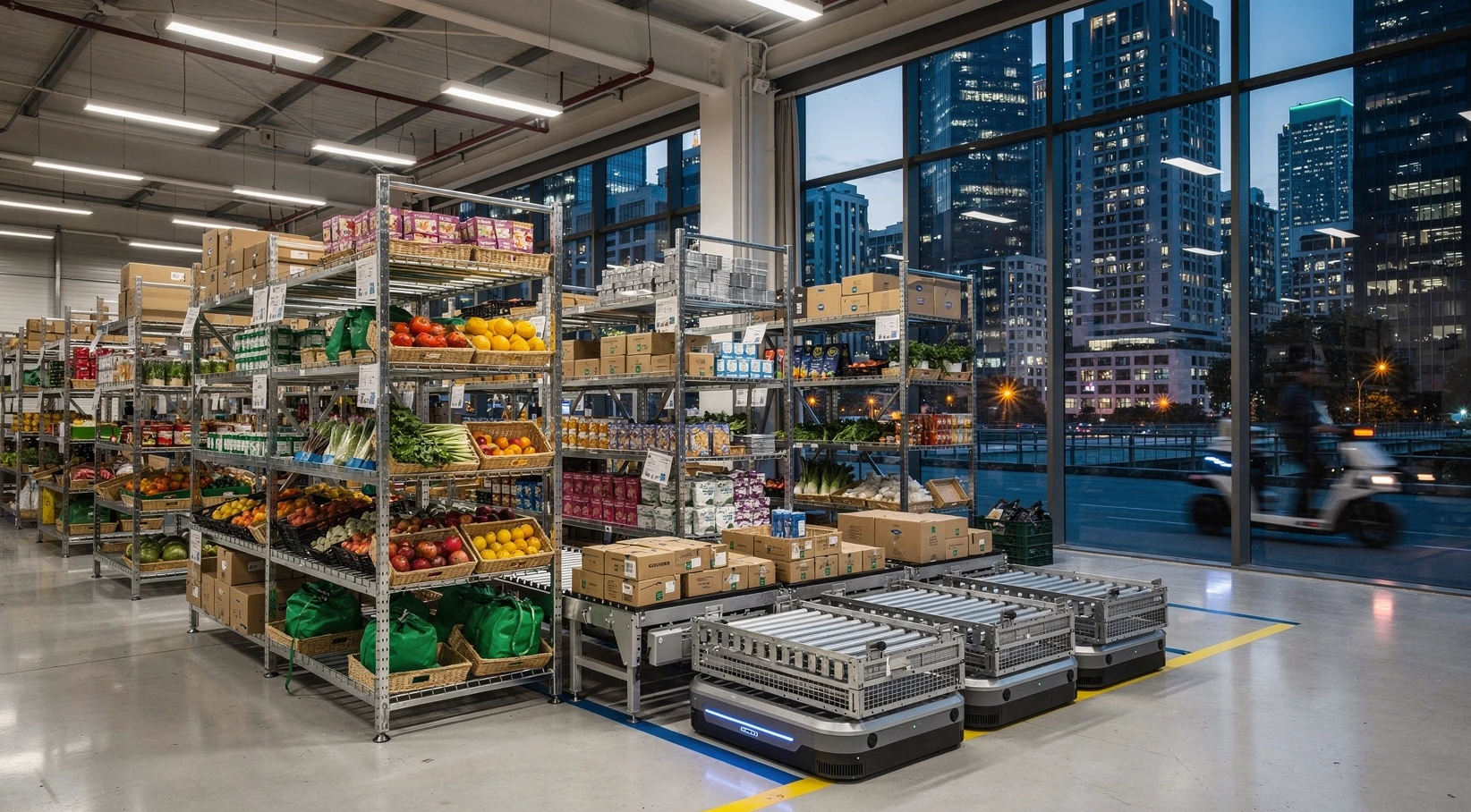
Pupu’s core design is the “forward warehouse plus pure online” model. Instead of stores, it operates small fulfillment hubs placed inside dense residential clusters. Orders placed in the app are picked from the nearest hub and delivered to the door, typically within about 30 minutes.
This approach trades the foot traffic of a supermarket for speed and inventory control. Because there is no shop floor, every square meter is dedicated to stock and picking. The trade-off is that each warehouse needs enough nearby orders to cover its fixed costs, which is why density matters so much in this business.
Forward warehouses are capital intensive and operationally demanding. Fresh produce spoils, demand swings by the hour, and delivery riders must be scheduled tightly. Operators that master the model can defend a local market fiercely; those that do not tend to bleed cash. Pupu’s survival and growth mark it as one of the stronger executors in the category.
A South China stronghold
Pupu’s network is heavily concentrated in southern China. The company runs more than 400 forward warehouses across Fujian and Guangdong, covering nine major southern cities including Fuzhou, Xiamen, Guangzhou and Shenzhen. In its home city of Fuzhou, household penetration is reported to exceed 70 percent.
That regional density is precisely what makes Pupu attractive. South China is a wealthy, urbanized market where on-demand grocery demand is high, and it is an area where Alibaba’s own instant-retail presence has lagged behind its strength in eastern China. Buying Pupu would close that gap in one step.
The numbers behind the business
Pupu generates annual revenue exceeding 30 billion yuan, or roughly $4.2 billion at current exchange rates, according to figures cited in reporting on the deal. The company’s valuation reportedly reached about $5 billion at an earlier funding stage, which puts the $1.5 billion acquisition discussion in context as a negotiation over a business whose private-market price has already been tested.
Revenue at that scale, paired with a tightly run warehouse network, is the kind of asset that is difficult to replicate quickly. It is also the kind of asset that a deep-pocketed acquirer can fold into a much larger logistics and commerce system to extract additional value. For more on how investors are now valuing grocery-delivery infrastructure rather than storefront brands, see our analysis of Instacart’s re-rating as grocery-tech infrastructure.
Why Alibaba wants Pupu now
The timing is not accidental. Instant retail has moved from a niche convenience to a central front in Chinese e-commerce, and Alibaba has been signaling for months that it intends to compete hard for it.
Quick commerce is Alibaba’s fastest-growing line
Alibaba’s quick-commerce revenue rose 57 percent year over year to 19.99 billion yuan in the fourth quarter of its 2026 fiscal year, and reached 78.52 billion yuan for the full year, up 47 percent, according to company disclosures referenced in coverage of the deal. Those growth rates dwarf the roughly 11 percent expansion in Alibaba’s overall group revenue for the same quarter.
When a single segment is compounding at nearly half again its prior size each year, leadership tends to fund it aggressively. An acquisition that adds scale and geographic reach to that segment fits the pattern of a company doubling down where it sees the steepest growth curve.
Filling the South China gap
Alibaba’s instant-retail operations have been strongest in eastern China and in tier-one cities where its broader logistics arm is dense. South China, and Fujian in particular, has been comparatively underserved. Pupu’s footprint maps almost perfectly onto that white space.
Rather than spend years and considerable capital building warehouses, hiring riders and learning local demand patterns, Alibaba could inherit a tested operation overnight. The speed advantage matters because rivals are expanding at the same time, and first-mover density tends to be self-reinforcing in delivery markets.
A pivot toward supply-chain depth
The reported deal reflects a broader strategic shift. For years, Alibaba’s model leaned on being an asset-light platform connecting buyers and sellers. Instant retail demands the opposite: owned or tightly controlled inventory, warehouses and delivery capacity close to the customer.
Buying Pupu would deepen Alibaba’s control of the physical supply chain in fresh groceries, a category that drives repeat visits and habit. Frequent grocery orders pull shoppers into the app several times a week, creating opportunities to cross-sell higher-margin goods. That habitual demand is the strategic prize beneath the produce and dry goods.
The bidding war: Sun Art and the price gap
Alibaba is not the only suitor. Sun Art Retail, the operator behind the RT-Mart hypermarket chain and backed by DCP Capital, had submitted a bid of about $600 million, according to reporting on the talks. Alibaba’s roughly $1.5 billion offer is more than double that figure.
The gap is striking and revealing. It suggests the two bidders value Pupu very differently, or that Alibaba is willing to pay a strategic premium to keep the asset away from competitors and to accelerate its own catch-up in instant retail.
A premium of that size also functions as a defensive measure. If Pupu were to fall into the hands of a rival platform, Alibaba would face a stronger competitor in exactly the region where it is weakest. Paying up to prevent that outcome can be rational even before counting the revenue the network would add. In contested markets, the value of an acquisition is often as much about denial as it is about addition.
| Bidder | Reported offer | Backer / parent | Strategic rationale |
|---|---|---|---|
| Alibaba Group | About $1.5 billion | Alibaba (self-funded, large net cash) | Close South China gap, scale quick commerce, block rivals |
| Sun Art Retail | About $600 million | DCP Capital | Add online grocery reach to hypermarket base |
It is worth noting that Alibaba was once a major shareholder in Sun Art before divesting its stake, so the two parties are familiar competitors in the grocery arena. The contest for Pupu now pits a focused retail operator against a platform giant with far greater financial firepower. Alibaba reported net cash of around $38 billion as of the end of March, which means a $1.5 billion outlay is comfortably within reach.
Meituan and JD.com: the rivals Alibaba is chasing
The Pupu bid only makes sense against the backdrop of an intensifying three-way war in Chinese local commerce. Meituan, the dominant food-delivery platform, has been extending its reach into grocery and general merchandise delivered in minutes. JD.com has likewise pushed hard into instant retail, leveraging its logistics heritage.
Meituan’s grocery push
Meituan has the largest rider network in China and an unmatched grip on on-demand consumer habits through food delivery. Extending that muscle into groceries is a natural adjacency, and the company has been investing to do exactly that. Industry reporting indicates Meituan has been consolidating grocery assets, reportedly including a move on the fresh-delivery operator Dingdong, a signal that it intends to own more of the category outright.
For Alibaba, allowing Meituan to keep adding scale unchallenged would risk ceding the fastest-growing slice of Chinese commerce. Pupu represents one of the few remaining independent operators large enough to materially shift the balance, which raises the strategic stakes of who ends up owning it.
JD.com and the logistics angle
JD.com built its reputation on owned logistics and reliable delivery, which gives it credibility in instant retail. Its presence keeps competitive pressure high and ensures that none of the three giants can take share for granted. The result is a market where speed, coverage and subsidy budgets all escalate together.
| Player | Core strength | Instant-retail approach |
|---|---|---|
| Alibaba | Marketplace scale, cloud, capital | Building density, now eyeing Pupu acquisition |
| Meituan | Largest rider network, food delivery habit | Extending delivery into grocery and merchandise |
| JD.com | Owned logistics, delivery reliability | Leveraging fulfillment heritage for fast retail |
| Pupu | Forward-warehouse fresh grocery in South China | App-only, 30-minute delivery, regional density |
The competitive logic mirrors what is happening elsewhere in global retail, where platforms increasingly compete on fulfillment infrastructure rather than catalog breadth. The same shift is visible in how social-commerce players are building out delivery, as we covered in our look at TikTok Shop’s push into in-house fulfillment.
The regulatory shadow over China’s subsidy wars
Any large platform deal in China now arrives under a watchful regulatory eye. This spring, Beijing’s market authorities publicly criticized the country’s biggest e-commerce platforms for “involution-style” competition, a term describing self-defeating spending wars that burn cash without expanding the overall market.
Regulators flagged misleading advertising and poor disclosure of promotional rules, and Alibaba’s large subsidy campaigns drew specific attention. In that environment, a $1.5 billion acquisition that concentrates the instant-retail market could attract antitrust review even if the headline price is affordable.
Why consolidation invites scrutiny
Chinese competition policy has grown more assertive toward large internet platforms over the past several years. A deal that removes one of the last sizable independents from the board may be read by regulators as reducing competition in a sector they want to keep contested.
At the same time, authorities have signaled discomfort with the relentless subsidy battles, which suggests a preference for rational competition over scorched-earth price wars. How regulators weigh those competing concerns, less subsidy chaos versus more market concentration, will shape the deal’s path. Cross-border watchers have seen Asian regulators move decisively before, as with South Korea’s record penalty detailed in our report on the data-breach fine levied on Coupang.
The broader China consumer backdrop
The bid also unfolds against a cautious Chinese consumer environment, where spending growth has been uneven and price sensitivity is high. Instant grocery delivery is one of the categories that has held up, partly because convenience and value combine in a way that suits a careful shopper.
That resilience helps explain why the giants are willing to fight over it even as they retrench elsewhere. The strategic reshuffling among multinationals operating in China adds to the picture, a theme we explored in coverage of Starbucks weighing an asset-light pivot after its China exit.
How Pupu would fit inside Alibaba’s logistics stack
Alibaba does not lack delivery infrastructure. The group owns Cainiao, its logistics arm, and operates a range of retail and on-demand assets. The question is how Pupu’s specialized fresh-grocery network would slot into that existing machine without duplicating cost or creating internal conflict.
Complement, not overlap
The strategic appeal rests on the idea that Pupu fills a gap rather than overlapping with what Alibaba already runs. Pupu’s strength is hyperlocal fresh grocery in southern cities, a capability that is distinct from long-haul parcel logistics or general marketplace fulfillment. In principle, the two systems are complementary.
In practice, integration always carries friction. Alibaba would need to decide whether to keep Pupu’s brand and operating team intact or to fold the warehouses into its own instant-retail banner. Each path has trade-offs between preserving local expertise and capturing synergies, and the wrong call can erase the value that justified the purchase.
The data and habit dividend
Beyond the physical warehouses, Pupu brings a stream of high-frequency consumer data. Grocery orders happen often, sometimes several times a week, which makes them a rich source of insight into what households buy and when. That data can sharpen inventory planning, personalize recommendations and feed Alibaba’s advertising and merchandising engines.
High-frequency demand also anchors customer loyalty. A shopper who relies on an app for fresh produce is more likely to use the same app for other purchases. That habitual engagement is one of the quietest but most valuable assets in the deal, because it lowers the cost of acquiring and retaining customers across Alibaba’s wider ecosystem.
The capital question
With net cash of around $38 billion at the end of March, Alibaba can absorb a $1.5 billion purchase without strain. The harder question is the ongoing investment instant retail demands. Forward warehouses, riders and subsidies all consume cash, and the segment is not uniformly profitable. Buying Pupu is the down payment; sustaining the network is the recurring bill.
Investors will watch whether Alibaba can grow instant retail while improving its margins, or whether the category remains a cash-hungry land grab. The answer will shape how the market judges not only this deal but the company’s broader pivot toward owned commerce infrastructure.
What it means for the global quick-commerce playbook
The Pupu contest is a Chinese story with global implications. Quick commerce, defined as the delivery of everyday goods within roughly 10 to 30 minutes, has become a defining battleground in markets from London to Istanbul to Sao Paulo. The Chinese giants are running the most capital-intensive version of that experiment at the largest scale.
Three lessons stand out for operators elsewhere. First, density beats breadth: the winner in any given city is usually the one with the most warehouses serving the most repeat orders. Second, fresh groceries are the wedge that builds habit, even though they are the hardest category to run profitably. Third, ownership of fulfillment is becoming the source of durable advantage, which is why a platform like Alibaba is willing to buy a warehouse operator outright.
For Western retailers and investors, the read-across is that grocery-delivery infrastructure is being valued as strategic plumbing rather than as a standalone consumer brand. The same logic that drives Alibaba toward Pupu is reshaping how capital flows into delivery startups around the world.
Risks and what to watch next
Several variables will determine whether this deal happens and whether it pays off. None is settled.
Will Pupu sell, and at what price?
Pupu has not agreed to a transaction, and a strong independent operator may extract a higher price or walk away. The presence of two bidders gives the seller leverage. The final number could move well above $1.5 billion if the contest heats up, or the talks could collapse if the founder prefers independence.
How will regulators respond?
Antitrust approval is the biggest external risk. A clearance with conditions, an outright block, or a prolonged review are all plausible outcomes. Given Beijing’s recent warnings about platform competition, the regulatory timeline is unpredictable.
Can Alibaba integrate without value leakage?
Acquiring a forward-warehouse operation is one thing; running it profitably inside a much larger organization is another. Cultural fit, technology integration and retention of Pupu’s operating talent will all matter. Grocery delivery margins are thin, and clumsy integration can erode the very efficiency that made the target attractive.
Will the subsidy war cool or intensify?
If regulators succeed in tamping down price wars, the economics of instant retail could improve for everyone, making the acquisition more valuable. If the subsidy battle reignites, even a well-run Pupu could face margin pressure that limits the deal’s returns.
The bottom line
Alibaba’s reported $1.5 billion bid for Pupu is a statement of intent. It says the company sees instant retail as a fight it cannot afford to lose, that South China is a gap worth closing immediately, and that owning fulfillment is now central to competing with Meituan and JD.com.
The premium over Sun Art’s offer, the speed of the growth Alibaba is chasing, and the strategic value of Pupu’s warehouse network all point in the same direction. Whether the deal clears regulators and delivers the returns Alibaba expects is the open question. What is no longer in doubt is that China’s instant-retail war has entered a new and more expensive phase, and the rest of the world’s quick-commerce operators are watching how it plays out.
Frequently asked questions
How much is Alibaba offering for Pupu?
Reporting from Nikkei Asia and Bloomberg, along with Chinese financial outlets, puts Alibaba’s offer at about $1.5 billion, equivalent to roughly 10.1 billion yuan or 11.8 billion Hong Kong dollars at current exchange rates. Neither company has confirmed the figure, and no deal has been signed.
What does Pupu actually do?
Pupu is a Chinese on-demand grocery platform founded in 2016 and based in Fuzhou. It uses a forward-warehouse, app-only model to deliver fresh food and daily necessities to customers’ doors, typically within about 30 minutes, rather than operating physical stores.
Why is Pupu valuable to Alibaba?
Pupu runs more than 400 forward warehouses concentrated in South China, a region where Alibaba’s instant-retail presence has been relatively weak. Buying Pupu would give Alibaba dense coverage and a proven fresh-grocery operation almost immediately, rather than years of building from scratch.
Who else is bidding for Pupu?
Sun Art Retail, the operator of the RT-Mart hypermarket chain and backed by DCP Capital, had reportedly bid about $600 million. Alibaba’s offer is more than double that amount, setting up a competitive contest for the company.
How does this affect Meituan and JD.com?
The bid is a direct challenge to Meituan and JD.com, both of which have invested heavily in instant retail. Acquiring Pupu would strengthen Alibaba’s position in a market the three giants are fighting over, and it would deny a sizable independent operator to its rivals.
Could regulators block the deal?
It is possible. Chinese authorities have grown more assertive toward large platforms and recently criticized “involution-style” subsidy wars among e-commerce companies. A deal that concentrates the instant-retail market could attract antitrust review, with outcomes ranging from conditional approval to a prolonged process.
How fast is Alibaba’s quick-commerce business growing?
According to company disclosures cited in coverage of the deal, Alibaba’s quick-commerce revenue rose 57 percent year over year to 19.99 billion yuan in its fiscal fourth quarter of 2026, and reached 78.52 billion yuan for the full year, up 47 percent. That is far faster than its overall group revenue growth.
What is the forward-warehouse model?
A forward warehouse is a small fulfillment hub placed inside a dense residential area, holding inventory close to customers so orders can be picked and delivered within minutes. It replaces the traditional store with a stockroom optimized for speed, but it requires high local order volume to cover its costs.
Has the deal been finalized?
No. As of the latest reporting, Alibaba is weighing the acquisition and Pupu has not agreed to sell. Both companies declined to comment. The situation is a live negotiation rather than a completed transaction, and terms could change or talks could end.