
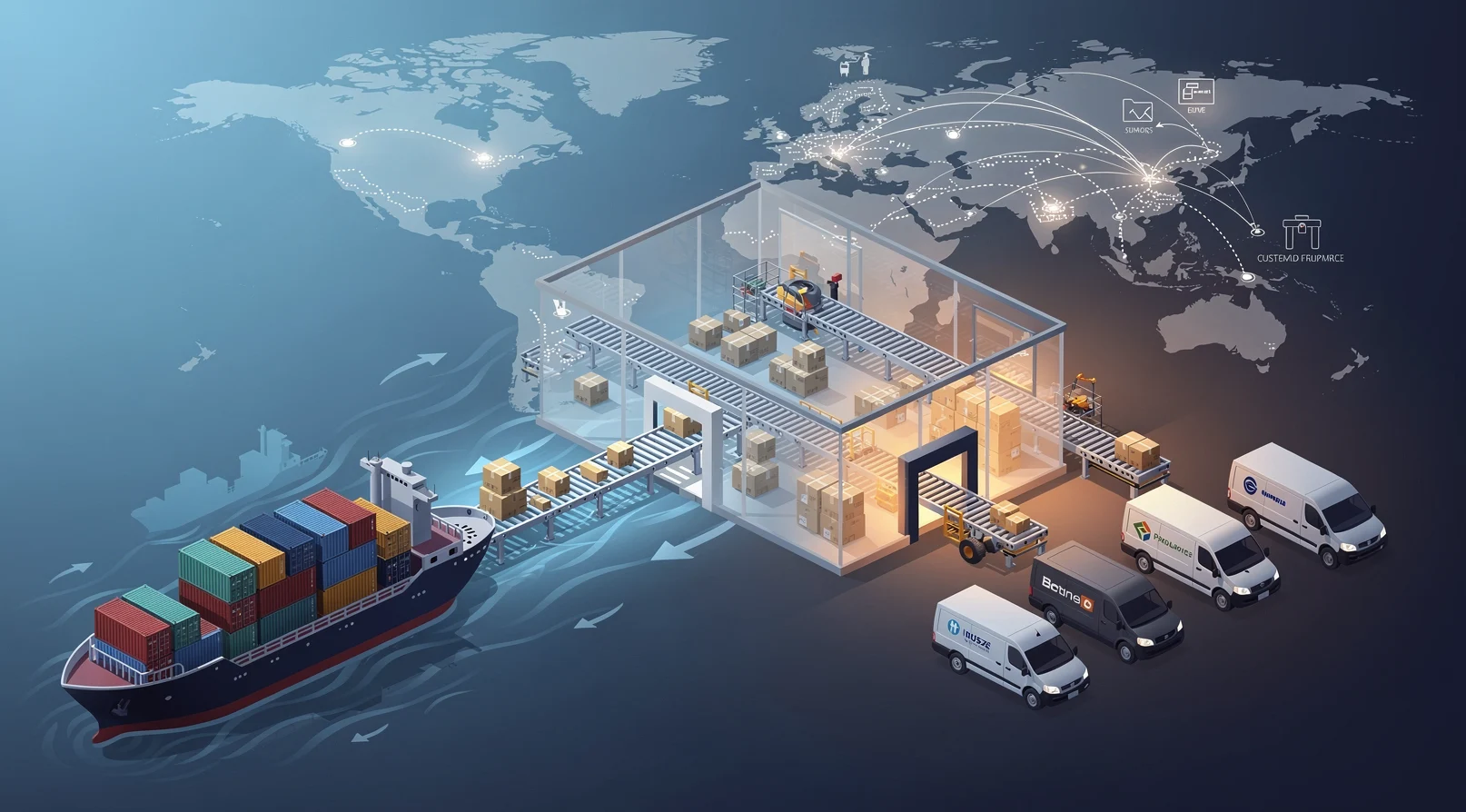
Temu spent 2026 rebuilding the part of its business that retail teams cared about least and now have to care about most: how products actually reach a US doorstep, who holds the inventory, and what the landed cost looks like once duties are paid. The marketplace that arrived in 2022 as a pure cross-border, China-direct, ultra-low-price app is no longer the same operation. A series of trade-policy shocks, a forced pivot to local fulfillment, and a quiet shift toward onboarding US-based sellers have changed the math for anyone who buys, sells, or competes against Temu. For retail and e-commerce teams, the question is no longer whether Temu matters, but how its 2026 reinvention reshapes pricing, sourcing, and channel strategy.
In short
- The de minimis exemption ended for low-value parcels in 2026, removing the duty-free entry that underpinned Temu’s original sub-$20 pricing and forcing the company to rebuild around tariffed, locally stocked goods.
- Temu pivoted hard to local fulfillment, prioritizing US-based sellers and domestic warehouses over the pure China-direct model, which compressed delivery times from weeks to days but raised landed costs.
- A semi-managed (local-to-local) model now sits alongside the original fully managed program, shifting more inventory, pricing, and logistics responsibility onto third-party sellers rather than Temu’s central operation.
- Prices rose and assortment narrowed in several categories as duties replaced the old loophole, closing part of the gap between Temu and incumbents like Amazon, Walmart Marketplace, and Shein.
- For retail teams the practical work in 2026 is recalculating Temu’s true price advantage post-duty, deciding whether to sell on it through the local model, and adjusting defensive pricing now that the cheapest channel is no longer structurally cheaper.
Why temu changes in 2026 matter for retail teams
For three years Temu’s appeal rested on a single structural advantage: parcels shipped directly from Chinese manufacturers to US consumers entered under the de minimis rule, which let shipments below a set value clear customs duty-free and with minimal paperwork. That advantage let Temu undercut domestic retailers on price by margins that no inventory-holding competitor could match. The 2026 changes matter because they remove or reshape that advantage, and they do so across the whole funnel, from sourcing to last-mile delivery.
Retail teams feel this in two directions at once. If you compete against Temu, the playing field tilted back toward you as its prices rose and its delivery model came to resemble a conventional marketplace. If you are considering selling on Temu, the door opened wider than ever for US-based sellers, but on terms that look more like Amazon than like the old cross-border gold rush. Either way, decisions made on 2024 assumptions are now wrong.
The wider context is a global reset in how low-price cross-border commerce works. Temu is not navigating this alone: its sister-category rival Shein faced the same duty changes, and both have been pushed toward local stocking in their major markets. We covered the parallel European shift in our analysis of why Temu and Shein will pivot to EU local fulfillment, and the US story in 2026 follows the same logic with a faster, sharper timeline. This piece sits inside our broader complete guide to selling on global e-commerce marketplaces, which maps how each major platform fits a multichannel strategy.
What does de minimis mean, and the other key terms
Before the practical analysis, a few terms recur throughout the 2026 story. Getting them precise matters because each one maps to a specific cost or operational change.
De minimis is the customs threshold below which imported goods enter a country with no duty and reduced inspection. In the US this exemption historically covered shipments under $800 in value, which is why a $12 Temu order could ship from a Chinese factory without import tax. The phrase comes from the Latin legal maxim meaning the law does not concern itself with trifles. You can read the general background on the de minimis principle for the broader legal context.
Fully managed model is Temu’s original setup: the seller ships bulk goods or individual parcels into Temu’s system, and Temu controls pricing, marketing, customer service, and cross-border logistics. The seller is effectively a supplier, not a merchant.
Semi-managed or local-to-local model is the 2026 emphasis: the seller holds inventory inside the destination country, sets more of its own pricing, and handles domestic fulfillment, while Temu provides the storefront, traffic, and checkout. This is much closer to how Amazon’s third-party marketplace works.
Landed cost is the total cost of a product delivered to the customer, including the unit cost, freight, duties, and fees. The whole 2026 shift is a story about landed cost rising as duties re-enter the equation.
Why the vocabulary shift signals a strategy shift
When a marketplace starts talking about local sellers, domestic warehouses, and semi-managed onboarding, it is telling you that its cost structure changed. Temu did not adopt local fulfillment because it preferred the economics. It adopted local fulfillment because the duty-free cross-border lane that made the old model cheap was closing. The language change is a reliable leading indicator of the operational change.
What actually changed in Temu during 2026
The 2026 transformation was not a single announcement but a sequence of forced adaptations. Laying them out in order shows how quickly the model was rebuilt and why retail teams could not rely on a stable picture from quarter to quarter.
| Change | What it was before | What it became in 2026 | Impact on retail teams |
|---|---|---|---|
| Import duties | Most parcels duty-free under de minimis | Low-value parcels subject to duty and tariffs | Temu’s structural price edge shrank |
| Fulfillment model | Direct from China, 1 to 3 week delivery | Local US warehouses, 2 to 5 day delivery | Faster delivery, higher landed cost |
| Seller base | Chinese manufacturers and exporters | Active recruitment of US-based sellers | New selling channel opened for domestic brands |
| Operating model | Fully managed, Temu sets price | Semi-managed local-to-local added | Sellers regain pricing and inventory control |
| Pricing | Aggressive sub-$20 anchors | Higher floors in duty-exposed categories | Defensive price pressure on incumbents eased |
The duty change was the trigger. Once low-value parcels lost guaranteed duty-free entry, every cross-border unit carried a new cost that Temu either absorbed, passed to consumers, or avoided by sourcing locally. The company chose a mix of all three, with the long-term answer being local sourcing.
The fulfillment pivot followed immediately. Temu accelerated the build-out of US warehousing and prioritized listings that could ship domestically. Products stocked inside the country avoid the per-parcel customs friction entirely, because the duty is handled once on a bulk import rather than on every consumer shipment. This is the same logic that drove the company’s parallel rewrite of low-price economics, which we unpack in how Temu is rewriting the rules of low-price e-commerce.
The seller-base change is the one most retail teams underestimate. Temu spent 2026 actively recruiting US sellers, offering them the semi-managed model and access to its very large traffic base. For a domestic brand sitting on inventory, Temu became a genuine incremental channel rather than a foreign threat. That reframing is the single most important practical takeaway of the year.
How the new Temu model works in practice
The operational reality in 2026 splits Temu into two parallel businesses that share a storefront. Understanding which one you are dealing with determines almost everything about cost, speed, and control.
In the fully managed lane, the experience for shoppers is closest to the original Temu: very low prices, broad assortment, and longer delivery windows on goods still moving cross-border. Margins here are thin and Temu controls the merchandising. This lane shrank in 2026 as duties made many of its products less competitive, but it did not disappear, because plenty of ultra-low-price categories still clear the math even with duty added.
In the semi-managed lane, a seller stores goods in a US warehouse, lists them on Temu, sets pricing within Temu’s guardrails, and fulfills domestically. Temu takes a commission and supplies the demand. For the shopper, these listings show faster delivery badges and slightly higher but still competitive prices. For the seller, it functions like a leaner version of Amazon’s marketplace with fewer fees but less brand control.
The landed-cost recalculation every team should run
The core analytical task in 2026 is recomputing Temu’s real price position after duties. A product that looked 40 percent cheaper than your equivalent in 2024 might be 15 percent cheaper in 2026 once tariffs and domestic fulfillment costs are added. That delta determines whether Temu still pressures your pricing or whether you have regained room.
Run the comparison on landed cost, not list price. Take a representative Temu SKU in your category, add the applicable duty rate, and compare against your own fully loaded cost to serve. Many teams discover that the gap narrowed enough to stop matching Temu on price and instead compete on delivery reliability, returns, and trust, which were always Temu’s weak points.
What faster delivery changes downstream
The shift to local warehouses cut Temu delivery times from weeks to days in stocked categories. That removes one of the biggest historical reasons shoppers hesitated. Retail teams that relied on speed as their defensive moat lost part of it in 2026, which is why service, returns ease, and product quality assurance matter more now than raw shipping time.
Common mistakes retail teams make and how to avoid them
The 2026 changes are recent enough that many teams are still operating on outdated mental models. A handful of mistakes recur across the retailers and brands adapting to the new Temu.
Mistake one: still treating Temu as duty-free. Pricing and competitive analysis built on the old cross-border assumption overstates Temu’s advantage. Teams that keep cutting their own margins to match a price gap that no longer exists are leaving money on the table. Rebuild the comparison on post-duty landed cost.
Mistake two: ignoring the selling opportunity. Brands that view Temu only as a competitor miss that the semi-managed model turned it into a low-friction incremental channel for domestic inventory. The cost of testing a few SKUs is low, and the traffic is large.
Mistake three: assuming the assortment is stable. Temu’s category mix shifted through 2026 as duty-exposed products were repriced or pulled and locally stocked goods were promoted. Competitive snapshots taken early in the year are unreliable by mid-year. Refresh the data quarterly.
Mistake four: copying Temu’s content without its cost base. Temu’s aggressive discounting and gamified app experience work because of its scale and ad budget. Smaller retailers that mimic the deep-discount theater without the unit economics simply erode their own margin. Compete on the dimensions where you are structurally stronger.
How to pressure-test your Temu assumptions
A simple quarterly audit keeps the picture current. Pull a basket of your most Temu-exposed SKUs, record Temu’s current price and delivery badge, estimate the duty component, and track the trend line across quarters. If Temu’s effective advantage is shrinking, shift spend from price matching to service and retention. If it is holding in a category, that category may simply be one where local sourcing keeps Temu cheap.
Examples from US retail and e-commerce
The abstract changes become concrete when you look at how they played out across different retail segments in 2026. The pattern varies sharply by category, which is itself one of the year’s main lessons.
In low-cost home goods and accessories, Temu’s advantage held up best. These categories are light, cheap to import in bulk, and well suited to local warehousing, so duties added relatively little to landed cost. Retailers in dollar-store-adjacent assortments saw continued pressure here and largely competed on store experience and immediacy rather than price.
In apparel and seasonal fashion, the picture was mixed. Temu and Shein both faced the duty reset at once, and both leaned on local stocking to defend speed. Domestic fast-fashion and marketplace sellers found the price gap narrower than in prior years, which gave better-known brands room to win on fit, returns, and quality consistency, three areas where ultra-cheap cross-border goods historically struggled.
In small electronics and accessories, the 2026 changes hit hardest. Many of these products sat right at the duty-exposure line, so repricing was sharp and some assortment thinned. Retailers competing here found that Temu’s threat eased more than in any other category, because the loophole that made a $9 cable viable was exactly what closed.
The defensive playbook that worked
The retailers that adapted best in 2026 stopped fighting Temu on its old terms. They recomputed the real gap, conceded the categories where Temu stayed structurally cheap, and reinvested in the dimensions where an inventory-holding domestic retailer wins: reliable delivery, easy returns, trustworthy quality, and loyalty programs. Where the gap had genuinely closed, several quietly raised prices back toward healthy margin, because the structural undercut that justified matching was gone.
Tools, partners and vendors worth knowing
Operating around the new Temu, whether selling on it or competing with it, leans on a recognizable stack of tools. The categories below map to the practical work the 2026 changes created.
| Need | Tool category | What it does for retail teams |
|---|---|---|
| Landed-cost math | Duty and tariff calculators | Estimate post-duty cost to compare Temu fairly |
| Competitive pricing | Repricing and price-monitoring tools | Track Temu SKUs and trigger pricing rules |
| Marketplace listing | Multichannel listing managers | Push catalog to Temu semi-managed alongside other channels |
| Local fulfillment | 3PL and warehouse partners | Stock domestically to qualify for fast-delivery badges |
| Demand analytics | Category and trend trackers | Spot which categories Temu is repricing or exiting |
If you are evaluating the selling side specifically, the operational details of onboarding, fees, and the semi-managed workflow deserve their own deep look. We cover the vendor landscape and integration choices in tools and vendors for Temu in 2026, which pairs naturally with this strategic overview.
For competitive teams, the most valuable tooling is whatever keeps your Temu price and assortment data fresh. Because 2026 was a year of constant repricing, a static competitive file is worse than useless: it encodes a market state that no longer exists. Automated monitoring that refreshes weekly is the difference between adapting and reacting late.
Choosing between competing on Temu and competing against it
The tool stack divides cleanly by intent. If you plan to sell on Temu, prioritize listing management and 3PL fulfillment so your goods qualify for the fast-delivery experience shoppers now expect. If you plan to defend against Temu, prioritize price monitoring and landed-cost analysis so your competitive decisions rest on current, duty-adjusted reality rather than 2024 instincts.
How the changes reshaped Temu’s competition with incumbents
The most useful way to read the 2026 shift is through the lens of competitive positioning. Temu’s original model defined a category by itself: nobody else could deliver cross-border goods at duty-free prices at that scale. Once the loophole closed, Temu moved closer to the field, and the comparison with established marketplaces became a fairer fight rather than a structural mismatch.
Against Amazon, the gap that mattered was always trust and speed. Amazon’s Prime delivery, returns infrastructure, and customer-service standards set a bar that Temu’s cross-border model could not meet. By stocking locally and badging fast delivery, Temu narrowed the speed gap, but it inherited the higher cost base that comes with domestic inventory. The result is a Temu that competes more directly with Amazon’s own low-price third-party sellers than with Amazon’s core retail offer.
Against Walmart Marketplace, the contest is about everyday-low-price credibility. Walmart’s strength is a deep value reputation backed by domestic logistics. Temu’s 2026 pricing increases in duty-exposed categories handed Walmart back some of the price-perception ground it had been losing, particularly in household consumables and basic goods where shoppers compare closely.
| Dimension | Temu before 2026 | Temu after 2026 changes | Incumbent edge |
|---|---|---|---|
| Price floor | Structurally lowest | Category-dependent | Incumbents regained parity in some lines |
| Delivery speed | 1 to 3 weeks | 2 to 5 days where stocked | Prime still faster on average |
| Returns and trust | Weak | Improving but uneven | Amazon and Walmart still ahead |
| Seller access | China-centric | Open to US sellers | Comparable to Amazon third-party |
What this means for category planning
For category and merchandising teams, the takeaway is that Temu can no longer be modeled as a single competitor with one price posture. It now behaves differently by category, mirroring an incumbent in duty-heavy lines and retaining its old aggression in light, locally stockable goods. Planning has to be category-specific rather than treating Temu as a uniform low-price threat across the assortment.
This also changes how you brief leadership. The simple narrative of an unbeatable foreign discounter no longer holds, and overstating the threat can lead to defensive overspending. The more accurate 2026 story is of a competitor that became more conventional, more beatable in several categories, and simultaneously available as a channel you can join.
What temu changes mean for your 2026 channel strategy
Pulling the threads together, the 2026 Temu story changes three decisions every retail team makes: where you source, how you price, and which channels you sell through. None of these can run on pre-2026 assumptions.
On sourcing, the closing of the duty loophole narrowed the cost gap between importing cheap goods and buying domestically. For some retailers that makes local or nearshore sourcing relatively more attractive than it was, because the cross-border arbitrage that Temu exploited shrank for everyone. The same trade-policy shift that reshaped Temu reshaped your own supply math.
On pricing, the headline is permission to stop bleeding margin. Where Temu’s effective advantage genuinely closed, matching its old prices is no longer necessary, and several categories opened room to restore healthier pricing. The discipline is to verify this category by category rather than assuming it applies everywhere, because in light, locally stockable goods Temu stayed cheap.
On channels, the semi-managed model turned Temu from a one-way threat into a two-way decision. A domestic brand with inventory can now treat Temu as a test channel with large traffic and modest commitment. Whether that fits depends on brand positioning, margin tolerance, and how price-led the platform’s audience is, but it is now a real option rather than a foreign one. Setting it in the wider context of every marketplace choice is exactly what our guide to selling on global e-commerce marketplaces is built to help you do.
Frequently asked questions
Did Temu get more expensive in 2026?
In duty-exposed categories, yes. When the de minimis exemption ended for low-value parcels, the duties that had been avoided re-entered the landed cost, and Temu passed part of that through as higher prices or higher price floors. In light, locally stockable categories the increase was smaller, because bulk domestic importing absorbs duty more efficiently than per-parcel cross-border shipping.
What is the difference between Temu’s fully managed and semi-managed models?
In the fully managed model, the seller acts as a supplier and Temu controls pricing, marketing, and cross-border logistics. In the semi-managed or local-to-local model, the seller holds inventory inside the destination country, sets more of its own pricing, and handles domestic fulfillment, while Temu provides the storefront and traffic. The semi-managed model is much closer to how Amazon’s third-party marketplace works.
Can US-based brands sell on Temu now?
Yes, and Temu actively recruited US-based sellers through 2026 as part of its pivot to local fulfillment. Domestic sellers use the semi-managed model, stocking goods in US warehouses and listing on Temu for access to its large traffic base. For a brand sitting on inventory, it functions as an incremental channel rather than a foreign competitor.
Why did Temu move to local US warehouses?
Because the duty-free cross-border lane that made the original model cheap closed. Goods stocked domestically clear duty once on a bulk import rather than on every consumer parcel, which avoids the per-shipment customs friction. The pivot also cut delivery times from weeks to days, removing one of the biggest historical reasons shoppers hesitated to buy.
How should I recalculate Temu’s price advantage for competitive analysis?
Compare on landed cost rather than list price. Take a representative Temu SKU in your category, add the applicable duty rate and any domestic fulfillment cost, and compare against your own fully loaded cost to serve. Many teams find the gap narrowed enough to stop matching Temu on price and instead compete on delivery reliability, returns, and trust.
Is Temu still cheaper than Amazon and Walmart in 2026?
It depends entirely on the category. In light, low-cost goods that are cheap to import in bulk and well suited to local warehousing, Temu often stayed cheaper. In small electronics and accessories that sat at the duty-exposure line, the gap narrowed sharply and in some cases closed. There is no single answer, which is exactly why a category-by-category audit matters.
Does the de minimis change affect Shein the same way?
Yes. Shein faced the same duty reset and was pushed toward local stocking in its major markets just as Temu was. Both companies leaned on domestic fulfillment to defend delivery speed and absorb duty more efficiently. The parallel pivot is clearest in their European operations, where regulatory deadlines forced a similar local-fulfillment shift.
What is the single most important Temu change for retail teams to act on?
Rebuilding competitive and pricing analysis on post-duty landed cost. Almost every other decision, from whether to keep matching Temu’s prices to whether to sell on it, flows from understanding that its structural price advantage shrank in 2026 and now varies by category rather than applying across the board.