
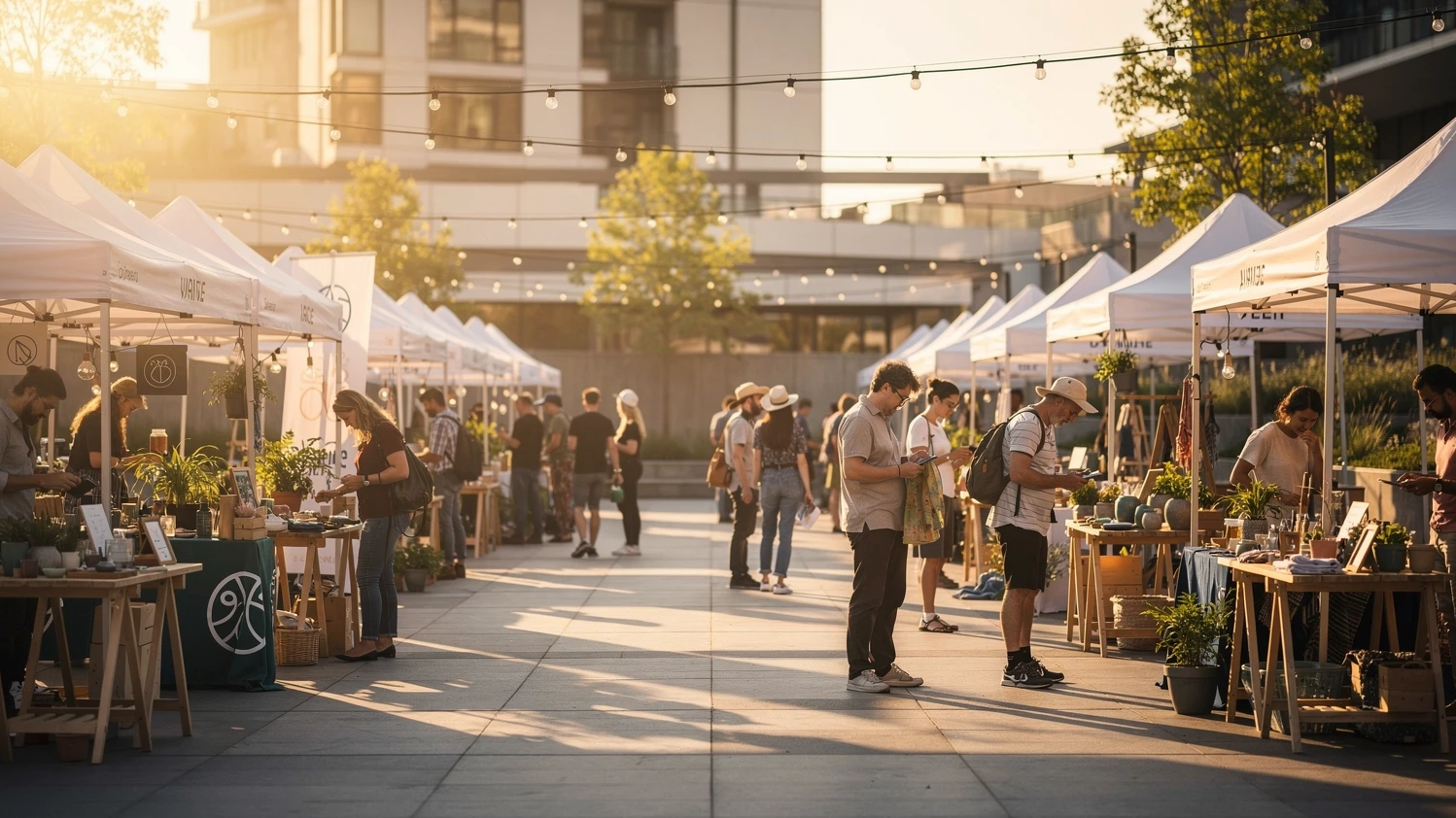
Pop-up markets have moved from a seasonal novelty to a permanent fixture in how communities buy, sell and gather. What once meant a folding table at a church fair now spans curated maker markets, night markets, food hall residencies and brand activations that draw thousands of people to a parking lot for a single weekend. The shift reflects a broader rebalancing of retail toward experiences that cannot be replicated by a browser tab, and it is reshaping how small brands launch, how landlords fill vacant space and how towns think about their own commercial identity.
This guide explains what pop up community markets are, why they have scaled so quickly in the United States, how organizers and vendors actually run them, and where the model fits inside the wider story of the future of local retail and main street commerce. It is written for retail operators, e-commerce founders, market organizers and town economic development teams who want a practical, numbers-aware view rather than a feel-good narrative.
In short
- Pop up community markets are temporary, recurring retail events that gather independent vendors in a shared physical space, blending commerce with social programming and local identity.
- The model grew because it lowers risk on every side: vendors test products without a lease, landlords monetize idle space, and shoppers get a reason to leave the house that algorithms cannot copy.
- Community-led events outperform purely commercial ones on repeat attendance, vendor loyalty and word-of-mouth, because the organizing intent is belonging first and sales second.
- The economics are real but thin: most markets run on vendor fees, sponsorships and small municipal grants, and the difference between a thriving market and a dead one is operational discipline, not foot traffic alone.
- For online brands, a pop-up is a customer-acquisition channel, not a side hustle: it generates first-party data, content, reviews and a local base that paid social keeps getting more expensive to reach.
Why pop-up markets matter in 2026
The pop-up has become one of the few retail formats that is growing attendance rather than defending it. As acquisition costs on paid social and search climb year after year, brands are looking for channels they actually own, and a recurring market is one of the cheapest ways to put a product in front of a warm, local crowd. The format sits at the intersection of three pressures that all peaked at once: expensive digital advertising, abundant vacant commercial space, and a consumer appetite for in-person experiences after years of screen fatigue.
There is also a supply-side story. The barrier to starting a small product business has collapsed, so the number of makers, bakers, roasters and small-batch brands looking for a first sales channel has exploded. Most of them cannot justify a storefront lease, and many find that selling online alone is a grind of paid ads and thin margins. A weekend market gives them a venue with built-in traffic, which is why vendor waitlists at established markets now routinely run months long.
Towns have noticed. Pop-up markets reactivate dead plazas, fill the gaps left by departed anchor tenants, and give a main street a heartbeat without requiring a developer to commit capital. This is the same dynamic reshaping brick and mortar retail in 2026, where flexibility and programming increasingly beat square footage and long leases. A market is, in effect, a pop-up anchor tenant that costs the town almost nothing to host.
The post-pandemic reset in shopping behavior
Consumer research keeps pointing to the same shift: shoppers will pay for experiences and convenience, but they resist paying full price for undifferentiated goods they can buy anywhere. A market threads that needle by bundling the purchase with a reason to be there, whether that is live music, street food, a maker demonstration or simply running into neighbors. The transaction becomes a souvenir of an afternoon rather than a line item.
Why digital-native brands keep showing up offline
The brands that built their early growth on cheap paid social are the ones now most aggressively booking market stalls. Customer acquisition that used to cost a few dollars now costs many times more, and the return on a single ad impression is far less durable than a face-to-face conversation that ends with an email signup and a sample in hand. The market is where a digital brand becomes a local one.
What exactly is a pop-up community market?
A pop-up community market is a temporary, usually recurring retail event that gathers multiple independent vendors in a shared space for a defined window, from a single afternoon to a long weekend. The word community is doing real work in that definition. A purely commercial market optimizes for vendor revenue and gate receipts. A community-led market optimizes for belonging, local identity and repeat participation, and treats sales as the natural by-product of getting those things right.
The distinction matters because it changes nearly every operating decision: who gets a stall, how the space is laid out, what the programming looks like, and how success is measured. Markets that confuse the two tend to fail slowly, filling stalls with whoever pays and wondering why the crowd thins after the launch buzz fades.
Key terms and definitions
- Vendor fee: the amount a seller pays for a stall, charged per event, per season or as a revenue share. This is the primary income line for most markets.
- Curation: the selection process that decides which vendors are admitted, used to control quality, avoid category clashes and protect the market’s identity.
- Activation: a branded or experiential element layered on top of the market, such as a sponsor booth, a workshop or a tasting, designed to deepen engagement.
- Anchor draw: the single element that pulls a crowd regardless of the vendor mix, often food, live music or a marquee maker.
- Residency: a longer-term arrangement where a market or vendor occupies a space for weeks or months, bridging the gap between a one-off pop-up and a permanent lease.
The main formats you will encounter
Pop-up markets are not one thing. The label covers maker and craft markets focused on handmade goods, night markets centered on food and atmosphere, vintage and flea markets built around resale, holiday markets tied to a calendar moment, and brand activation pop-ups where a single company stages an immersive retail moment. Each format has its own economics, vendor profile and crowd, and conflating them is a common planning mistake.
How community-led markets actually work in practice
Behind every market that looks effortless is a tight operational loop that runs for weeks before a single tent goes up. Understanding that loop is the difference between an organizer who burns out after two events and one who builds something that lasts for years. The work breaks into four stages: securing space, curating vendors, programming the experience, and managing the day itself.
Securing and pricing the space
Space is the first constraint and the first negotiation. Organizers source venues from a wide range of holders: municipal parks departments, private parking lot owners, breweries and restaurants with patios, vacant retail units, and even residential streets closed for a day. The best arrangements are symbiotic, where a landlord with idle square footage trades access for foot traffic, a percentage of vendor fees, or simply the goodwill of activating a dead block.
Pricing the space back to vendors is where many markets get the math wrong. A stall fee has to cover the venue cost, insurance, permits, marketing, staffing and a margin, divided across however many vendors the space can hold. Set it too high and quality vendors stay home; set it too low and the market cannot afford to promote itself, which thins the crowd and drives those same vendors away anyway.
Curating the vendor mix
Curation is the single most underrated lever in the entire model. A market is only as good as the worst stall a shopper remembers, so disciplined organizers reject far more applicants than they accept and actively balance the categories so that ten candle makers are not competing for the same dollar. Good curation also creates scarcity, which turns a vendor slot into something worth waiting and paying for.
The curation process usually runs through an application that asks for product photos, price points, production capacity and social following. Established markets weigh community fit as heavily as product quality, favoring vendors who will show up reliably, bring their own audience, and treat the market as a relationship rather than a one-time cash grab.
Programming the experience
The programming layer is what separates a community market from a parking lot full of tables. This is the live music slot, the kids’ craft corner, the chef demonstration, the local nonprofit booth and the seating that invites people to linger rather than transact and leave. Every minute a shopper stays raises the odds they buy, and the programming is what buys those minutes.
The economics of running a pop-up market
Markets look like grassroots community projects, and many are, but the ones that survive run on a clear-eyed understanding of their own unit economics. Revenue comes from a handful of predictable lines, and costs are dominated by space, marketing and labor. The margins are thin enough that small operational mistakes compound quickly into a market that cannot afford to promote itself into existence.
| Revenue line | Typical share of income | Notes |
|---|---|---|
| Vendor stall fees | 50 to 70 percent | The backbone of most markets, charged per event or per season |
| Sponsorships | 10 to 25 percent | Local banks, breweries and brands paying for visibility and activations |
| Food and beverage cut | 5 to 15 percent | Revenue share from food trucks or a bar, often the highest-margin line |
| Ticketing or gate | 0 to 15 percent | Rare for community markets, common for ticketed night or holiday markets |
| Grants and municipal support | 0 to 20 percent | Economic development funds for markets that reactivate a district |
The cost side is less varied. Venue rental or revenue share, liability insurance, permits, portable facilities, marketing and a small staff or volunteer coordination budget account for nearly all of it. The hardest cost to cut without consequence is marketing, because a market that no one hears about cannot draw the crowd that justifies the vendor fees that fund everything else.
The vendor’s side of the math
For a vendor, the market is a customer-acquisition channel that has to be judged on more than the day’s sales. A stall that barely breaks even on gross sales can still be a win if it generates email signups, repeat customers, content for social channels, and reviews that compound online. The smartest vendors treat the booth as a storefront and a data-collection point at once, the same instinct behind running a retail business through a town Facebook group, where the relationship is the asset and the transaction is downstream.
Common mistakes and how to avoid them
Most market failures are not mysterious. They repeat a short list of avoidable errors, and recognizing them early is the cheapest insurance an organizer can buy. The pattern is almost always the same: a strong launch followed by a slow decline as operational shortcuts catch up with the experience.
| Mistake | Why it kills the market | The fix |
|---|---|---|
| No curation | Filling stalls with anyone who pays floods categories and lowers quality | Reject more than you accept; balance categories deliberately |
| Underpricing stalls | Leaves no marketing budget, so the crowd never materializes | Price to cover promotion plus a margin, not just venue cost |
| One-and-done scheduling | A single event builds no habit and no repeat attendance | Commit to a recurring cadence shoppers can rely on |
| Ignoring weather and logistics | A bad-weather day with no backup wipes out vendor trust | Plan covered space, clear rain policies and parking ahead |
| Treating vendors as customers | Churns sellers who feel squeezed rather than supported | Build vendor relationships; their loyalty is the moat |
The recurring cadence problem
The most expensive mistake is treating a market as an event rather than a habit. A one-off draws curiosity, but it builds no muscle memory, and the second event starts from zero. Markets that publish a reliable schedule, the first Saturday of every month or every Friday night through summer, train a crowd to keep the date open, and that predictability is worth more than any single piece of marketing.
The vendor-churn trap
Vendors are the supply that makes the whole thing work, and markets that treat them as a revenue source to be maximized rather than partners to be retained end up constantly recruiting replacements. Every lost vendor takes their audience and their reliability with them. The markets with the longest waitlists are usually the ones that treat their sellers best.
Examples from US retail and e-commerce
The clearest way to understand the model is to look at how it shows up across very different American contexts, from dense cities to small towns. The format flexes to fit the place, but the underlying logic, lower risk plus community programming, stays constant.
Urban night markets and food halls
In larger cities, the night market has become a reliable draw, pairing dozens of food vendors with makers and live entertainment after dark. These events lean heavily on the food and beverage revenue share, which carries the highest margins, and use the social atmosphere as the anchor draw that pulls a crowd regardless of which specific vendors show up. The food hall residency is the semi-permanent cousin of this model, giving rotating vendors a fixed roof.
Small-town maker markets
In towns under fifty thousand people, the maker market often doubles as the community’s main social calendar event. These markets succeed less on vendor density than on identity, becoming the place where a town sees itself. The economics are tighter, but the loyalty is deeper, and a local hardware store, bakery or roaster can build a real customer base one Saturday at a time, much like the operator profiled in a hardware store that built a YouTube channel into revenue turned attention into a durable local business.
Brand activations and D2C pop-ups
Digital-native brands increasingly use markets and standalone pop-ups as a physical proving ground. A direct-to-consumer label that lives on a website rents a stall or a vacant unit to run a weekend activation, collect feedback, gather user-generated content and convert browsers into a local base. For these brands the pop-up is a marketing line item with a measurable return, not a retail experiment.
What the formats have in common
Across all three contexts the same three ingredients keep showing up: a low-commitment footprint, a programmed reason to gather, and a deliberate effort to capture the relationship before the shopper walks away. Markets that have one or two of these survive; markets that have all three compound. The night market without data capture leaves money on the table, and the maker market without programming becomes a parking lot of tables that nobody lingers in.
The geography changes the weighting but not the recipe. Urban markets over-index on the anchor draw because they compete with endless alternatives for the same evening, while small-town markets over-index on identity because they are often the only thing happening that weekend. Knowing which lever your context rewards is most of the strategy, and copying a big-city playbook into a town of ten thousand is a reliable way to fail.
Tools, partners and vendors worth knowing
The infrastructure around pop-up markets has professionalized fast, and an organizer no longer has to build everything from scratch. A handful of categories of tools and partners now cover the operational backbone, from applications to payments to insurance, and knowing which to lean on saves both money and weekend sanity.
| Need | What it solves | What to look for |
|---|---|---|
| Vendor application and management | Intake, curation, scheduling and stall assignment | Built-in payments, waitlists and recurring-event support |
| Mobile point of sale | Card acceptance for vendors with no fixed register | Offline mode, low per-transaction cost, fast setup |
| Event insurance | Liability coverage for the day and the venue | Per-event policies and vendor coverage options |
| Marketing and ticketing | Promotion, RSVPs and crowd forecasting | Local social reach plus email capture for repeat events |
| Permits and compliance | Food handling, vending and street-closure permits | Clear municipal guidance and lead-time planning |
Payments and data capture
The payments layer has quietly become the most important tool in the kit, because it is where the market’s data lives. Mobile point-of-sale systems let every vendor accept cards in minutes, but the strategic value is the transaction and contact data that flows from them. A market that helps vendors capture emails and repeat-purchase data turns a weekend into a compounding asset.
Working with municipalities and landlords
The most valuable partner is often the one that controls the space. Parks departments, downtown business associations and private landlords each have different incentives, and an organizer who understands them can secure better venues on better terms. Many towns now have economic development staff specifically tasked with reactivating commercial districts, and a well-run market is exactly what they are looking to support. The wider playbook for this sits inside the future of local retail and main street commerce, where flexible, community-driven formats increasingly define how districts stay alive.
How to launch your first market in 90 days
For an organizer or a brand considering its first event, the path is well worn enough to follow with confidence. The work compresses into a roughly three-month runway, and the sequence matters more than the speed.
- Weeks 1 to 3: define the identity and format, scout and lock a venue, and confirm permits and insurance requirements.
- Weeks 4 to 7: open vendor applications, curate the mix, and set stall pricing that funds marketing.
- Weeks 8 to 11: build the programming, line up sponsors and food, and run the local marketing push with a clear date and email capture.
- Week 12: stage the event, collect data from every stall, and survey vendors and shoppers the same week while it is fresh.
The single most important decision is committing to the second event before the first one happens, because the habit is the product. According to the US Census Bureau retail data, in-person retail still accounts for the large majority of US sales, and a recurring market is one of the lowest-cost ways for a small brand to claim a slice of it.
Risks and what to watch over the next two years
The model is durable but not immune to pressure. Rising costs for insurance, permits and venue rentals are squeezing thin margins, and in hot markets the competition for both quality vendors and prime weekend dates is intensifying. Saturation is a genuine risk in dense areas where every neighborhood now hosts its own market and the same crowd is split too many ways.
The opportunity sits in the same place as the risk. As physical retail keeps shifting toward experience and flexibility, the markets that invest in genuine community identity rather than chasing vendor revenue will keep their crowds while undifferentiated markets fade. The format that started as a folding table at a fair has become a serious channel, and the operators who treat it with operational discipline will own the next phase of local commerce.
Watch three signals over the next two years. First, whether payments and vendor-management platforms keep consolidating the back office, which would lower the operational bar and let more first-time organizers compete. Second, whether landlords and municipalities formalize pop-up access into standing programs rather than one-off permissions, which would turn the format from a hustle into infrastructure. Third, whether brands shift more of their acquisition budget from paid social into owned physical channels as digital costs keep rising, which would deepen the vendor pool and the money flowing through every stall.
The through-line is that the pop-up is no longer a fringe experiment. It has become a measurable, repeatable channel that sits between the website and the lease, and the teams that learn to run it with the same rigor they bring to a paid-media account will find it is one of the few growth levers getting cheaper rather than more expensive.
FAQ: pop up community markets
What is the difference between a pop-up market and a farmers market?
A farmers market is a specific format focused on agricultural producers and food, usually with strict rules about what vendors can sell and how local it must be. A pop-up community market is broader, gathering makers, artisans, food vendors and brands across categories, and is defined by being temporary and recurring rather than by what is sold.
How much does it cost to rent a stall at a pop-up market?
Stall fees vary widely by market size, location and demand, ranging from modest single-event fees at small-town markets to significantly higher rates at established urban markets with long waitlists. The fee should be judged against the customer acquisition value, including email signups and repeat customers, not just the day’s gross sales.
Are pop-up markets profitable for vendors?
They can be, but profitability depends on treating the booth as a customer-acquisition channel rather than a one-day sales target. A stall that barely breaks even on the day can be highly profitable over time if it generates email signups, repeat buyers, content and reviews that compound across online channels.
How do I start a community market in my town?
Begin by defining a clear identity and format, securing a venue from a park, lot or willing landlord, and confirming permits and insurance. Then curate a balanced vendor mix, price stalls to fund marketing, and commit to a recurring schedule so shoppers build the habit of attending.
What permits do pop-up markets require?
Requirements vary by municipality but commonly include a vending or special-event permit, food-handling permits for any food vendors, and sometimes a street-closure permit. Liability insurance is almost always required by the venue, and lead times can run several weeks, so permits should be confirmed early in planning.
Why are pop-up markets becoming more popular?
Three pressures converged: rising digital advertising costs pushing brands toward owned channels, abundant vacant commercial space, and a consumer appetite for in-person experiences. Markets lower risk for vendors, landlords and shoppers simultaneously, which is why the format has scaled across cities and small towns alike.
Can online-only brands benefit from pop-up markets?
Yes, and increasingly they are the most aggressive participants. For a direct-to-consumer brand facing rising paid-social costs, a market stall is a measurable marketing channel that delivers face-to-face conversations, first-party data, content and a local customer base that paid advertising cannot match on durability.
How often should a community market be held?
A reliable recurring cadence matters more than frequency. Whether it is the first Saturday of every month or every Friday night through a season, predictability trains shoppers to keep the date open, which builds the repeat attendance that funds the vendor fees the whole model depends on.