
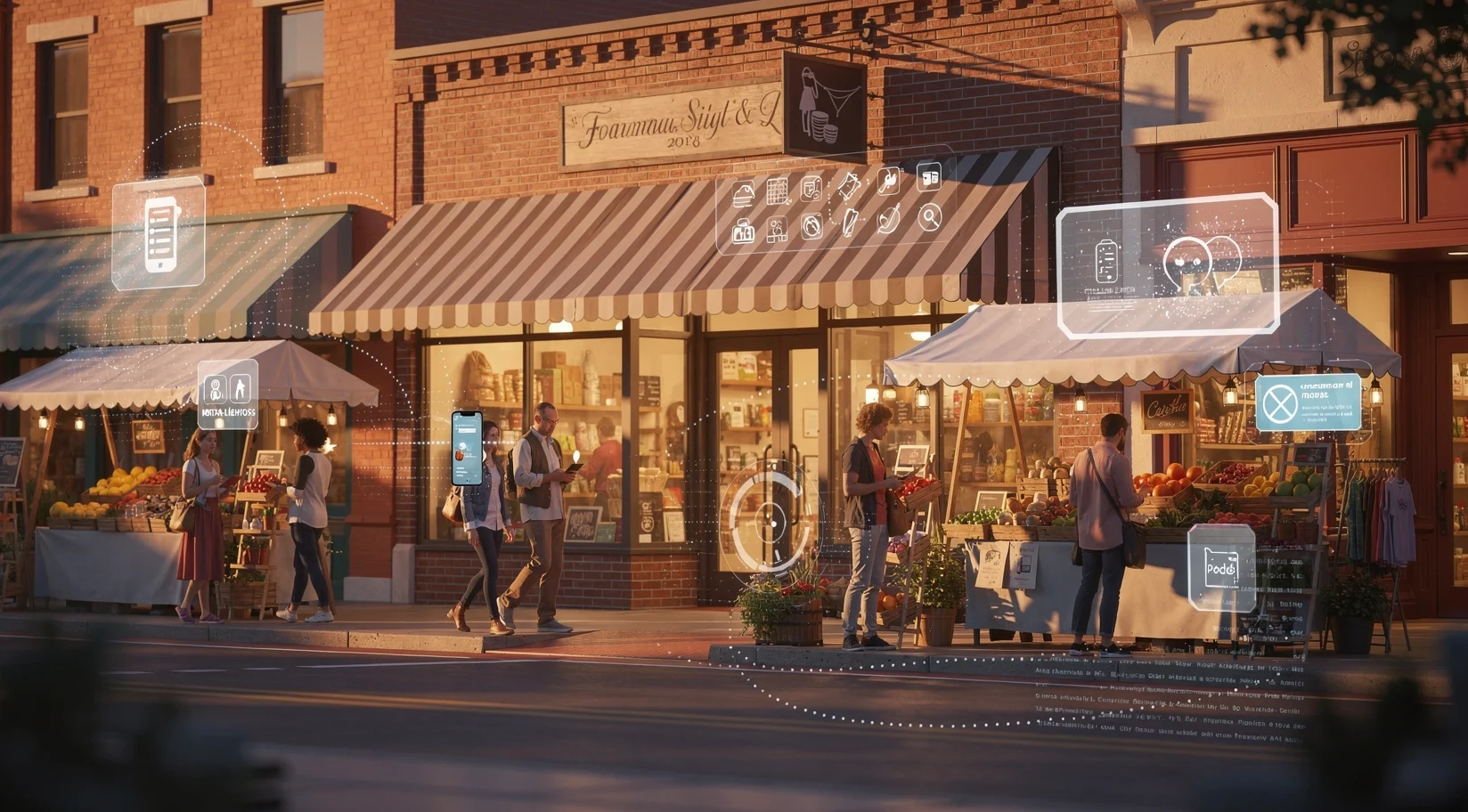
Local retail is having the strangest decade in its history. For fifteen years the story was simple and grim: e-commerce was eating main street, malls were dying, and the independent store was a nostalgia object rather than a business model. That story was always too neat, and by 2026 it has quietly collapsed. Independent retailers, main street districts, local marketplaces, and community commerce projects are not just surviving the platform era. In many categories they are growing faster than the national chains that were supposed to bury them.
This pillar maps the entire local retail territory as it stands in 2026. It covers what local retail actually means, the segments inside it, how big the market is, who the major players are, the playbooks that work, the risks that matter, and where the next two years are heading. It is written for retailers, brand operators, marketplace builders, and the civic actors who increasingly shape whether a shopping district lives or dies.
In short
- Local retail is being selected, not erased. Commodity goods keep migrating online, but experience-led and service-led local retail is growing.
- Four segments form a stack: small business retail, main street districts, local marketplaces, and community commerce, each reinforcing the others.
- Proximity is now an asset again. Same-day expectations, rising online acquisition costs, and a spend-local preference have reversed the old logic.
- Tooling is the quiet differentiator. Affordable point-of-sale, loyalty, and local marketing software let a single store run tighter systems than a 2016 chain.
- Civic actors decide outcomes. Cities, chambers, and business improvement districts shape whether a district thrives, which no other retail category can claim.
Introduction and 2026 context
The backdrop for local retail in 2026 is a consumer who has run the full loop. People bought everything online during the pandemic, discovered the limits of that experience, and rebalanced. Convenience still wins for commodity purchases. But for anything with a discovery, trust, or experience component, physical proximity has regained value that pure logistics cannot replicate.
Three structural shifts define the moment. First, the cost of acquiring a customer online has climbed past the point where many small brands can profitably scale through paid social alone. Second, same-day and next-day expectations have made local inventory a genuine fulfillment advantage rather than a quaint feature. Third, a generational preference for spending that visibly stays in the community has moved from slogan to purchasing behavior, especially among younger shoppers who track where their money goes.
None of this means local retail is easy. Margins remain thin, labor is scarce, commercial rents in desirable districts are punishing, and the operational sophistication required to compete has risen sharply. The independent store that thrives in 2026 runs tighter systems than the chain store of 2016. What has changed is that the structural tailwinds are real, and the tools to capture them are finally affordable.
It also helps to be precise about who the consumer rebalancing favors. The shopper returning to physical stores is not abandoning convenience; they are sorting purchases into buckets. Routine, predictable, low-involvement buying stays online or moves to a subscription. Discovery, advice, social, and immediate-need buying flows back to local. Local retailers who understand which bucket they are competing in stop trying to win the wrong fight, and start defending the ground where proximity is decisive.
The other shift worth naming early is generational. Younger consumers treat where a dollar lands as part of the product, not a footnote. They will pay a modest premium for a purchase that visibly supports a neighbor, a local employer, or a cause, provided the claim is credible and not obviously laundered marketing. That preference is fragile and easy to abuse, but where it is honored it gives local retail a pricing advantage it has not had in a generation.
For a sense of how this plays out at the storefront level, the small business stories in this cluster are deliberately granular, because the difference between a store that makes it and one that does not usually lives in the details. The piece on why small business retail stories matter to the wider industry explains why these case studies are not human-interest filler but the clearest available signal of what is working.
Defining the local retail territory
Local retail is not a single market. It is a loose federation of business types, ownership structures, and civic arrangements that share one trait: the unit of competition is a place, not a platform. Defining the territory precisely matters because the strategies, economics, and risks differ sharply across its segments.
At its core, local retail means commerce where physical proximity to the customer is a structural advantage rather than an accident. A neighborhood bookstore, a family hardware store, a regional grocery chain, a farmers market, and a city-run online marketplace all qualify. A national pure-play e-commerce brand that happens to ship to a town does not, because proximity gives it nothing.
What counts and what does not
The cleanest test is whether removing the local element would break the business. A coffee roaster that depends on morning regulars walking three blocks is local retail. The same roaster shipping nationwide through a direct-to-consumer site has become something else, even if the original cafe still anchors the brand. Many of the strongest operators run both models at once, which is why the lines blur.
It also helps to separate local retail from small retail. Size and locality correlate but are not the same thing. A regional grocery chain with forty stores is large but deeply local. A two-person Shopify brand selling globally is small but not local. This pillar focuses on the locality axis, because that is where the distinctive 2026 dynamics live.
The civic dimension
One feature sets local retail apart from almost every other retail category: government and civic institutions are stakeholders, not just regulators. City councils zone for it, business improvement districts fund it, chambers of commerce organize it, and buy-local campaigns try to steer demand toward it. No other part of retail has this layer, and ignoring it misses half the picture. The boring infrastructure of rent, parking and zoning often decides outcomes more than merchandising ever will. The term itself carries a century of meaning, which the main street entry traces from civic ideal to commercial reality.
Key segments and how they connect
Inside the territory sit four segments that this cluster covers in depth: small business retail, main street districts, local marketplaces, and community commerce. They are distinct enough to warrant separate strategies and connected enough that strength in one reinforces the others.
Small business retail
This is the individual store: the bakery, the bike shop, the independent pharmacy. The economics are intensely operational, where survival hinges on inventory turns, labor scheduling, and a handful of loyal customers who account for a disproportionate share of revenue. The cluster digs into real examples, including a small bakery that beat a national chain on customer loyalty and a family hardware store that survived the big box era.
The recurring lesson across these stories is that independents win on relationship density, not price. A store that knows its customers by name, remembers their last purchase, and solves problems a chain employee cannot is selling something Amazon does not stock. The bookstore that turned events into half its revenue shows how far that logic can be pushed when a store stops thinking of itself as a shelf and starts thinking of itself as a gathering place.
Main street districts
The second segment is the district itself, the cluster of storefronts that share a sidewalk and a fate. Main street is a collective good: any single store benefits from the foot traffic, parking, and reputation that the whole district generates, and suffers when vacancies spread. This is why the district, not just the store, is a unit of strategy.
Districts that thrive in 2026 have usually reinvented their mix, leaning into food, services, and experiences that cannot be ordered online while shedding the commodity retail that migrated to the web years ago. The shift is documented in the cluster piece on how main street districts are reinventing themselves post-pandemic, and the persistent advantages are laid out in what main street retail still gets right that e-commerce never will.
Local marketplaces
The third segment is the local marketplace, a platform that aggregates many local sellers under one roof, whether digital, physical, or both. These range from Nextdoor and Facebook Marketplace to city-run shop-local portals and chamber-built directories. They matter because they give small sellers reach and shoppers a single place to browse local supply. The fundamentals are covered in local marketplaces explained: how they compete with national platforms.
Community commerce
The fourth segment is the most diffuse and the most interesting: community commerce, the set of practices that tie retail spending to local social value. Co-ops, buy-local campaigns, local loyalty programs, pop-up markets, and retailer sponsorship of schools and sports all sit here. The throughline is explained in what community commerce really means beyond the slogan.
The four segments form a stack. Strong individual stores fill main street, main street feeds local marketplaces with credible sellers, and community commerce supplies the demand-side glue that makes shoppers choose local in the first place. A health failure in one layer weakens the others, which is why effective local retail strategy works the stack rather than any single tier.
The stack also explains why so many local retail interventions fail. A city that pours money into a buy-local campaign while its main street sits half-vacant is funding demand with no supply to absorb it. A marketplace that launches into a district of weak, undercapitalized stores inherits their weakness. The interventions that work tend to address the binding constraint in the stack rather than the most visible symptom, which is rarely the same thing. Diagnosing that constraint is the first job of any serious local retail strategy.
| Segment | Unit of competition | Primary advantage | Hardest constraint |
|---|---|---|---|
| Small business retail | The individual store | Relationship density and service | Operational capacity and labor |
| Main street districts | The shared district | Foot traffic and experience mix | Vacancies, rent, and coordination |
| Local marketplaces | The aggregating platform | Reach and discovery for small sellers | Liquidity and trust at launch |
| Community commerce | The local network | Demand loyalty and dollar circulation | Measurement and authenticity |
Market sizing and growth signals
Quantifying local retail is harder than quantifying e-commerce, because the data is fragmented and locality is not a standard reporting category. National statistics agencies track retail sales and small business formation, but they do not draw a clean boundary around the local segment. The picture has to be assembled from several signals.
The first signal is the scale of small business retail overall. Retail trade remains one of the largest private employers in the United States, and the majority of retail establishments are single-location firms rather than chains. Aggregate retail sales data from the US Census Bureau shows that brick-and-mortar still accounts for the large majority of total retail spending, even after two decades of online growth. E-commerce is the fast-growing slice, not the dominant one.
The second signal is business formation. New business applications have run well above pre-pandemic levels for several years, and a meaningful share are retail and local service ventures. High formation does not guarantee high survival, but it indicates that the local storefront remains an attractive bet for founders, not a dying category they are fleeing.
The third signal is the resilience of physical share in experience-led categories. In food, beverage, personal services, specialty goods, and anything where touch, fit, or immediacy matters, online penetration has plateaued well below the levels once predicted. These are precisely the categories where local retailers concentrate.
Reading the growth correctly
The honest read is that local retail is not a high-growth market in aggregate. It is a large, stable, slowly evolving market with pockets of strong growth and pockets of decline. Commodity local retail keeps losing share to online and big-box players. Experience-led and service-led local retail is gaining. The averages hide both, which is why segment-level analysis beats headline numbers.
For operators, the practical implication is that growth is available but selective. It comes from moving up the experience curve, from capturing same-day demand that national players cannot serve as well, and from building loyalty that survives a competitor opening down the street. It does not come from competing on price with platforms, which is a fight local retail loses by structure.
| Category type | Online penetration trend | Local retail trajectory | Strategic read |
|---|---|---|---|
| Commodity goods (basics, electronics) | High and still rising | Structural decline locally | Exit or convert to service |
| Grocery and fresh food | Moderate, plateauing | Stable with local advantage | Defend on freshness and immediacy |
| Specialty and hobby goods | Moderate | Selective growth | Win on expertise and curation |
| Personal and home services | Low | Durable growth | Anchor the district mix here |
| Food, drink, and experiences | Low by nature | Strong growth | Lead reinvention with this |
Employment and the labor lens
A second way to size the segment is through labor. Retail trade employs millions of people, and local retail accounts for a large share of those jobs, especially outside major metropolitan cores where national chains thin out. Retail employment data tracks closely with the health of local commerce, which is why a sustained shift in store-level hiring is a more honest indicator than any single sales print.
The labor story in 2026 cuts both ways. Tight labor markets have raised wages and made staffing harder, squeezing the stores that depend on cheap part-time help. But they have also pushed wages up enough that retail jobs are more competitive than they were, slowing the churn that used to drain institutional knowledge from independent stores. A store that keeps its staff for years builds the customer familiarity that is its core advantage, and rising wages, paradoxically, can help with that.
The geography of local retail health
Local retail health is wildly uneven across geography, and national averages obscure it completely. Affluent suburbs and revitalized urban districts often have thriving, oversubscribed retail, while rural towns and struggling small cities face genuine retail deserts. The same policy or platform shift lands very differently across these contexts, which is why the cluster pays specific attention to mid-size markets in the main street outlook for 2026 rather than treating the country as one market.
For operators and investors, the geographic point is practical. The strategy that works in a dense, high-income walkable district will not transfer to a car-dependent town with a hollowed-out center, and vice versa. Reading the local context honestly, including its income, density, and civic capacity, matters more than importing a playbook that worked somewhere structurally different.
How technology is reshaping local retail
The most underappreciated story in local retail is technological. The narrative usually casts technology as the enemy, the force that built the platforms eating main street. The 2026 reality is more interesting: the same technological maturation that empowered the platforms has now diffused down to the smallest stores, and it is the independents who are gaining the most from it relative to their starting point.
Point of sale and the data layer
Modern point-of-sale systems have quietly become the operating system of the independent store. A single affordable platform now handles payments, inventory, customer records, loyalty, and basic analytics that would have required a dedicated team a decade ago. The store that uses this data, watching which products turn, which customers lapse, and which hours convert, runs with a discipline that used to be the exclusive advantage of chains.
The gap is no longer access to data; it is the willingness to act on it. Many independents own systems that capture rich information and never look at it. The ones that pull ahead build simple habits around the numbers, a recurring theme in what main street retailers should actually track, where the lesson is that a few well-chosen metrics beat a dashboard nobody reads.
Local discovery, search and AI
Discovery is where technology has shifted the most leverage toward local. A strong presence in local search and maps can put a small store in front of high-intent buyers within a tight radius at a cost no national advertiser can match per conversion. The rise of AI-assisted search adds a new layer, where being the well-described, well-reviewed, structurally clear local answer increasingly determines whether a model surfaces a store at all.
This is a genuine opportunity for stores willing to do unglamorous work: accurate listings, real reviews, clear hours, and a tidy web presence that machines can parse. The coffee roaster that used local SEO to outsell chains is the clearest case study in the cluster of how far this leverage extends when a small operator takes it seriously.
Payments, fulfillment and same-day
The third technological front is the convergence of payments and fulfillment. Same-day local delivery, buy-online-pickup-in-store, and integrated local payment options have collapsed the convenience gap that once made online the obvious default. A local store with real-time inventory and a same-day option competes on the one axis, speed, where it has a genuine structural edge over a distant warehouse.
Payments also carry hidden risk for local sellers, especially on marketplaces, where a trust or settlement failure can unravel a fragile business. That fragility is examined in local marketplace payments and trust: what fails first, which is required reading for anyone building or joining a local platform.
Major players and dynamics
Local retail has no single dominant company, which is the point. But it does have major players, and they fall into categories that shape how the whole territory behaves. Understanding who holds leverage clarifies where independent operators have room and where they are squeezed.
The platforms that touch local
Several large platforms now compete for a slice of local commerce. Nextdoor has built a neighborhood social graph that increasingly carries local seller activity. Facebook Marketplace remains the default for casual local selling at enormous scale. The trade-offs between them for a local seller are dissected in Nextdoor commerce versus Facebook Marketplace for local sellers.
Google sits behind much of local discovery through search and maps, where a strong local profile can outperform a paid national campaign within a tight radius. The mechanics of using that channel are covered in the cluster story of a coffee roaster that used local SEO to outsell chains, which is a cleaner illustration of platform leverage than any abstract framework.
The chains that compete locally
National and regional chains remain the heaviest competitors for most independents. Big-box stores, dollar chains, and regional grocers bring scale economics that no single store can match. But scale also brings rigidity, and the chain that cannot adjust to a specific neighborhood leaves room for an independent that can. The history of independents outmaneuvering scale players is the spine of the family hardware store case.
The civic and collective players
The least visible but often most decisive players are civic. Business improvement districts, chambers of commerce, and city economic development offices control the levers that determine whether a district has parking, events, marketing, and a coherent identity. A city or chamber can also build a local marketplace directly, a path mapped in how to launch a local marketplace as a city or a chamber. When these actors function well, the whole local ecosystem lifts. When they are absent, even strong individual stores struggle against decay around them.
Practical playbooks for retailers and brands
Strategy is only useful if it survives contact with a shop floor. This section translates the analysis into concrete playbooks for the three actors who most need them: the independent store, the main street district, and the brand or platform trying to reach local buyers.
Playbook for the independent store
The independent store wins by maximizing the two things platforms cannot copy: relationship and immediacy. In practice that means a disciplined loyalty system, a tight and well-curated inventory, and a genuine reason for customers to visit rather than order. The most durable independents treat their best fifty customers as the business and everything else as upside.
Operationally, the playbook is unglamorous. Track inventory turns by category and cut the slow movers without sentiment. Schedule labor against actual traffic patterns rather than habit. Build an email and text list that you own, because it is the one marketing channel no platform can take away or tax. And measure what matters: the foot traffic and conversion data that the cluster piece on what main street retailers should actually track lays out in detail.
The online presence question trips up many owners, who either ignore it or overbuild it. The right posture for most stores is a lightweight, accurate, well-maintained digital footprint that drives people to the door, not a full e-commerce operation that competes with their own shelves. The balance is argued in how main street retailers should think about online presence.
Playbook for the main street district
A district is a portfolio, and it should be managed like one. The goal is a mix of anchors and tenants that generates steady, repeated foot traffic across the week and across the day. Food and services that pull people in during off-peak hours are worth more to the district than a high-margin shop that draws a thin trickle.
Districts also have to solve the collective action problem. Individual stores will not fund shared marketing, events, or beautification on their own, which is why business improvement districts and chambers exist. The districts that pull ahead in 2026 run shared calendars of events, coordinated hours, and a unified local marketing presence that no single store could afford. The mechanics of that turnaround are covered in main street reinvention.
Playbook for brands and platforms reaching local
National brands and platforms that want local reach face a different problem: they have scale but lack trust and proximity. The winning approach is to partner with local actors rather than bypass them, using buy-local campaigns, local loyalty integrations, and sponsorships that route value through the community. The campaign tactics that genuinely move behavior, as opposed to the ones that just signal virtue, are examined in buy local campaigns that actually shift consumer behavior.
Sponsorship is a particularly sharp tool when done with restraint. Backing a school program or a youth sports league builds the kind of credibility that paid media cannot buy, but it curdles instantly if it reads as a marketing stunt. The line between authentic and exploitative is walked carefully in how retailers can sponsor schools and sports without it feeling fake.
Choosing the right tools
Tooling has become the quiet differentiator in local retail, because the same point-of-sale, loyalty, scheduling, and local marketing software that once required enterprise budgets is now affordable to a single store. The cluster maintains practical, vendor-level guides for each segment, including tools for small business retail, for main street districts, and for local marketplaces. The common thread is to buy systems that own your customer relationship, not ones that rent it back to you.
Playbook for community and civic actors
The fourth actor, often forgotten in retail strategy, is the civic one: the city office, the chamber, the business improvement district, the cooperative board. Their playbook is different again, because they do not run a store, they run the conditions under which stores succeed or fail. Their highest-leverage moves are infrastructural: parking, events, beautification, shared marketing, and a coherent district identity.
The most ambitious civic actors go further and build demand-side programs directly, from buy-local campaigns to local loyalty schemes that keep dollars circulating within the community. The difference between a program that works and one that wastes money usually comes down to measurement and authenticity, themes drawn out in the community commerce explainer and the buy local campaigns analysis.
Financing and ownership models
How a local retailer is owned and financed shapes its strategy as much as its merchandise. Local retail spans a wider range of ownership structures than almost any other part of the economy, from sole proprietorships to family dynasties to member-owned cooperatives, and each model creates different incentives, constraints, and time horizons.
Family and founder ownership
The dominant model is still the owner-operated or family business, and its defining trait is a long time horizon. A family that expects to pass a store to the next generation makes different decisions than an operator optimizing for a quick exit, investing in relationships and reputation that pay off over decades. The family hardware store case is a study in exactly this patience, where survival through multiple competitive waves came from a willingness to think in decades.
The weakness of family ownership is succession. Many strong local businesses fail not in the market but at the handoff, when the next generation does not want the business or is not prepared to run it. Planning the transition, including the option of a graceful wind-down, is part of responsible ownership, a point made unusually well in lessons from a small retailer that closed gracefully.
Cooperative and member-owned models
Cooperatives are a serious and underrated structure in local retail, particularly in grocery and specialty categories. A member-owned store aligns the business with the community it serves by definition, and that alignment can produce loyalty and resilience that investor-owned competitors struggle to match. The model has real constraints around capital and governance, but it deserves more attention than it gets, which is why the cluster treats it directly in its community commerce coverage.
Capital and the financing gap
The hardest financial truth in local retail is the capital gap. Independent stores are too small and too idiosyncratic for most institutional capital, and they rely on personal savings, local banks, and increasingly on alternative lenders whose costs can be punishing. This gap is the quiet reason many promising stores never scale and many viable ones fail under a cash crunch they could have survived with patient capital. Closing it is one of the most useful things a civic actor or local financial institution can do for the segment.
Local marketplaces as a strategic layer
Local marketplaces deserve a dedicated treatment, because they are the segment most likely to reshape the territory over the next two years. A marketplace that successfully aggregates local supply and local demand creates a defensible position that no individual store and no national platform occupies cleanly.
The hard part of any marketplace is the cold start. A marketplace with sellers but no shoppers, or shoppers but no sellers, dies fast. Local marketplaces have a structural advantage here, because the geography is bounded and the participants often already know each other, but they still have to solve liquidity carefully. The failure modes are catalogued in local marketplace payments and trust: what fails first, where the recurring killer is a trust or payment breakdown rather than a lack of demand.
The marketplaces that succeed tend to do so quietly, by serving a specific community need rather than chasing scale. The cluster studies three of them in lessons from three local marketplaces that quietly succeeded, and the shared trait is patience: each built trust and liquidity in a narrow lane before expanding. That is the opposite of the venture-backed marketplace playbook, and in local commerce it works better.
Risks, regulation and what to watch
Local retail faces a distinct risk profile that does not map neatly onto the risks of national retail or e-commerce. Some risks are economic, some are regulatory, and some are structural to the segment itself. Operators who track the right ones avoid being blindsided.
Economic and operational risks
The first-order risks are familiar: rent, labor, and credit. Commercial rent in successful districts rises with their success, which can price out the very independents that made the district attractive. Labor scarcity raises wage costs and caps how many hours a store can stay open. And small retailers remain acutely sensitive to credit conditions, because thin margins leave little buffer when borrowing costs rise.
A subtler operational risk is over-dependence on a single platform. A store that gets most of its discovery from one social platform or its sales from one marketplace is one algorithm change away from a crisis. The defensive move is channel diversification and, above all, owning the customer relationship directly through email, text, and in-store loyalty.
Regulatory and civic risks
Regulation touches local retail mostly through local government: zoning, parking minimums, licensing, and signage rules can quietly determine whether a business model is even legal in a given district. These boring constraints, detailed in the cluster piece on rent, parking and zoning, are often the binding limit on what a store or district can do.
At the national level, the policy variables to watch are interchange and payment costs, minimum wage trajectories, and any shift in how online sales tax and de minimis import rules are enforced, since those affect the relative cost position of local sellers versus cross-border platforms. Broader retail and macro coverage of these forces is tracked across the wider portfolio, including the official data published by the Bureau of Labor Statistics on retail employment and wages.
The graceful-exit risk
One risk that the local retail conversation usually ignores is the risk of an ugly ending. Many stores will close, and closing badly destroys value that closing well preserves: customer goodwill, supplier relationships, and the owner’s own next venture. The cluster treats this seriously in lessons from a small retailer that closed gracefully, because how a business ends is part of how the segment stays healthy.
What separates winners from losers
After enough case studies, the patterns that separate thriving local retailers from failing ones become visible, and they are remarkably consistent across segments. The winners are rarely the ones with the best location or the deepest pockets. They are the ones who got a small number of fundamentals right and compounded them over time.
The first divider is ownership of the customer relationship. Winners hold a direct line to their customers through email, text, and in-store loyalty, while losers depend on platforms that can change the rules or raise the toll at any moment. The second is operational discipline, especially around inventory and labor, where small, consistent decisions accumulate into either healthy cash flow or a slow bleed. The third is a clear, defensible reason to exist that a platform cannot replicate.
The bakery, bookstore, and coffee cases in this cluster all share that third trait. The bakery built loyalty no app could copy, the bookstore turned itself into an events venue, and the coffee roaster combined a local product with platform-grade discovery. None competed on price, and none tried to be a worse version of Amazon.
| Dimension | Thriving local retailer | Struggling local retailer |
|---|---|---|
| Customer relationship | Owned via email, text, loyalty | Rented from platforms |
| Reason to exist | Distinct, hard to replicate | Interchangeable with online |
| Inventory discipline | Tracked, pruned by turns | Sentiment-driven, stale stock |
| Pricing posture | Value and service, not low price | Competing on price with platforms |
| Digital presence | Lightweight, accurate, found | Absent or overbuilt |
| Civic engagement | Active in district and community | Isolated from local network |
The encouraging implication is that the winning factors are mostly within an operator’s control. Location and capital help, but they are not destiny. A store with a modest location and tight execution beats a store with a prime location and sloppy fundamentals more often than the romance of retail admits. That is the central, hopeful argument running through this entire cluster.
Recommended deep dives and case studies
This pillar is the map. The depth lives in the cluster, where each segment is explored through concrete cases and practical guides. The recommended path through the material depends on which actor you are.
If you run or advise an individual store, start with the small business stories. The bakery loyalty and coffee roaster local SEO cases show offense, the hardware store case shows defense against scale, and the graceful closure case shows how to manage the downside. Together they are a compact education in independent retail economics.
If you work at the district level, the main street pieces form a sequence: what main street still gets right for the why, reinvention for the how, foot traffic data for the measurement, and the main street outlook for 2026 in mid-size US cities for the forward view.
If you are building or studying marketplaces, read local marketplaces explained first, then the platform comparison in Nextdoor versus Facebook Marketplace, then the success patterns in three marketplaces that quietly succeeded. And if your work is demand-side, the community commerce explainer is the right anchor.
Outlook for the year ahead
The next twelve months will not produce a dramatic verdict on local retail, because this is not a market that swings violently. It will instead deepen the divergence already visible: experience-led and service-led local retail strengthening, commodity local retail continuing to fade, and the gap between well-run and poorly-run operators widening as tooling raises the bar.
Expect local marketplaces to be the most active frontier. More cities and chambers will launch their own, more of them will fail at the liquidity stage, and a handful will prove the quiet-success model at larger scale. Expect community commerce to move from rhetoric toward measurable programs, as local loyalty and buy-local efforts finally get the data infrastructure to prove their effect on dollar circulation.
Expect main street districts to keep converting commodity retail space into food, services, and experience, accelerating a mix shift that has been underway for years. And expect the independents that survive to be noticeably more sophisticated than their predecessors, running owned customer channels, disciplined inventory, and local marketing that punches above its budget. The forward-looking detail for specific markets is mapped in the 2026 main street outlook.
There are also a few specific developments worth watching closely over the next year. Watch whether AI-assisted local discovery meaningfully redistributes foot traffic toward the stores that invest in structured, machine-readable presence, because that could become a new and durable advantage for prepared independents. Watch whether any local marketplace cracks the liquidity problem at city scale without venture subsidy, which would validate the quiet-success model as repeatable. And watch whether community commerce programs finally produce credible measurement, because proof of dollar circulation would turn a feel-good idea into a fundable policy.
Watch too for the downside scenarios. A sharp rise in commercial rents in revitalized districts could hollow out the independents that made those districts attractive, leaving them to national chains. A tightening credit environment could expose the financing gap and push otherwise viable stores into failure. And a regulatory shift on payments or cross-border imports could change the relative cost position of local sellers overnight. None of these is certain, but each is plausible enough to plan around.
The larger truth is that local retail has stopped being a story about decline and become a story about selection. The format is not dying. The weak operators within it are being replaced by stronger ones, the commodity layer is migrating online where it always belonged, and what remains is a leaner, more defensible, more genuinely local retail economy than the one the platform era was supposed to erase.
Frequently asked questions
Is local retail actually growing or just surviving in 2026?
Both, depending on the segment. In aggregate local retail is a large, stable market rather than a high-growth one. But experience-led and service-led local retail, including food, personal services, and specialty goods, is genuinely growing, while commodity local retail continues to lose share to online and big-box players. The headline averages hide both trends, so segment-level analysis is essential.
What is the difference between local retail and small business retail?
They overlap but are not identical. Small business retail is defined by size, while local retail is defined by whether physical proximity to the customer is a structural advantage. A regional grocery chain is large but deeply local, and a two-person global Shopify brand is small but not local. This pillar focuses on the locality axis because that is where the distinctive 2026 dynamics live.
How do independent stores compete with Amazon and big-box chains?
By maximizing what platforms and chains cannot copy: relationship density, immediacy, and curated expertise. The durable independents treat their best customers as the core business, own their customer relationship through email and text rather than renting it from a platform, and convert their store into a reason to visit rather than just a shelf. Competing on price against platforms is a fight local retail loses by structure.
Should a small retailer build a full e-commerce site?
Usually not. For most local stores the right digital posture is a lightweight, accurate, well-maintained online presence that drives people to the door, not a full e-commerce operation that competes with their own shelves. A handful of stores with shippable, distinctive products benefit from selling online, but for the majority the web is a discovery channel, not a second storefront.
What is a local marketplace and why does it matter?
A local marketplace is a platform, digital or physical, that aggregates many local sellers so shoppers can browse local supply in one place. Examples range from Nextdoor and Facebook Marketplace to city-run shop-local portals. They matter because they give small sellers reach and create a defensible position between the individual store and the national platform. Their main challenge is solving liquidity and trust at launch.
What is community commerce and is it more than a slogan?
Community commerce is the set of practices that tie retail spending to local social value, including co-ops, buy-local campaigns, local loyalty programs, pop-up markets, and retailer sponsorship of schools and sports. It is more than a slogan when it is measured. The credible programs in 2026 are building the data infrastructure to prove their effect on local dollar circulation rather than relying on goodwill alone.
What are the biggest risks to local retailers right now?
The first-order risks are rent, labor scarcity, and credit sensitivity, since thin margins leave little buffer. A subtler risk is over-dependence on a single platform for discovery or sales, which leaves a store exposed to one algorithm change. Local zoning, parking, and licensing rules can also quietly determine whether a business model is even viable in a given district.
What role do cities and chambers of commerce play in local retail?
A decisive one. Unlike other retail categories, local retail has civic institutions as direct stakeholders. Cities zone for it, business improvement districts fund shared marketing and events, and chambers organize collective action that no single store could afford. A city or chamber can also build a local marketplace directly. When these actors function well the whole ecosystem lifts; when they are absent, even strong stores struggle against decay around them.
Where should I start if I want to go deeper than this overview?
Pick the path that matches your role. Store operators should start with the small business stories, district actors with the main street sequence, marketplace builders with the local marketplaces explainer and case studies, and anyone focused on demand with the community commerce explainer. This pillar is the map; the cluster articles linked throughout are the depth.