
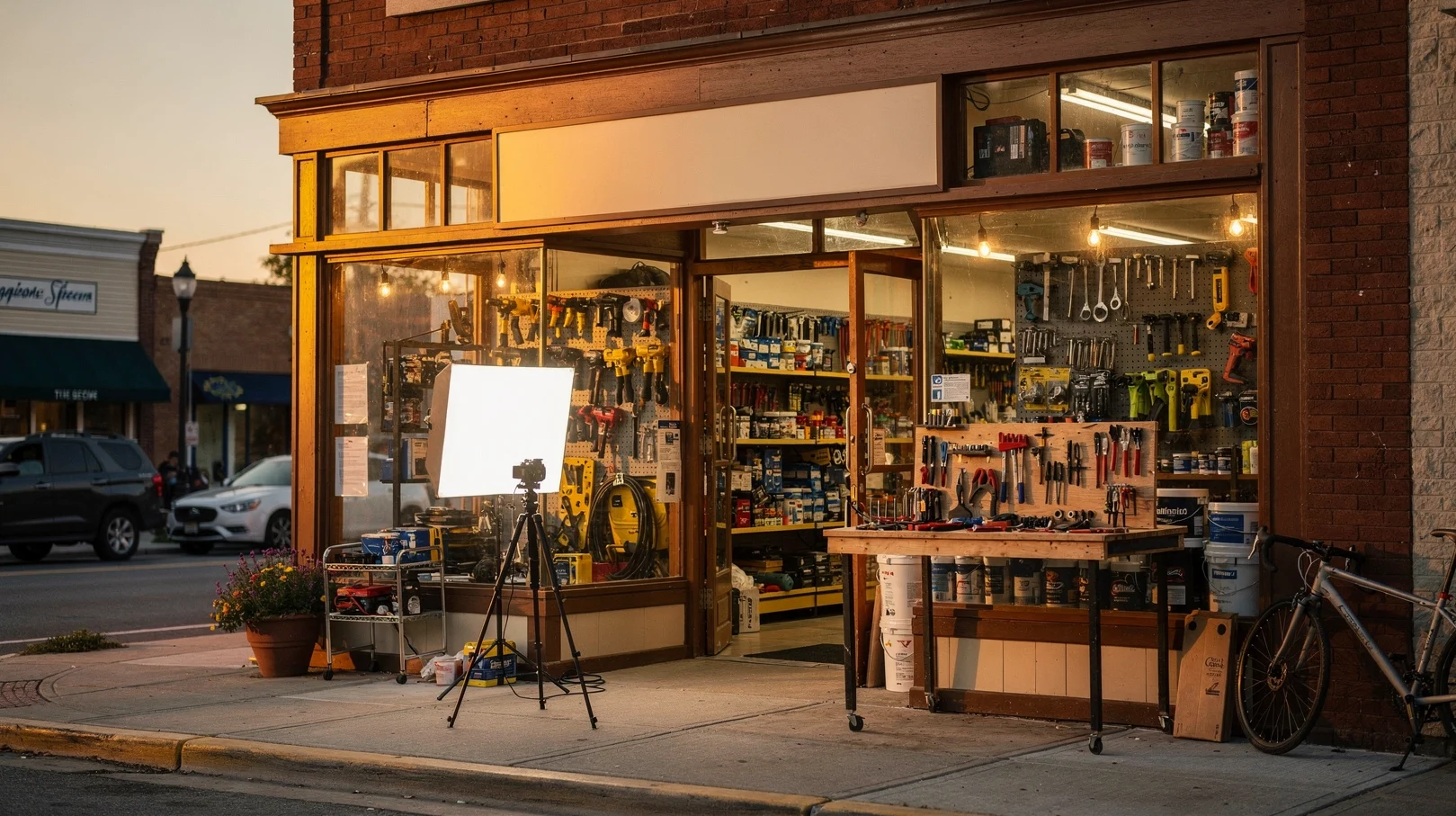
One of the most instructive small business stories in independent retail this year is not a venture-backed direct-to-consumer brand. It is a single 4,200-square-foot hardware store in a mid-sized American town that turned a how-to YouTube channel into a measurable revenue line: roughly 18% of total sales by its third year on camera. The owner did not chase virality. He filmed faucet repairs, deck-staining walkthroughs, and snow-blower tune-ups on a tripod next to the paint mixer, then attached every video to products he already stocked.
This piece breaks down exactly how that worked: the publishing cadence, the unit economics, the staffing reality, and the attribution method that let him prove the channel paid for itself. The point is not that every shop should start filming. It is that a small retailer can build a durable media asset on near-zero budget if the content maps cleanly onto inventory and the owner treats it as a department, not a hobby.
In short
- A neighborhood hardware store grew YouTube to about 140,000 subscribers and tied roughly 18% of revenue to video-driven demand within three years.
- The winning format was boring on purpose: short, evergreen repair tutorials filmed in-store, each tied to specific SKUs the shop already carried.
- Revenue arrived through four channels: in-store visits, a tightly curated online store, affiliate links, and modest ad payouts (AdSense), in that order of importance.
- The biggest cost was not gear, it was the owner’s time and a part-time editor; production discipline mattered far more than camera quality.
- Attribution was crude but honest: a dedicated landing page, a checkout question, and unique discount codes per video series.
Why a hardware store is an ideal YouTube candidate
Hardware retail sells solutions to problems people search for the moment they happen. A leaking shutoff valve, a sticking door, a generator that will not start: each is a query with clear commercial intent and a finite parts list. That is the rare overlap where helpful content and a shopping cart point at the same outcome. The store did not have to invent demand; it filmed answers to demand that already existed.
Independent operators who win on the physical street usually win because they understand foot traffic, neighbors, and the unglamorous economics of a lease, themes covered in our guide to the boring truths of main street retail. A video channel extends that same instinct online: it is local expertise, packaged so it travels past the city limits while still funneling nearby buyers through the front door.
The store’s owner had one structural advantage many e-commerce sellers lack: genuine subject authority. He had cut threaded pipe for 22 years. On camera that reads as trust, and trust is what converts a viewer in another state into someone who buys a $14 cartridge from a shop they will never visit. As covered in how a family hardware store survived the big box era, the independents that endured did so by owning the expertise the warehouse chains could not staff. Video simply made that expertise scalable.
What the content actually looked like
The format was deliberately repetitive. Each video opened with the problem stated in the title, showed the fix in three to seven minutes, and ended with a plain-spoken parts list. No intro music longer than four seconds, no channel-trailer fluff. The thumbnail was the broken part with a red circle on the failure point. This consistency is what let the catalog compound: a viewer who liked one valve-repair video found nine more in the same shelf-stable style.
Volume mattered more than polish. The shop committed to two videos a week for the first 18 months, which produced a library deep enough that search and the recommendation engine had something to surface in every season. Crucially, the owner mined his own point-of-sale data and his returns desk for topics: the parts customers bought most, and the repairs they botched, became the editorial calendar.
Here is the rough breakdown of how the catalog was structured by the end of year two:
| Content type | Share of catalog | Primary purpose | Revenue link |
|---|---|---|---|
| Single-part repair tutorials | 52% | Capture high-intent search | Direct product, affiliate |
| Seasonal maintenance (HVAC filters, snow gear) | 21% | Predictable traffic spikes | In-store and online |
| Tool comparisons and buying guides | 15% | Higher ticket conversion | Online store, affiliate |
| Shop tours and behind-the-counter | 8% | Community and loyalty | In-store visits |
| Quick tips and shorts | 4% | Subscriber growth, reach | Indirect (funnel top) |
Notice that the repair tutorials, the least exciting category, carried the most weight. They aged well, ranked for narrow queries, and pulled steady traffic years after filming. The shop tours felt good to make but moved the fewest dollars. That gap between what is fun to publish and what actually pays is the lesson most first-time creators learn too late.
The revenue model, broken down
The channel never relied on a single income stream, which is exactly why it survived YouTube algorithm shifts. Revenue stacked across four sources, and the owner managed each like a separate department with its own target.
- In-store and local pickup: Roughly 40% of video-attributed revenue came from viewers within driving distance who watched a fix, then came in for the parts and a second opinion. This was the highest-margin channel because it carried no shipping cost and frequently produced add-on sales at the counter.
- Curated online store: The shop sold only what it filmed, about 300 SKUs, shipped from the back room. Keeping the catalog tight kept fulfillment sane and let every video link to an exact product page rather than a generic search.
- Affiliate links: For tools the store did not stock (premium brands, large machinery), affiliate links captured intent the shop could not fulfill directly. Low margin per click, but pure incremental income on demand that would otherwise leak away.
- Platform ad revenue: AdSense payouts were the smallest slice and the least controllable. The owner treated it as a bonus that covered the editor’s salary, never as the foundation.
The mix mattered. By keeping in-store and owned-store sales as the core, the business avoided the trap of becoming a content company that happens to sell hardware. It stayed a hardware store that happens to publish content, which kept margins healthy and the brand grounded in a real place.
The unit economics reward this stacking. A single $14 cartridge sale online nets perhaps $5 after shipping and card fees, a thin margin that would never justify the filming time on its own. But the same video also drove three local walk-ins who each bought $40 to $60 of parts at full counter margin, plus a handful of affiliate clicks and a slice of ad revenue. No single line item paid for the content; the combined contribution did, and comfortably. This is the arithmetic that escapes most retailers who model a YouTube channel against one revenue stream, decide the numbers do not work, and never start.
It also compounds in a way paid advertising never does. A repair video filmed in year one was still generating views, code redemptions, and counter traffic in year three at essentially zero marginal cost. The owner described it as the difference between renting attention and owning a small piece of infrastructure: every paid ad stops working the moment the budget stops, while the back catalog keeps earning. By the third year the store had effectively built a sales asset on its balance sheet that no competitor could buy, only out-publish over the same multi-year horizon.
Attribution without an enterprise analytics budget
Proving the channel paid off is where most small retailers give up, because they assume they need a data team. This shop used three cheap, durable methods. First, a single landing page printed in every video description, tracked separately in basic web analytics. Second, a one-line question at checkout, online and in person: “Did a video bring you in today?” Cashiers logged it with a tally counter. Third, unique discount codes per video series, so redemptions mapped back to specific content themes.
None of this is precise to the dollar, and the owner is candid about that. But it was good enough to make budget decisions: when the tool-comparison series showed a 3.2x higher code redemption rate than shop tours, he reallocated filming time accordingly. Crude attribution that drives a correct decision beats perfect attribution that arrives too late to act on.
Understanding why those shoppers behaved the way they did also helped him refine topics. The broader shift toward research-before-purchase, documented in our look at the state of consumer behavior in retail, meant buyers increasingly arrived already half-convinced by a video, shortening the in-store conversation and lifting close rates.
Staffing and the real cost
The headline cost was not equipment. A used mirrorless camera, a lapel mic, and a softbox totaled under $1,200, and the store filmed against its own shelves for free. The genuine expense was time. For the first year the owner spent about eight hours a week filming and scripting, on top of running the store, which is unsustainable without a plan. The fix was hiring a part-time editor in month seven, paid for almost entirely by the ad revenue the channel had started generating.
This is where storefront economics and media economics collide. A main street operator already running thin on labor cannot simply add a content department, and many shops that tried failed here, not on creative quality. The districts that have adapted best, profiled in how main street districts are reinventing themselves post-pandemic, tend to treat digital presence as core operations with assigned hours and owners, not as something squeezed into evenings. According to the U.S. Small Business Administration’s business guidance, building any new revenue line works best when it has a written plan, a budget, and a single accountable person, advice this owner followed almost by accident.
The part-time editor changed the economics in a second, less obvious way. By taking over cuts, captions, and uploads, the editor freed the owner to film in batches: a single Sunday morning could produce four videos against the same lighting setup, dropping the per-video time cost by more than half. Batch filming is the operational unlock that lets a one-location store sustain a publishing cadence a national chain would staff with a small team. Without it, the channel competes directly with selling hours, and selling hours always win in a cash-tight retail business.
One staffing trap worth flagging: the owner remained the on-camera talent throughout, and that was deliberate. He tested handing tutorials to a younger employee who was more comfortable on camera, and watch time on those videos fell roughly 30%. The audience was buying his 22 years behind the counter, not slick presentation. In a small business story like this, the founder’s face and hands often are the brand, which means the channel cannot be fully delegated, only supported. That ceiling is real, and any owner planning to scale this should budget their own time honestly rather than assume they can hire it away.
A replication playbook for your shop
If you want to test this without betting the business, the sequence below mirrors what worked here, compressed into the first 90 days. The goal of the trial period is not revenue; it is to learn whether your category and your on-camera presence convert at all before you commit a year.
| Phase | Timeline | Action | Success signal |
|---|---|---|---|
| Pilot | Weeks 1-4 | Film 5 repair tutorials from your top-selling SKUs | Any video crosses 500 views unpaid |
| Cadence | Weeks 5-12 | Commit to one video per week, log topics from POS data | Steady week-over-week view growth |
| Measure | Week 6 onward | Add landing page, checkout question, discount codes | First video-attributed sale logged |
| Scale | Month 4+ | Hire part-time editor, batch-film, open curated store | Channel covers editor’s pay |
Each phase has a kill switch. If after four weeks no video clears a few hundred organic views, the problem is usually topic selection or thumbnails, both fixable, but if a revised batch still flatlines, your category may simply not have searchable repair intent. Knowing that within a month, rather than after a year of sunk evenings, is itself a valuable result. The retailers who regret this experiment are almost always the ones who skipped the measurement step and could never tell whether to double down or walk away.
Common mistakes
Most retailers who copy this model stumble in predictable ways, and they are worth naming plainly so you can skip them.
Chasing reach over intent. Shops obsess over subscriber count and viral shorts while ignoring the unglamorous repair videos that actually convert. Subscribers are a vanity metric; logged-in buyers and redeemed codes are the scoreboard.
Selling everything they film. Trying to stock and ship hundreds of SKUs to match every video destroys fulfillment and ties up cash. The discipline of a tight catalog plus affiliate links for the rest is what kept this store solvent.
Treating it as a side hobby. Without assigned hours and a content calendar pulled from real sales data, output collapses within three months. Inconsistency is the single most common cause of failure, not poor production value.
Skipping attribution entirely. A shop that cannot tell whether videos drive sales will eventually cut the channel during a slow quarter, often right before it would have compounded. Cheap, consistent measurement protects the investment.
Frequently asked questions
How long until a retail YouTube channel makes real money?
For this store, meaningful in-store lift appeared around month nine, once the catalog held about 70 evergreen videos that search and recommendations could surface reliably. Ad and affiliate income trailed behind, becoming material near the 18-month mark. The pattern is consistent across similar small business stories: the first six months produce almost no revenue and feel like wasted effort, then a back catalog reaches critical mass and traffic compounds. Plan for a year of investment before judging results, and fund it from a source that does not depend on the channel paying off early.
Do you need expensive equipment to start?
No. This store filmed its earliest and still highest-performing videos on a used camera and a $30 lapel microphone, total kit under $1,200. Viewers of repair content care about whether the fix works and whether the audio is clear, not about cinematic lighting. Clean audio matters far more than picture quality, so spend on a decent mic first. Upgrading the camera later produced no measurable bump in views or conversions, which suggests gear is the last constraint, not the first.
Should a store sell its own products or rely on affiliate links?
Both, but in the right order. The highest margin comes from selling parts you already stock to viewers nearby or shipping a tight curated catalog. Affiliate links are best reserved for products you cannot or should not stock, such as premium tools or large machinery, where they capture demand that would otherwise leak away entirely. This hardware store kept owned sales as the core, roughly 70% of video revenue, and used affiliates only to monetize intent it could not fulfill itself.
How do you pick which videos to film?
Mine your own data first. This owner pulled topics straight from point-of-sale records (the parts customers bought most) and from the returns desk (the repairs people botched and brought back). Both signal exactly what your local market is trying to fix. Seasonal patterns, such as furnace filters in fall and snow gear in winter, fill the calendar predictably. Avoid filming what is fun for you; film what answers a question a buyer is typing into a search bar at the moment something breaks in their home.
Can this work for retailers outside hardware?
It works best where products solve searchable, finite problems: auto parts, garden centers, kitchen supply, pet care, and craft stores all fit. The model struggles in categories driven by taste or impulse, like fashion or general gift retail, because the content cannot point to a specific fix and a specific part. If your customers regularly ask “how do I” questions that end with buying something concrete, the format translates. If they mostly browse for inspiration, you will need a different content strategy entirely.
How do you measure whether the channel is actually working?
Use methods cheap enough to sustain without a data team. A dedicated landing page tracked in basic analytics, a checkout question asking whether a video brought the customer in, and unique discount codes per video series together give you a usable picture. None is precise to the dollar, but the combination is accurate enough to decide which content earns more filming time. The goal is a decision-grade signal, not a perfect attribution model, and crude data you act on beats perfect data that arrives too late.
What’s next
If you run a shop with genuine product expertise, start by filming five answers to the questions your counter staff already field every day, then track them with a single landing page and a checkout question before you spend a dollar on gear. Pair that with a hard look at your fixed costs, because the operators who scale this without burning out are the ones who already understand the unglamorous math laid out in our main street economics guide and who treat content as a department with real hours, not a hobby crammed into the evenings.