
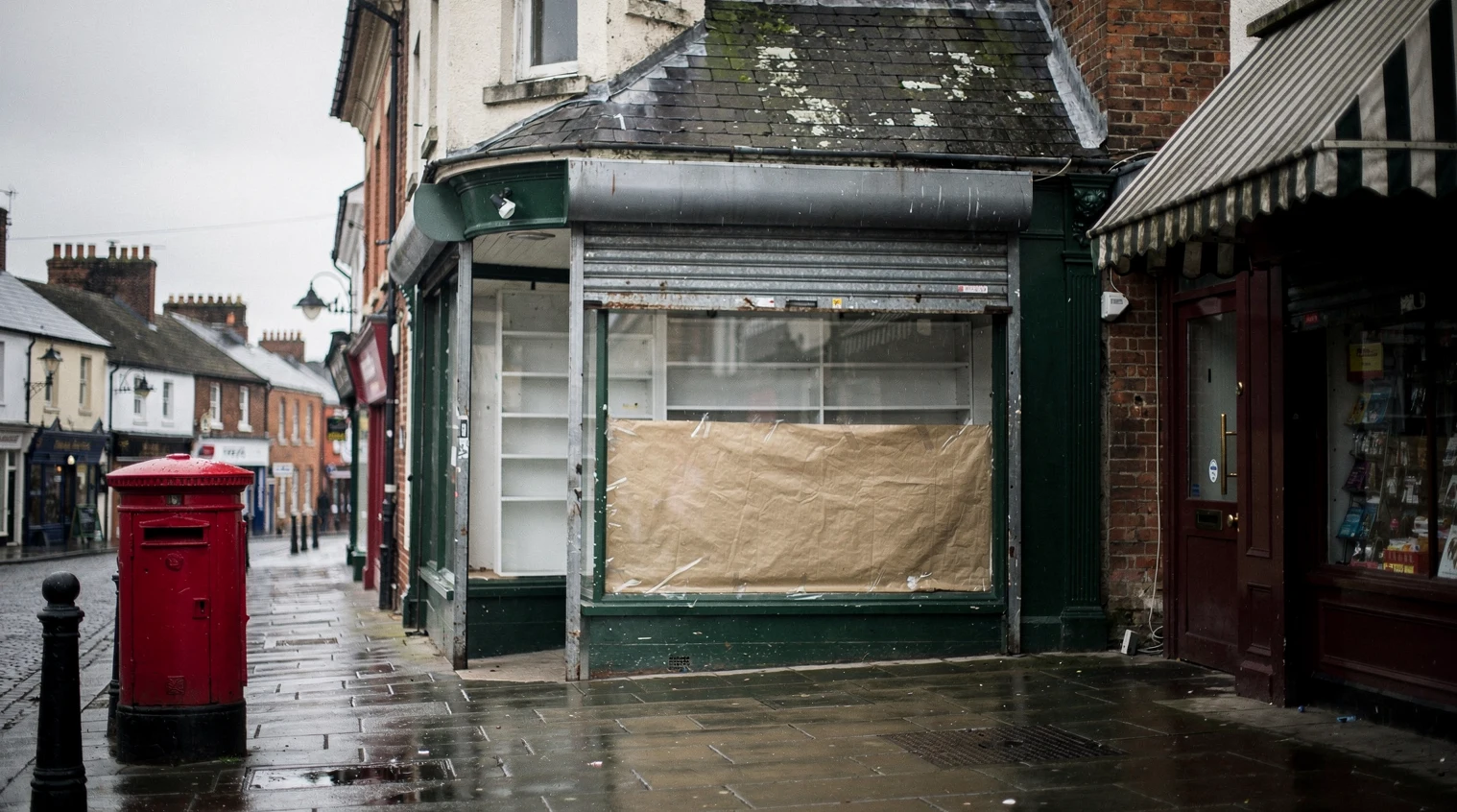
Sixteen more TG Jones shops are due to switch off their tills between 12 and 30 September, and in most of those towns the shop is not the only thing going. The Post Office counter inside it goes too.
TG Jones, the chain created when private equity firm Modella Capital bought WHSmith’s UK high street business in 2025, confirmed 19 closures for September as part of a court sanctioned restructuring plan that allows it to shut up to 150 shops. Three of the 19 have already gone. The rest fall in the next three weeks.
In short
- 19 TG Jones shops close in September 2026, of which 16 are still trading as of 9 September and shut between the 12th and the 30th.
- Up to 150 closures are permitted under a Part 26A restructuring plan sanctioned by the High Court on 1 July, out of an estate of 451 shops and roughly 4,700 staff.
- Post Office counters are the sharper local loss. TG Jones hosts 180 of them, and as many as 60 are considered at risk.
- High street footfall fell 3.1% year on year in August according to BRC-Sensormatic data, while retail parks were the only destination to grow.
- Cost pressure is structural, not seasonal: the National Living Wage rose to £12.71 in April, employer National Insurance sits at 15% on a £5,000 threshold, and business rates were rebuilt into five multipliers.
Update, 8 October: September is finished and October is the bigger tranche
All 19 September closures went ahead, the last of them in the final days of the month. October is bigger. More than 20 shops have confirmed closing dates this month, starting with Bishop’s Stortford and Bury St Edmunds on 3 October and running to Droitwich on 31 October, and TG Jones is still adding towns as individual leases are settled. Treat the number as a floor rather than a final count.
| Town | October closing date |
|---|---|
| Bishop’s Stortford (South Street) | Saturday 3 October |
| Bury St Edmunds (Cornhill) | Saturday 3 October |
| Inverness (High Street) | Tuesday 6 October |
| Malvern (Belle Vue Terrace) | Tuesday 6 October |
| Truro (Pydar Street) | Tuesday 6 October |
| Maldon (High Street) | Friday 9 October |
| Tamworth (Ventura Park) | Friday 9 October |
| Dorking (High Street) | Saturday 10 October |
| Melton Mowbray (Market Place) | Saturday 10 October |
| Bradford (The Broadway) | Sunday 11 October |
| Leek (Derby Street) | Monday 12 October |
| Wickford (High Street) | Monday 12 October |
| Bridgnorth (High Street) | Tuesday 13 October |
| Hythe (High Street) | Tuesday 13 October |
| Pinner (Bridge Street) | Wednesday 14 October |
| York (Coney Street) | Wednesday 14 October |
| Marlborough (High Street) | Saturday 17 October |
| Rickmansworth (High Street) | Saturday 17 October |
| West Wickham (High Street) | Monday 19 October |
| Stratford-upon-Avon (High Street) | Tuesday 20 October |
| Ormskirk (Moor Street) | Wednesday 21 October |
| Orpington (High Street) | Wednesday 28 October |
| Droitwich (Victoria Square) | Saturday 31 October |
| Billericay (High Street) | On the October list, date not yet confirmed |
The Post Office thread runs straight through that list. York’s Coney Street shop houses the city’s main Post Office counter, which goes with it in October, and Nottingham’s Victoria Centre branch is the same arrangement on a later date. Check the official Post Office branch finder for your town rather than assuming a replacement counter has been lined up, because the relocation is agreed town by town and not always before the shop shuts.
Three dates already sit beyond this month. Nottingham Victoria Centre closes on 31 December, Cannock is slated for early 2027, and the Crawley town centre Post Office counter is due to go in February 2027 as TG Jones leaves County Mall. The plan permits up to 150 closures out of an estate of 451, and the closures keep arriving in tranches, so a town that survived September and October is not safe for the year.
Which TG Jones shops close in September, and when
The September timetable was published in early September and has been reported consistently across UK national and regional outlets. Closing down sales are running in the affected shops, with discounts reported at up to 30% in store and deeper reductions online on books, stationery and seasonal stock.
Three shops have already closed: Bath on 1 September, and Redcar and Redhill on 5 September. The table below sets out the full list, with the 16 closures that are still ahead marked as upcoming.
| Town | Closing date | Status as of 9 September |
|---|---|---|
| Bath | Tuesday 1 September | Closed |
| Redcar | Saturday 5 September | Closed |
| Redhill | Saturday 5 September | Closed |
| Market Harborough | Saturday 12 September | Upcoming |
| Uckfield | Saturday 12 September | Upcoming |
| Cambridge | Monday 14 September | Upcoming |
| Swindon | Tuesday 15 September | Upcoming |
| Helston | Wednesday 16 September | Upcoming |
| Deal | Saturday 19 September | Upcoming |
| Basildon | Monday 21 September | Upcoming |
| Rustington | Wednesday 23 September | Upcoming |
| Clevedon | Saturday 26 September | Upcoming |
| Greenford | Saturday 26 September | Upcoming |
| Kenilworth | Saturday 26 September | Upcoming |
| Southend-on-Sea | Saturday 26 September | Upcoming |
| Exmouth | Monday 28 September | Upcoming |
| Frome | Wednesday 30 September | Upcoming |
| Cardigan | End of September | Upcoming, date not confirmed |
| Wells | September, date to be confirmed | Upcoming, date not confirmed |
Why the list is heavily weighted to smaller towns
Look at the geography rather than the dates. Market Harborough, Uckfield, Helston, Deal, Rustington, Clevedon, Kenilworth, Exmouth, Frome, Cardigan and Wells are not large retail centres. They are market towns and coastal towns where a mid sized stationery and newsagent unit is often one of the biggest floorplates on the primary shopping street.
That matters for the local effect. In Cambridge or Swindon a vacated unit sits among dozens of comparable ones. In Frome or Helston it can be the anchor of an entire parade, and the vacancy is visible from every direction.
The list is a rolling programme, not a final tally
September’s 19 are a tranche, not the conclusion. Retail research firm Coresight, in its weekly UK store openings and closures tracker for week 35, recorded a further 16 TGJones closures planned as the restructuring rollout continued. Anyone treating the September list as the end of the process is reading it wrong.
Why TG Jones is closing shops: the restructuring plan arithmetic
The closures are not an operational tidy up. They are the mechanism of a formal insolvency adjacent process, and the numbers explain the urgency.
Modella Capital announced on 7 May that up to 150 shops would close as an essential part of a restructuring. The company then put a Part 26A restructuring plan to creditors. Lenders were told the retailer faced administration by the end of July if the plan was not approved.
What the court actually sanctioned
The High Court sanctioned the plan on 1 July. Bloomberg reported that the judge approved an arrangement including a fresh £15 million cash injection from Modella Capital, which Bloomberg put at about $19.9 million. That followed roughly £10 million lent in April, with the wider package of support reported at around £35 million.
The sanction was not consensual. Eleven creditor classes did not approve the plan, which means the court used the cross class cramdown power that Part 26A provides. Legal commentary from Kirkland & Ellis and Slaughter and May has since treated the case as a reference point for so called landlord plans, and specifically for the question of equity retention: whether shareholders should keep their position while landlords and suppliers take losses.
Reporting of the hearing noted the judge characterising the arrangement as having “all the hallmarks of an adventurous equity play”. Without the plan, the business faced a reported £8 million shortfall.
Who takes the loss
The distribution of pain is the part that local landlords and suppliers should read closely.
| Group | Treatment under the plan |
|---|---|
| Landlords of viable shops | Asked to accept rent reductions across much of the estate |
| Landlords of non-viable shops | Can take the site back rather than continue on reduced terms |
| Core suppliers | Paid in full, by monthly instalments, after a six month delay |
| Non-core suppliers | Paid 50% of amounts owed, spread over three years |
| Owner (Modella Capital) | Injects new money and retains its equity position |
For a small local supplier that sold greetings cards or seasonal stock into a TG Jones branch, “non-core” means recovering half, over three years. That is a working capital event for a small business, not an accounting footnote.
The Post Office counters are the bigger local story
A stationery shop closing is a commercial event. A Post Office counter closing is a public services event, and that is where the September programme bites hardest.
TG Jones operates 180 Post Office counters across its estate. Reporting in May indicated as many as 60 of those outlets could be at risk under the restructuring. When a counter sits inside a closing shop, the service either relocates to another nearby premises or it disappears from the town.
The contract change that made speed possible
Alongside the restructuring, Modella sought changes to the group’s agreement with the Post Office. According to reporting by Retail Gazette in May, the requested terms were:
- Reduce the notice period for branch closures from six months to 56 days.
- Waive compensation rights for affected shops.
- Instead pay the Post Office 170% of estimated closure profits, subject to a minimum of £500.
- Apply those terms through June 2029, after which normal rights would resume.
The practical effect of moving from six months to 56 days is that a community gets roughly eight weeks of warning instead of half a year to arrange an alternative. For a parish council, a chamber of trade or a retailer thinking about taking on a counter, eight weeks is a very short runway.
What the Post Office and the union have said
The Post Office acknowledged the situation directly. In a statement reported in May it said it was “regrettable that following the restructuring plan announcement by TG Jones on 7 May, a small number of Post Office branches inside TG Jones stores will close in the coming months”, adding that it was “working hard to find locations nearby to continue offering Post Office services”.
The Communication Workers Union was blunter, warning that affected communities risked becoming “postal deserts” and that outsourcing such services “will put shareholders before communities we serve”.
Modella’s stated intention is to relocate counters lost through the restructuring into other businesses it owns, including the craft retailer Hobbycraft. That works where a Hobbycraft or comparable unit exists in the same town. In Helston, Frome, Cardigan or Uckfield, it generally does not.
Southend shows the pattern in practice
Southend-on-Sea is the clearest documented example. The shop closes on 26 September, and Southend’s main Post Office, which operates above the store, goes with it. Customers are being directed to branches on Sutton Road and Hamlet Court Road.
That is the good version of the outcome. Southend is a large town with alternative branches within reach. Local reporting has also flagged York’s main Post Office on Coney Street as facing closure alongside the TG Jones shop there, and separate local coverage has tracked the same pattern in Uckfield and in North Wales. Smaller towns have fewer fallbacks, and the parcel and banking access that a counter provides is exactly what keeps small traders able to fulfil orders without a daily drive. Independent shops that have already shifted volume to couriers and delivery apps will feel the change less, and the practical trade-offs in local delivery for independent shops become considerably more relevant once a town loses its counter.
The counter losses are not coming from one source
TG Jones is not the only host retailer shedding counters this autumn, which is why the cumulative effect is larger than any single announcement suggests.
| Source of change | Scale reported | Timing |
|---|---|---|
| TG Jones restructuring | 180 counters hosted, up to 60 at risk | Rolling through 2026 |
| Morrisons Daily closures | At least 52 counters expected to close, tied to around 100 convenience store closures | By early October 2026 |
| Directly managed branches | 115 previously proposed for closure | Proposal predates the 2026 network commitment |
| Network minimum | Around 11,500 branches to be maintained, with £483m of modernisation funding over two years | Confirmed February 2026 |
The important nuance is that the network total and the local availability are different questions. Government has committed to maintaining roughly 11,500 branches nationally. That commitment says nothing about whether the branch survives in Frome, and a town can lose its counter while the national number holds.
What August’s trading data says about the wider high street
The TG Jones closures land into a market that was already soft, and the August figures are worth reading because they separate the chain’s own problems from the sector’s.
The BRC-KPMG Retail Sales Monitor recorded total UK retail sales up 0.7% year on year in the four weeks to 29 August. That was down from 1.3% growth in July and below the 12 month average of 1.6%. Like for like sales, which strip out floorspace changes, rose 0.5% against 1.0% the previous month.
Separate BRC-Sensormatic footfall data showed the destination split clearly.
| Destination | Footfall change, August 2026 vs August 2025 | Direction versus July |
|---|---|---|
| Total UK retail | -1.7% | Still negative |
| High streets | -3.1% | Improved from -3.8% |
| Shopping centres | -0.5% | Mildly negative |
| Retail parks | +1.0% | Only destination in growth |
The number that explains the closure list
Retail parks growing 1% while high streets fall 3.1% is a four point gap in one month, and it repeats. A chain deciding which shops to keep is looking at exactly this split. High street units with long leases and full rates liabilities are the ones that fail the test first, which is precisely the profile of the September list.
The BRC attributed the sales slowdown partly to the fading of spending linked to unusually warm weather earlier in the summer, alongside growing pressure on household budgets. Neither factor reverses quickly.
What it now costs to keep a shop open
Three cost lines changed in ways that fall hardest on labour intensive, physical retail. None of them are TG Jones specific, which is why the same arithmetic is being run in every chain’s property department right now.
Business rates were rebuilt, not simply cut
From 1 April 2026 the retail, hospitality and leisure relief was replaced by permanently lower multipliers for qualifying properties with rateable values below £500,000. The lower multipliers sit 5p below the relevant national ones, and they are funded by a higher multiplier applied to properties at £500,000 and above, set 2.8p above the standard rate. The package was announced at the Budget on 26 November 2025 and valued at an estimated £4.3 billion over five years.
| Multiplier, 2026/27 | Rate | Applies to |
|---|---|---|
| Small business RHL | 38.2p | Qualifying small retail, hospitality and leisure premises |
| Standard RHL | 43.0p | Qualifying larger RHL premises below £500,000 rateable value |
| Small business non-domestic | 43.2p | Small premises outside the RHL definition |
| Standard non-domestic | 48.0p | Standard premises outside the RHL definition |
| High-value non-domestic | 50.8p | Premises at £500,000 rateable value and above |
For most independent shops on a high street, this is genuinely helpful: a qualifying small retail premises pays 38.2p rather than 43.2p. The catch is that the relief it replaced was, for many, more generous in cash terms, and a permanently lower multiplier applied to a revalued rateable value does not always produce a lower bill.
Wages and National Insurance moved together
The National Living Wage rose 4.1% to £12.71 an hour from April 2026 for workers aged 21 and over, with £10.85 for 18 to 20 year olds and £8.00 for 16 to 17 year olds. Employer National Insurance remains at 15% with the secondary threshold at £5,000 a year, both carried over from April 2025. The Employment Allowance stands at £10,500.
The threshold cut from £9,100 to £5,000 is the detail that hits shops specifically, because it pulls part time and lower paid staff into charge far earlier. A shop rota built on short shifts absorbs that change worse than an office payroll does. The BRC has put the combined effect of the higher NICs rate, the lower threshold and two above inflation National Living Wage increases at £6.5 billion over two years across the sector.
Why fixed costs decide which shops close
Rent, rates and staffing are largely fixed against a footfall line that fell 3.1% on high streets. When a shop’s contribution turns negative, the lease becomes the only variable a restructuring can move, and that is exactly what a landlord plan is designed to do. The September closures are the output of that calculation, town by town.
Who Modella Capital is, and why the pattern matters
Understanding the owner helps predict what happens next in the affected towns.
Modella Capital is a British private equity firm founded in August 2022, part of the Hay Wain Group owned by Jamie Constable. It has assembled a portfolio of high street and specialist retail assets in a short period.
The portfolio and its track record
- Hobbycraft, acquired from Bridgepoint in August 2024. Its owner was reported to be exploring a sale in February 2026.
- The Original Factory Shop, acquired from Duke Street Capital in February 2025. It entered administration on 28 January 2026 and the final shops closed on 4 April 2026.
- WHSmith high street, acquired 30 June 2025 for £40 million, reduced from an initial valuation reported at around £76 million, covering 480 shops. Rebranded to TGJones from 1 July 2025, first at Aylesbury.
- Lakeland was reported as a takeover target in March 2025, alongside other interests including Claire’s, Wynsors and Crafter’s Companion.
The Original Factory Shop sequence is the one that local traders should note: acquisition in February 2025, administration in January 2026, complete closure by April 2026. That is not a prediction about TG Jones, which has fresh funding and a sanctioned plan. It is a reason to treat “up to 150” as a live, moving number rather than a settled one.
The brand was designed to look like continuity
The TGJones name was invented by Modella to sound similar to WHSmith and convey the impression of a family business, despite not referring to any actual person. The chain is headquartered at Greenbridge in Swindon, is led by chief executive Alex Willson, and operates Toys “R” Us concessions in 76 shops alongside Hobbycraft and Claire’s sections.
Willson has publicly acknowledged the difficulty of the task, saying that “turning around a business is not straightforward”. For shoppers, the practical point is that the familiar looking fascia does not indicate the familiar ownership or the familiar balance sheet.
What a closure does to the rest of the parade
An anchor unit going dark changes the economics of every neighbouring business, and the effect is measurable rather than sentimental.
A stationery and newsagent shop with a Post Office counter generates repeat, non-discretionary, mid-week visits. People come for a passport form, a parcel, a card, a lottery ticket. Those trips are the ones that create incidental spend in the café, the butcher and the hardware shop either side.
Losing a footfall generator is different from losing a competitor
Independent retailers sometimes greet a chain closure as reduced competition. For a card shop or a bookshop that may be partly true. For everyone else on the street, an anchor closing removes a reason to visit the street at all.
The distinction is the same one that applies in reverse when a large operator arrives, and the strategic response is the opposite of the instinctive one. The framework for reading anchor changes set out in what independent stores should do when a big box is opening nearby applies here too, simply with the sign flipped: the question is which trips you can now capture, not which competitor has gone.
The vacancy itself is the risk
A large empty unit with papered windows depresses the perceived quality of a parade quickly. Re-letting a mid sized high street unit in a market town is slow, and the realistic outcomes are a discount operator, a charity shop, a subdivision into smaller units, or an extended vacancy.
Where a unit is re-let or subdivided, the incoming occupier will face a planning and consents process before trading, and shopfront alterations are where those projects usually stall. The rules on signage, window displays and permits are worth checking early by anyone considering taking on one of these units, because consent timelines often exceed the fit out.
What independent retailers in these towns should do now
There is a narrow, practical window between now and the end of September in each affected town. The actions below are ordered by how quickly they need to happen.
Establish exactly what the town is losing
Confirm whether your local branch actually hosts a Post Office counter, and whether a relocation has been identified. Do not assume the shop closure and the counter closure are the same event, because in some towns the counter is retained elsewhere and in others it is not. The Post Office maintains an official branch finder that reflects confirmed changes.
Reprice your own fulfilment before you need to
If you post orders and the counter is going, work out now what the alternative costs in time and money. A twenty minute drive to the next town, three times a week, is a real cost that most small retailers discover only after the counter has closed.
Plan for a footfall shock, not a footfall dip
Anchor closures produce a step change rather than a gradual decline, and the businesses that cope best are the ones that had already reduced their dependence on passing trade. The pattern is well illustrated by the independent florist that replaced walk-ins with subscriptions after a road closure removed its passing trade: the substitution had to be built before it was needed, not after.
Fix your local discoverability this month
When a familiar shop closes, local search volume for its category rises immediately as people look for a replacement. In the affected towns, searches for card shops, stationers, parcel drop-off points and Post Office alternatives will spike in the days after each closure date.
That demand goes to whichever business is most visible in local results, which makes this a short window in which listing accuracy matters more than usual. It is worth reviewing how Google, Yelp and Nextdoor return results for local shops and confirming that opening hours, categories and services are correct before the closure date rather than after it.
Talk to the landlord and the council early
If your business could use additional space, a subdivided portion of a vacated anchor unit may be available on terms that would not normally be offered. Landlords facing a long vacancy in a market town are more flexible in the first three months than in the twelfth.
What shoppers should check before the end of September
Practical points for anyone in the 16 towns still facing a closure this month.
- Gift cards and vouchers. Use them before the closing date. Redemption rules can change during a closing down period, and a restructuring does not guarantee acceptance elsewhere.
- Post Office business. Complete passport applications, vehicle tax, banking and parcel returns before the counter closes, and confirm where the nearest alternative is.
- Returns and refunds. Goods bought in a closing down sale are still covered by your normal statutory rights if faulty, but discounted stock is frequently marked as final sale for change of mind returns.
- Regular orders. If you have a magazine or newspaper reservation at the branch, arrange an alternative locally rather than assuming it transfers.
What to watch after September
Three things determine how the rest of this programme lands, and each is observable.
First, the pace of the next tranche. Coresight’s tracker already records a further 16 closures planned beyond the September list. With up to 150 permitted and 451 shops at the point of sanction, the programme has considerable room left to run before it reaches its ceiling.
Second, the counter relocations. The test of the Post Office’s commitment to find nearby locations is whether counters actually reopen in the smaller towns, not the large ones. Southend has alternatives. Helston and Cardigan have far fewer, and those are the towns where the outcome will be visible.
Third, the golden quarter. Shops closing on 26, 28 and 30 September exit trading before the Christmas period entirely, which tells you the units were judged unable to earn their keep even in the strongest quarter of the year. If further closures are announced during October and November, that will indicate the plan’s assumptions are being tested rather than met.
For the towns on the September list, the immediate question is narrower and more urgent. It is not whether TG Jones survives. It is whether the Post Office counter comes back, and how long the unit stays dark.
Frequently asked questions
How many TG Jones shops are closing in September 2026?
Nineteen shops are closing during September 2026. Three closed in the first week (Bath on 1 September, Redcar and Redhill on 5 September) and 16 more are scheduled between 12 and 30 September, including two in Cardigan and Wells where exact dates had not been confirmed.
Is TG Jones the same company as WHSmith?
No. Modella Capital bought WHSmith’s UK high street business, completing on 30 June 2025 for a reported £40 million, and rebranded the shops as TGJones from 1 July 2025. WHSmith retains its travel business in airports, railway stations and hospitals, which is a separate operation and is not affected by these closures.
Will my Post Office close if the TG Jones shop closes?
Not automatically, but frequently. TG Jones hosts 180 Post Office counters and as many as 60 have been reported at risk. Where a counter is inside a closing shop, the Post Office has said it is working to find nearby locations, and Modella has indicated it would seek to relocate counters into other businesses it owns such as Hobbycraft. Check the official Post Office branch finder for your town rather than assuming either outcome.
How many TG Jones shops will close in total?
The restructuring plan permits up to 150 closures. The business operated 451 shops when the plan was sanctioned on 1 July 2026, so the maximum represents roughly one in three. The closures are being announced in tranches, and the September list is one of those tranches rather than the total.
Why did the High Court approve the plan if creditors objected?
The plan was made under Part 26A of the Companies Act, which allows a court to impose a plan on dissenting classes through cross class cramdown. Eleven creditor classes did not approve it. The court sanctioned it on 1 July 2026 alongside a fresh £15 million injection from Modella Capital, on the basis that the alternative for those creditors would be worse. The alternative in this case was administration, which lenders had been warned was likely by the end of July without approval.
Are the closing down sale discounts genuine?
Discounts of up to 30% in store have been reported, with deeper reductions online on books, stationery and Christmas stock. Prices in a closing down sale are set against the retailer’s own previous price, so compare against other shops rather than against the ticket. Note also that final sale terms usually apply to change of mind returns, though your statutory rights on faulty goods are unaffected.
How bad is the UK high street generally right now?
Softening rather than collapsing, but with a clear split by destination. BRC-KPMG data showed total retail sales up 0.7% year on year in the four weeks to 29 August, below the 12 month average of 1.6%. BRC-Sensormatic footfall data showed high street visits down 3.1% year on year in August while retail parks rose 1.0%, making retail parks the only destination in growth.
What happens to the staff in the closing shops?
TG Jones employed around 4,700 people across its estate. Hundreds of jobs were reported at risk under the restructuring. The company has said that supporting affected colleagues remains a priority and has thanked staff in individual closing shops in its statements, but it has not published a consolidated redundancy figure for the September tranche.
Could an independent retailer take over one of these units?
In some towns, yes. Landlords of non-viable shops can take sites back under the plan, and a landlord facing a long vacancy in a market town is typically more flexible on terms early. Subdivision into smaller units is common for mid sized high street floorplates. Anyone considering it should factor in the time required for shopfront and signage consents, which frequently takes longer than the fit out itself.