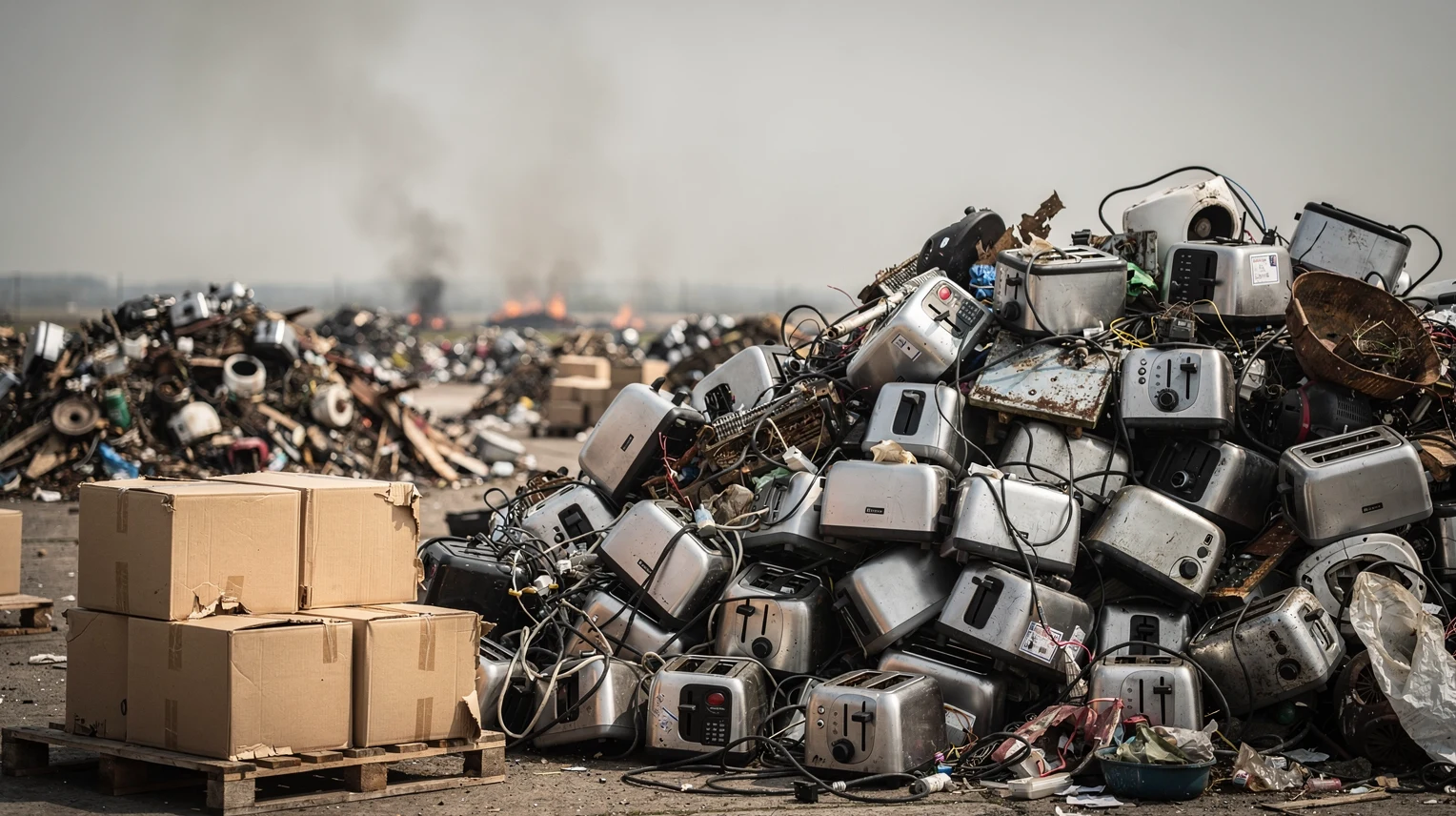
Toasters, kettles and slow cookers that UK shoppers handed back to Tesco, Argos and Asda as faulty have been found on one of the world’s most notorious e-waste dumps, at Agbogbloshie in Accra, Ghana. The joint investigation by Unearthed, the journalism unit of Greenpeace UK, and Greenpeace Africa was published at midday on Thursday 26 November, the eve of Black Friday, and was reported the same day by the Guardian and the Daily Mail.
Tesco has suspended its third-party electronic waste management providers “with immediate effect” while it audits them. Argos says it is reviewing the findings, and Asda says it has launched an immediate investigation. The story goes to the heart of a question few shoppers ever ask at the returns desk: what actually happens to the broken kettle once the refund has gone through?
In short
- Dozens of boxed appliances returned to Tesco, Argos and George at Asda were documented at the Agbogbloshie dump and in second-hand shops in Accra, many with returns slips reading “not working” or “cutting out”.
- Only one of nine returned Tesco, Argos and George items that investigators tested actually worked.
- The likely route is the liquidation market: untested returns sold by the pallet to “jobbers” and brokers, some of whom openly advertise pallets “for export” to Africa.
- Exporting broken electricals to Ghana is illegal in almost every circumstance; the Environment Agency says no exporter has been permitted to send e-waste to West Africa for at least three years.
- Your refund rights are unaffected, but the findings land as Black Friday drives a surge in returns, and they put pressure on retailers to test returns before selling them on.
What did the Greenpeace investigation find?
Over four visits to Agbogbloshie and trips to nearby electrical goods shops, reporters for Unearthed and Greenpeace Africa documented dozens of small kitchen appliances from British retailers. Many were still in their boxes. Many carried returns labels showing they had been handed back to high street stores because they were faulty.
Agbogbloshie sits beside the Odaw river in the centre of Ghana’s capital. It was once ranked alongside Chernobyl as one of the most polluted sites on earth, and has long been one of the world’s biggest digital scrapyards. Workers break open appliances with mallets to recover copper and aluminium; what has no value is burned or dumped.
According to Unearthed, one Tesco toaster carried a returns slip reading “not working” from the Sandhurst Extra store. A second had been returned for “product quality”. Not everything was faulty: two Crock-Pot slow cookers with Tesco returns labels were marked “change of mind”.
In one jumbled pile about two metres high, the investigators counted two Tesco toasters, two Tesco ceramic slow cookers and at least eight Crock-Pots. The same pile held at least nine boxed items from Cookworks, an Argos own brand. A Cookworks toaster bought at the Whitley Bay Argos had been returned on the same day in April with the fault “cutting out”, and a Cookworks slow cooker from Taunton had been returned for “not heating up”.
Several George Home toasters, Asda’s own brand, were also photographed, some unboxed with yellow logistics labels and others with Asda till receipts still taped to them. Some items found at the dump and in shops in Accra carried stickers reading “untested return”.
Only one in nine worked
The investigators bought or collected nine returned Tesco, Argos and George items that had been marked as faulty, from second-hand shops and from the dump site, and tested them. Only one worked. That figure matters because UK law allows used electrical equipment to be exported for reuse only if each item has been tested and shown to work.
Shopkeepers in Accra, whose names were changed by the reporters, said they typically work with a contact based in the UK. One said that “about 10%” of a shipment could be unusable; another put the waste share at “about 30%”, adding that broken stock cannot be returned at any point in the chain. The broken items, one trader said, go into a box for “the Agbogbloshie boys” to collect.
How do faulty returns from UK shops end up in Ghana?
The investigation does not claim that Tesco, Argos or Asda shipped anything to Ghana themselves. It traces a chain of intermediaries. When a recently bought item is returned for a refund, even as faulty, it does not automatically enter the regulated e-waste system. It can instead join the wider stream of customer returns that retailers sell off to recover some value.
This is a familiar problem in UK retail. Returns are expensive to process, and many retailers would rather sell unchecked stock in bulk than pay staff to test each item. It is the same economics that has pushed some platforms towards letting shoppers keep low-value items, as we reported when Amazon UK introduced returnless refunds for FBA sellers.
The liquidation market and the “jobbers”
Unearthed says faulty returns are likely to have been sold through liquidation channels to “jobbers”: individuals and small firms who buy goods by the palletload and extract whatever value they can. That can mean listing items one by one on eBay or Vinted, selling them through discount shops, or exporting them.
Argos runs its own liquidation site, Argos Clearance, which auctions pallets of returns. An Argos Clearance auction that ended last week advertised six pallets of “small kitchen appliances RETURNS”, with more than 200 items including toasters, blenders, slow cookers and microwaves, described as “raw customer returns that have NOT been checked or tested for faults (mainly faulty)”. Unearthed also found a job lot of Tesco returns listed on a third-party auction site.
Argos Clearance’s terms require buyers to repair, rework, recycle or resell items as second-hand, to have electrical items tested by a qualified electrician before resale, and to comply with e-waste rules. Argos declined to tell the reporters how it monitors or enforces those conditions, or whether it had ever acted against a buyer.
The export brokers
The investigators found TikTok videos in which UK-based middlemen advertise pallets of returned goods as suitable for export to Africa and the Middle East, with descriptions such as “Tesco small appliances” and “Customer return mix Pallet kitchen appliances for Export”. Another advertised “Asda onlin [sic] return pallets for export”.
Posing as buyers, the reporters approached several of these firms. A broker near Derby said its pallets of small appliances “come directly from Tesco” and cost £300–700 each. “You’ll have some brand new, some faulty,” a salesperson said, adding that the model works for Africa because “it doesn’t cost a lot of money to fix it”. The broker estimated that 80% of its exports go to Africa. A second broker said his kitchen stock was “all Asda, George Home” and “mostly raw returns, untested”.
| Stage | What should happen | What the investigation found |
|---|---|---|
| Shopper returns a faulty appliance | Refund or replacement; the item is logged and handled responsibly | Returns slips marked “not working”, “cutting out”, “not heating up” |
| Retailer disposes of faulty stock | Sent into the regulated (obligated) e-waste system or tested for reuse | Faulty and working returns sold in bulk as untested pallets |
| Liquidation buyer | Repairs, tests, recycles or resells in line with terms | Brokers advertise “raw returns, untested” pallets “for export” |
| Export | Only tested, working items with paperwork may leave as reuse | Items reach Accra untested; eight of nine tested did not work |
| End of life | Recycled at an approved facility | Stripped and burned at Agbogbloshie |
What have Tesco, Argos and Asda said?
All three retailers responded to the investigation, but none answered directly when asked whether faulty electrical returns had been sold through liquidation channels rather than being processed as e-waste, according to Unearthed and the Guardian.
A Tesco spokesperson said: “We’re extremely concerned about these claims. We have suspended our third-party electronic waste management providers with immediate effect while we complete a full audit of them and their practices.” The retailer added that it works with experts “to ensure we handle materials responsibly, in line with legal requirements and our own robust standards”. Unearthed notes that Tesco’s own website states that it recycles faulty products through the official “obligated” e-waste channels.
Argos, which is owned by Sainsbury’s, said: “As a responsible retailer, we have processes in place for products returned to Argos. We take these findings seriously and are reviewing the information provided to establish what further action is needed to ensure our requirements are met.”
Asda initially referred questions to the British Retail Consortium, the Guardian reported. In an updated statement carried by Unearthed, Asda said it had “immediately launched an investigation into these claims” and would “continue to seek answers into how this happened”. The BRC called the reports “deeply concerning” and said used electronics “should only be exported for legitimate reuse where they are safe and functional”.
| Retailer | Brands documented in Ghana | Example returns label | Response |
|---|---|---|---|
| Tesco | Tesco own-brand toasters, kettles and ceramic slow cookers; Crock-Pot slow cookers with Tesco labels | “Not working” (Sandhurst Extra); “change of mind” | Suspended third-party e-waste providers; full audit under way |
| Argos | Cookworks toasters, slow cookers and food slicers | “Cutting out” (Whitley Bay); “not heating up” (Taunton) | Reviewing the findings to decide further action |
| Asda | George Home toasters, some with till receipts attached | Yellow logistics labels; Asda receipts | Launched an immediate investigation; BRC called reports “deeply concerning” |
Is it legal to export faulty electricals from the UK?
In almost every circumstance, no. The Guardian and Unearthed both report that exporting broken electrical goods from the UK to Africa is illegal under UK waste export rules. Ghana’s Environmental Protection Authority agrees: Larry Kotoe, its acting director for sustainability, told Unearthed that broken goods “should not be here”, while acknowledging that trade in working second-hand equipment “provides important economic and social benefits”.
The reuse loophole
The most likely legal disguise is “reuse”. Under Schedule 9 of the Waste Electrical and Electronic Equipment Regulations 2013, used equipment can be exported for reuse only if every item has been tested and shown to work, with a record of the test attached, and with paperwork and a declaration from the exporter that none of the shipment is waste. Unearthed says it saw no testing records on any British appliance on sale in Accra.
Mark Sayers, director of the compliance consultancy CircuMetrics, told the reporters that a supermarket recording an item as “not working” “doesn’t always mean they’ve technically declared it as a waste”. By labelling goods as products rather than waste “at the very top end of that value chain, you can circumvent all of it”, he said. Jim Puckett, founder of the Basel Action Network, called the treatment of untested returns a “major loophole” and argued they “should be considered waste until proven otherwise”.
The Basel Convention changes since January 2025
The Basel Convention, the 35-year-old treaty that limits waste dumping by rich countries on poorer ones, was expanded at the start of 2025 to cover e-waste more tightly. Since January 2025, most non-hazardous e-waste, a category that includes most small domestic appliances, can only be shipped abroad with the consent of both the UK government and the receiving country.
Environment Agency data shows no such consents have been granted for Ghana or any other African country in that time, according to Unearthed. The agency also said, in response to a freedom of information request, that no approved exporter has been permitted to send obligated e-waste to Ghana, or anywhere in West Africa, for at least the past three years. The Guardian reports that no facilities in West Africa are approved to receive British WEEE.
Why enforcement struggles
The Environment Agency is responsible for stopping illegal waste exports from England, but experts told Unearthed that it can physically check only a fraction of what leaves UK ports. Between January 2025 and 23 October 2026, the agency inspected 35 containers bound for Ghana; five were stopped after e-waste was found, and four were later judged to be illegal waste shipments.
An Environment Agency spokesperson said illegal waste exports “are a serious crime” and that “new controls mean exports of waste electrical and electronic equipment must be notified and approved before they leave the country”. The agency said it is using intelligence to target suspicious shipments, and warned that offenders risk prosecution and financial penalties.
| Rule or figure | Detail | Source |
|---|---|---|
| Reuse exports | Every item must be tested and working, with a test record and exporter declaration | WEEE Regulations 2013, Schedule 9 |
| Non-hazardous e-waste exports | Prior consent of the UK and the receiving country needed since January 2025 | Basel Convention amendments, per Unearthed |
| Consents granted for African countries | None since January 2025 | Environment Agency data, per Unearthed |
| Approved exporters to West Africa | None for at least three years | Environment Agency FOI response |
| Containers to Ghana inspected | 35 (January 2025 to 23 October 2026); 5 stopped; 4 ruled illegal | Environment Agency figures, per Unearthed |
Why does this matter on Black Friday?
Greenpeace timed the release for the eve of Black Friday, the busiest online shopping day of the year, and says industry research suggests that one in five discounted items bought on the day are likely to be returned. That is a large flow of goods into exactly the returns systems the investigation has put under scrutiny.
Small kitchen appliances are a staple of Black Friday promotions, from air fryers to slow cookers, and many are bought on impulse at prices that make them easy to send back. Unearthed’s reporting describes how blenders that were once a significant outlay, kept for years and repaired, can now cost about as much as a pizza. Shoppers weighing up whether a deal is worth it may want to read our earlier coverage of how Which? found only one in five Black Friday deals to be genuine.
Dr Doug Parr, Greenpeace UK’s chief scientist, said customers “will be appalled to learn that, instead of being repaired or recycled, these faulty returns ended up in a notorious megadump”. He called it “long-range fly-tipping” rather than the circular economy, and said retailers “should take some responsibility and test these returns before flogging them off”.
The investigation cites the UNITAR Global E-waste Monitor, which found that a record 62 million tonnes of e-waste was produced worldwide in 2022, up 82% from 2010, and forecasts a rise to 82 million tonnes by 2030. Less than a quarter of the 2022 total, by mass, was properly collected and recycled.
The health effects at sites such as Agbogbloshie are well documented. Studies cited by Unearthed found lead levels in workers two-thirds higher than US safety benchmarks, and a single egg from a chicken raised at Agbogbloshie would exceed EU safety limits for dioxins 220 times over. Puckett said that even appliances classed as non-hazardous release carcinogenic dioxins when their plastic housings are burned.
What does it mean for UK shoppers returning faulty goods?
Nothing in the investigation changes your legal rights, and it would be a mistake to keep a faulty appliance rather than return it. The point is what happens after the refund. Shoppers can, however, make choices about how they hand back or dispose of electricals, and they can ask retailers what happens to the returns they collect.
Under the Consumer Rights Act 2015, goods must be of satisfactory quality, fit for purpose and as described. If an appliance is faulty, you have a short-term right to reject it within 30 days for a full refund. After that, and within six months, the retailer gets one chance to repair or replace it before you can claim a refund or price reduction. For online orders, the Consumer Contracts Regulations also give you 14 days from delivery to cancel for any reason, with a further 14 days to send the item back.
The investigation makes a useful distinction between three routes. A faulty return is handled under consumer law. A change-of-mind return depends on the retailer’s own policy, unless the purchase was made online. Disposing of an old item you no longer want is a separate matter, covered by retailer take-back schemes under the WEEE regulations: the Guardian notes that all major UK retailers selling electricals operate a take-back scheme, and goods collected that way should be logged as e-waste and count towards government-mandated recycling targets.
| Situation | Your right or option | Time limit | Where the item should go |
|---|---|---|---|
| New appliance is faulty | Full refund (short-term right to reject) | 30 days from purchase or delivery | Retailer’s returns system |
| Fault appears later | One repair or replacement, then refund or price cut | Up to six months for the easiest claim; longer with evidence | Retailer’s returns or repair process |
| Bought online, changed your mind | Cancel and get a refund | 14 days from delivery, plus 14 days to return | Retailer’s returns system |
| Bought in store, changed your mind | Depends on the retailer’s policy | Set by the retailer; Christmas periods often extended | Retailer’s returns system |
| Old appliance you no longer want | Retailer take-back or council recycling centre | Usually when buying a like-for-like replacement | Regulated (obligated) e-waste system |
Shoppers who want to know what happens to their returns can ask the retailer directly whether faulty electricals are tested, repaired or recycled, and whether untested returns are sold in bulk. Retailers that sell refurbished goods often explain their grading process, which offers a clue about how they treat returned stock. Comet, for instance, came back as an online electricals platform this month, as we covered in our report on Comet’s relaunch as an online electricals marketplace.
What does it mean for resellers and marketplace sellers?
Buying returns pallets is a well-established side business in the UK, and the investigation is clear that genuine reuse is welcome. Sam Corp, head of regulation at the Environmental Services Association, told Unearthed that “some returned products can be repaired, refurbished or safely returned to use, and these routes should be encouraged”, but that there must be “a clear distinction between genuine reuse and the onward sale of faulty or untested goods without adequate checks”.
For sellers on eBay, Vinted and other marketplaces, the practical message is about testing and disclosure. Selling a returned appliance as working without checking it risks complaints, refunds and, for electrical items, safety liability. Platforms are moving in the same direction: eBay has started offering paid inspections on some categories, as set out in our piece on how eBay’s Condition Guarantee checks phones and iPads.
Corp also stressed “the legal duty of care businesses have over the waste they produce”, and said it is “not sufficient for companies to pass their waste to an intermediary and hope that it is handled and treated responsibly further down the line”. Puckett argued that while exporters are largely to blame, retailers “cannot assume that whoever they give it to is going to be doing things properly”.
One sustainability expert at a British household appliance company, who asked not to be named, told Unearthed that his firm had chosen not to sell returned small electricals to liquidators, despite the lost income, because it could not get a guarantee that faulty goods would not be shipped overseas. “The last thing that we want to see is a picture of somebody on a waste site somewhere in Africa holding one of our products,” he said.
The refurbished market offers a model in which returns are tested, graded and sold with a warranty. That market has grown in the UK this year, including the arrival of the platform described in our report on Refurbed bringing its refurbished tech marketplace to the UK.
What could happen next?
Greenpeace UK has called on the environmental regulator to launch a full investigation into how widespread the practice is and whether any laws have been broken. The Environment Agency has not announced a specific inquiry into the findings, but its statement stresses that it is targeting suspicious shipments and that offenders face prosecution.
Tesco’s audit of its e-waste contractors is the most concrete step so far, and its outcome will show whether the problem lies with a contractor, with the liquidation channel, or both. Argos faces questions about how it enforces the testing conditions in its Clearance terms. Asda’s investigation is at an early stage.
The BRC used its statement to call for “greater investment in the UK’s recycling infrastructure so more electrical waste can be safely reused and recycled here”. That reflects a long-running argument between retailers, producers and government over who should pay for collecting and processing small electricals, which are often binned or stored in drawers rather than recycled.
For shoppers, the immediate effect is likely to be more scrutiny of returns policies over the Christmas period, when volumes peak. For retailers, the reputational risk is plain: a till receipt taped to a toaster on a burning dump in Accra is the kind of image no brand wants. The next dated steps to watch are the results of Tesco’s audit and any statement from the Environment Agency on whether it will investigate.
Frequently asked questions
What did the Greenpeace investigation into UK supermarket returns find?
Unearthed and Greenpeace Africa documented dozens of small appliances returned to Tesco, Argos and Asda, many labelled as faulty, at the Agbogbloshie e-waste dump and in second-hand shops in Accra, Ghana. Of nine returned items the investigators tested, only one worked.
Which retailers were named?
Tesco, Argos (owned by Sainsbury’s) and Asda. Items included Tesco own-brand toasters and slow cookers, Crock-Pot slow cookers with Tesco labels, Argos Cookworks appliances and George Home toasters from Asda.
Did Tesco, Argos or Asda send the goods to Ghana?
The investigation does not say so. It suggests faulty returns were sold in bulk through liquidation channels to middlemen, some of whom export untested pallets. Tesco has suspended its third-party e-waste providers, Argos is reviewing the findings and Asda has opened an investigation.
Is it illegal to export broken electrical goods from the UK?
In almost every circumstance, yes. Used electricals can be exported for reuse only if each item is tested and working, with records. The Environment Agency says no exporter has been approved to send e-waste to West Africa for at least three years.
Should I still return a faulty appliance?
Yes. Your rights under the Consumer Rights Act 2015 are unchanged: you can reject a faulty item within 30 days for a full refund. You can also ask the retailer how it tests, repairs or recycles faulty returns.
How do I recycle an old kettle or toaster properly?
Use a retailer take-back scheme, usually available when you buy a like-for-like replacement, or take it to a council household recycling centre. Items collected this way should enter the regulated e-waste system.
What is a returns pallet and is buying one legal?
A returns pallet is a bulk lot of customer returns sold by a retailer or liquidator. Buying one is legal, but reselling electricals as working without testing is risky, and exporting untested or broken items is generally against the law.
Why is this linked to Black Friday?
Greenpeace published the findings on the eve of Black Friday and says industry research suggests one in five discounted items bought on the day will be returned, adding to the flow of goods through retailers’ returns systems.