
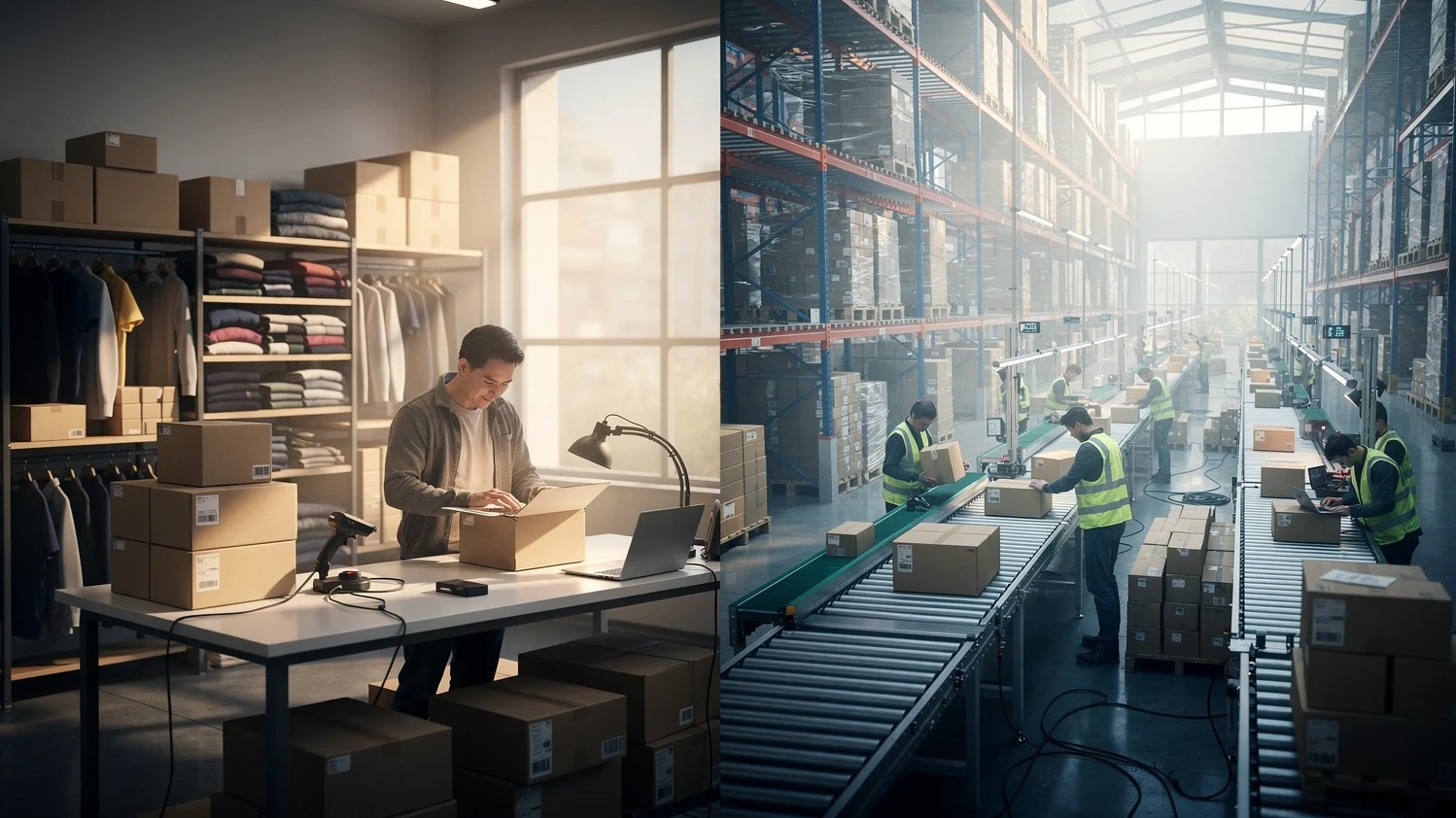
In house vs 3pl is the fulfillment question every retailer eventually faces. Stay in your own warehouse and you keep control over packing, branding and the relationship with the carrier. Hand the keys to a third party logistics provider and you trade some of that control for flexibility, geography and capital you can put back into the brand. Get the timing right and the switch unlocks growth. Get it wrong and you sit on dead pallets in Memphis while customers cancel orders on the West Coast.
This guide is written for operators inside US e-commerce and omnichannel retail teams, not for theorists. It walks through where each model wins, the unit economics that actually move the decision, and the operational signals that say “now is the time to switch.” If you want the wider context first, our pillar on modern retail logistics from warehouse to doorstep sets the stage for everything below.
In short
- In-house fulfillment wins on brand control, custom packaging and gross margin once volume is steady and predictable in a single region.
- 3PL fulfillment wins on speed-to-market, multi-node distribution and variable cost when SKUs, channels or seasonality are volatile.
- The switch typically pays off between roughly 2,500 and 8,000 orders per month, but the trigger is rarely volume alone. Geography, returns rate and SKU velocity matter more.
- Hybrid models, where the brand keeps a flagship warehouse and uses a 3PL for overflow or distant regions, are now the default among scaled DTC brands.
- Run the math on fully loaded cost per order, not warehouse rent in isolation. Labor, shrinkage, software and the cost of stockouts are where the real difference lives.
Why this decision matters more in 2026
Three forces have changed the calculus since 2023. First, US warehouse vacancy ticked back up in 2025 after the pandemic squeeze, so 3PL pricing finally cooled in secondary markets like Indianapolis, Kansas City and Reno. Second, parcel carriers raised general rate increases above 5% for the third year in a row, which makes zone skipping and multi-node networks a real lever rather than a luxury. Third, Amazon and Temu trained shoppers to expect two-day delivery as a baseline, and that expectation now reaches small mid-market brands.
The practical effect is that the question is no longer “in-house or 3PL,” it is “which mix of nodes, and who runs each one.” Brands that ignore the question lose the margin war to competitors that engineered their fulfillment stack on purpose. For a longer view on how shipping networks reshape competition, see how Temu is rewriting the rules of low-price e-commerce.
What “in-house” and “3PL” actually mean
The labels are looser than they sound, so it helps to anchor the vocabulary before you compare costs.
In-house fulfillment
You lease or own the warehouse, hire the pickers, pay the workers’ comp policy, run the WMS, and negotiate carrier contracts directly. Returns come back to your dock. Anything that goes wrong is your phone call to make at 9 p.m. on a Sunday. The upside is total visibility and the ability to bake the brand into every touch, from the box to the unboxing note.
3PL fulfillment
A third party logistics provider, often abbreviated 3PL, stores your inventory in their facility, picks and packs your orders, and ships using their negotiated carrier rates. Pricing is usually per pallet stored plus per order picked plus a packing materials line. Some providers add tech fees, kitting fees and a long-tail of “value added services” that quietly erode the headline number.
Fulfillment by Amazon and other marketplace models
FBA, Walmart WFS and Shopify Fulfillment Network sit in a separate bucket. They behave like 3PLs but lock you to a single channel, with their own rules on labeling, inventory limits and prep. Many brands run FBA for Amazon-only SKUs and a separate 3PL or in-house operation for everything else.
Hybrid and 4PL
Hybrid is exactly what it sounds like: a primary in-house node, plus a 3PL on the opposite coast, plus FBA for Amazon. A 4PL goes one step further and manages the network of 3PLs on your behalf. It is a real category for brands above roughly $50 million in revenue, and not relevant for most operators making the in-house versus 3PL call.
How the unit economics really compare
Spreadsheets that compare “warehouse rent versus 3PL invoice” miss the point. The right comparison is fully loaded cost per order, against a steady-state monthly volume, in your real geographic mix. The table below shows a representative US apparel brand shipping a single 1.2 lb item per order, with a 14% return rate and 60% of orders going to zones 4 to 8 from a single East Coast origin.
| Cost element | In-house (single node) | Single 3PL | Two-node 3PL |
|---|---|---|---|
| Pick and pack labor | $2.40 | $3.10 | $3.20 |
| Warehouse rent and utilities (per order) | $0.95 | $0.55 | $0.70 |
| Packaging materials | $0.80 | $0.95 | $0.95 |
| Outbound parcel (blended) | $7.20 | $6.40 | $5.20 |
| Returns processing | $1.10 | $1.60 | $1.60 |
| WMS, integrations, support | $0.45 | $0.35 | $0.40 |
| Management overhead allocation | $0.90 | $0.20 | $0.30 |
| Fully loaded cost per order | $13.80 | $13.15 | $12.35 |
Two things jump out. First, on a single-node basis the in-house and 3PL numbers are close enough that the decision is rarely about pennies. Second, the moment you split inventory into two nodes the parcel line drops materially, because zones shrink. The savings on shipping (about $2 per order in this example) cover the higher labor and storage cost of running two locations, with cash left over.
When in-house is the right answer
In-house wins in a tighter set of cases than vendors will admit. Look for these signals before you commit capital to leases, racking and a WMS implementation.
- You sell something complicated. Kitted subscription boxes, custom personalization, fragile goods, age-restricted SKUs or anything that needs hand inspection rarely fits 3PL workflows cleanly. The exceptions exist, but they cost a premium.
- Brand experience is the moat. If unboxing, hand-written notes, custom inserts or sustainable packaging are core to repeat purchase, every step away from your own staff is a step away from quality control.
- Volume is steady and concentrated. 8,000 to 25,000 orders per month, mostly shipping to the same one or two zones, is the sweet spot where in-house labor scales efficiently.
- Returns are an asset, not a cost. If you refurbish, repackage or resell returns at a premium, owning the returns dock is worth a lot.
- You have the operational DNA. Founders who came from operations, with a real ops leader on payroll and a board that tolerates a multi-month warehouse build, can pull it off. Marketing-led teams almost never can.
If three or more of those apply, in-house is on the table. Two or fewer and you should be looking hard at a 3PL.
When a 3PL is the right answer
3PLs are not just a stopgap for early-stage brands. Many of the largest DTC names in the US run 100% through third parties because the math, the speed and the optionality work. Strong fits include:
- Multi-region demand. If 40% or more of orders ship to zones 7 and 8 from your current node, a 3PL with a Western or Central US facility cuts transit time by 1 to 2 days and parcel cost by 15 to 25%.
- Seasonal or promo-driven volume. A brand that triples in November cannot lease and staff the peak as in-house, then absorb the fixed cost in February.
- New category launches. When you do not yet know whether a SKU sticks, putting it in a 3PL keeps the experiment cheap.
- International or cross-border flow. A 3PL that already runs IOR (importer of record) services, Section 321 entries or Canadian fulfillment cuts months off a launch.
- Channel sprawl. Selling on Shopify plus Amazon plus TikTok Shop plus wholesale at the same time is far easier with a 3PL whose integrations are already built.
The honest list of trade-offs
Here is what no one tells you on the sales call.
What in-house quietly costs
People-management overhead is the silent line. Hiring, training, retention bonuses, the inevitable workers’ compensation claim, and the cost of replacing a shift supervisor who quit on Thursday. If your founder spends a full day a week on warehouse staffing, that is a meaningful equity-level cost that never shows up in the cost-per-order spreadsheet.
What 3PLs quietly cost
Switching costs, inventory accuracy disputes, and the soft cost of slower iteration. If you want to test a new packing insert next week, the 3PL can usually do it, but it will take a change order, a new SKU in their system, and a meeting. In-house, it takes a conversation at the dock.
The cost of getting it wrong
Switching back and forth burns cash. A bad 3PL relationship that you exit within nine months can cost 1 to 2% of annual revenue in inventory write-offs and SLA penalties. A premature in-house build that you mothball within 18 months loses the lease deposit plus capex plus the WMS contract. Pick once, with eyes open.
Operational signals that the time is now
Volume is a lazy heuristic. Better signals tell you when to switch.
- Your warehouse is over 85% utilized for three consecutive months. You are not running a buffer, you are running on luck.
- Same-day cutoffs slip more than 5% of the time. If pickers cannot keep up by 5 p.m., the customer experience is already eroding.
- You are paying overtime every week. Persistent overtime is the cheapest signal of an understaffed or undersized operation. Compare the overtime annualized to the cost of a 3PL switch.
- Zone 7 to 8 transit is over 4 business days. Customers in Seattle and San Diego are slower to repeat. A second node fixes this.
- Returns dwell time is over 7 days. Returns sitting on the dock means cash sitting outside the cycle. Either fix the in-house process or hand it to a specialist returns 3PL.
- You raised a round to fund growth, not real estate. Capital allocated to a 5-year warehouse lease is capital not allocated to acquisition. Be explicit about which tradeoff you are making.
How to evaluate a 3PL without getting burned
Most 3PL relationships go wrong in the first 90 days because the brand never asked the questions that matter. Use this short list before you sign.
- Ask for SLA performance for the last 12 months on similar brands, not best-case quotes. Pick rate accuracy, on-time ship rate and inventory accuracy are the three to demand.
- Ask for two reference customers in your vertical and size range, and call them.
- Walk the facility. A clean dock, clearly labeled lanes and visible KPI boards say more than any deck.
- Read the contract, especially storage minimums, peak surcharges, value added service fees and termination clauses. Most disputes start in the fine print.
- Test integration with your store, ERP or OMS before you migrate inventory. A 3PL that needs 6 weeks to integrate is a 3PL whose tech is behind the market.
- Negotiate a 90-day true-up. If actual volume is 30% below or above the assumption in the contract, pricing renegotiates automatically.
For a closer look at evaluating providers and what current tooling is on offer, the deep dive on tools and vendors for shipping and fulfillment in 2026 is a useful companion to this piece.
How to evaluate going in-house without lighting cash on fire
The mistake on the in-house side is romanticizing it. Founders who tour a beautiful brand-owned warehouse and decide to build their own often skip the harder questions.
- Hire the ops leader first. Not the warehouse, not the racking. A real ops leader will choose the racking better than you will.
- Pick the building for parcel zones, not commute time. A 30 minute drive from the founder’s office that costs $1.20 more per outbound shipment is a bad trade.
- Buy proven WMS, not the cheapest one. The total cost of a bad WMS dwarfs the license savings within 12 months.
- Plan for peak at 2.5x average, not 1.5x. Most brands underestimate Q4 lift and learn the hard way.
- Negotiate carrier contracts before move-in. Day-one rates set the floor; you renegotiate from there.
Tools, partners and vendors worth knowing
Whichever path you pick, the underlying technology stack does a lot of the heavy lifting. A few categories are worth understanding before the conversation with any vendor.
- Warehouse management systems (WMS). Manhattan Active, Blue Yonder, Fishbowl and ShipHero anchor the in-house side. Most 3PLs run their own WMS, so you adopt theirs by default. Either way, the WMS is the single most consequential piece of software in fulfillment, and a bad fit shows up as missed shipments rather than line-item complaints.
- Order management systems (OMS). Shopify’s native OMS works to a point; Cin7, NetSuite, Brightpearl and Stord cover heavier multi-channel demands. The OMS is where the in-house versus 3PL decision often goes from theoretical to operational.
- Shipping platforms. ShipStation, Easyship, Shippo and EasyPost negotiate or arbitrage carrier rates and abstract away the differences between USPS, UPS, FedEx and the regional carriers. In-house operations gain the most from these; a good 3PL already has them baked in.
- 3PL networks. ShipBob, Stord, Flexport, Ryder, GEODIS and Quiet Logistics dominate the mid-market in 2026. Each has a different sweet spot, from DTC fashion to industrial bulk. Always shortlist at least two providers in different size tiers.
- Returns specialists. Loop, Happy Returns and Returnly handle the customer-facing flow; ReverseLogix and Optoro handle the physical disposition. A good returns partner can rescue 5 to 12 points of margin on a returns-heavy category.
None of these tools by themselves “decide” between in-house and 3PL, but they collectively define how flexible either model can be once you commit. Underinvest in this layer and you end up overpaying for either path.
Common mistakes and how to avoid them
Five mistakes show up over and over in post-mortems from US e-commerce operators who switched models. None of them are unusual, all of them are avoidable.
- Picking on price alone. The cheapest 3PL quote is almost always the most expensive after 90 days, once you add SLA failures and inventory accuracy disputes. Weight quality and culture fit at least as heavily as the per-order rate.
- Skipping the pilot. A weekend cutover for an entire catalog is how brands miss peak. Always migrate in waves, even if the 3PL or the new in-house team insists they can absorb it.
- Underestimating onboarding bandwidth. Migrations are an internal lift, not just a vendor task. Plan for 0.5 to 1 full-time-equivalent on your side, for 8 to 12 weeks.
- Letting carrier contracts stay stale. Whichever model you pick, renegotiate carrier contracts at least annually. Parcel pricing has moved meaningfully every year since 2021, and the providers will not call you with the better rate.
- Treating the choice as permanent. Fulfillment is a 12 to 24 month decision, not a 10-year one. Build the relationship and the contract so that revisiting it does not feel like starting from zero.
Real examples from US retailers
A mid-market home goods brand in North Carolina, doing about 12,000 orders a month with heavy East Coast skew, moved from a 3PL in Pennsylvania back to in-house in 2025. The driver was packaging quality, not cost. Their fully loaded cost went up by about $0.60 per order, but repeat purchase rate climbed two points within six months, which paid for the move many times over.
A women’s apparel brand based in Los Angeles, doing 35,000 orders a month, went the other way. They started in-house, hit a ceiling on West Coast capacity, and added a second node with a 3PL in Columbus, Ohio. Coast-to-coast transit times dropped from 5 days to 2, and parcel spend fell by 19%. Their in-house Los Angeles operation remained intact and now handles 100% of returns and 60% of outbound.
A specialty food company in Texas tried to run fulfillment in-house from day one. Cold chain compliance, FSMA documentation and seasonal demand spikes around the holidays overwhelmed a four-person team. They moved to a temperature-controlled 3PL in Dallas in late 2024 and freed the founders to focus on product development. Revenue grew 80% the following year.
Hybrid is the boring answer that usually wins
Look at the largest DTC brands in the US over $50 million in revenue and almost none of them run pure in-house or pure 3PL. The standard pattern is one owned facility close to headquarters, where R&D, sampling, returns and brand-critical SKUs live, plus a 3PL contract for a Midwest or West Coast node, plus FBA for the SKUs that move there. This blunts the trade-offs and keeps optionality high.
If you are reading this and trying to make a single binary choice, that is your first warning sign. Map the SKU portfolio, map the demand geography, and assign each combination to the model that fits. The right answer is almost always a portfolio, not a single bet. The pillar on modern retail logistics from warehouse to doorstep goes deeper into the network design questions that follow once you commit to a hybrid.
A 90-day playbook to make the switch
If your signals point to moving (in either direction), give yourself a structured 90 day window. Compressing this into 30 days is how brands end up with two warehouses and one missed peak.
Days 1 to 30: diagnose and design
- Pull 12 months of order data by ZIP, by SKU, by channel.
- Build the fully loaded cost-per-order baseline for the current state.
- Map projected demand for the next 18 months, with explicit seasonality.
- Shortlist three providers (if moving to 3PL) or three buildings (if going in-house).
Days 31 to 60: pilot and validate
- Move 10 to 20% of SKUs to the new model. Test cycle counts, picking accuracy, shipping cutoffs.
- Validate integrations with the store, the ERP, returns and customer support tools.
- Calibrate your SLA expectations against actual performance, not contracted numbers.
Days 61 to 90: scale and stabilize
- Migrate the rest of the catalog in waves, not a single weekend cutover.
- Renegotiate carrier contracts based on the new origin mix.
- Lock the cost-per-order target into the next quarter’s plan.
If you skip the pilot stage, expect a 60% chance of friction in the first holiday peak. For a refresher on which carriers and what rate structures matter when you finalize the network, see our 2026 shipping carrier comparison for US retailers.
Compliance, taxes and the boring stuff that bites later
One last thing operators routinely underestimate. Moving inventory across state lines creates nexus for sales tax and may trigger additional state-level filings. A new 3PL in Texas or Pennsylvania means new state registrations and possibly new economic nexus thresholds. Talk to your tax accountant before signing, not after the first quarterly filing surprises you. The US Census Bureau monthly retail trade reports are a good public reference for benchmarking how your category is moving, especially before a multi-year fulfillment commitment.
Frequently asked questions
At what volume should I move from in-house to 3PL?
There is no single threshold. The common range is 2,500 to 8,000 orders per month, but geography, returns rate and SKU complexity matter more. A brand with 4,000 orders heavily skewed to the opposite coast often saves more by switching than a brand with 8,000 local orders.
Is a 3PL always cheaper than in-house?
No. On a single-node basis the two models often land within $1 per order of each other once you fully load the costs. Where 3PLs reliably win is when they enable multi-node distribution, which cuts parcel zones and transit time in a way a single in-house facility cannot.
What is the biggest hidden cost of going in-house?
People management. Recruiting, training, turnover, workers’ compensation and the founder hours spent on staffing problems. None of this shows up cleanly in a cost-per-order spreadsheet, yet it can quietly eat 20% of operating margin.
How do I price a 3PL contract fairly?
Insist on transparent line items: per pallet storage, per order pick-and-pack, per additional pick, packaging materials, peak surcharges and tech fees. Get a written list of value added services and their pricing. Benchmark against at least two competing quotes for the same projected volume profile.
Can I run in-house and a 3PL at the same time?
Yes, and most scaled DTC brands do. The common pattern is a brand-owned primary node, a 3PL for the opposite coast or for peak overflow, and FBA for Amazon-only SKUs. Hybrid networks reduce risk and almost always lower blended cost.
How long does it take to switch from in-house to 3PL?
Plan for 90 days from contract signature to fully operational. The first 30 days are integration and pilot, the middle 30 are migration in waves, and the last 30 are stabilization. Compressing this timeline is the single biggest source of failed transitions.
What does Fulfillment by Amazon mean for my 3PL decision?
FBA is a marketplace-locked fulfillment model. It usually runs in parallel with another solution rather than replacing it. Many brands route Amazon orders through FBA and everything else through a 3PL or in-house. FBA’s storage and long-term inventory fees can be brutal on slow-moving SKUs, so monitor them monthly.
How do I know if my current 3PL is underperforming?
Watch four metrics monthly: pick accuracy (target above 99.5%), on-time ship rate (above 98%), inventory accuracy (above 99%), and customer complaint rate tied to fulfillment (under 0.5% of orders). Persistent slippage on any two of these, especially after escalation, is a clear signal to start exploring alternatives.
Final word
The in house versus 3PL question is less binary than it looks. The brands that thrive in 2026 build the right portfolio of fulfillment models for their SKU mix, their geography and their growth plan, and revisit the choice every 12 to 18 months. The wrong move is to default to whatever you started with, or to copy what the loudest competitor is doing. Run the numbers on fully loaded cost per order, listen to your operational signals, and let the data make the call.