
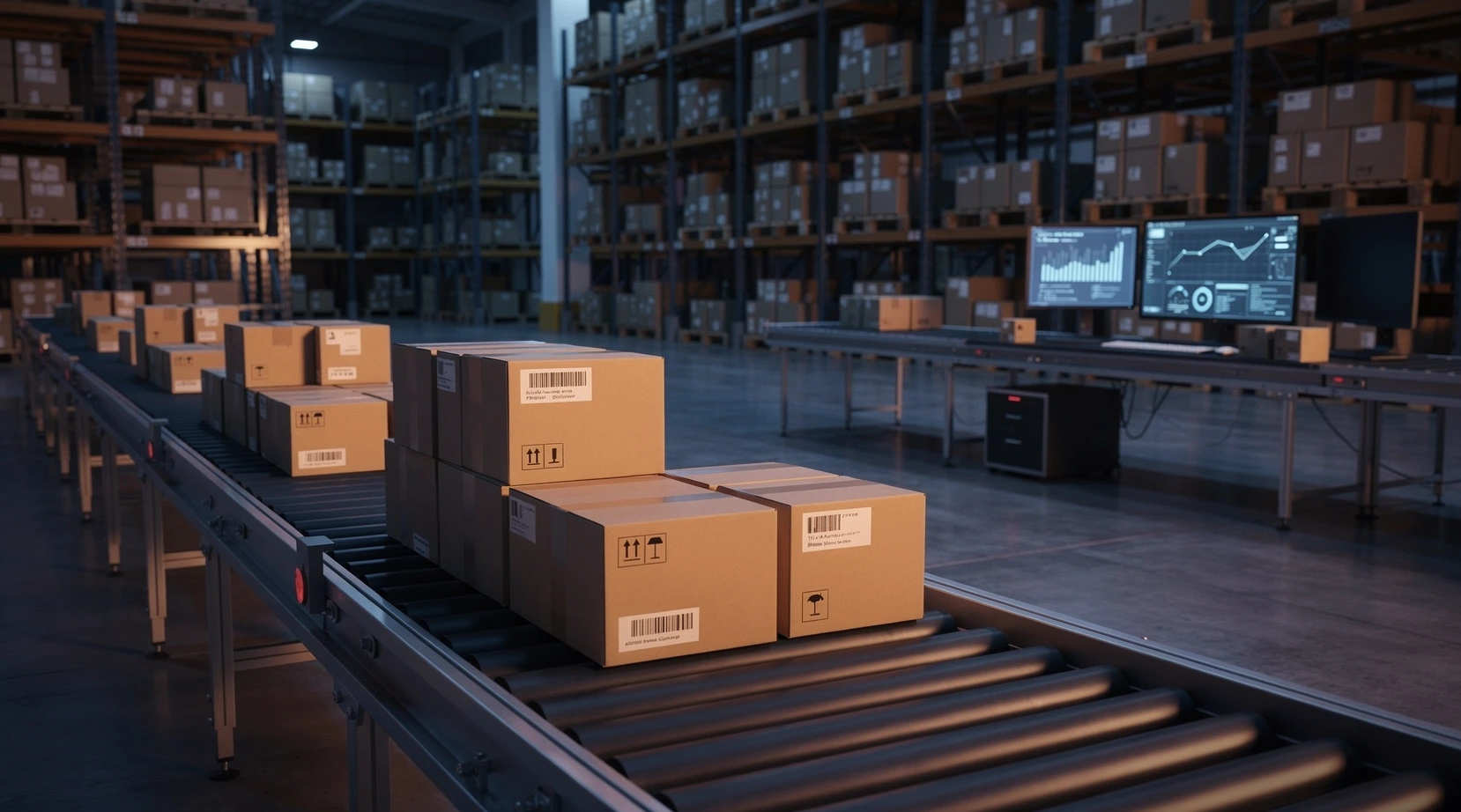
The shipping and fulfillment stack a US retailer ran in 2022 looks almost quaint by 2026 standards. Carrier rates have lurched, marketplace volume has stayed elastic, and the gap between brands that picked the right tools and brands that bolted on a label printer in 2020 is now measured in margin points, not minutes saved. This is a practical map of the shipping and fulfillment tools 2026 retail and e-commerce teams should actually understand before signing another annual contract.
In short
- Multi-carrier shipping platforms (ShipStation, Shippo, EasyPost, Stamps.com) are now table stakes for any merchant doing more than 500 orders a month.
- 3PL networks like ShipBob, Deliverr (Shopify Logistics), Flexport, and Saltbox have absorbed most of the small and mid-market fulfillment workload.
- Order management systems (Shopify Plus OMS, Brightpearl, Fluent Commerce, Manhattan Active Omni) are the connective tissue that decides where an order ships from.
- Real-time rate shopping, distributed inventory, and address validation cut shipping cost by 8 to 22 percent in benchmark studies from late 2025.
- The biggest 2026 shift is not a new tool: it is the move from single-carrier negotiated rates to API-driven rate marketplaces where parcels are tendered per order.
Why shipping and fulfillment tools matter more in 2026
Shipping used to be a back-office function. In 2026 it is a product feature. Buyers see the carbon estimate, the promised delivery window, and the return policy before they hit checkout, and any one of those numbers can lose the sale. That moves the tooling decision out of operations and into the same conversation as merchandising and pricing.
The 2024 USPS rate restructure, the FedEx and UPS general rate increases averaging 5.9 percent year over year, and the continued growth of regional carriers like OnTrac and LSO have all widened the gap between the cheapest and most expensive label a retailer can buy for the same package. A merchant without a rate-shopping engine is leaving four to six points of contribution margin on the table. That is the entire reason the modern shipping and fulfillment tools 2026 conversation exists.
For a broader view of how shipping fits inside the wider retail supply chain, see our pillar guide on modern retail logistics from warehouse to doorstep, which frames where these tools sit between procurement, warehousing, and last-mile delivery.
The four layers of a modern fulfillment stack
It helps to think of the tooling in four stacked layers, because vendors blur the boundaries on their marketing pages but the categories are real once you sign a contract. Mixing layers is fine. Buying two tools that occupy the same layer almost never is.
- Carrier and rate layer: the actual postage. USPS, UPS, FedEx, DHL, regional carriers, and consolidator networks.
- Multi-carrier shipping software (MCSS): the rate-shopping, label-printing, manifesting brain. ShipStation, Shippo, EasyPost, ShipHero, Stamps.com.
- Warehouse and fulfillment layer: the physical pick, pack, ship. In-house with a WMS, or outsourced to a 3PL.
- Order management system (OMS): the orchestrator that decides which location and which carrier each order should use.
The classic mistake is to buy an MCSS and assume it replaces an OMS. It does not. An MCSS optimizes the label once an order is already routed. An OMS decides where the order is routed in the first place, and at retail scale that decision is worth far more than the label savings.
Multi-carrier shipping platforms compared
This is the most crowded category and the one most retailers shop for first. The platforms below are the ones US merchants actually deploy at volume in 2026, not the long tail of niche tools.
| Platform | Best for | Pricing model (2026) | Carriers | Notable in 2026 |
|---|---|---|---|---|
| ShipStation | Shopify, Amazon, Etsy SMBs | $10 to $230 per month, tiered by orders | USPS, UPS, FedEx, DHL, regional | Owned by Auctane; tight integration with Stamps.com rates |
| Shippo | Direct-to-consumer brands under 5,000 orders/mo | Pay-per-label ($0.05) or $19 to $99/mo plans | 40+ carriers globally | Strong API for headless commerce, transparent pricing |
| EasyPost | Developers, marketplaces, high-volume API users | API-first, custom volume pricing | 100+ carriers, including international | Now the default for most Shopify Plus stores running custom checkout |
| ShipHero | Brands with their own warehouse and a 3PL network | $1,995/mo and up (WMS + shipping bundle) | USPS, UPS, FedEx, DHL, regional | Combines WMS and shipping in one platform |
| Stamps.com / Endicia | USPS-heavy mailers, returns processors | $19.99/mo plus postage | USPS-focused, UPS via Auctane | Still the cheapest entry point for USPS Commercial Plus pricing |
One thing every benchmark study confirms: the headline subscription fee is a rounding error compared with the rate differences between carriers on the same package. A 2 pound box from a New Jersey warehouse to a Texas residential address can vary by $3.40 between USPS Ground Advantage, UPS Ground Saver, and OnTrac Ground depending on the day. Pick the platform with the best rate-shopping logic, not the lowest sticker price.
3PL networks and what changed in 2026
The 3PL market in 2026 looks very different from the post-pandemic boom. A wave of consolidation through 2024 and 2025 left four serious networks targeting the SMB and mid-market: ShipBob, Shopify Fulfillment Network (rebuilt on Flexport infrastructure after the Deliverr acquisition), Saltbox for warehouse-and-workspace hybrid models, and ShipMonk for subscription and crowdfunding brands. Beyond that tier are enterprise-grade networks like Geodis, Radial, and the dedicated 3PL arms of XPO and Ryder.
The newer wrinkle is that several of these networks now publish their fulfillment node locations as an API, so an OMS can route in near real time based on inventory position and ship-from cost. The arithmetic of picking warehouse locations is genuinely tricky, and we walk through the underlying decision in fulfillment center locations: the math behind a good network.
If you are evaluating a 3PL in 2026, ask for three numbers in writing: cost per pick, cost per outbound order including a standard 2 pound parcel, and storage cost per cubic foot per month. Most 3PL pricing sheets in 2026 still hide the true outbound cost inside a bundle, and the only way to compare quotes is to normalize on those three units.
Order management systems are the real upgrade
For retailers crossing roughly $20 million in annual revenue, the highest-leverage tool is usually not a new shipping platform. It is an OMS that can split orders, route to the optimal node, and expose live inventory across stores, warehouses, and 3PL pods.
The 2026 shortlist for US retailers looks like this: Shopify Plus OMS (formerly Shopify Distributed Order Management), Brightpearl by Sage for mid-market multichannel, Fluent Commerce for headless retailers, and Manhattan Active Omni for enterprise. Each one handles ship-from-store, partial backorders, and multi-node allocation, but the configuration cost varies by an order of magnitude. Manhattan implementations routinely cross $1 million. Brightpearl typically lands in the $30,000 to $90,000 range. Shopify Plus OMS is bundled into Plus pricing.
The reason an OMS matters so much for shipping cost is sourcing logic. Routing an order from the closest in-stock node, rather than a default warehouse, regularly saves 12 to 18 percent on parcel cost. That is roughly the same magnitude as a year of negotiated carrier rate cuts, and an OMS captures it automatically every day.
Address validation, weight capture, and the boring tools that pay back fastest
Two unglamorous tool categories pay back faster than any rate negotiation. The first is address validation: SmartyStreets, Loqate, and Google Address Validation all cut undeliverable-as-addressed rates from a typical 3 to 5 percent down to under 0.4 percent. At an average reship cost of $14, that is real money for any merchant over 1,000 orders per month.
The second is dimensional weight capture. Cubiscan, Dimensional Insight, and the lower-cost camera-based systems from Logiwa now sit on the pack bench and measure every outbound parcel. UPS and FedEx both bill on dimensional weight when it exceeds actual weight, and merchants who guess dimensions overpay or get billed back at the end of the month. Auto-capture removes both errors.
Returns tooling has matured too. Loop Returns, Happy Returns (now owned by UPS), Returnly, and ReturnGO dominate the US market, with the new entrant Parcel Lab moving up from European tracking into full returns orchestration. These tools matter because the unit economics of a return are roughly half the unit economics of an outbound order, and they directly influence working capital.
How to actually evaluate a stack: a numbered process
- Pull six months of shipped orders with origin zip, destination zip, weight, dimensions, and the carrier and service used.
- Re-run each order through two or three candidate MCSS platforms using their rate APIs to get a true side-by-side cost.
- Calculate landed cost, not just shipping cost. Our walk-through of how to actually calculate landed cost for retail orders covers the line items most teams forget, like fuel surcharge, residential surcharge, and dimensional reweigh fees.
- Stress-test peak: the platform that wins on a normal Wednesday is not always the one that holds up during Cyber Week. Ask for peak failover, queue length, and SLA in writing.
- Test address validation latency at checkout. A 600 ms validation call costs you conversion. Aim for sub-200 ms or call asynchronously.
- Pilot before committing annually. Most platforms still offer 30 to 90 day pilots in 2026 even when their sales teams pretend they do not.
Common mistakes US retailers make in 2026
Three patterns recur often enough to flag. The first is consolidating on a single carrier to chase a deeper discount, then watching service degrade in zones where that carrier is structurally weak. UPS is strong in dense urban routes, FedEx in air and B2B, USPS in residential and saturation, and regional carriers in their footprint. A blended book is almost always cheaper than a single-carrier book, even with a smaller discount.
The second is treating shipping and fulfillment tools 2026 as a procurement decision rather than a product decision. The team that owns the stack should sit close to the checkout team and the merchandising team. Shipping speed and cost are merchandising levers, not back-office costs.
The third is underestimating cross-border complexity. Even purely domestic US retailers now route a meaningful slice of parcels through Mexico and Canada because of fulfillment economics. The regulatory environment for cross-border parcels has tightened sharply, especially for marketplaces. Our briefing on regulatory pressure on Temu in 2026 and what changes for buyers covers the de minimis changes and downstream effects on US-bound parcels that increasingly touch domestic 3PL networks.
What to budget for in 2026
A realistic 2026 budget for a US e-commerce brand doing $10 million to $50 million in revenue, fulfilling roughly 5,000 to 30,000 orders a month, looks something like this. MCSS software runs $300 to $2,500 a month. Address validation lands at $0.005 to $0.02 per lookup. An OMS at this scale costs $20,000 to $120,000 a year fully loaded. 3PL fees vary too widely to average, but most brands at this volume see total fulfillment cost between 10 and 16 percent of net revenue. Returns tooling adds $500 to $3,000 a month depending on volume.
The single line item to over-invest in is data plumbing. A clean event stream from cart through delivery is worth more than any one tool, because it lets you switch tools without losing institutional memory. Most retailers regret cutting that line item within 18 months.
Last-mile carriers and the rise of regional networks
The story of US parcel in 2026 is not just the three legacy carriers. Regional and alt-national carriers now move close to one in five domestic parcels for the merchants who actively bid them in. OnTrac dominates the Western US, LSO handles Texas and the South-Central region, Lone Star Overnight overlaps in pockets, and UDS continues to build out the Northeast and Midwest. Several of these networks now plug directly into the major MCSS platforms, so adopting them is a matter of enabling a service, not signing a new account.
The catch is that regional carriers price aggressively but have narrower service tables. A merchant tendering blindly will see a few packages drop into impossible service days. The MCSS rules engine has to enforce service eligibility before rate shopping, or the savings evaporate in late deliveries and refund credits. Most platforms support this with a few lines of routing logic, but it has to be set up intentionally.
Same-day and on-demand delivery is the other end of the last-mile spectrum. Uber Direct, DoorDash Drive, Roadie (owned by UPS), and Veho now offer rate APIs that surface alongside parcel rates in modern MCSS platforms. For categories like beauty, gifting, and high-AOV apparel, plugging same-day into the rate shop quietly raises conversion without changing the fulfillment footprint.
Carbon, returns, and the operational metrics that matter
Sustainability dashboards used to live in the marketing team. In 2026 they are wired into the operations stack. Tools like EcoCart, Cloverly, and Pachama integrate at the MCSS layer to surface a per-parcel carbon estimate, and major MCSS vendors expose that figure in their reporting dashboards by default. The point is not the carbon offset itself, which remains a marketing decision, but the visibility into mode-of-transport mix that often reveals expensive ground-to-air upgrades nobody asked for.
Beyond carbon, the operational metrics that separate good stacks from mediocre ones are the same in 2026 as they were in 2022: on-time delivery percentage by service, first-attempt delivery rate, claims rate per 1,000 parcels, and chargeback rate from carrier weight reweighs. A modern stack reports all four automatically. If the candidate platform cannot produce these in a single dashboard, treat that as a serious red flag during evaluation.
| Metric | Healthy 2026 benchmark | Where it goes wrong |
|---|---|---|
| On-time delivery | 94 to 97% | Single-carrier dependence in weather-prone zones |
| First-attempt delivery | 96 to 98% residential | Address validation skipped or disabled |
| Claims rate | Under 0.4% of parcels | Insufficient packaging spec or wrong service mix |
| Reweigh chargebacks | Under 1% of weekly invoice | Manual weight entry, no dimensional capture |
| Return rate | 10 to 20% apparel; 4 to 8% non-apparel | Vague sizing data, no exchange flow |
API-first vs all-in-one: the philosophical fork
Retail engineering leads in 2026 still face a real architectural decision when picking shipping and fulfillment tools. The all-in-one path (ShipStation, ShipHero, Stamps.com) is faster to deploy, easier for ops teams to learn, and acceptable for the vast majority of brands under $25 million in revenue. The API-first path (EasyPost, Shippo, plus a headless OMS) demands engineering investment but produces a stack that can scale without rip-and-replace as channels multiply.
The honest answer is that most growing brands cross the threshold sometime between $25 million and $75 million in revenue. Below that, all-in-one wins on time-to-value. Above it, the all-in-one tools start hitting limits on routing logic, carrier coverage, and reporting, and brands quietly migrate. Planning the migration on the way up is far cheaper than reacting to it during peak.
A useful tactic for buyers stuck between the two paths is to pilot an API-first platform alongside the all-in-one tool for a quarter, routing only a slice of orders (often a single channel or a single warehouse) through the new stack. That lets the team build the operational muscle and the dashboard set on a low-stakes order flow before any commitment is required. Almost every successful migration we have seen in 2026 follows this dual-running pattern rather than a single cutover weekend.
One more practical note: the tooling choices that look cheapest on a 12 month view almost never look cheapest on a 36 month view. Switching costs in this category are real because the historical shipment dataset, the trained ops team, and the carrier account integrations all carry inertia. Stretch the financial analysis to three years before signing any annual contract.
A final word on hub and spoke fulfillment thinking
The cluster of tools above only works if the underlying network strategy is right. A great MCSS over a bad node footprint just produces optimized labels for orders shipping from the wrong warehouse. Read the pillar on modern retail logistics from warehouse to doorstep before reordering the tooling shortlist, because the network decisions upstream of these tools tend to dominate the financial outcome downstream.
For an authoritative reference on US parcel industry sizing and carrier benchmarks, the US Census Bureau quarterly e-commerce report remains the cleanest public dataset for revenue normalization.
Frequently asked questions
What are the most important shipping and fulfillment tools 2026 for a Shopify store under 5,000 orders a month?
A solid baseline stack is Shopify Shipping plus ShipStation or Shippo for rate shopping, SmartyStreets for address validation, and Loop Returns for outbound and return label flow. Most stores at this volume do not need a separate OMS yet because Shopify covers the routing logic adequately. Total monthly software cost typically lands between $200 and $700.
Is ShipBob still the right 3PL choice in 2026?
ShipBob remains a strong choice for brands between 1,000 and 30,000 orders per month, especially those that want US, Canadian, and EU nodes under one contract. Above that volume, the economics often favor a hybrid model with a dedicated 3PL in one region and ShipBob for overflow. Shopify Fulfillment Network is increasingly competitive on price but still narrower on apparel and oversized SKUs.
How do EasyPost and Shippo really differ?
Shippo is a hosted product with a built-in dashboard and is friendlier for non-developer teams. EasyPost is an API-first platform and assumes you are wiring it into your own application or OMS. Most Shopify Plus and headless commerce builds use EasyPost. Most owner-operated brands without an in-house engineering team use Shippo.
Do I still need address validation if my checkout has Google Autocomplete?
Yes. Autocomplete reduces typos but does not confirm deliverability. Address validation runs the candidate address against USPS CASS or an equivalent global registry and flags non-deliverable points, vacant addresses, and apartment-number omissions. The reship cost savings typically pay back the tool within the first 30 days of any retailer over 1,000 orders a month.
How much can rate shopping actually save versus a single negotiated carrier contract?
Benchmark studies in late 2025 consistently showed 8 to 22 percent total parcel cost savings versus a single-carrier book, with the wider end of the range applying to merchants with heavy residential and lightweight parcel mix. The savings are smallest for B2B-heavy and oversized freight, where a single carrier with a deep discount still wins.
When should I consider an OMS like Brightpearl or Fluent Commerce?
Look at OMS investment seriously once you cross two or more fulfillment locations, sell through more than two channels (e.g. Shopify plus Amazon plus retail wholesale), or hit roughly $20 million in annual revenue. Below those thresholds the configuration cost rarely pays back. Above them, the sourcing logic alone usually justifies the project.
What is the best returns platform for US e-commerce in 2026?
Loop Returns leads the apparel and lifestyle segment, Happy Returns wins on physical drop-off network access through the UPS Store footprint, and Returnly remains strong for marketplaces. ReturnGO is the fastest mover in the mid-market. The right pick depends on your category, return rate, and whether your priority is exchange revenue retention or cost containment.
How do I avoid being locked into a single shipping platform contract?
Negotiate month-to-month or quarterly terms during the pilot, hold the right to export your historical shipment data in CSV at any point, and avoid platforms that route all your label printing through a proprietary carrier account they own. Keeping your USPS, UPS, and FedEx accounts in your own name preserves portability between MCSS vendors.