
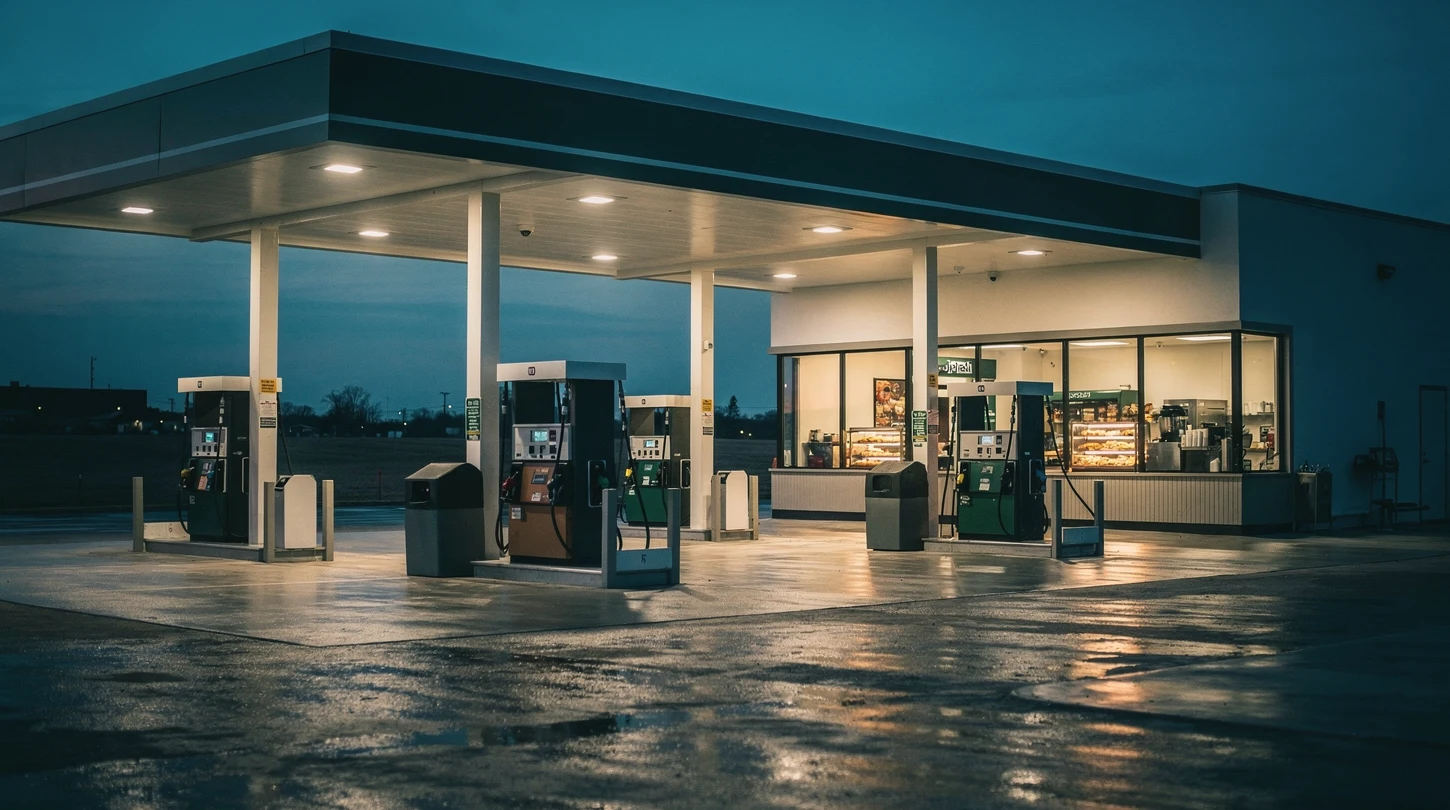
Casey’s General Stores (Nasdaq: CASY) releases first quarter fiscal 2027 results after the market closes on Tuesday, September 8, 2026, with a conference call the following morning at 7:30 a.m. central. The company confirmed that timing in a scheduling release issued on August 19, 2026. It is the first quarterly report of a new three-year planning horizon, and the first read on whether the fuel margin windfall that carried the whole US convenience sector through 2026 is still intact.
In short
- When: Q1 fiscal 2027 results land after the close on September 8, 2026; the call follows at 7:30 a.m. central on September 9.
- The consensus bar: roughly $6.58 per diluted share on revenue near $5.65bn, against $5.80 and $4.57bn in the year-ago quarter.
- The number that decides the quarter: the fuel margin in cents per gallon. Casey’s closed fiscal 2026 at 42.6 cents, a level that historically looked like a peak, not a base.
- The guidance frame: fiscal 2027 calls for EBITDA growth of 8% to 10%, inside same-store sales of 2% to 5%, inside margin above 42%, and at least 120 new stores on about $800m of capital spending.
- The risk: guidance assumes same-store fuel gallons of minus 1% to plus 1%. A soft gallon number plus any margin give-back compounds quickly against an 8% to 10% EBITDA commitment.
What Casey’s actually reports on September 8
Casey’s fiscal year ends on April 30, so the first quarter covers May, June and July 2026. That is the summer driving season, which makes Q1 structurally the company’s highest-volume fuel quarter and a disproportionately large contributor to full-year gallons. It is also the quarter in which prepared food attaches most efficiently to fuel traffic.
The company operates close to 3,000 convenience stores, principally across the Midwest and, since the Fikes Wholesale acquisition, a substantially larger footprint in Texas and the Gulf states. It is the third-largest convenience store retailer in the United States by store count and, by its own description, the fifth-largest pizza chain in the country. That second claim is not marketing decoration: it is the reason the margin profile looks unlike a fuel retailer’s.
Investors will get four disclosures that matter, in roughly this order of importance: fuel margin per gallon, same-store fuel gallons, inside same-store sales split between prepared food and grocery, and any change to the fiscal 2027 guidance ranges issued in June. Everything else is commentary.
Geography is the second thing to hold in mind. Casey’s built its franchise in small midwestern towns, frequently in communities where it is the only meaningful food retailer within a reasonable drive. That is a defensible position, because the population density does not support a second operator, but it caps the growth available organically inside the legacy footprint.
The Texas and Gulf coast stores acquired through Fikes Wholesale sit in a different competitive environment, with denser fuel competition and a more crowded quick-service food landscape. Blending those two profiles into one same-store number is the analytical challenge in every Casey’s print now. Management has generally declined to break out geographic comps, so the mix effect has to be inferred from commentary.
The fiscal calendar quirk that trips people up
Because Casey’s reports on an April fiscal year end, its “first quarter fiscal 2027” is the calendar quarter that most other US retailers call Q2 2026. Comparisons against grocers and general merchandisers reporting the same week are therefore period-aligned even though the labels differ. That matters when reading Casey’s inside comps against, for example, Kroger’s second quarter print on September 11, which covers a broadly overlapping stretch of the summer.
Where the numbers get published
The results release and the webcast are posted to the company’s investor relations site, with an audio replay held for twelve months afterward. Readers who want the primary numbers rather than the wire summary can take them from Casey’s investor events page at the moment of release.
Why the fuel margin line matters more than the EPS print
Casey’s closed fiscal 2026 with a fuel margin of 42.6 cents per gallon. For context, the NACS CSX benchmarking database put the industry fuel margin at 43.7 cents per gallon across 2025, itself a record that the sector spent years insisting was unsustainable. OPIS had the market average at 35.7 cents per gallon as recently as the start of 2025. The entire category has re-based upward, and nobody in it is fully confident the new level holds.
The arithmetic is unforgiving. A convenience retailer selling in the region of three billion gallons a year converts every one cent of margin movement into tens of millions of dollars of gross profit. That single line can swing a quarter more than any merchandising initiative the company has running.
This is why the fuel line, not the headline EPS, is the number to read first. An EPS beat driven entirely by a fuel margin spike tells you about crude and rack price volatility. An EPS beat driven by inside margin tells you about the business.
How the margin is actually earned
Retail fuel margin is a spread, not a markup. Operators buy at a wholesale rack price that moves daily and sell at a street price that moves more slowly, because posted pump prices are sticky in both directions. When wholesale costs fall quickly, the lag between the two widens the spread and margins expand.
The corollary is that the strongest fuel margin quarters usually follow periods of falling crude, not periods of high prices. This is counter-intuitive to most retail investors, who read a high pump price as good for a fuel retailer. It is the direction and speed of wholesale cost change, plus local competitive intensity, that sets the number.
It also explains why the sector’s re-basing has proved more durable than sceptics expected. Structurally higher credit card acceptance costs, higher labor costs and higher compliance costs have all been passed into the street price over several years, and competitors have not undercut each other back down. Whether that discipline survives a sustained volume decline is untested.
The cost narrative has already shifted
Fuel and energy costs have been displacing tariffs as the dominant variable in US retail guidance through the back half of 2026, a pattern visible across the sector rather than at any single company. Casey’s sits on both sides of that trade: higher fuel prices raise its cost of goods, but volatility in wholesale costs is historically what widens retail fuel margins in the first place. The relationship between fuel costs and the rest of the retail cost stack is the single most useful lens for reading this print.
Diesel costs in particular have been rising into September 2026, which affects Casey’s on the distribution side as well as at the pump. The company runs its own distribution centers and delivers prepared food inputs to its stores, so freight inflation lands directly in operating expense.
What the consensus numbers actually assume
Published estimates cluster around $6.58 in diluted earnings per share, up roughly 14% from the $5.80 posted in the year-ago quarter. Revenue estimates centre near $5.65bn against $4.57bn a year earlier, which implies growth of about 24%. That top-line figure deserves scrutiny.
Estimate dispersion is unusually wide for a company of this size. Alternative compilations put EPS as high as $6.74 to $6.78 and revenue as low as roughly $5.56bn. A gap of that width on the revenue line usually signals disagreement about the retail fuel price assumption rather than disagreement about the underlying business.
That is the key point for anyone reading the headline on Tuesday evening. Convenience store revenue is dominated by fuel dollars, and fuel dollars move with the pump price. Revenue growth of 24% at Casey’s is not a demand signal; it is largely a price and mix signal, and it can coexist with flat or negative gallon volume.
| Metric | Q1 FY2026 (actual) | Q1 FY2027 (consensus) | Implied change |
|---|---|---|---|
| Total revenue | $4.57bn | about $5.65bn | about +24% |
| Diluted EPS | $5.80 | about $6.58 | about +14% |
| Net income | $215.4m | not separately guided | n/a |
| Year-earlier EPS comparison | $4.86 (Q1 FY2025) | $5.80 (Q1 FY2026) | +19% then, +14% now |
The deceleration in the EPS growth rate, from about 19% to about 14%, is itself informative. It reflects a harder comparison base rather than a deteriorating business, but it narrows the room for error against a full-year consensus of roughly $21.11 per share.
Inside sales: prepared food is the real engine
Casey’s fiscal 2026 inside margin was 42.2%, with inside same-store sales up 4.2%. Underneath that, the split is stark. Prepared food and dispensed beverage ran a 58.6% margin on same-store sales growth of 5.2%, while grocery and general merchandise ran a 35.8% margin on 3.9% growth.
That 22.8 percentage point margin gap between the two inside categories is the company’s structural advantage over pure fuel retailers. Every incremental point of prepared food mix lifts blended inside margin without any pricing action at all.
Pizza is a manufacturing business, not a merchandising one
Casey’s makes its pizza in store, which means the prepared food margin is exposed to cheese, flour and labor costs rather than to wholesale product cost. Cheese in particular is the single largest input swing factor, and dairy markets moved through the summer of 2026. Management commentary on prepared food margin will therefore be read as a commodity update as much as a demand update.
The strategic logic runs in one direction. Fuel brings the customer onto the forecourt, the store converts some proportion of those visits into an inside transaction, and prepared food converts some proportion of those inside transactions into a high-margin basket. Each step in that funnel is measurable, and each is a separate operating lever.
This is also why Casey’s can afford to price fuel less aggressively for margin than a pure fuel operator. A cent given up at the pump that generates an incremental pizza sale is a profitable trade at a 58.6% food margin. The question analysts return to is whether the company is optimising that trade or simply benefiting from a strong fuel market.
Beverages carry the grocery category
In the year-ago quarter, grocery and general merchandise growth of 3.2% was attributed principally to strong non-alcoholic beverage sales. That dependence makes the category sensitive to regulatory change as well as to weather. State-level restrictions on which beverages qualify for benefit purchases have measurable effects on category volumes, and the evidence that SNAP soda restrictions cut sugary drink purchases by 12.4% across the states that adopted them is directly relevant to a chain with heavy midwestern exposure.
The value shopper has not gone away
Convenience is the format most exposed to trade-down, because its price premium over a supermarket basket is explicit and the shopper knows it. Pack-size and formulation changes are one of the levers operators pull to protect price points, and shoppers notice: the behavioral response to shrinkflation among value-focused shoppers is now a measurable driver of category switching rather than a talking point.
How Casey’s fuel margin compares with its peers
The convenience sector reports fuel margin on slightly different bases, so the comparison below is directional rather than exact. Murphy USA reports a total fuel contribution that bundles merchandise-adjacent fuel economics; Arko reports a same-store retail fuel margin; Couche-Tard reports a US fuel gross margin. All three moved sharply higher through 2026.
| Operator | Reported fuel margin | Period | Prior-year comparison |
|---|---|---|---|
| Couche-Tard (US) | 52.44 cents per gallon | Most recent reported quarter | Up more than 9 cents year over year |
| Arko (same-store retail) | 48.7 cents per gallon | Q2 2026 | 45.7 cents in Q2 2025 |
| NACS CSX industry benchmark | 43.7 cents per gallon | Full year 2025 | Record level for the dataset |
| Casey’s | 42.6 cents per gallon | Full year FY2026 | Company record |
| Murphy USA (total fuel contribution) | 37.9 cents per gallon | First half 2026 | 35.0 cents in Q1 2026 vs 25.4 cents in Q1 2025 |
Two things stand out. First, Casey’s sits below the industry benchmark and well below Arko and Couche-Tard, which is consistent with a chain that deliberately prices fuel to drive inside traffic rather than to maximise pump profit. Second, Murphy USA has guided to roughly 35 cents per gallon for the second half of 2026, a step down from the 37.9 cents it achieved in the first half.
That Murphy USA assumption is the most useful external read-across available before Tuesday. It is an explicit management statement that at least one large operator expects fuel margins to compress from first-half levels. If that view is correct sector-wide, Casey’s fiscal 2027 fuel assumptions carry more risk than the guidance range implies.
The 120-store build and what it costs
Fiscal 2027 guidance calls for at least 120 new stores against about $800m of capital expenditure. In fiscal 2026 the company built 40, acquired 40 and closed 41, ending the year at 2,944 stores. That is a step change in unit growth ambition, not an incremental adjustment.
Unit growth of that scale can be met three ways: ground-up construction, single-site acquisition, or a platform deal in the mould of Fikes Wholesale. The mix determines both the capital intensity and the timing of the earnings contribution, because acquired stores contribute revenue immediately while new builds ramp over a period of quarters.
At roughly $800m against a base of 2,944 stores, the implied spend is not purely growth capital. A meaningful share funds remodels, fuel infrastructure, technology and distribution capacity, all of which are required to support 120 net new units without degrading service levels. Investors reading the capex line as a proxy for unit growth will overstate the expansion.
Why the acquisition base matters for the comp
The Fikes transaction added slightly over $1.03bn of revenue across the first six months of fiscal 2026 and drove a 17.4% increase in gallons sold in the relevant period. When acquired volume of that scale enters the base, reported growth and same-store growth diverge sharply for several quarters. Reading the reported revenue line without checking the same-store line will produce the wrong conclusion.
By Q1 fiscal 2027, Fikes should be substantially inside the comparison base, which is why the consensus revenue growth figure of roughly 24% looks demanding. Either estimates embed a materially higher retail fuel price than the year-ago quarter, or they embed further acquisition activity, or some of them are stale.
What the year-ago quarter set as the bar
Casey’s beat its Q1 fiscal 2026 numbers convincingly. Revenue came in about 2.3% ahead of estimates and EPS about 15% ahead, with net income of $215.4m on revenue of $4.57bn and a profit margin of 4.7%, up from 4.4% the year before. Prepared food same-store sales rose 5.0%, driven by hot sandwiches, bakery and whole pizzas.
A 15% EPS beat is not a normal quarter, and it resets expectations for the following year. The market has already priced a substantial part of that operational improvement, which is why the reaction function on Tuesday is asymmetric: an in-line print is unlikely to be rewarded, while a fuel margin miss will be punished.
| Fiscal 2026 result | Reported | Fiscal 2027 guidance |
|---|---|---|
| Total revenue | $17.56bn | Not guided directly |
| Net income | $714.4m | Not guided directly |
| Diluted EPS | $19.16 | Consensus about $21.11 |
| EBITDA | $1.484bn | Growth of 8% to 10% |
| Inside same-store sales | +4.2% | +2% to +5% |
| Inside margin | 42.2% | Above 42% |
| Prepared food same-store sales | +5.2% at 58.6% margin | Included in inside guidance |
| Grocery and general merchandise | +3.9% at 35.8% margin | Included in inside guidance |
| Same-store fuel gallons | +1.4% | -1% to +1% |
| Fuel margin | 42.6 cents per gallon | Not guided as a point estimate |
| Store count | 2,944 | At least 120 new units |
| Capital expenditure | Not restated here | About $800m |
| Operating expense growth | Not restated here | +5% to +7% |
| Effective tax rate | Not restated here | 24% to 26% |
Chief executive Darren Rebelez framed fiscal 2026 as the close of a three-year strategic plan, describing it as a record year completed “on an extremely high note.” Fiscal 2027 is therefore year one of whatever replaces that plan, and the September 8 call is the first opportunity to hear how management intends to frame the new period.
One further consideration sits behind all three risks. Casey’s guidance ranges were set in June, before the summer quarter was complete and before diesel costs began rising into September. Management therefore has the option of reaffirming ranges it set with information that is now three months stale, or of narrowing them. A narrowing, in either direction, would be the most substantive disclosure of the quarter.
Where Casey’s sits in a crowded earnings week
The week of September 7 is dense with retail reporting, which affects how much attention the Casey’s print receives and how cleanly it trades. GameStop reports on September 8. Academy Sports and Outdoors reports before the open on September 9, with consensus near $2.12 per share on revenue of about $1.66bn. Chewy, American Eagle Outfitters and Signet Jewelers also report on September 9, Oracle and Adobe follow on September 10, and Kroger closes the week on September 11.
That clustering matters for a specific reason. Casey’s, Kroger and the discount and value names are all reporting into the same US consumer backdrop within a few days of one another, and the read-across on trade-down behavior will be built from the set rather than from any single company.
There is also a scheduling disadvantage. Reporting after the close on a Tuesday, with the call the next morning, means the stock trades on the release overnight and into a session already crowded with four other retail prints. Casey’s results have historically been reasonably well telegraphed, but the attention available to parse a nuanced fuel margin story is limited in that window.
The payments angle at the pump
Fuel retail is the category where card acceptance costs bite hardest, because interchange is charged on a high-ticket, low-margin transaction. Operators have historically responded with cash discounts and proprietary payment rails rather than explicit surcharging, and the reasons that large US retailers are likely to avoid card surcharges this holiday season apply with particular force to convenience formats where the posted pump price is the primary competitive signal.
What could go wrong
The most likely negative surprise is a fuel margin below 40 cents per gallon. That would not be a disaster in isolation, but it would validate the compression thesis that Murphy USA has effectively guided to, and it would put the 8% to 10% EBITDA growth commitment under immediate pressure.
The second risk is gallons. Guidance permits same-store gallons to fall by up to 1%, which is an explicit acknowledgement that volume is not expected to grow. If gallons fall faster than that in the peak summer quarter, the full-year range is difficult to defend.
The third risk is operating expense. Guidance allows opex growth of 5% to 7% against inside same-store sales growth of 2% to 5%. At the bottom of the sales range and the top of the cost range, the operating leverage inverts. Labor and distribution costs are the two lines to watch in that scenario.
The fourth risk is less discussed and harder to quantify: integration drag. Adding at least 120 units in a single year while continuing to absorb a large acquired estate stretches field management, and the operational symptoms tend to appear in inside margin and in shrink rather than in the headline numbers. A softening inside margin alongside healthy inside sales growth would be the tell.
What a good quarter looks like
A clean beat has four components: fuel margin at or above 42 cents, same-store gallons positive, prepared food same-store sales at 4% or better, and inside margin holding above 42%. Any three of those four with an explicit reaffirmation of full-year EBITDA growth would be read as a strong quarter.
What to watch on the September 9 call
Management commentary will be more informative than the release itself on three specific points. First, the fuel margin outlook for the balance of fiscal 2027, and whether the company is willing to characterise 42 cents as a floor or as a peak. Second, the composition of the 120-store target, and specifically whether it assumes another platform acquisition.
Third, the prepared food margin bridge. A 58.6% margin is high enough that even modest commodity pressure is visible, and analysts will press on cheese and labor specifically. Any hedging disclosure on dairy inputs would be a meaningful new datapoint.
Analysts are also likely to probe the relationship between the new unit target and the return profile of recent openings. A chain moving from roughly 80 gross additions to at least 120 is either finding better sites than before or accepting lower average returns, and management has not publicly reconciled the two. The answer determines how much of the 8% to 10% EBITDA growth is genuinely repeatable beyond fiscal 2027.
The final item is capital allocation. With roughly $800m of planned capital expenditure and a business generating close to $1.5bn of EBITDA, the balance between unit growth, buybacks and the dividend is a live question in year one of a new plan.
Frequently asked questions
When exactly does Casey’s report Q1 fiscal 2027 results?
After the market closes on Tuesday, September 8, 2026. The conference call and webcast follow on Wednesday, September 9 at 7:30 a.m. central time, with an audio replay available for twelve months on the company’s investor relations site.
What are analysts expecting?
Consensus centres on roughly $6.58 in diluted earnings per share on revenue near $5.65bn. Estimate dispersion is wide, with some compilations showing EPS as high as $6.74 to $6.78 and revenue as low as about $5.56bn. The year-ago quarter delivered $5.80 per share on $4.57bn of revenue.
Why is the fuel margin the most important number?
Fuel volume is large enough that a one cent change in margin per gallon translates into a material change in quarterly gross profit. Casey’s closed fiscal 2026 at 42.6 cents per gallon, against an industry benchmark of 43.7 cents for 2025. Because the sector re-based upward from historical norms, the durability of that level is the central open question.
How does Casey’s compare with Murphy USA and Arko?
Arko reported same-store retail fuel margin of 48.7 cents per gallon in Q2 2026 and Couche-Tard reported a US fuel gross margin of 52.44 cents. Murphy USA reported 37.9 cents of total fuel contribution in the first half of 2026 and has assumed roughly 35 cents for the second half. Casey’s 42.6 cents sits in the middle of that range, consistent with a strategy of pricing fuel to drive inside traffic.
What is Casey’s fiscal 2027 guidance?
EBITDA growth of 8% to 10%, inside same-store sales of 2% to 5%, inside margin above 42%, same-store fuel gallons between minus 1% and plus 1%, at least 120 new stores, capital expenditure of about $800m, operating expense growth of 5% to 7%, and an effective tax rate of 24% to 26%.
Why is consensus revenue growth so much higher than EPS growth?
Convenience store revenue is dominated by fuel dollars, which move with the retail pump price rather than with volume or demand. Revenue can grow more than 20% on higher fuel prices while gallons are flat or falling. Earnings growth tracks margin and inside sales, which is why the two figures diverge.
How large is Casey’s relative to the rest of the sector?
The company operates close to 3,000 stores and describes itself as the third-largest convenience store retailer in the United States and the fifth-largest pizza chain. It closed fiscal 2026 with revenue of $17.56bn, net income of $714.4m and EBITDA of $1.484bn.
What did the Fikes acquisition change?
Fikes Wholesale added slightly over $1.03bn of revenue across the first six months of fiscal 2026 and drove a 17.4% increase in gallons sold in the relevant period, expanding the footprint materially into Texas and the Gulf states. Because acquired volume enters the base, reported growth and same-store growth diverged for several quarters, and readers should check the same-store line rather than the reported line.
Which other retailers report the same week?
GameStop on September 8; Academy Sports and Outdoors, Chewy, American Eagle Outfitters and Signet Jewelers on September 9; Oracle and Adobe on September 10; and Kroger on September 11. The clustering means the US consumer read-across will be assembled from the group rather than from any single print.