
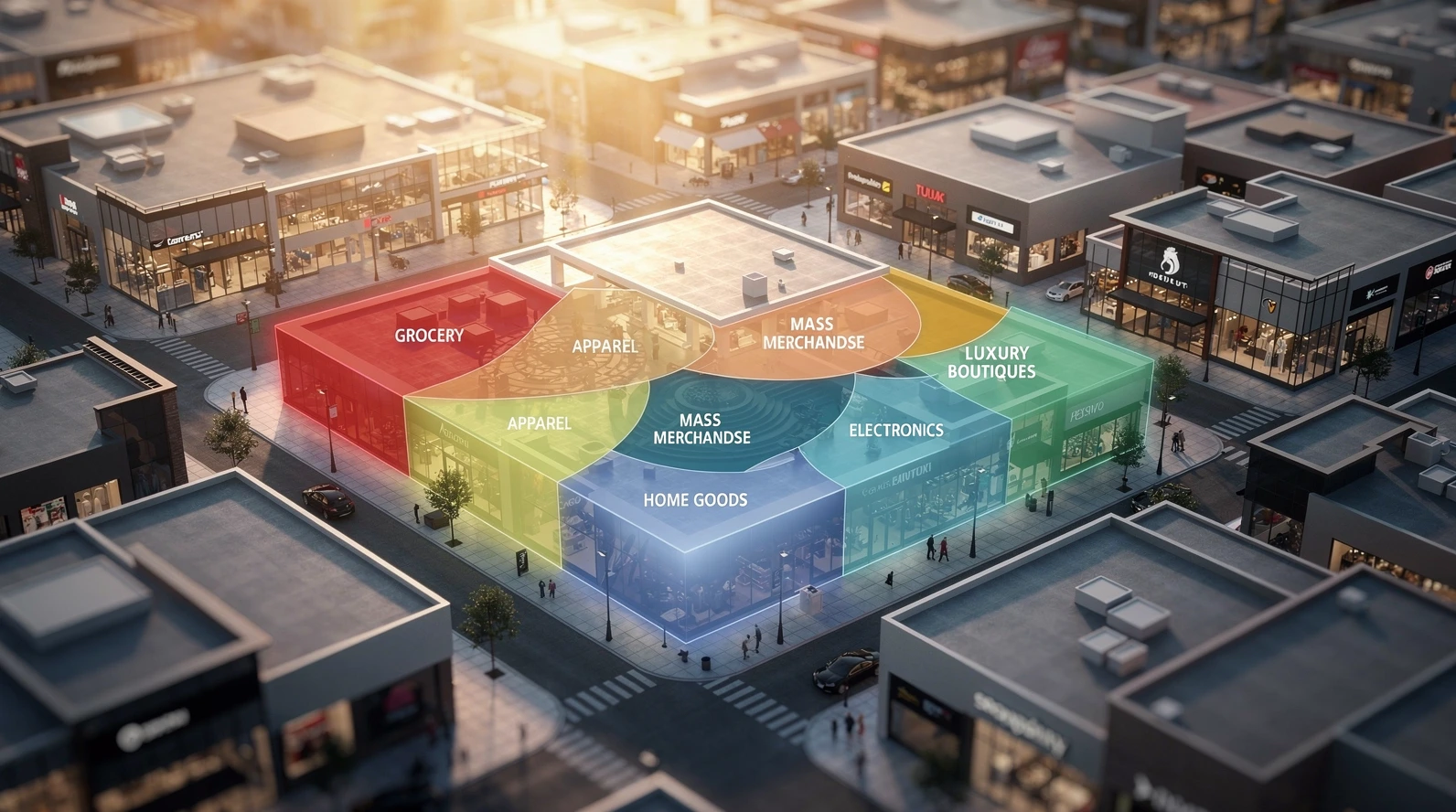
Walk into a Kroger on a Tuesday morning, then step into a Tiffany boutique on Madison Avenue that afternoon, and you have witnessed two corners of the same industry. Both sell goods to consumers. Both worry about inventory turns, labor scheduling, and shrink. Yet the operating playbooks, margin profiles, and customer expectations could not look more different. That gap is what makes retail industry segments a useful map rather than a buzzword: it tells operators, investors, and policy watchers which playbook to apply and which competitors actually matter.
This guide breaks the US retail landscape into the segments that practitioners use day to day, with examples from public companies, working definitions, and a clear view of where e-commerce sits inside the picture. It belongs to the ShopAppy news cluster that explains how retail news shapes the global e-commerce industry today, so segment vocabulary lines up with the way reporters and analysts use it in 2026.
In short
- Retail splits along two axes: what is sold (grocery, apparel, electronics, luxury, etc.) and how it is sold (mass, specialty, off-price, direct-to-consumer, marketplace).
- Grocery and general merchandise are the largest segments by revenue, but their margins are thin and the competitive moat is supply chain, not branding.
- Specialty, luxury, and DTC live on brand equity, higher gross margin, and curated assortments. They are smaller in dollars, larger in valuation multiples.
- E-commerce is not a segment, it is a channel that cuts across every segment. Treating Amazon, Wayfair, and Net-a-Porter as one bucket misses how the underlying economics differ.
- The US Census Bureau publishes the official segment breakdown through NAICS codes, and the Monthly Retail Trade Survey is the closest thing to a shared scoreboard.
Why segmenting retail still matters in 2026
It is tempting in a marketplace-dominated era to flatten retail into one giant shopping aggregator. That view does not survive contact with operations. A grocery chain runs on a 1 to 3 percent net margin and 25 to 50 inventory turns per year. A luxury house runs at 60 to 70 percent gross margin with two collections a season and a different model entirely. Treating them as the same industry is how investors get burned and how operators copy the wrong tactics.
Segmentation also matters because regulators, lenders, and ad platforms speak the language. Bank underwriting templates, vendor credit lines, store leases, and even media rate cards are calibrated by segment. When a category manager says “we are in mass merchandise, not specialty apparel,” the rest of the supply chain reads that as a set of expectations on payment terms, markdown cadence, and replenishment.
For ShopAppy readers covering deal flow and store openings, the segment label is also the fastest way to compare a story to the rest of its peer set. Coverage that ignores segmentation tends to drift into generic e-commerce narratives. Sharper coverage, including the panels at retail industry conferences worth attending, is built around segment-specific KPIs and benchmark data.
The official segmentation: NAICS and Census codes
The US Census Bureau classifies retailers under NAICS sector 44-45 (Retail Trade) and food services under 72. Inside 44-45 there are roughly a dozen subsectors that form the spine of every government report and most third-party datasets. Anyone serious about retail industry data sources analysts actually trust ends up here, because revenue benchmarks, store counts, and same-store sales are reported using these definitions.
Major NAICS subsectors
| NAICS code | Subsector | Representative players |
|---|---|---|
| 441 | Motor vehicle and parts dealers | AutoNation, CarMax, Penske |
| 444 | Building material and garden equipment | Home Depot, Lowe’s, Tractor Supply |
| 445 | Food and beverage stores | Kroger, Albertsons, Publix, Trader Joe’s |
| 448 | Clothing and accessories | Gap, Ross, TJX, Lululemon, Tapestry |
| 449 | Furniture, home furnishings, electronics | RH, Williams-Sonoma, Best Buy |
| 455 | General merchandise (mass) | Walmart, Target, Costco |
| 456 | Health and personal care | CVS, Walgreens, Ulta |
| 457 | Gasoline stations and fuel dealers | 7-Eleven, Casey’s, Murphy USA |
| 458 | Sporting goods, hobby, music, book | Dick’s, Academy Sports, Barnes & Noble |
| 459 | Other miscellaneous (pet, florist, art) | Petco, Five Below, Hobby Lobby |
NAICS does not have a separate code for “luxury” or “DTC.” Those are commercial labels layered on top of the official taxonomy. A Hermès boutique sits inside 448 alongside Old Navy as far as Census is concerned, which is why operator-side segment maps differ from government ones.
How practitioners actually slice the industry
Inside boardrooms and on earnings calls, retailers describe themselves with a more flexible vocabulary. The two axes that matter most are product category and format. Combining them produces the segments that show up in research reports.
By product category
- Grocery and consumables: food, beverages, household paper, cleaning, pet food. Largest dollar segment in the US, roughly $1.5 trillion when food service is excluded.
- General merchandise: clothing, home, electronics, toys, and seasonal goods sold under one roof or one digital storefront. Walmart, Target, Costco, and Amazon’s first-party retail business anchor this group.
- Apparel and footwear: roughly $400 billion in US sales, split between mass, mid-tier, premium, and luxury.
- Home and furniture: includes hardware, home improvement, furniture, decor, and appliances. Sensitive to housing starts and rate moves.
- Electronics: a shrinking footprint of dedicated stores, with most volume migrating to Amazon, big-box, and direct manufacturer channels.
- Health and beauty: drugstores, prestige beauty, and increasingly DTC wellness brands.
- Auto, fuel, and parts: high-ticket, lower-frequency, mostly outside the typical e-commerce conversation.
- Luxury and premium: a cross-category layer covering watches, jewelry, leather goods, fashion, and select beauty. Run by groups like LVMH, Kering, and Richemont.
By format and channel
- Mass merchants: high SKU count, thin margin, scale-driven (Walmart, Target).
- Warehouse clubs: membership fee economics, limited SKU, treasure hunt experience (Costco, Sam’s Club, BJ’s).
- Off-price: opportunistic buying, no-markdown culture, treasure-hunt assortment (TJX, Ross, Burlington).
- Specialty: one category, deep assortment, often vertically integrated (Lululemon, Sephora, Dick’s).
- Department stores: legacy multi-category footprint under pressure (Macy’s, Nordstrom, Kohl’s).
- Convenience: 24/7, small basket, high frequency, fuel-anchored (7-Eleven, Wawa, Casey’s).
- Dollar and value: small-box, low ticket, rural and underserved trade areas (Dollar General, Dollar Tree, Five Below).
- DTC and digitally native: brand owns the customer, sells primarily online, layers wholesale and stores later.
- Marketplaces: third-party seller platforms with first-party assortments layered on (Amazon, Walmart Marketplace, eBay, Etsy).
The grocery segment up close
Grocery is the workhorse of US retail. The US Department of Agriculture estimates Americans spend about $1.5 trillion a year on food at home and away from home, and the at-home portion flows through the food and beverage subsector. Margins are famously thin: Kroger reports operating margins in the low single digits, and even the strongest regional chains struggle to clear 4 percent.
The defining tactical battle inside grocery is private label. Trader Joe’s runs 80 percent private label. Costco’s Kirkland brand is reportedly larger than most public consumer packaged goods companies. Mainstream chains are catching up, and the shift is reshaping vendor relationships across the segment. Our deep dive on grocery private label winning shelf space everywhere traces how the category economics have changed since 2022.
Within grocery, the relevant sub-segments are:
- Conventional supermarkets: Kroger, Albertsons, regional chains like Wegmans and H-E-B.
- Discount grocery: Aldi and Lidl, growing aggressively in the US through 2026.
- Premium and natural: Whole Foods, Sprouts, Erewhon.
- Warehouse club grocery: Costco and Sam’s Club, where a meaningful share of basket is still food and consumables.
- Convenience and small format: 7-Eleven, Wawa, and the urban small-format Walmart and Target stores.
General merchandise and the mass segment
General merchandise is the segment most people picture when they think “store.” It is dominated by Walmart, Target, Costco, and increasingly Amazon’s first-party retail business operating across categories. The defining feature is breadth, not depth: a Target carries roughly 80,000 SKUs across grocery, apparel, home, electronics, beauty, and seasonal. Specialty retailers in any one of those categories will carry more depth but a fraction of the breadth.
The mass segment is also where private label leverage is most visible. Target’s owned brands (Good & Gather, Threshold, Cat & Jack) collectively cross $30 billion in sales, more than many standalone retail companies. Walmart’s Great Value and Equate brands play the same role.
Margins are higher than grocery-only operators because of category mix. Apparel and home routinely run 30 to 50 percent gross margin, which subsidizes the lower-margin grocery aisles. The trade-off is inventory risk: a single bad seasonal buy in apparel can wipe out a quarter.
Specialty, apparel, and the brand-driven segments
Specialty retail is where brand equity does the heaviest lifting. Lululemon, Sephora, Williams-Sonoma, and Dick’s are not selling commodities; they are selling a curated point of view. Gross margins sit between 40 and 65 percent, store productivity is high, and the customer relationship is direct.
Apparel sits across specialty, off-price, and mass. The key sub-segments are:
- Premium athletic: Lululemon, Vuori, Alo, and the direct businesses of Nike and On.
- Mid-tier mall: Gap, Banana Republic, J.Crew, American Eagle. Pressured by both DTC and off-price.
- Fast fashion: Zara, H&M, and the marketplace-based players like Shein and Temu, which the National Retail Federation has flagged as the most disruptive entrants since the rise of Amazon.
- Off-price: TJX, Ross, Burlington, which have been net winners as full-price chains struggle.
- Workwear and outdoor: Carhartt, Duluth Trading, REI.
Luxury as a segment of its own
Luxury sits across multiple NAICS codes but operates as a distinct business model. Gross margins of 60 to 75 percent, vertically integrated manufacturing (often in Europe), and tightly controlled distribution. The biggest groups are not US companies: LVMH, Kering, Richemont, and Hermès. In the US they show up through directly operated boutiques in major cities, leased space inside Saks and Neiman Marcus, and a slowly growing e-commerce footprint.
Within luxury, three sub-segments behave differently:
- Hard luxury: watches and jewelry. Long product cycles, durable resale value, dominated by Rolex, Cartier, Patek Philippe.
- Soft luxury: leather goods, fashion, ready-to-wear. Faster cycles, more exposed to taste swings.
- Aspirational and premium beauty: La Mer, Tom Ford Beauty, Chanel beauty. The mass-affluent gateway into luxury houses.
For US-focused retail coverage, the luxury segment matters as a signal more than as a volume driver. Spending patterns in luxury are a leading indicator for discretionary categories overall, and the segment is reported on quarterly by analysts at Statista and other research houses.
E-commerce: a channel, not a segment
One of the most common analytical mistakes is treating “e-commerce” as a segment. It is a channel layered across every segment above. Amazon, Walmart.com, Costco.com, Sephora.com, and Hermes.com are not in the same business just because the transaction happens in a browser or app.
A cleaner way to think about it: every segment has a digital share, and that share has been climbing since 2010. Grocery is around 13 to 15 percent digital. Apparel sits closer to 35 percent. Consumer electronics is near 60 percent. Luxury is the laggard, still under 25 percent, because the in-store experience is part of the product.
Where pure-play digital retailers fit
| Player | Underlying segment | Format |
|---|---|---|
| Amazon (1P retail) | General merchandise | Mass online |
| Amazon (3P marketplace) | All segments | Marketplace platform |
| Wayfair | Home and furniture | Specialty online |
| Chewy | Pet (miscellaneous retail) | Specialty online subscription |
| Etsy | Craft and gift | Marketplace |
| Shein, Temu | Fast fashion, general merchandise | Cross-border marketplace |
| Stitch Fix | Apparel | Specialty subscription |
Common mistakes when categorizing retailers
Even experienced operators muddle segment definitions. The most frequent errors:
- Conflating channel and segment: calling Wayfair an “e-commerce company” instead of an online home and furniture specialist with home-segment economics.
- Treating luxury as premium: a $400 Lululemon jacket is premium athletic, not luxury. Real luxury implies controlled distribution and heritage brand equity.
- Mixing wholesale and retail: Costco runs a hybrid model with significant business member sales. Sam’s Club is similar.
- Ignoring food service: a Walmart Supercenter and a Cracker Barrel both sell food, but they sit in different NAICS sectors with very different unit economics.
- Forgetting cross-segment players: a Target food aisle competes with Kroger, but a Target electronics aisle competes with Best Buy and Amazon. Same store, different segment dynamics.
How segments interact: the competitive map
Segments do not exist in isolation. Mass merchants encroach on specialty (Target on Sephora’s territory through Ulta-inside-Target). Specialty encroaches on mass (Lululemon adding footwear and tennis lines). Off-price feasts on specialty’s overstock. Dollar stores eat into grocery’s bottom basket.
The most important cross-segment dynamics for 2026:
- Marketplaces blurring the lines: Walmart Marketplace and Amazon 3P make every brand a potential retail competitor to itself.
- Private label as a moat: in grocery, mass, and increasingly apparel and beauty.
- Resale and recommerce: ThredUp, The RealReal, and Poshmark create a parallel market that touches apparel and luxury especially.
- Healthcare and grocery convergence: Amazon Pharmacy, CVS HealthHubs, Walmart Health.
- Convenience and grocery convergence: 7-Eleven and Wawa expanding fresh and prepared food.
Direct-to-consumer and the post-2020 reset
The DTC label covers a lot of ground. At one end sit digitally native brands that started online (Warby Parker, Glossier, Allbirds, Casper). At the other end sit heritage manufacturers that built a direct relationship with shoppers after years of wholesale dependence (Nike, Hanes, Levi’s). The shared feature is that the brand owns the customer file, the price, and the brand presentation.
Through 2020 and 2021, DTC was treated as a discrete segment by venture investors. The post-2022 reset reframed it. Customer acquisition costs on Meta and Google rose, free shipping cracked the unit economics, and the most successful DTC brands ended up adding wholesale and physical retail. Warby Parker now has more than 250 stores. Allbirds opened, closed, and re-opened locations. Casper sold itself to private equity and retreated from many of its stores.
The pragmatic 2026 read is that DTC is a launch strategy and a channel mix, not a permanent segment. Successful operators end up in the specialty or premium category they belong to (athletic, beauty, home, eyewear) and the DTC label fades as the business matures.
Region, format, and segment overlap
One last reason the segment map gets tangled: US retail is regional. A grocery chain like H-E-B is a Texas powerhouse and effectively invisible nationally. Wegmans is a Northeast specialist. Publix is the Southeast leader. None of them shows up on national share-of-segment rankings at full weight, yet inside their footprint they are the segment leader.
Format also overlaps. Costco is a warehouse club but its grocery business alone would rank in the top five US grocers. Walmart is a mass merchant but its grocery business is the largest in the country. Target is a mass merchant but its apparel and beauty businesses run like specialty operators. When a retailer crosses formats, the right way to read its earnings is segment-by-segment, not as one number.
That is why analysts often build their own segment maps that combine NAICS codes with custom format buckets. The result is messier than the Census taxonomy, but closer to how operators actually compete.
The same caveat applies to international retailers operating in the US. Aldi and Lidl are reported by their parent companies as European hard discounters, but inside the US trade they are tracked alongside conventional supermarkets. Uniqlo is a global fast-fashion brand, but in US comps it is benchmarked against Gap and H&M. Always check which segment a retailer is being placed in before comparing growth, margin, or store-count numbers, because the lens can swing the conclusion.
Picking the right segment lens for your work
If you are an operator, the segment map drives benchmarking. A regional grocery chain should not be measured against Lululemon’s gross margin. If you are an investor, segment-specific KPIs (comp sales, inventory turn, four-wall margin) are the language earnings calls are conducted in. If you are a reporter or analyst, segment vocabulary is the difference between coverage that lands with practitioners and coverage that reads as generic.
This is also why ShopAppy organizes coverage around the segments that operators recognize. The flagship explainer on how retail news shapes the global e-commerce industry today sits at the top of the cluster, with segment-specific pieces below it covering grocery, apparel, mass, and DTC. Pieces tagged “industry” tend to focus on the cross-segment dynamics covered above.
Tools and data sources for segment analysis
- US Census Bureau, Monthly Retail Trade Survey: official segment-level revenue, updated monthly. The Census retail portal is the canonical source.
- NRF and CIRP: trade group data on sales, store counts, and consumer sentiment.
- Placer.ai, Adentro, Foursquare: foot traffic by chain and segment.
- Numerator and Circana: panel data, especially for grocery and CPG.
- Coresight Research and eMarketer: e-commerce share by segment.
- Statista and Euromonitor: global segment sizing.
Frequently asked questions
What are the main retail industry segments in the US?
The major segments are grocery and consumables, general merchandise (mass), apparel and footwear, home and furniture, electronics, health and beauty, auto and fuel, and luxury. They map roughly onto US Census NAICS subsectors 441 through 459, with luxury treated as a commercial layer rather than a separate code.
Is e-commerce a separate retail segment?
No. E-commerce is a channel that exists inside every segment. A grocery e-commerce business has grocery economics, a luxury e-commerce business has luxury economics. Grouping pure-play digital retailers together obscures more than it reveals.
How does the US Census Bureau define retail segments?
Through the North American Industry Classification System, sector 44-45. Each subsector (445 for food and beverage, 448 for clothing, 455 for general merchandise, etc.) groups establishments by primary product line. The Monthly Retail Trade Survey reports revenue by these codes.
Where does luxury fit in the segmentation?
Luxury sits across NAICS codes (448 for fashion, 458 for jewelry, 456 for prestige beauty) but operates as a distinct business model with 60 to 75 percent gross margins, controlled distribution, and brand heritage. Analysts treat it as a separate segment even when government statistics do not.
What is the difference between mass and specialty retail?
Mass retailers carry broad assortments across many categories (Walmart, Target, Costco) and compete on price and breadth. Specialty retailers go deep in one category (Lululemon in athletic apparel, Sephora in beauty) and compete on assortment depth, brand fit, and service.
Which retail segments are growing fastest in 2026?
Discount and value (Aldi, Dollar General, off-price like TJX), warehouse clubs (Costco, Sam’s), and select specialty categories like pet and prestige beauty. Department stores and mid-tier mall apparel continue to lose share.
How do dollar stores fit into the segment map?
Dollar stores are a sub-segment of general merchandise with a small-box, low-ticket format and rural or underserved trade areas. Dollar General and Dollar Tree are the two scale players. The economics are closer to mass than to convenience, but the basket size and SKU mix are unique to the format.
Are marketplaces a retail segment?
Marketplaces (Amazon 3P, Walmart Marketplace, Etsy, eBay) are a format that sits across segments. They host third-party sellers from every category. From a financial reporting perspective marketplaces show up as a service business, not a retailer, even though they shape consumer behavior across all retail segments.