
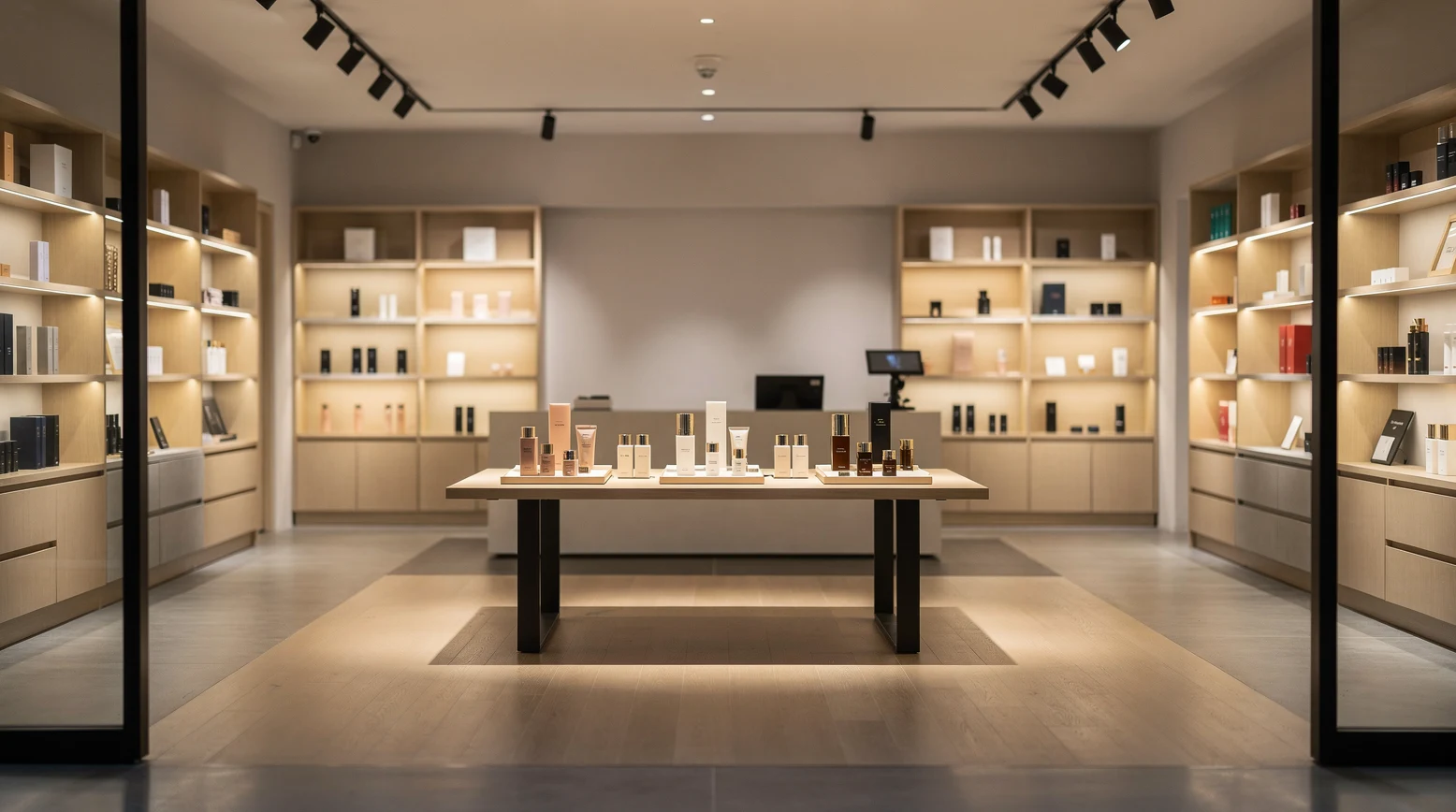
Store design is one of the few retail levers that works on every shopper who walks through the door, yet it is also the one most often left to instinct, vendor templates or whatever the last remodel happened to produce. The phrase “store design that drives conversion” sounds like it should require a large capital budget and a famous architect. In practice the highest-returning changes are quiet ones: where you put the entrance pause, how you sequence the first ten feet, how legible the path to the register is, and how little friction sits between a shopper picking something up and paying for it. The stores that convert best in 2026 rarely look like they are trying hard, and that is exactly the point.
This guide is written for retail and e-commerce teams who own a physical footprint, whether that is one flagship, a fleet of mall stores, or a handful of showrooms attached to a direct-to-consumer brand. It treats store design as a conversion discipline with measurable inputs and outputs, not as a decorating exercise. For the wider context on where physical retail sits today, see the broader state of US retail, which frames the format shifts this playbook operates inside.
In short
- Store design conversion is the share of visitors who buy, and it responds far more to layout, sightlines and friction at the register than to expensive fixtures or mood lighting.
- The first ten feet matter most: a decompression zone at the entrance and a clear primary path set the tone for the entire visit and protect product on the right-hand power wall.
- The most common mistakes are over-merchandising, blocked sightlines and a hidden or slow checkout, all of which suppress conversion even when traffic is strong.
- US winners like Apple, Trader Joe’s, Costco and Aesop succeed through restraint and sequencing, not visual noise, and each is replicable at a smaller budget.
- You can measure design impact with conversion rate, dwell time, path completion and units per transaction, and you should test changes one zone at a time rather than remodeling everything at once.
Why does store design matter so much for conversion in 2026?
Physical retail is no longer competing only with the store across the street. It competes with a phone in every shopper’s pocket that offers infinite selection, instant price comparison and next-day delivery. The reason a shopper chose to visit a physical space at all is that they wanted something the phone could not give them: immediacy, tactile evaluation, a curated edit, or simply a reason to leave the house. Store design is how a retailer delivers on that reason, and conversion is the scoreboard that says whether it worked.
The economics are unforgiving. A physical store carries rent, staff, utilities and inventory whether or not anyone buys. Every visitor who walks out empty-handed is a fixed cost spread across fewer transactions. Raising conversion from 20 percent to 25 percent on the same traffic is a 25 percent revenue increase with almost no incremental cost, which is why design changes that lift conversion compound faster than almost any marketing spend.
US retail sales data from the US Census Bureau continues to show the majority of retail spending happening in physical locations, even as e-commerce grows. The store is not disappearing. It is being asked to justify its footprint with better outcomes per visit, and design is the most direct way to do that.
Conversion is a behavior problem, not a taste problem
The trap most teams fall into is treating store design as a question of taste: which palette, which fixtures, which fonts. Those choices matter for brand, but they are weakly correlated with conversion. What actually moves the number is shopper behavior: whether people slow down, whether they can find what they came for, whether they discover something they did not plan to buy, and whether paying feels effortless.
Reframing design as behavior engineering changes the questions you ask. Instead of “does this look premium,” you ask “does this make the shopper pause at the hero product.” Instead of “is the store full enough,” you ask “can a visitor see the back wall from the door.” These behavioral questions have measurable answers, which is what makes store design a discipline rather than a matter of opinion.
What does “store design conversion” actually mean?
Store design conversion is the relationship between how a physical space is laid out and the percentage of visitors who complete a purchase. Conversion rate itself is simple arithmetic: transactions divided by visitors, usually measured per day or per week. The design part is everything that influences a shopper’s path, attention and friction between entering and paying.
It helps to separate the vocabulary, because teams often use these terms loosely and then talk past each other when a remodel underperforms.
| Term | What it means | Why it matters for conversion |
|---|---|---|
| Conversion rate | Share of store visitors who make a purchase | The headline scoreboard for whether design is working |
| Decompression zone | The first five to fifteen feet inside the entrance | Shoppers ignore product here, so it sets pace rather than sells |
| Power wall | The wall to the right as a shopper enters | Most shoppers turn right first, making it prime real estate |
| Sightlines | What a shopper can see from any given position | Clear sightlines pull shoppers deeper into the space |
| Dwell time | How long a visitor spends in the store or a zone | Longer dwell correlates with higher basket size, to a point |
| Friction | Any step that slows or stops a purchase | Checkout friction is the single largest silent conversion killer |
The reason the term “conversion” travels from e-commerce into physical retail is that the discipline is genuinely shared. An online store worries about hero images, navigation clarity and one-click checkout. A physical store worries about hero displays, wayfinding and a fast register. The surface differs, the underlying behavior is identical, and teams that run a digital storefront alongside their physical one increasingly apply the same conversion vocabulary to both.
The difference between traffic, conversion and basket
Three numbers determine store revenue, and conflating them is a frequent source of bad decisions. Traffic is how many people enter, and it is driven by location, marketing and foot traffic patterns, not by interior design. Conversion is the share who buy, and it is the number most responsive to layout and friction. Basket is how much each buyer spends, driven by merchandising, cross-sell adjacencies and price architecture.
A store with strong traffic and weak conversion has a design problem, not a marketing problem, and spending more on advertising simply pours more visitors into a leaky funnel. Diagnosing which of the three numbers is underperforming is the first step before any design change, because the fix for each is completely different.
How does store design move conversion in practice?
The mechanics of design-driven conversion come down to a sequence: a shopper enters, decompresses, turns right, follows a primary path, encounters product at decision points, and eventually pays. Each stage has a design lever, and the levers compound. A store that gets the entrance right but botches the checkout will still bleed conversion at the final step.
The entrance and the decompression zone
Shoppers crossing the threshold are in transition mode. They are adjusting from the sidewalk or parking lot to the store environment, and for the first several feet they are effectively blind to merchandising. Retailers who place high-margin product or critical signage in this decompression zone waste it, because shoppers walk past without registering it.
The fix is to treat the first ten feet as breathing room. Keep it relatively open, use it to signal the store’s identity and price level, and let the shopper’s pace settle. The product work begins just past this zone, on the power wall to the right, where attention has switched on. Stores that crowd the entrance with bins and tables often see lower conversion than stores that hold the space open, which feels counterintuitive until you watch the shopper behavior.
Sightlines and the primary path
Once a shopper is oriented, the question is whether the space pulls them deeper. Clear sightlines to the back wall, an obvious primary path, and visible category landmarks all reduce the cognitive load of navigating. A shopper who can see where to go keeps moving. A shopper who feels lost slows in the wrong way, gets frustrated, and leaves.
Grocery and big-box layouts exploit this with deliberate fixture heights: lower fixtures in the center of the floor so sightlines carry across the space, taller fixtures on the perimeter to hold the boundary. Specialty and apparel stores use the same principle at smaller scale, keeping center-floor tables low and reserving height for walls. The goal is always the same, which is to let the eye travel so the feet follow.
Decision points and the right amount of choice
Conversion happens at decision points, the moments where a shopper considers a specific product. Design influences these moments by controlling how much choice is presented at once. Too little choice and the shopper does not find what fits. Too much choice and the shopper freezes, a well-documented effect where excess options reduce the likelihood of any purchase at all.
The practical answer is curated edits: fewer SKUs presented well, with clear good-better-best tiers, rather than a wall of undifferentiated options. The retailer does the filtering so the shopper does not have to. This is why a tightly edited specialty store often converts better per visitor than a vast store with ten times the selection.
The checkout as a conversion stage
Everything upstream is wasted if the final step fails. A hidden register, a long line, a clunky payment flow, or a checkout that requires the shopper to backtrack across the store all suppress conversion at the moment of highest intent. The checkout should be easy to find, fast to clear, and positioned so the path to it is natural rather than a detour.
Mobile point-of-sale, queue-busting with handheld devices, and self-checkout where the category supports it all attack this friction directly. The brands that obsess over a fast, frictionless register, the way Apple removed the traditional checkout counter entirely, consistently outperform on conversion because they protect the one stage where intent is already maxed out.
What are the most common store design mistakes, and how do you avoid them?
The failure patterns are remarkably consistent across formats and price points. Most underperforming stores are not making exotic mistakes; they are making the same handful of avoidable ones. Naming them makes them easy to audit on a single walk-through.
Over-merchandising and visual noise
The most frequent mistake is cramming. The instinct that more product on the floor means more sales is intuitive and wrong past a certain density. Crowded floors block sightlines, raise cognitive load, and make the store feel chaotic, all of which suppress conversion. The fix is editing: pull SKUs, open up the floor, and trust that clarity sells better than abundance. Restraint is the hardest discipline because it feels like leaving money on the table, yet the conversion data almost always rewards it.
Blocked sightlines and dead zones
Tall fixtures in the wrong places, poorly positioned promotional displays, and back corners with no draw all create dead zones that shoppers never reach. A store with dead zones is paying rent on square footage that generates nothing. The fix is to walk the store from the entrance and note every spot you cannot see, then redesign fixture heights and add visual landmarks to pull traffic into the neglected areas.
Understaffing the floor at the wrong moments
Design and staffing interact. A beautifully laid-out store still converts poorly if there is no one to answer a question at the decision point or to clear the register at peak. Matching floor coverage to traffic patterns is a design decision as much as an operational one, and getting it wrong wastes the layout. For the staffing side of this equation, including how to cover peaks in a tight labor market, see our guide to staffing brick and mortar retail.
Designing out shoppers in the name of security
Loss prevention and conversion can pull in opposite directions. Locking up product, aggressive security presence, and a layout built around surveillance all reduce friction for theft but also reduce conversion for honest shoppers, who feel watched or cannot access the product they want to buy. The balance is delicate, and the best operators design loss prevention to be present without being hostile. We cover that trade-off in detail in theft, shrink and loss prevention without scaring shoppers.
A checkout that fights the shopper
The final recurring mistake is treating checkout as an afterthought. A register tucked in a corner, a single lane during a rush, or a payment process that stalls on the most common payment method all destroy conversion at the worst possible moment. The fix is to design the checkout first, not last, and to staff and equip it for peak rather than average demand.
What does effective store design look like in US retail?
The clearest way to understand these principles is to look at US retailers who execute them well. None of these examples relies on a famous architect or a vast budget. Each one applies restraint and sequencing in a way that any operator can study and adapt.
Apple: removing friction until none is left
Apple stores are the canonical conversion case study. The decompression zone is enormous, the product tables are low and walkable, sightlines are total, and the checkout was reinvented so staff can complete a sale anywhere on the floor with a handheld device. The lesson is not the glass staircase. It is the obsessive removal of every step between wanting and paying.
Trader Joe’s: curation as conversion
Trader Joe’s converts exceptionally well on a small footprint by carrying a fraction of the SKUs of a conventional grocer. The tight edit means shoppers rarely freeze on choice, the compact layout keeps sightlines short and legible, and the curated assortment turns the store itself into a recommendation engine. Fewer choices, presented with confidence, convert better than endless aisles.
Costco: the deliberate treasure hunt
Costco runs the opposite playbook and still wins, which proves there is no single correct layout. The deliberately shifting product placement creates a treasure-hunt dynamic that raises dwell time and basket size, while the warehouse format keeps fixtures simple and sightlines long. The design serves the membership model: the goal is to maximize discovery and basket, and the layout is engineered for exactly that.
Aesop and the specialty playbook
Aesop builds each store as a distinct space tied to its location, with sparse product, a central communal sink, and staff who function as guides rather than cashiers. The conversion mechanism is the unhurried, consultative experience that justifies premium pricing and makes the purchase feel considered rather than transactional. It is restraint deployed as a luxury signal.
Across these examples, the through-line is that conversion comes from clarity and the removal of friction, not from spending. The same logic increasingly applies online, where retailers who run unified digital and physical operations treat the storefront and the website as two expressions of one conversion discipline. Cart-recovery and lifecycle messaging close the loop after the visit, as covered in our look at retail email flows that recover abandoned carts.
Which tools, partners and vendors are worth knowing?
Store design is supported by a mature vendor ecosystem, and you do not need all of it. The right stack depends on store count and budget, but a few categories deliver outsized return on the conversion question specifically.
| Category | What it does | Conversion payoff |
|---|---|---|
| People counters and traffic analytics | Count visitors and measure conversion rate | Turns conversion from a guess into a measured number |
| Heat-mapping and path analytics | Track where shoppers walk and dwell | Reveals dead zones and validates layout changes |
| Planogram software | Plan fixture and shelf layouts at scale | Enforces sightline and adjacency discipline across a fleet |
| Modern point of sale | Mobile and self-checkout hardware and software | Removes friction at the highest-intent moment |
| Lighting and fixture vendors | Spotlighting, modular displays, signage systems | Directs attention to hero product and decision points |
| Store design and visual merchandising firms | Full layout and rollout services | Useful for remodels and new formats, not for small tweaks |
Start with measurement before fixtures
The most common vendor mistake is buying fixtures and lighting before installing the measurement to know whether they worked. A people counter and a heat-mapping pilot in one store cost a fraction of a remodel and tell you precisely where conversion leaks. Measure first, change one variable, then measure again. The discipline of planogramming formalizes shelf and fixture placement so that a winning layout in one store can be rolled out consistently across a fleet.
Where the digital stack overlaps
For brands running both physical and online storefronts, the point-of-sale and inventory layer is increasingly the same system, and the underlying commerce platform choices ripple into the store experience. Teams evaluating that infrastructure should understand how modern stacks are assembled, which we cover in composable commerce stacks and what retailers actually assemble. A unified stack lets a shopper start online and finish in-store, or vice versa, without the friction that suppresses conversion at the handoff.
How do you measure whether store design is working?
Design changes are only as good as the measurement around them. Without a baseline and a clear metric, a remodel becomes an expensive matter of opinion. The four metrics below cover the conversion question without drowning a team in data.
| Metric | How to read it | What it tells you |
|---|---|---|
| Conversion rate | Transactions divided by visitors | The headline measure of design effectiveness |
| Dwell time | Average minutes per visit or per zone | Whether the layout holds attention or pushes people out |
| Path completion | Share of shoppers reaching key zones | Whether sightlines and layout pull traffic deep |
| Units per transaction | Average items per completed sale | Whether merchandising and adjacencies drive basket |
Test one zone at a time
The single biggest measurement error is remodeling an entire store at once and then having no way to attribute the result. Conversion moved, but which of the forty changes caused it? The disciplined approach is to change one zone or one variable, measure against a baseline and ideally a control store, and only then move to the next change. This is slower and far more informative, and it prevents expensive changes from being credited or blamed by accident.
Connect store conversion to lifetime value
Conversion on a single visit is the start, not the end. A shopper who converts once and never returns is worth far less than one who becomes a repeat customer, and store design influences both. A frictionless, well-curated experience builds the kind of trust that supports a loyalty relationship. For how that retention layer is structured, see our guide to loyalty program design across points, tiers and paid membership, which connects the in-store experience to long-term value.
How should a team put this into practice over the next quarter?
The temptation after reading a guide like this is to plan a full remodel. Resist it. The highest-return approach is a sequenced 90-day program that starts with measurement and moves one variable at a time, so every change is attributable and reversible.
- Install measurement first. Put a people counter at the entrance and run a heat-mapping pilot in your highest-traffic store. Establish a conversion-rate baseline before changing anything, because without it you cannot prove any change worked.
- Audit the first ten feet. Walk the store as a first-time shopper. Is the decompression zone open. Does the power wall on the right hold your best product. Fix the entrance before touching anything deeper, because it sets the tone for the whole visit.
- Clear the sightlines. Lower center-floor fixtures, remove the displays that block the view to the back, and add a landmark that pulls traffic into your worst dead zone. Measure path completion before and after.
- Attack checkout friction. Time your queue at peak. Add mobile point-of-sale or a second lane if shoppers are abandoning at the register. This is usually the fastest single conversion win available.
- Edit the assortment. Pull underperforming SKUs, tighten the choice at key decision points into clear good-better-best tiers, and watch whether conversion and units per transaction rise as the floor opens up.
Run each step for long enough to gather a clean signal, typically two to four weeks per change in a single store, and document what moved. By the end of the quarter you will have a validated, store-specific playbook rather than a generic remodel, and you will know which changes to roll out across the rest of the fleet. The wider format and category context for these decisions sits in our pillar on the state of retail, which is worth revisiting as you plan beyond the first 90 days.
Frequently asked questions
What is a good conversion rate for a physical store?
It varies enormously by format. Grocery and convenience stores convert above 90 percent because most visitors arrive with intent to buy. Apparel and specialty stores typically sit between 20 and 40 percent. Big-ticket categories like furniture or electronics can convert in the single digits because shoppers research over multiple visits. The useful benchmark is not an industry average but your own store’s trend over time and the gap between your best and worst locations on comparable traffic. A widening gap usually points to a design or operational difference you can isolate and fix.
How much does a conversion-focused redesign cost?
The range is wide, but the premise of this guide is that the highest-return changes are cheap. Installing a people counter and running a heat-mapping pilot costs a few thousand dollars per store. Reorganizing fixtures, editing assortment and clearing sightlines is largely labor. Adding mobile point-of-sale is a modest hardware and software investment. Full architectural remodels run into six or seven figures, but you should only commit to those after the cheap behavioral changes have been measured and exhausted, because they frequently deliver most of the available conversion lift.
Why do shoppers turn right when they enter a store?
In markets where people drive on the right and read left to right, the dominant tendency is to turn right after entering and circulate counter-clockwise. The pattern is strong enough that the right-hand wall is called the power wall and is treated as prime merchandising real estate. It is a tendency rather than a law, and it can be overridden by a strong visual draw elsewhere, but designing with it rather than against it is the lower-risk default for most US stores.
Does lighting actually affect conversion or is it just ambiance?
Lighting affects conversion through attention, not mood alone. Focused spotlighting on a hero display draws the eye and slows the shopper at a decision point, which is the behavior that precedes a purchase. Even, flat lighting across the whole floor gives the eye nothing to land on and flattens the merchandising hierarchy. The conversion payoff comes from directing attention to the right product at the right moment, so lighting should be treated as a wayfinding and emphasis tool, not as a decorating choice.
How do I avoid the choice paralysis that kills conversion?
Curate. The retailer’s job is to do the filtering the shopper would otherwise have to do alone. Present fewer SKUs at each decision point, organize them into clear good-better-best tiers, and remove near-duplicate options that add cognitive load without adding genuine choice. Stores that carry a deliberately tight assortment, like Trader Joe’s in grocery, consistently convert better per visitor than stores that present an overwhelming wall of similar options, because the curation itself functions as a recommendation.
Should small independent retailers bother with traffic analytics?
Yes, and the entry cost has fallen far enough to make it worthwhile even for a single store. A basic people counter turns conversion from a vague feeling into a number you can act on, and that number is the foundation for every other decision in this guide. Without it, an independent retailer is guessing about whether a slow day was a traffic problem or a conversion problem, and those two problems have opposite fixes. Even a simple monthly conversion-rate trend is enough to start testing changes with confidence.
How does store design relate to my online conversion work?
The disciplines are the same even though the surfaces differ. Online conversion worries about hero images, clear navigation and frictionless checkout. Store conversion worries about hero displays, clear sightlines and a fast register. Teams that run both increasingly share vocabulary, tooling and even staff between the two, and they treat the physical store and the website as two expressions of one conversion practice. The unification deepens when the point-of-sale, inventory and commerce platform are a single connected system rather than two silos.
How long before a store design change shows up in conversion data?
For a single clear change in one store, you usually see a directional signal within two to four weeks, assuming traffic is stable enough to compare like-for-like. Seasonality, promotions and weather all add noise, which is why a control store or a year-over-year comparison strengthens the read. The mistake to avoid is judging a change after a few days or after a single weekend, because daily conversion is volatile enough that short windows produce false positives and false negatives in roughly equal measure.
What to read next
Store design is one discipline inside a larger retail operation, and the conversion gains it produces compound when they connect to staffing, loss prevention, retention and the wider format strategy. Treat the next quarter as a measurement-led sprint: install the counters, fix the entrance, clear the sightlines, attack checkout friction, and edit the assortment, in that order, changing one variable at a time. The teams that win on conversion are not the ones with the biggest remodel budgets. They are the ones who treat the store as a behavior problem, measure relentlessly, and have the discipline to do less rather than more.