
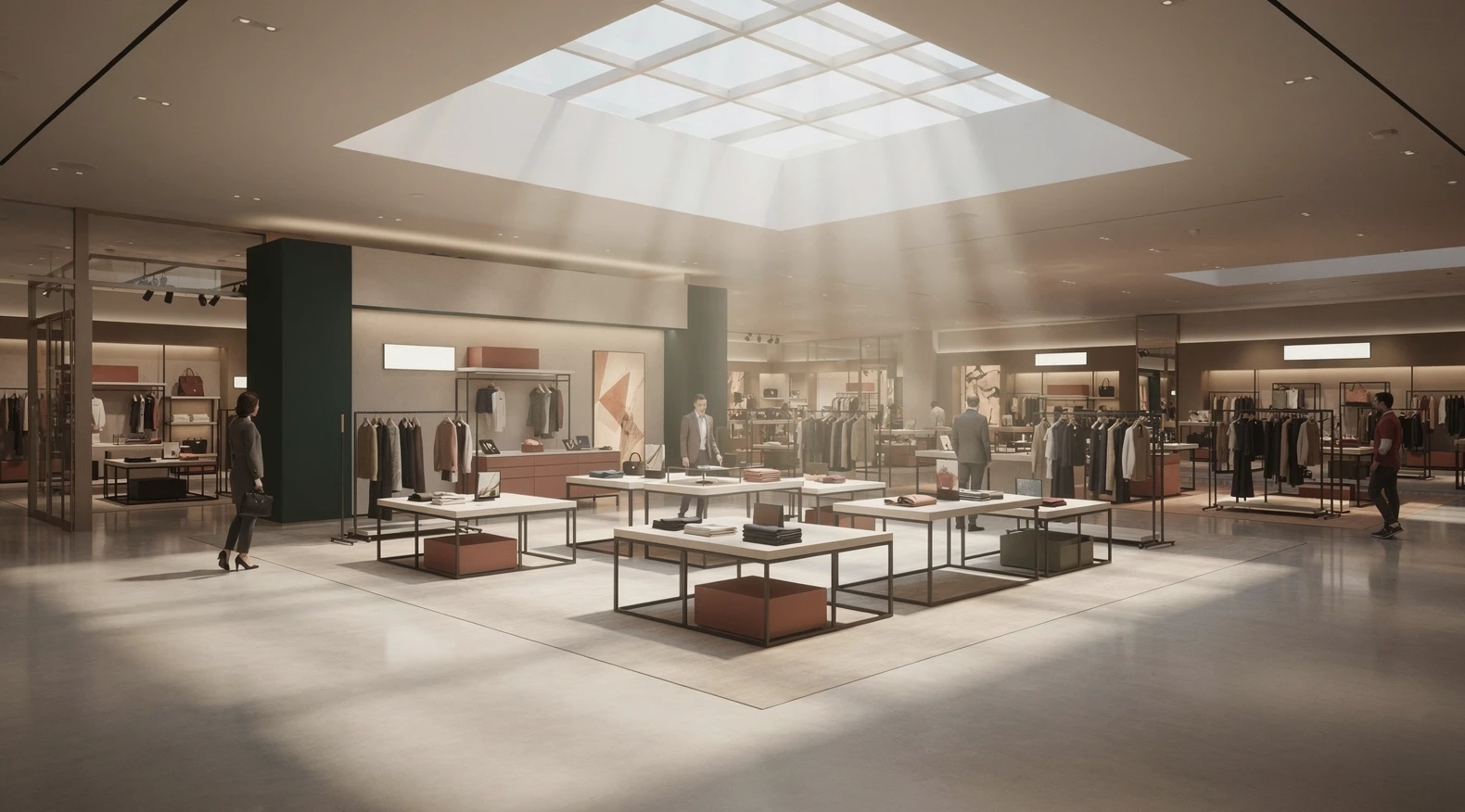
A concession is the quietest way for a brand to get a physical storefront without signing a lease. The brand takes a defined footprint inside a department store or a larger host retailer, keeps ownership of the stock, sells through the host’s tills, and pays the host a percentage of every sale. No key money, no fit-out on a 10 year commitment, no separate business rates bill. What the brand gives up, in exchange, is control: over pricing, over promotions, over staffing standards, and over how quickly it can walk away.
Shop-in-shop is the broader term for the same idea. It covers the branded fixture inside an electronics chain, the cosmetics counter that has operated on concession terms for decades, and the 400 square foot branded box inside a fashion floor. The commercial machinery underneath varies more than most brand teams expect, and the difference between a good concession deal and a bad one usually sits in four numbers: the commission rate, the markdown liability, the staffing cost, and the data access. This piece walks through each of them, using the terms that actually appear in host retailer contracts.
In short
- A concession is not wholesale. The brand keeps title to the stock, books the full retail sale as its own revenue in most structures, and pays the host a commission on gross sales rather than taking a one-off wholesale margin.
- Commission rates cluster in a wide band, commonly reported between roughly 20% and 40% of gross retail sales depending on category, host prestige, staffing split and whether the host funds fixtures. Beauty and fashion sit at the higher end; bulky, low-margin categories sit lower.
- Markdown liability is the number that kills deals. If the host can call a storewide promotion and the brand funds the discount on its own stock, the effective commission is far higher than the headline rate.
- Staffing decides both cost and standards. Brand-employed staff protect service quality and carry payroll, national insurance or payroll tax and holiday cover; host-employed staff cost less but sell your product alongside 30 others.
- Data access should be written into the contract, not requested later. Daily SKU-level EPOS feeds, stock positions and returns data are negotiable at signature and very hard to extract afterwards.
Concession, wholesale and consignment: three different risks
The three models get used interchangeably in conversation and mean completely different things on a balance sheet. Getting the definitions right is the first step, because each one moves risk to a different party.
In a wholesale relationship, the department store buys the stock outright at a wholesale price, typically somewhere between 40% and 55% of the intended retail price in fashion and accessories. Title passes to the retailer. The retailer decides the retail price, decides when to discount, and eats the markdown. The brand books revenue at the wholesale price on delivery and moves on. Cash arrives predictably, on the buyer’s payment terms, and the brand’s exposure ends at the loading dock.
In a concession, nothing is bought. The brand ships stock into the host store, retains ownership, and the host acts as a sales channel. The customer pays the host’s till, the host deducts an agreed commission plus any contracted charges, and remits the balance to the brand on a monthly or fortnightly cycle. Revenue recognition depends on who controls the goods before transfer, a question governed under IFRS 15 and ASC 606 principal versus agent guidance, so the accounting treatment is worth confirming with your auditor before the first invoice cycle rather than after it.
In a consignment arrangement, the host also avoids buying stock, but the sale is usually treated as the host’s sale, with the brand paid a fixed cost price per unit sold. Consignment tends to appear in categories with slow turns and high unit values (furniture, fine jewelry, some electronics) where the host wants range without inventory risk. The brand’s ceiling is the agreed cost price, so upside from a strong sell-through goes to the host.
What each model does to your cash cycle
Wholesale converts stock into cash fastest, at the lowest price. Concession converts stock into cash slowest, at the highest price, because the brand funds the inventory sitting on the host’s floor for as long as it takes to sell. A brand with 12 concessions and 8 weeks of cover in each is financing a meaningful chunk of working capital that never appears in its own store count. That is a treasury question as much as a merchandising one.
| Dimension | Wholesale | Concession | Consignment |
|---|---|---|---|
| Who owns the stock on the floor | Host retailer | Brand | Brand |
| Who sets the retail price | Host retailer | Usually brand, with host promo rights | Often negotiated, host leads |
| Who funds markdowns | Host retailer | Brand, unless contracted otherwise | Brand, via cost price renegotiation |
| Brand’s revenue line | Wholesale price | Gross retail less commission | Agreed cost price per unit |
| Payment timing | On buyer terms after delivery | After sale, on settlement cycle | After sale, on settlement cycle |
| Working capital load on brand | Low | High | High |
| Upside if product sells through | Capped at wholesale margin | Full retail margin less commission | Capped at cost price |
| Exit speed | End of season order | Notice period, often 3 to 6 months | Notice period, usually short |
None of these models is inherently better. A brand with tight cash and unproven sell-through is usually safer in wholesale. A brand with strong sell-through data, capital to fund inventory and a reason to control presentation is usually better off in concession, because it keeps the retail margin that a wholesale buyer would otherwise take. The operational discipline required, though, is the same discipline a brand needs in its own stores, which is why the retail store operations playbook matters as much for a concession estate as it does for a standalone chain.
Who owns the stock, and who carries the markdown
Stock ownership sounds like a settled question in a concession: the brand owns it. In practice the contract splits ownership into several separate questions, and each one has a cost attached.
Shrinkage and who pays for it
Stock loss inside a host store is a recurring source of dispute. The brand owns the goods, but the host controls security, staffing, back-of-house access and the till. Most concession agreements set a shrinkage allowance, often expressed as a percentage of sales, with losses above that threshold shared or charged back to the host. A brand signing a contract with unlimited shrinkage exposure and no stocktake rights is accepting an uncapped cost line. Ask for a documented stocktake cadence (twice yearly is common, quarterly is better in high-value categories) and for the right to attend.
Markdown authority
This is the single most expensive clause in most concession contracts. Host retailers run storewide events: mid-season sale, Black Friday, a loyalty weekend, a clearance push before a refit. The question is whether the brand can decline to participate. Three patterns appear:
- Full participation, brand funded. The brand must match the storewide discount and absorbs the margin loss. Cheapest for the host, most expensive for the brand.
- Opt-out with visibility penalty. The brand can decline, but the space loses signage, is excluded from the promotional floor plan, and often sees a sharp sales drop during the event.
- Shared funding. The host contributes part of the discount, usually by reducing its commission rate for the promotional period. This is the fairest structure and the hardest to get without leverage.
Run the arithmetic before signing. A 30% commission looks acceptable. A 30% commission on a base that is discounted 20% for 14 weeks of the year, with the brand funding the discount, produces a materially lower gross margin than the headline suggests. Model it on a realistic promotional calendar rather than on full-price assumptions.
Returns and who eats them
Returns processed at the host’s customer service desk are usually charged back to the brand at full retail value, including sales made in other stores or online if the host operates a single returns policy. Two details matter: whether the brand is charged commission on the original sale that is later returned (it should be refunded), and whether returned goods come back in sellable condition or are written off. In apparel and beauty, a returns rate that runs 4 to 6 points above the brand’s own channel average is a signal that the host’s staff are selling without fitting support, not that the product is wrong.
Commission rates and what drives them up or down
Concession commission is quoted as a percentage of gross retail sales, usually excluding sales tax or VAT. There is no public rate card, and the reported ranges vary by market and category, so treat any specific figure you read (including the indicative bands below) as a starting point for negotiation rather than a benchmark, and verify current market terms with a retail property advisor or a broker who works the category.
| Category | Typical commission band on gross sales | Usual staffing model | Main cost driver |
|---|---|---|---|
| Beauty and fragrance | High, often 30% and above | Brand-employed beauty advisors | Prime ground floor space and fixture cost |
| Womenswear and accessories | Mid to high 20s and above | Mixed, brand staff on larger units | Markdown participation |
| Menswear and tailoring | Mid 20s to low 30s | Often host staff | Lower footfall floors, slower turns |
| Footwear | Mid 20s to low 30s | Mixed | Stockroom space and size depth |
| Home and furniture | Lower, often high teens to mid 20s | Host staff, brand specialists on order days | Bulky stock, delivery logistics |
| Consumer electronics | Lower band, thin retail margins | Brand-funded specialists common | Price transparency limits margin |
| Food, cafe and services | Wide range, often structured as rent plus turnover | Brand staff | Utilities, waste, extraction and hours |
What pushes a rate up
Prestige of the host is the biggest single factor. A flagship on a major shopping street with high tourist footfall commands a premium because the space is genuinely scarce. Ground floor beats upper floors. A position near an escalator, a main entrance or an anchor category beats a corner behind the stairs. If the host funds the fit-out, expect several points of commission on top, effectively amortizing the capital cost into the rate.
What pulls a rate down
Volume commitments help: a brand willing to guarantee a minimum annual sales figure, or to open several sites at once, has something to trade. So does taking difficult space, committing to a longer term, funding your own fixtures, or supplying your own staff. Brands that bring their own footfall (a name customers travel for) can negotiate hard, because the host benefits from the traffic even on sales that happen elsewhere in the store.
The clauses that sit alongside the rate
The headline percentage is rarely the whole cost. Watch for a service charge or space contribution charged separately, a marketing levy expressed as a percentage of sales, card processing fees passed through, a minimum guaranteed payment that applies when sales underperform, and settlement terms that can stretch to 45 or 60 days after month end. Add them together and compare the all-in cost to the wholesale margin you would otherwise have given away. That is the only comparison that means anything.
Staffing: host store team, brand team or a mix
Who stands in the space determines both the cost base and the customer experience, and it is the area where concession agreements most often go wrong in year two.
Brand-employed staff
The brand recruits, trains, pays and manages the team, who work inside the host’s building under the host’s operating rules (opening hours, security procedures, dress code where applicable, till systems). The brand gets product knowledge, brand standards, and a team whose targets are its own. It also gets the full employment cost: payroll taxes, holiday and sick cover, recruitment in a tight labor market, and the management overhead of supervising people in a building you do not control. Scheduling is harder than in an owned store because the host sets trading hours and expects cover across all of them, which is why the same rules that govern store labor scheduling apply with even less flexibility inside a concession.
Host-employed staff
The host’s floor team sells the brand’s product alongside everything else on the floor. Cost to the brand is embedded in the commission rate, which is why host-staffed deals often carry a higher percentage. The tradeoff is attention: a generalist selling 20 brands will not know your fit, your fabric story or your warranty terms unless you invest in training, and training host staff is voluntary from their side. Brands that succeed here treat host staff as an audience to be won, with clear product cards, short training sessions timed around shift patterns, and simple incentives where the host permits them.
The mixed model
A common compromise: brand-funded specialists on the busiest trading days plus host cover the rest of the week. It contains cost while protecting peak conversion. It also creates the classification question that catches brands out, because a worker embedded in another company’s premises, on that company’s rota, using that company’s systems, can raise questions about who the real employer is. The rules differ by jurisdiction; in the United States, worker classification tests are set out by the Internal Revenue Service and by state law, and employment status in a host retailer setting is a question for an employment lawyer in the relevant market rather than something to resolve in a merchandising meeting.
Data, EPOS feeds and getting your own sales numbers out
In a concession, every transaction runs through the host’s till, which means the host owns the raw data and the brand receives whatever the contract says it receives. Brands routinely discover, months in, that they are getting a monthly PDF summary and nothing else.
What to ask for at signature
- Daily sales by SKU, not weekly totals by department, delivered by file feed or API rather than by email attachment.
- Stock on hand by SKU and by site, reconciled to the brand’s own dispatch records, so replenishment is driven by data instead of by a store manager’s phone call.
- Returns data with reason codes where the host captures them, and at minimum the SKU and value of every return charged back.
- Footfall or traffic data for the floor, if the host measures it, which allows a genuine conversion rate rather than a sales figure with no denominator.
- Promotional participation flags, so discounted sales can be separated from full-price sales in analysis.
Reconciling the host’s numbers with your own
Settlement disputes almost always come from timing rather than dishonesty. The host reports on its trading calendar, which may be a 4-5-4 retail calendar rather than a Gregorian month; the brand books on a calendar month; returns land in a later period than the original sale; and commission is sometimes calculated on gross including tax and sometimes on net. Agree the basis in writing, then reconcile monthly for the first six months. After that, a quarterly check is usually enough.
The metrics that matter for a concession
Sales density (sales per square foot or square meter per week) is the number the host cares about, because it decides whether your space gets renewed, extended or reallocated. Track it alongside conversion, units per transaction, average selling price and full-price sell-through. The same weekly discipline described in the guide to store KPIs worth tracking weekly applies here, with one addition: benchmark your density against the floor average if the host will share it, because that comparison is exactly what the host uses when the space comes up for review.
Space quality, adjacencies and why location inside matters
Two concessions in the same building, on the same commission rate, can produce completely different results. The variable is the space itself.
Floor level is the first filter. Ground floor captures customers who never intended to browse; upper floors capture customers who arrived with a purpose. Beauty sits on the ground floor in most department stores for exactly this reason. Proximity to vertical circulation (escalators, lifts, main stairs) drives passing traffic, and proximity to a destination category (a strong menswear brand, a well-known homeware name, the cafe) borrows footfall that the brand did not have to buy.
Adjacency is the second filter, and it works in both directions. Sitting next to a complementary brand at a similar price point lifts both. Sitting next to a heavily discounted clearance area drags perceived value down and trains customers to wait. Ask what is going in next door and whether the host can commit to notifying you before a neighboring space changes hands. Few contracts guarantee adjacency, but a notification clause at least removes the surprise.
Size interacts with both. A small footprint in a high traffic position frequently outperforms a larger unit tucked away, because sales density, not absolute square footage, is what the model rewards. Brands testing a market often start small on purpose, prove density, then negotiate for more space from a position of evidence. The logic mirrors short-term retail formats, where the terms are structured around turnover rather than fixed rent; the mechanics are covered in the breakdown of pop-up lease terms, and several of the same clauses (percentage rent, deposits, exit rights) show up in concession contracts under different names.
Fit-out, fixtures and who owns them at the end
Fit-out is usually the brand’s cost, sometimes with a host contribution amortized into the commission rate. Two clauses deserve attention: dilapidations (what condition the space must be returned in, which can mean stripping out a fit-out you paid for) and ownership of fixtures at termination. A brand that spends heavily on a bespoke fixture package and then exits after two years on a six month notice has effectively bought a very expensive marketing campaign. Match the capital spend to the security of tenure, not to the ambition of the design.
When a concession beats opening your own store
The comparison that matters is not concession against wholesale. It is concession against the alternative use of the same capital, which for most growing brands is a store of their own.
| Factor | Concession inside a host store | Own store on a lease |
|---|---|---|
| Upfront capital | Fixtures and opening stock | Deposit, fit-out, legal fees, opening stock |
| Fixed monthly cost | Usually none, cost scales with sales | Rent, rates or property tax, utilities, insurance |
| Downside if sales disappoint | Commission falls with sales | Rent is payable regardless |
| Exit | Notice period, commonly 3 to 6 months | Lease term, assignment or break clause |
| Footfall | Borrowed from the host | Must be generated by the brand |
| Brand control | Constrained by host rules | Complete |
| Customer data | Host owns the transaction and the customer | Brand owns both |
| Margin at scale | Commission applies to every sale forever | Fixed cost dilutes as volume grows |
The structural difference sits in the last two rows. A concession is a variable cost model, which is exactly what a brand wants while demand is unproven. Once volume is high and stable, the same model becomes expensive, because a percentage of every sale keeps being paid forever while a fixed rent would have been diluted by growth. Brands that outgrow concession usually notice it in the numbers first: sales density is strong, the commission line has become one of the largest costs in the channel, and the customer file is still owned by someone else.
The case for staying in concession
Test a new city, a new country or a new category. Reach a customer who shops the host and would not seek out the brand. Build a physical presence without a property team. Trade through an uncertain period with a cost base that falls when sales fall. Access a market where retail leases are long, inflexible and heavily front-loaded. All of these are good reasons to keep paying the commission.
The case for going it alone
Strong, repeatable sales density in the concession. A customer file worth owning. Product that needs a full range presentation the host cannot accommodate. Pricing or promotional strategy that keeps colliding with the host’s calendar. If those conditions hold, the exercise becomes a straightforward property decision, and the practical steps line up closely with the questions in the checklist before you sign a lease. The most common sequence in practice is not either-or: brands keep two or three high-density concessions for reach and open their own store in the city where the customer file is deepest.
A realistic decision test
Run the concession for four full quarters, including one peak. Then answer three questions with data rather than instinct. First, does sales density beat the floor average, or at least hold its own against it? Second, after all-in commission, service charges and staffing, does the channel clear the brand’s target contribution margin? Third, is the sales growth coming from the host’s traffic or from the brand’s own marketing spend, because if it is the latter, the brand is paying commission on customers it acquired itself. Two positive answers argue for expanding the concession estate. Three negatives argue for an exit at the next notice date. A brand that keeps a concession running on hope alone is subsidizing someone else’s floor, and the operational fundamentals in the store operations playbook will not rescue a space that the numbers have already rejected.
A note on contracts, tax and professional advice
This article is general information for retail and brand teams, not legal, tax or accounting advice. Concession agreements are commercial contracts, and the treatment of revenue, sales tax or VAT, employment status and stock ownership varies by jurisdiction and by the specific wording of the deal. Revenue recognition under IFRS 15 or ASC 606 turns on a principal versus agent assessment that depends on the facts of each arrangement, and worker classification rules differ between the IRS position in the United States and equivalent tests elsewhere. Any commission band, notice period or allowance mentioned here is an indicative market observation, not a legal standard, and market terms change. Before signing a concession or shop-in-shop agreement, have it reviewed by a qualified commercial solicitor or attorney, and confirm the accounting and tax treatment with your auditor or tax advisor for your own circumstances. Sector context and category-level retail sales figures can be checked against official data, including the US Census Bureau monthly retail trade reports.
FAQ on concessions and shop-in-shop
What is the difference between a concession and a shop-in-shop?
The terms overlap and are often used interchangeably. Shop-in-shop describes the physical format: a branded, visually distinct space inside a larger retailer. Concession describes the commercial model: the brand keeps ownership of the stock and pays the host a commission on sales. Most concessions are shop-in-shops, but a shop-in-shop can also run on wholesale terms, where the host has bought the stock and simply presents it under the brand’s fixture design.
Who pays for the fit-out of a concession space?
Usually the brand, because the fixtures carry the brand’s identity. Some hosts contribute to the capital cost and recover it through a higher commission rate over the term. Check the dilapidations clause as well: if the brand must strip the space back to shell on exit, that removal cost belongs in the original investment case rather than appearing as a surprise at termination.
How is concession commission actually calculated?
Almost always as a percentage of gross retail sales, with sales tax or VAT stripped out, calculated over the host’s trading period and settled monthly. The detail that matters is the base: whether returns are deducted before commission, whether discounted sales are commissioned at the discounted price or the original price, and whether gift card redemptions, staff sales and click-and-collect transactions are included. Get the definition of the base in writing before the first settlement.
Can the host force the brand into a sale event?
It depends entirely on the contract. Many agreements include a participation requirement for storewide events, with the brand funding the discount on its own stock. Others allow an opt-out with reduced promotional visibility. A minority share the funding by cutting the commission rate during the event. This clause has a larger effect on annual margin than a two point difference in the headline commission rate, so it deserves proportionate attention during negotiation.
Who employs the staff in a concession?
Either party, and sometimes both. Brand-employed teams give better product knowledge and cost more; host-employed teams cost less and split their attention across the floor. Where staff are embedded in a host’s premises and rota, employment status questions can arise, and the answer differs by jurisdiction. Take local employment law advice before setting up a mixed model rather than after a dispute begins.
What happens to unsold stock when a concession closes?
Because the brand retains ownership, unsold stock returns to the brand at the end of the term, subject to the contract’s exit provisions. Agree in advance who pays for the collection and how a final stocktake is conducted, since the difference between the brand’s book stock and the host’s floor stock tends to surface exactly at that point. A joint stocktake signed off by both parties avoids most closing disputes.
Do brands get the customer data from concession sales?
Rarely by default. The transaction happens on the host’s system, so the host is the party with the customer relationship and, in most jurisdictions, the controller of that personal data. Brands can sometimes negotiate aggregated or anonymized insight, but transfer of identifiable customer records raises data protection obligations that must be handled properly. If owning the customer file is strategically important, that argues for a direct channel alongside the concession.
How long is a typical concession agreement?
Shorter and more flexible than a lease. Terms of one to three years with rolling renewal are common, with notice periods frequently in the three to six month range on either side. That flexibility is the model’s central advantage and its central risk: the brand can exit quickly, and so can the host, which is why heavy capital investment in fixtures should be tested against the notice period rather than the hoped-for tenure.
Is a concession worth it for a small brand with limited stock?
Only if the brand can keep the space properly stocked. An under-stocked concession looks neglected, sells poorly, records weak sales density and is quickly reallocated to another brand. Small brands are usually better served by proving demand through a short-term format or a wholesale door first, then converting to concession once the working capital exists to keep a full-looking space trading for a whole season.